Arbor.guide

Carlina acaulis

Root studies

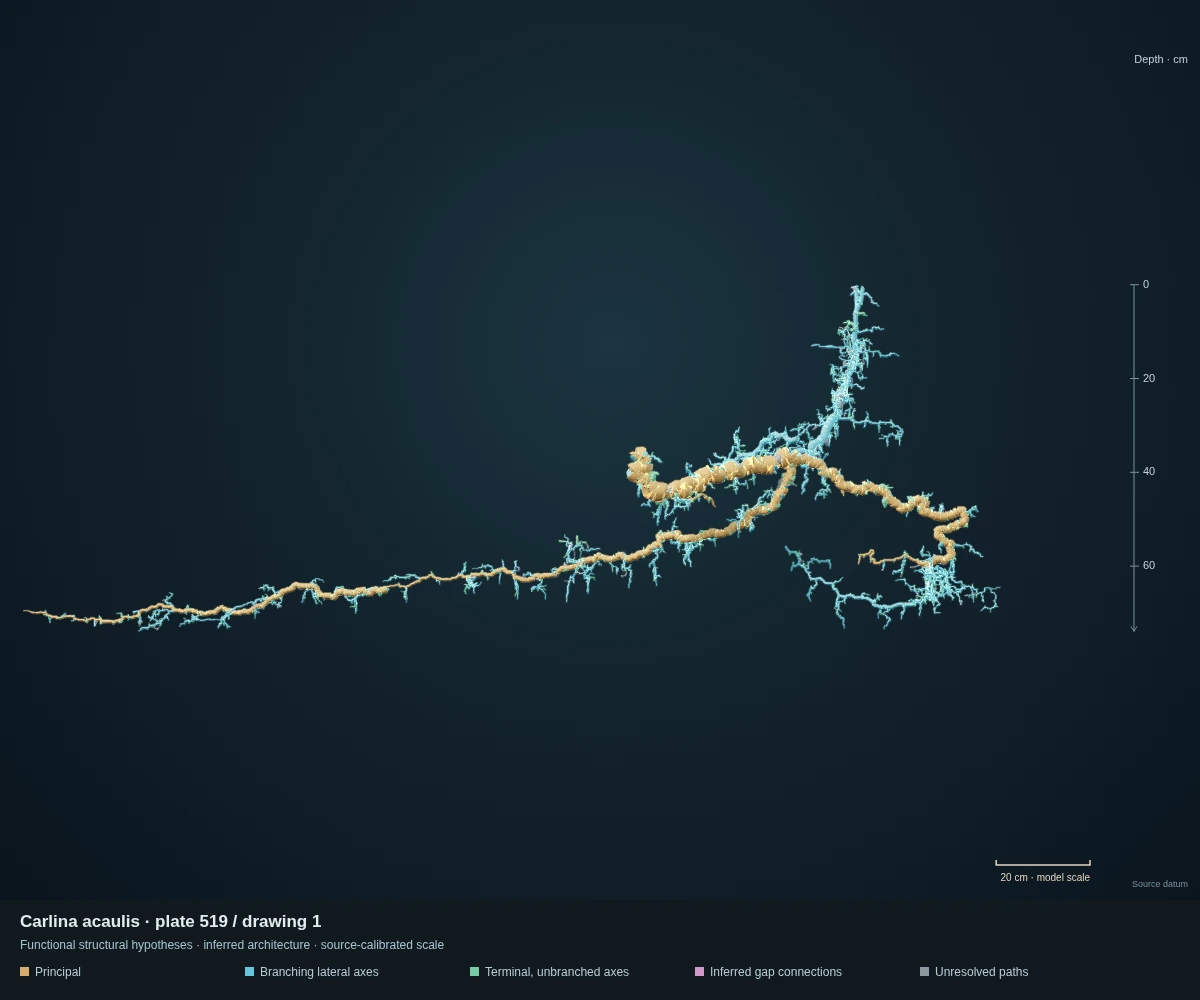
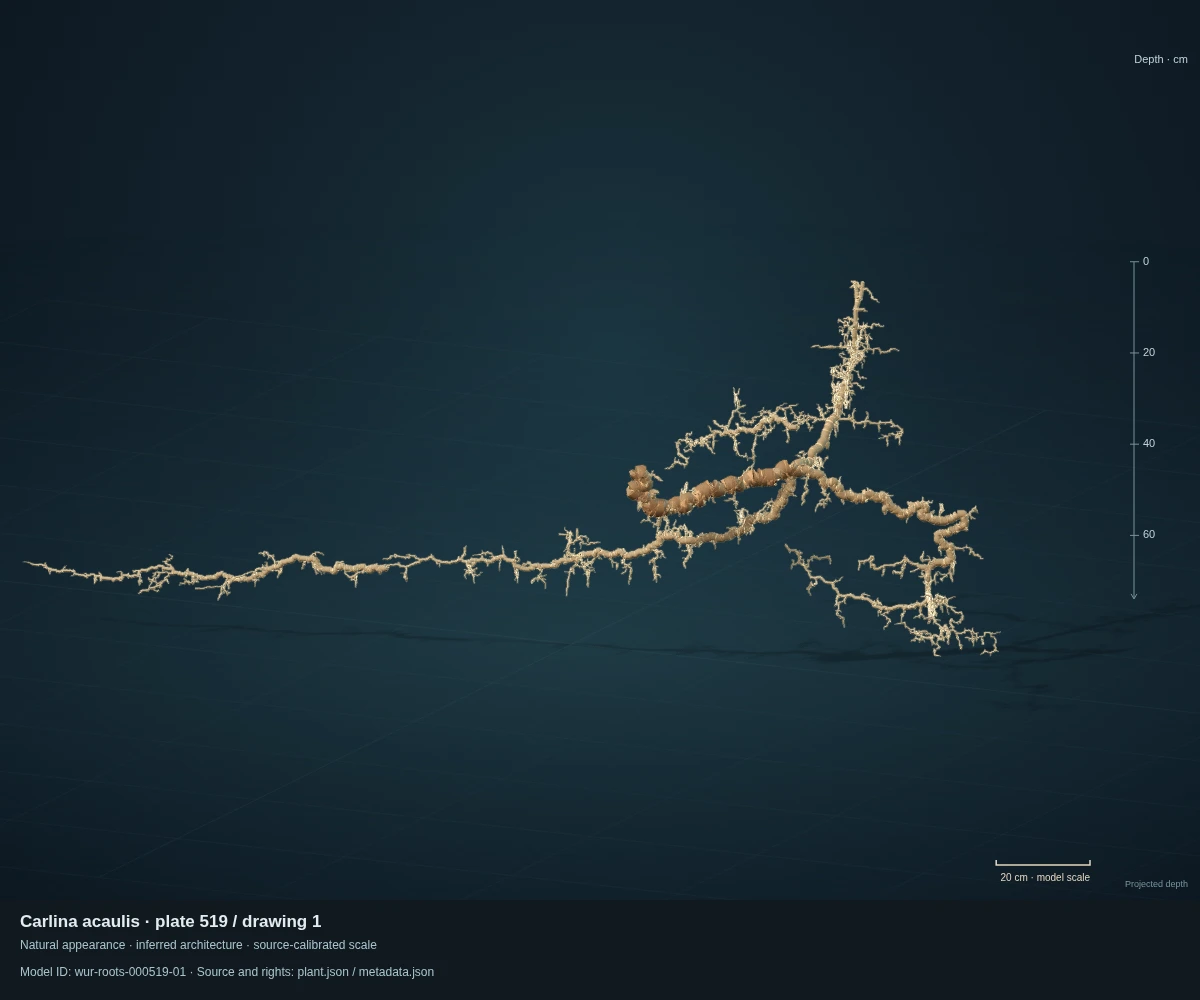
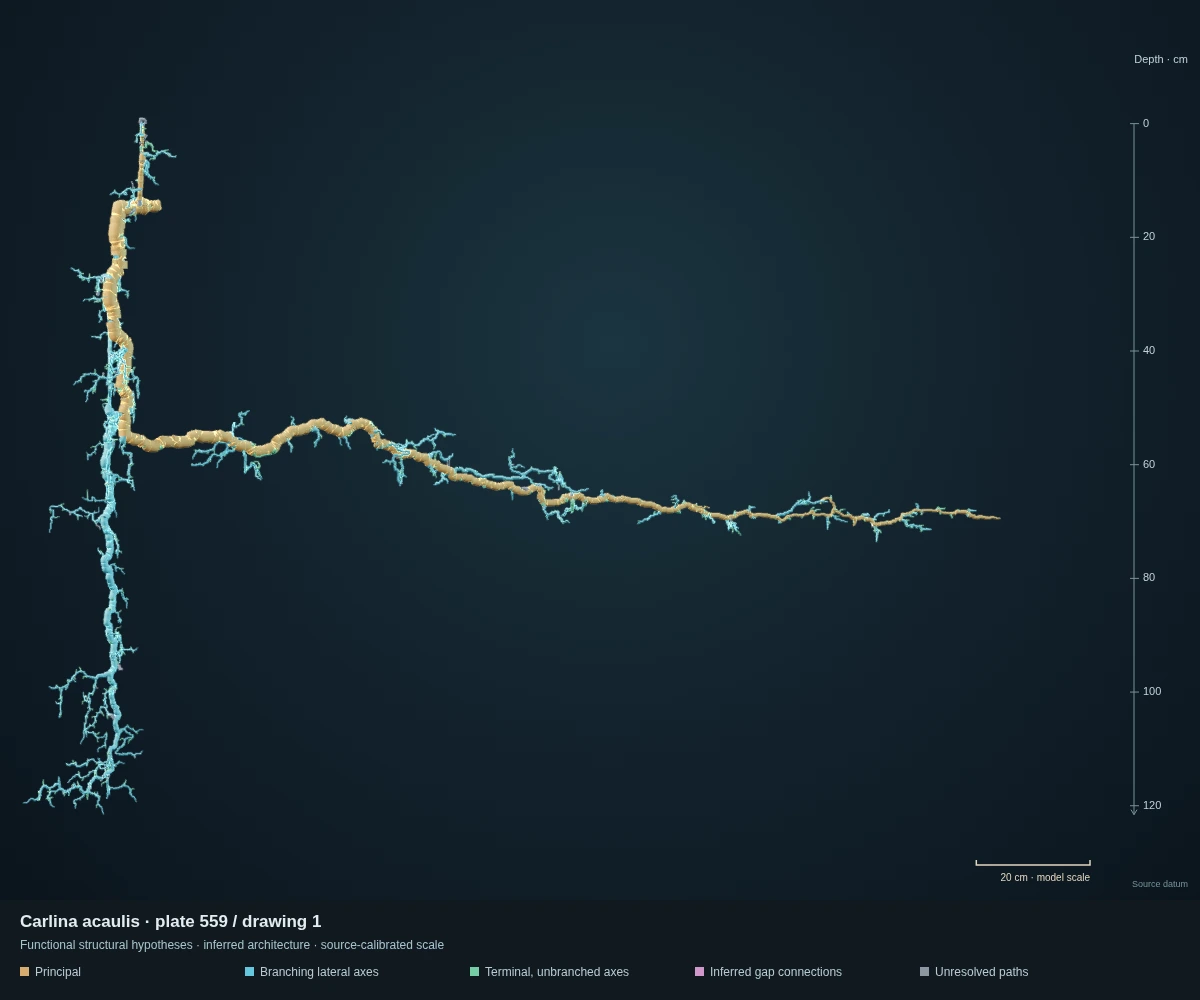
These reconstructions follow archived root drawings. Colour identifies the modelled structural role of each root.

Functional view
Natural view
Source projection
Side view
Calibration
Source-calibrated
Vertical extent
73.5 cm
Inferred axes
1921
Model metrics and plate observations

Model metrics

Depth follows the printed scale. Equal horizontal scale and hidden depth are modeling assumptions; root thickness is illustrative.

Vertical extent
73.5 cm
Horizontal span (x)
2.25 m
Horizontal span (z)
72.4 cm
Centreline length
37.4 m
Inferred axes
1921
Branching sites
1849
Terminal paths
1875
Mean modelled diameter
4.82 mm
Surface area proxy
6,040 cm²
Volume proxy
1,640 cm³
Inferred connection length
1.54 cm
Projected length
34.4 m
Mean angle from vertical
51.1°

Dimensions reported on the source plate

Plant height
8 cm plate_519
Root depth
123 cm plate_519
Root-system diameter
178 cm plate_519

Drawing observations

  • The shoot is short and closely surrounded by spreading divided blades; no tall flowering stem is shown.
  • A thick proximal root descends below the rosette and curves obliquely left.
  • One coarse path extends far left near the lower part of the drawing while branched laterals spread to the right.
  • Short fine branches crowd many portions of the longer sinuous axes.

Biologically constrained spatial reconstruction from source morphology. Root azimuths, hidden placement, growth responses, circular sections, thickness and proposed connections are inferred. The separate source trace retains exact drawing coordinates. No measured 3D anatomy or observed growth sequence is claimed.

Source and attribution

Study 519 · Model 01

Carlina acaulis · Wageningen University & Research archive
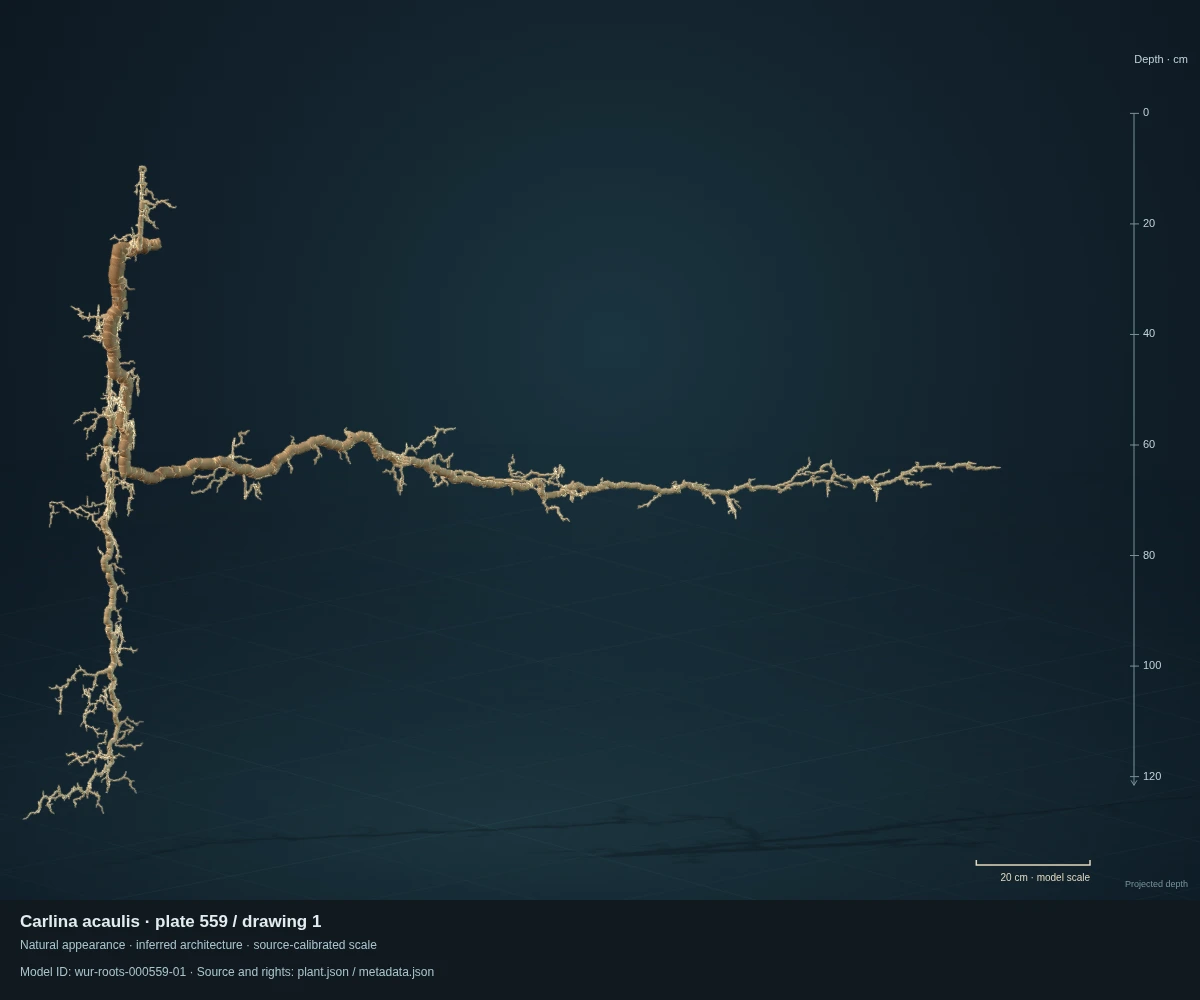
Functional view
Natural view
Source projection
Side view
Calibration
Source-calibrated
Vertical extent
1.22 m
Inferred axes
1161
Model metrics and plate observations

Model metrics

Depth follows the printed scale. Equal horizontal scale and hidden depth are modeling assumptions; root thickness is illustrative.

Vertical extent
1.22 m
Horizontal span (x)
84.4 cm
Horizontal span (z)
1.67 m
Centreline length
22 m
Inferred axes
1161
Branching sites
1143
Terminal paths
1169
Mean modelled diameter
4.81 mm
Surface area proxy
3,470 cm²
Volume proxy
852 cm³
Inferred connection length
0 cm
Projected length
20.3 m
Mean angle from vertical
50.1°

Dimensions reported on the source plate

Plant height
8 cm plate_559
Root depth
123 cm plate_559
Root-system diameter
178 cm plate_559

Drawing observations

  • long outlined near vertical root from right rosette
  • very long nearly horizontal branch runs left near 60 cm region
  • separate coarse path descends on far right toward 120 cm
  • sparse short forks and large open intervals between paths

Biologically constrained spatial reconstruction from source morphology. Root azimuths, hidden placement, growth responses, circular sections, thickness and proposed connections are inferred. The separate source trace retains exact drawing coordinates. No measured 3D anatomy or observed growth sequence is claimed.

Source and attribution

Study 559 · Model 01

Carlina acaulis · Wageningen University & Research archive
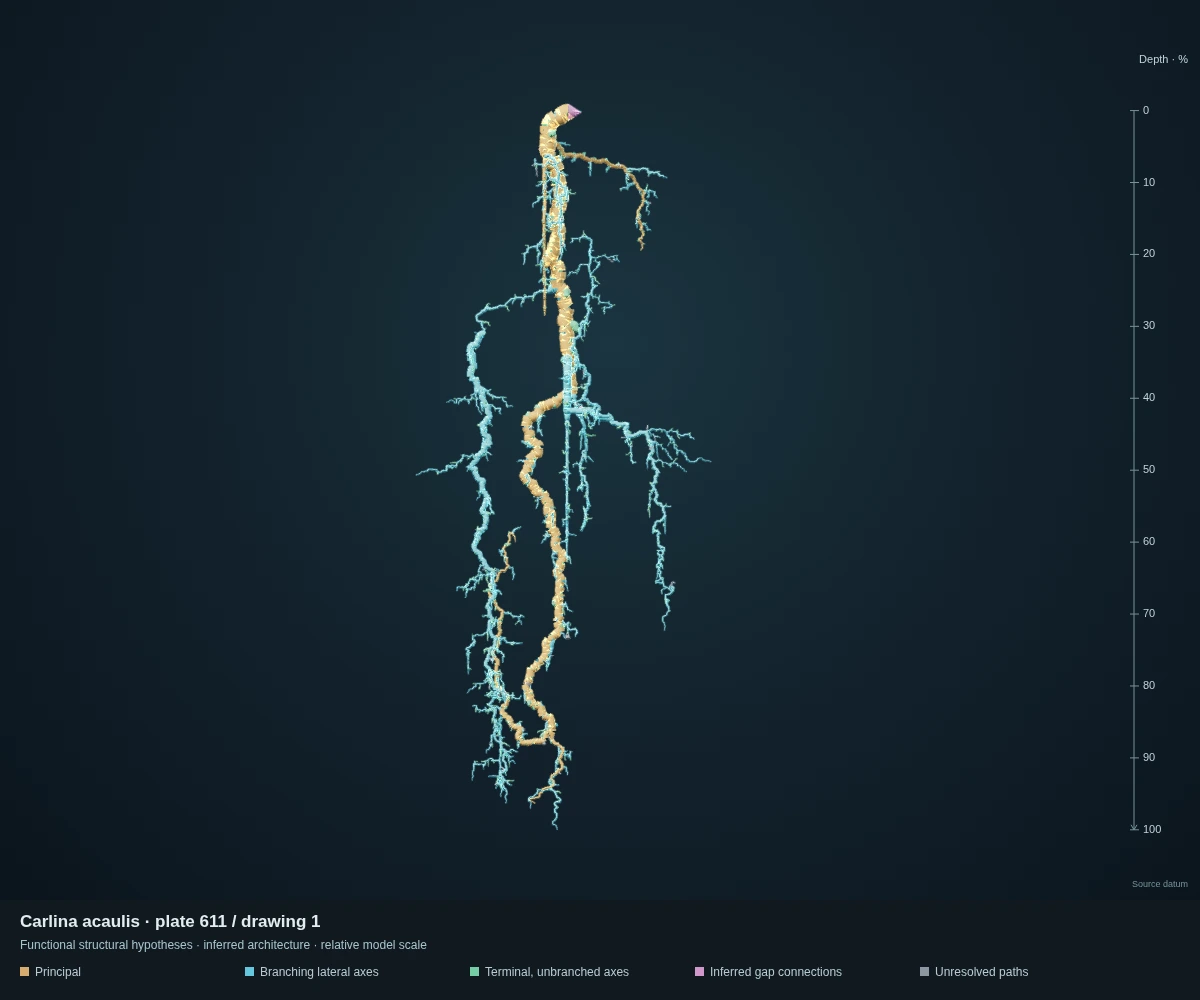
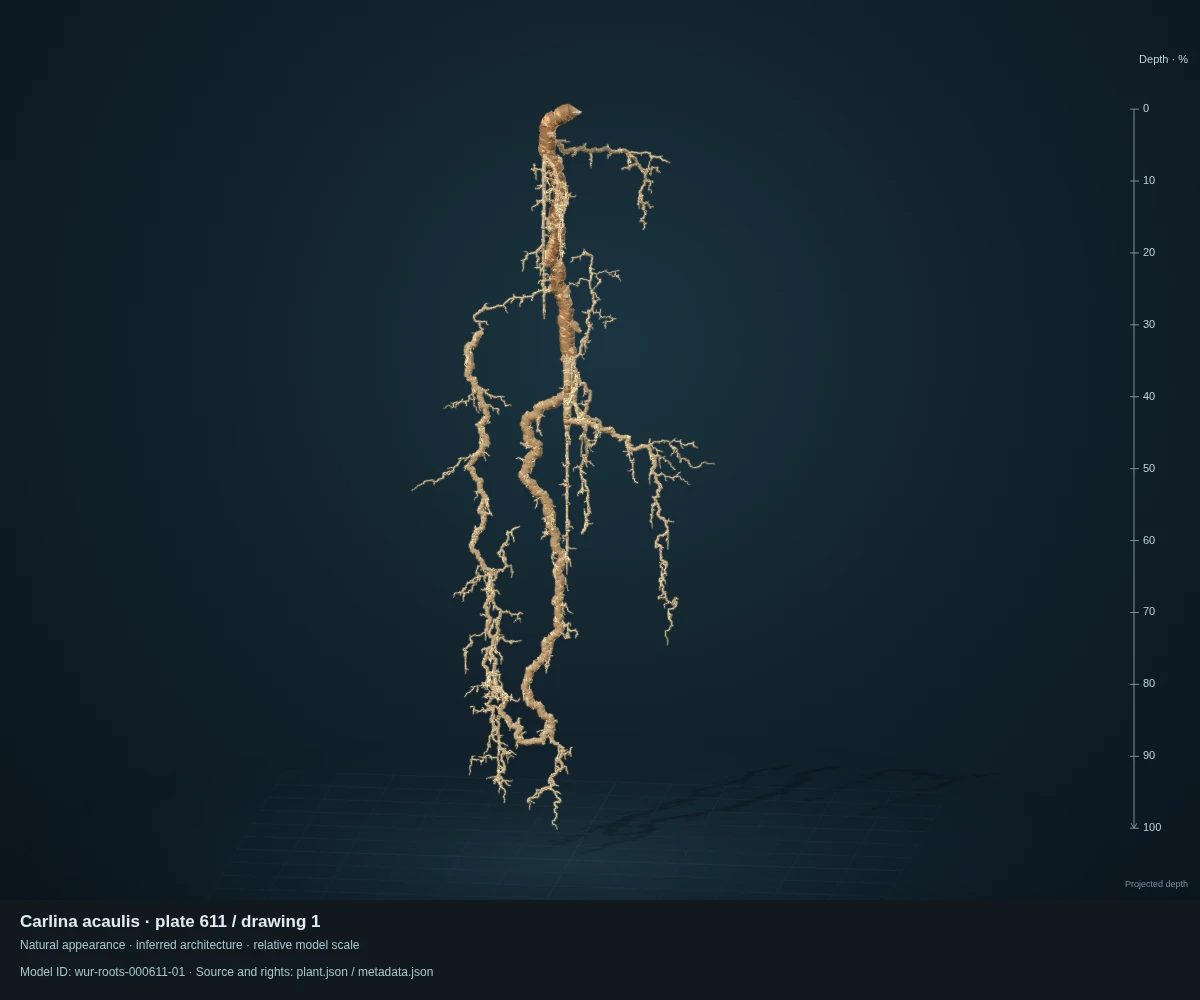
Functional view
Natural view
Source projection
Side view
Calibration
Ambiguous scale
Vertical extent
0.951 model units
Inferred axes
1418
Model metrics and plate observations

Model metrics

No metric calibration; values are in normalized model coordinates.

Vertical extent
0.951 model units
Horizontal span (x)
0.378 model units
Horizontal span (z)
0.298 model units
Centreline length
18.4 model units
Inferred axes
1418
Branching sites
1403
Terminal paths
1415
Mean modelled diameter
0.00332 model units
Surface area proxy
0.201 model units²
Volume proxy
0.000365 model units³
Inferred connection length
0.0328 model units
Projected length
16.2 model units
Mean angle from vertical
47.2°

Dimensions reported on the source plate

Plant height
19 cm plate_611
Root depth
408 cm plate_611
Root-system diameter
174 cm plate_611

Drawing observations

  • One thick upper root descends before giving long broad side arms.
  • Several long nearly vertical trajectories carry short fine forks through a very open middle field.
  • The lower paths diverge and end at unequal levels, with a central path just beyond the 400 cm reference.

Biologically constrained spatial reconstruction from source morphology. Root azimuths, hidden placement, growth responses, circular sections, thickness and proposed connections are inferred. The separate source trace retains exact drawing coordinates. No measured 3D anatomy or observed growth sequence is claimed.

Source and attribution

Study 611 · Model 01

Carlina acaulis · Wageningen University & Research archive
Names & classification

Family
Asteraceae
Genus
Carlina
Order
Asterales
Botanical authority
L.
Taxonomic rank
Species
Life form
perennial
Native range
Europe to Caucasus
Climate
subalpine or subarctic
Archive names
Carlina acaulis

European ecological indicators

Light (1–9, shade to sun)
8.2
Moisture (1–12, dry to submerged)
4
Soil reaction (1–9, acidic to base-rich)
No single indicator
Nutrients (1–9, poor to rich)
2.4
Tichý et al. (2023)