Arbor.guide

Cirsium arvense

Creeping Thistle

Root studies

These reconstructions follow archived root drawings. Colour identifies the modelled structural role of each root.

Functional view
Natural view
Source projection
Side view
Calibration
Source-calibrated
Vertical extent
2.82 m
Inferred axes
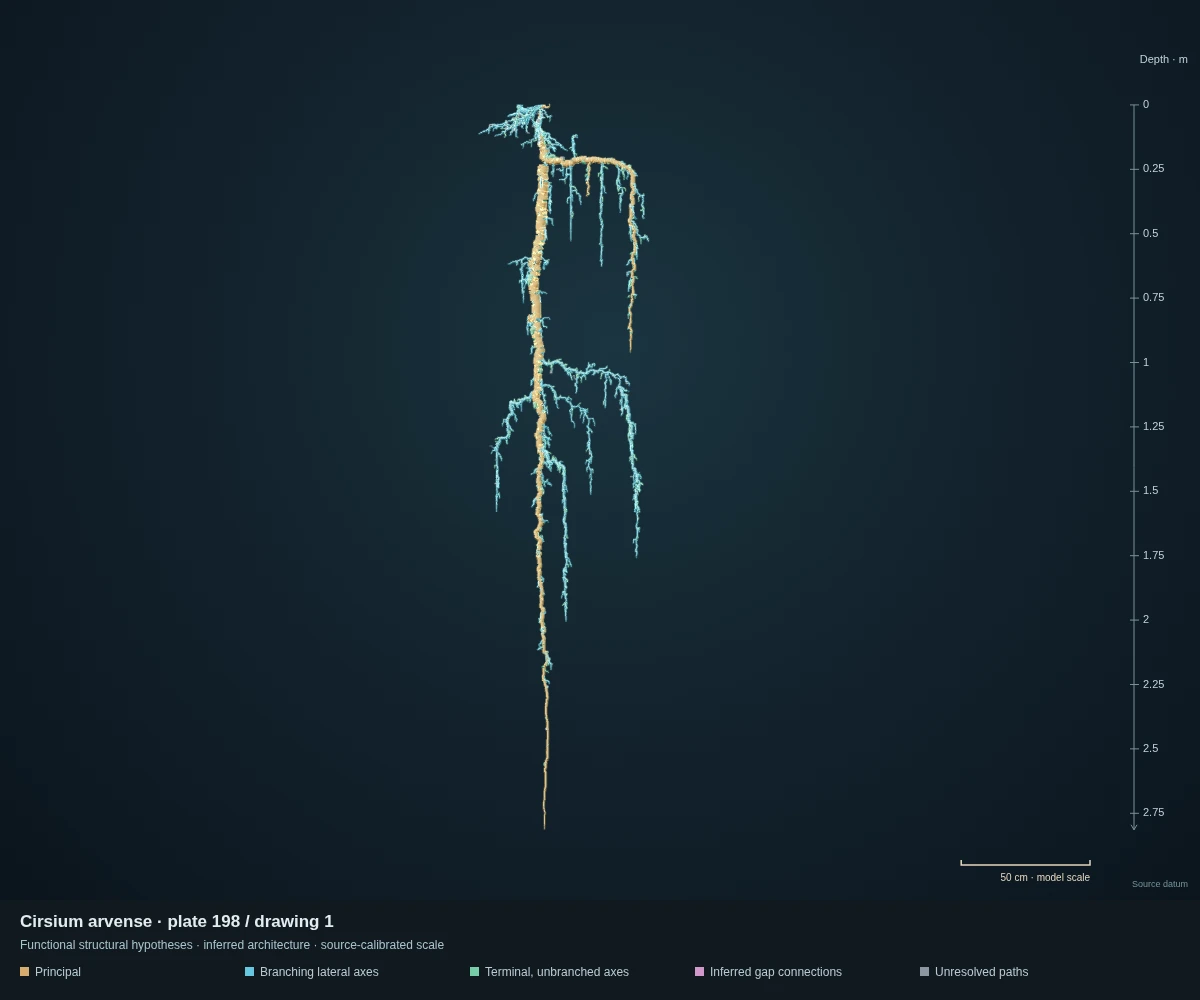
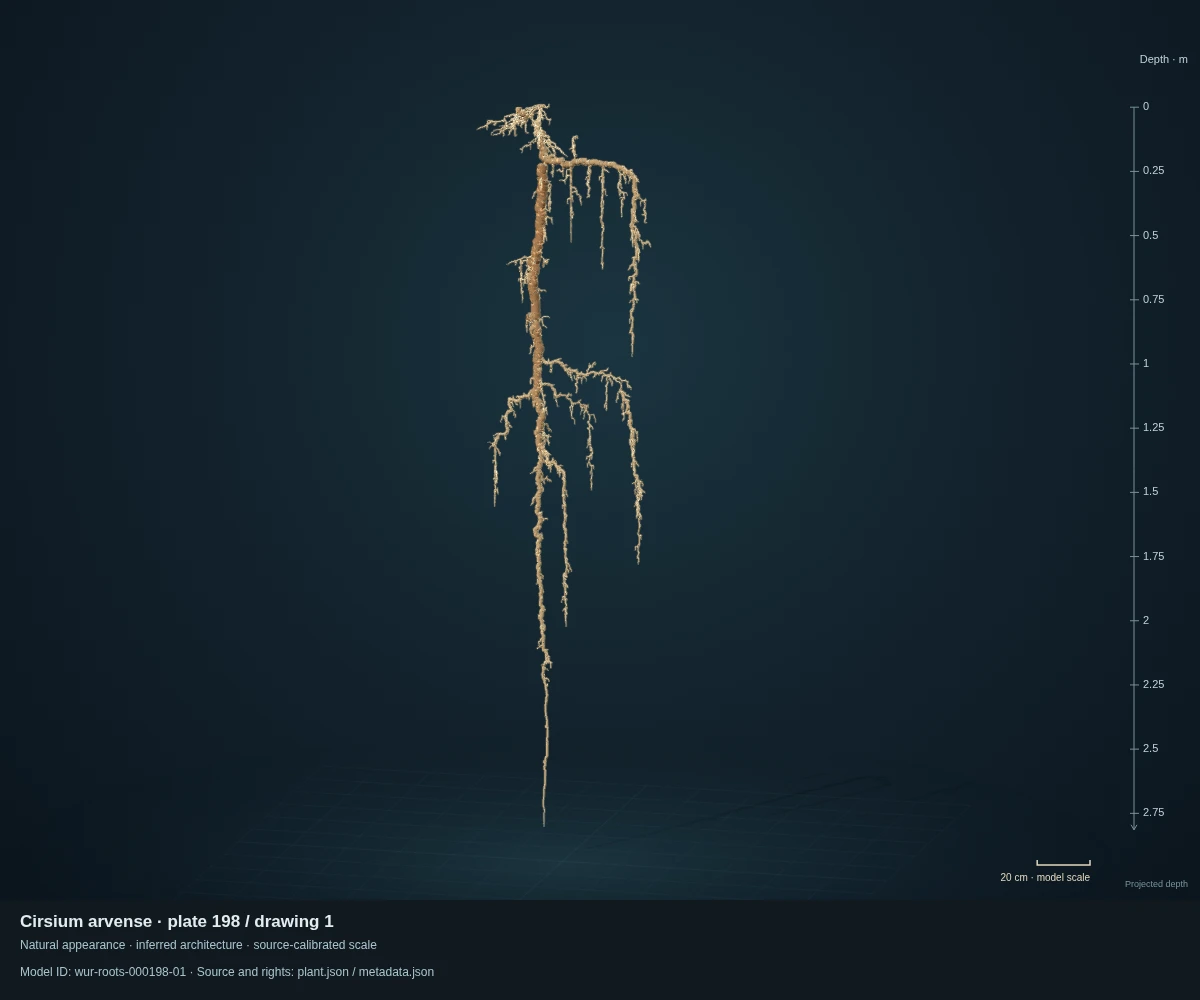
1194
Model metrics and plate observations

Model metrics

Depth follows the printed scale. Equal horizontal scale and hidden depth are modeling assumptions; root thickness is illustrative.

Vertical extent
2.82 m
Horizontal span (x)
68.4 cm
Horizontal span (z)
24.1 cm
Centreline length
34.3 m
Inferred axes
1194
Branching sites
1156
Terminal paths
1170
Mean modelled diameter
7.31 mm
Surface area proxy
8,210 cm²
Volume proxy
2,920 cm³
Inferred connection length
1.41 cm
Projected length
34.2 m
Mean angle from vertical
38.8°

Dimensions reported on the source plate

Plant height
140 cm plate_198
Root depth
300 cm plate_198
Root-system diameter
67 cm plate_198

Drawing observations

  • Large left leafy shoot and smaller right leafy shoot meet a coarse shallow connecting axis
  • A coarse horizontal underground path connects the two shoot bases
  • The left base has a broad upper fan; a rightward lateral turns downward
  • A long central root descends through much of the profile with repeated lateral branches
  • Sparse long lower paths extend beneath local fine branch clusters

Biologically constrained spatial reconstruction from source morphology. Root azimuths, hidden placement, growth responses, circular sections, thickness and proposed connections are inferred. The separate source trace retains exact drawing coordinates. No measured 3D anatomy or observed growth sequence is claimed.

Source and attribution

Study 198 · Model 01

Cirsium arvense · Wageningen University & Research archive
Functional view
Natural view
Source projection
Side view
Calibration
Source-calibrated
Vertical extent
2.34 m
Inferred axes
882
Model metrics and plate observations

Model metrics

Depth follows the printed scale. Equal horizontal scale and hidden depth are modeling assumptions; root thickness is illustrative.

Vertical extent
2.34 m
Horizontal span (x)
89.6 cm
Horizontal span (z)
1.28 m
Centreline length
34 m
Inferred axes
882
Branching sites
838
Terminal paths
850
Mean modelled diameter
7.3 mm
Surface area proxy
7,970 cm²
Volume proxy
2,410 cm³
Inferred connection length
2.66 cm
Projected length
27.9 m
Mean angle from vertical
51.5°

Dimensions reported on the source plate

Plant height
40 cm plate_638
Root depth
236 cm plate_638
Root-system diameter
130 cm plate_638

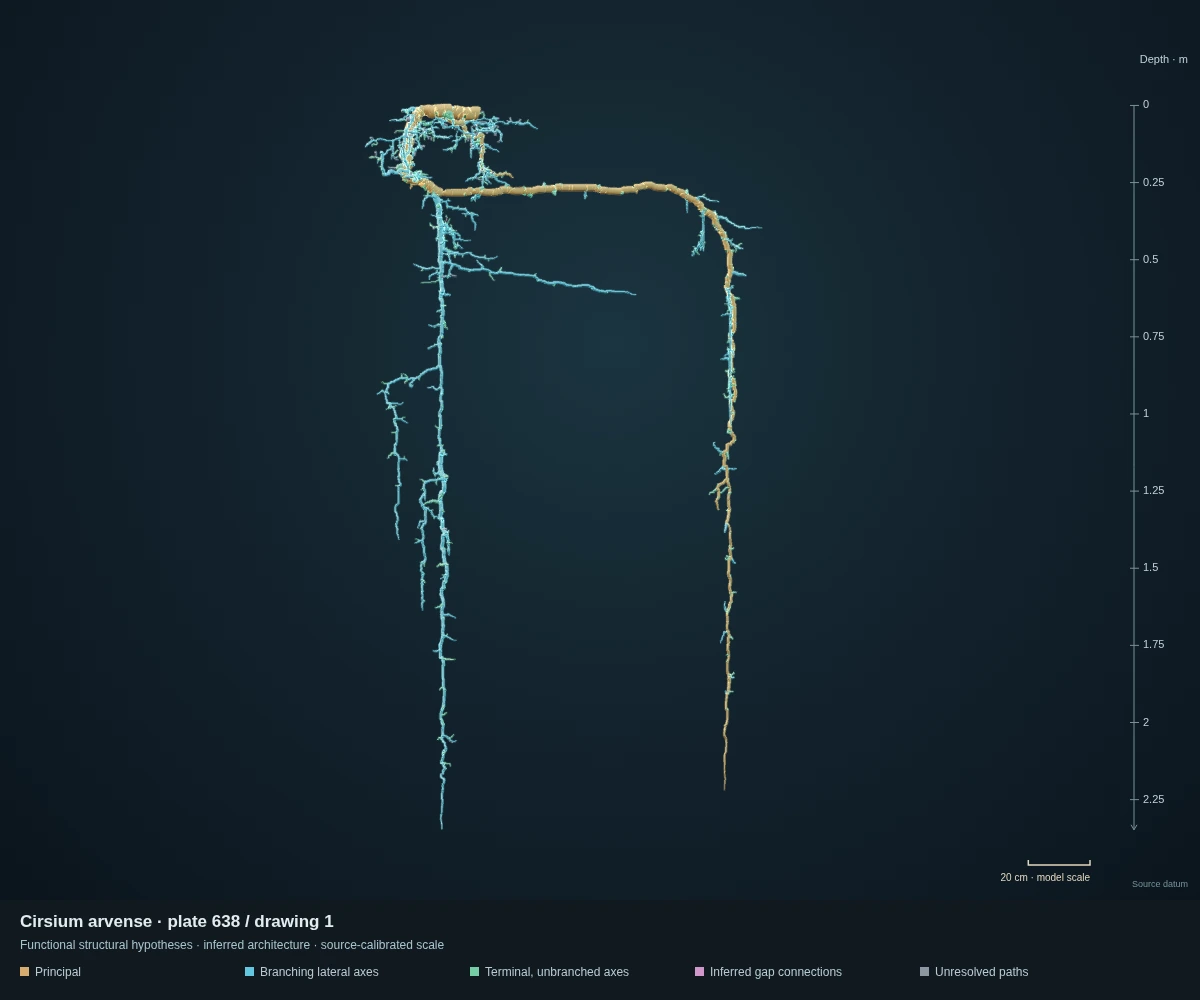
Drawing observations

  • Two upright divided-leaf shoots and a narrow bare stub connect to a deep spreading underground axis system.
  • Short upright basal axes carry dense fine branching and join a thicker near-horizontal axis below the ground.
  • The coarse horizontal system gives one central descender and a long right arm turning downward; deep trajectories are sparse and widely separated.
  • The two long principal roots carry small short side branches and end at unequal levels near 240 cm, with the central one deepest.

Biologically constrained spatial reconstruction from source morphology. Root azimuths, hidden placement, growth responses, circular sections, thickness and proposed connections are inferred. The separate source trace retains exact drawing coordinates. No measured 3D anatomy or observed growth sequence is claimed.

Source and attribution

Study 638 · Model 01

Cirsium arvense · Wageningen University & Research archive
Functional view
Natural view
Source projection
Side view
Calibration
Source-calibrated
Vertical extent
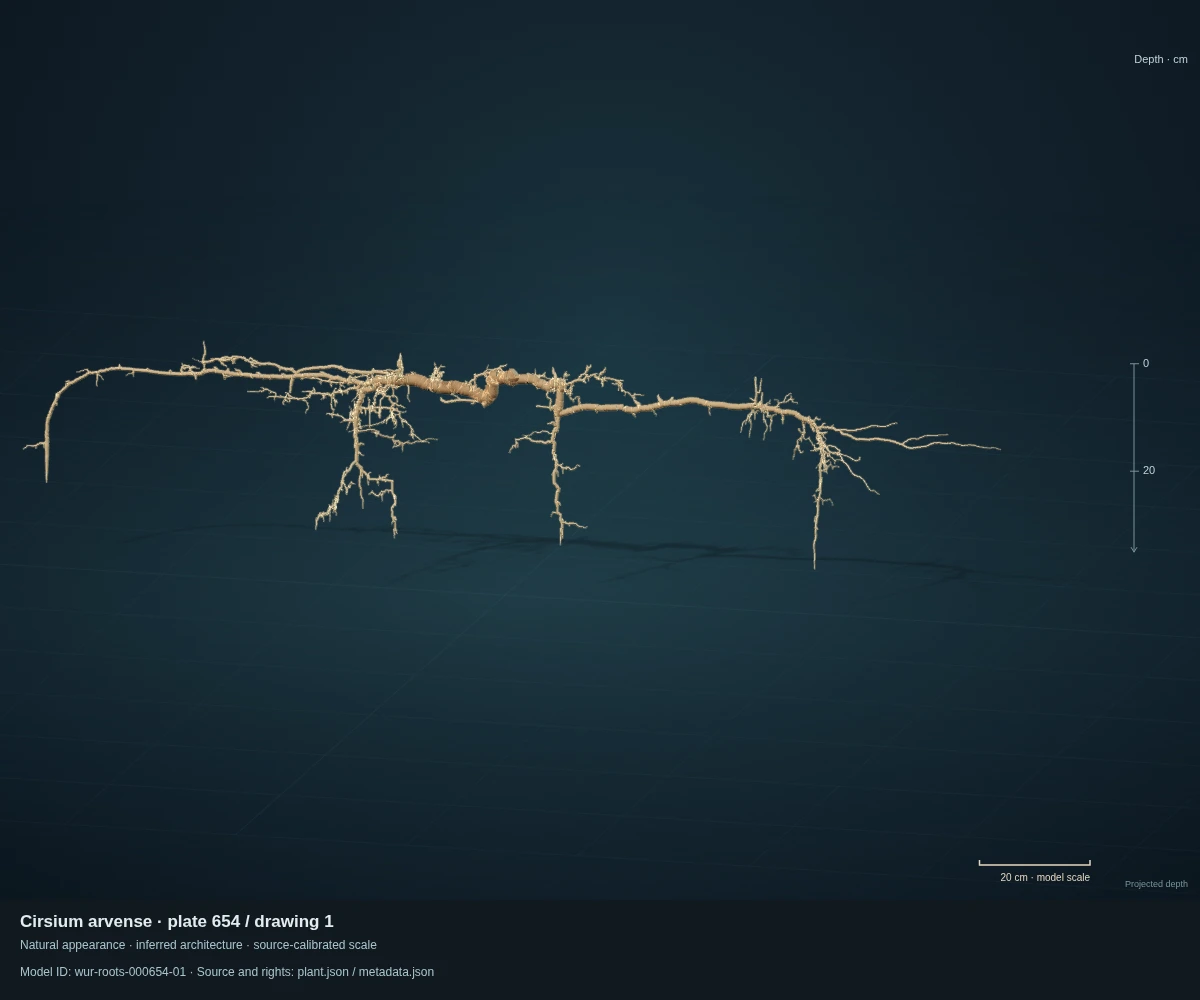
34.6 cm
Inferred axes
778
Model metrics and plate observations

Model metrics

Depth follows the printed scale. Equal horizontal scale and hidden depth are modeling assumptions; root thickness is illustrative.

Vertical extent
34.6 cm
Horizontal span (x)
1.83 m
Horizontal span (z)
32.1 cm
Centreline length
16.5 m
Inferred axes
778
Branching sites
728
Terminal paths
738
Mean modelled diameter
3.9 mm
Surface area proxy
2,080 cm²
Volume proxy
406 cm³
Inferred connection length
3.25 mm
Projected length
16.5 m
Mean angle from vertical
51.3°

Dimensions reported on the source plate

Plant height
48 cm plate_654
Root depth
34 cm plate_654
Root-system diameter
183 cm plate_654

Drawing observations

  • Four unequal leafy shoots are distributed along a long shallow connecting axis with localized descending roots.
  • Coarse root-bearing paths link the shoot bases along a wide shallow axis.
  • Several localized descending roots occur beneath the shoots, with long nearly horizontal extensions beyond the outer bases.
  • Fine branches are sparse on some coarse stretches and denser near particular shoot/root junctions.

Biologically constrained spatial reconstruction from source morphology. Root azimuths, hidden placement, growth responses, circular sections, thickness and proposed connections are inferred. The separate source trace retains exact drawing coordinates. No measured 3D anatomy or observed growth sequence is claimed.

Source and attribution

Study 654 · Model 01

Cirsium arvense · Wageningen University & Research archive
Functional view
Natural view
Source projection
Side view
Calibration
Source-calibrated
Vertical extent
1.74 m
Inferred axes
3037
Model metrics and plate observations

Model metrics

Depth follows the printed scale. Equal horizontal scale and hidden depth are modeling assumptions; root thickness is illustrative.

Vertical extent
1.74 m
Horizontal span (x)
1.58 m
Horizontal span (z)
1.6 m
Centreline length
90.1 m
Inferred axes
3037
Branching sites
2849
Terminal paths
2862
Mean modelled diameter
5.1 mm
Surface area proxy
1.49 m²
Volume proxy
4,110 cm³
Inferred connection length
0 cm
Projected length
76.8 m
Mean angle from vertical
55.2°

Dimensions reported on the source plate

Plant height
40 cm plate_778
Root depth
236 cm plate_778
Root-system diameter
133 cm plate_778

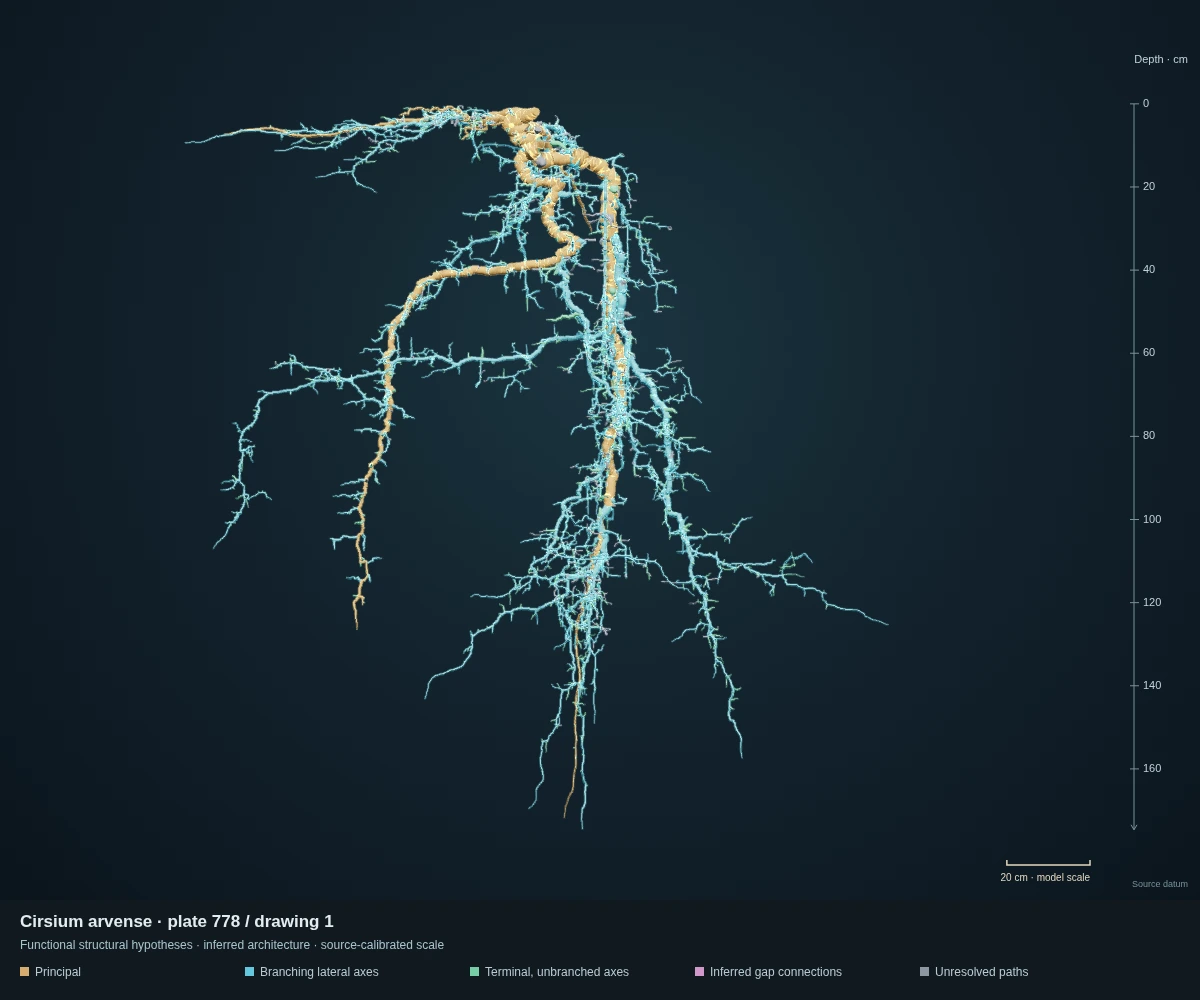
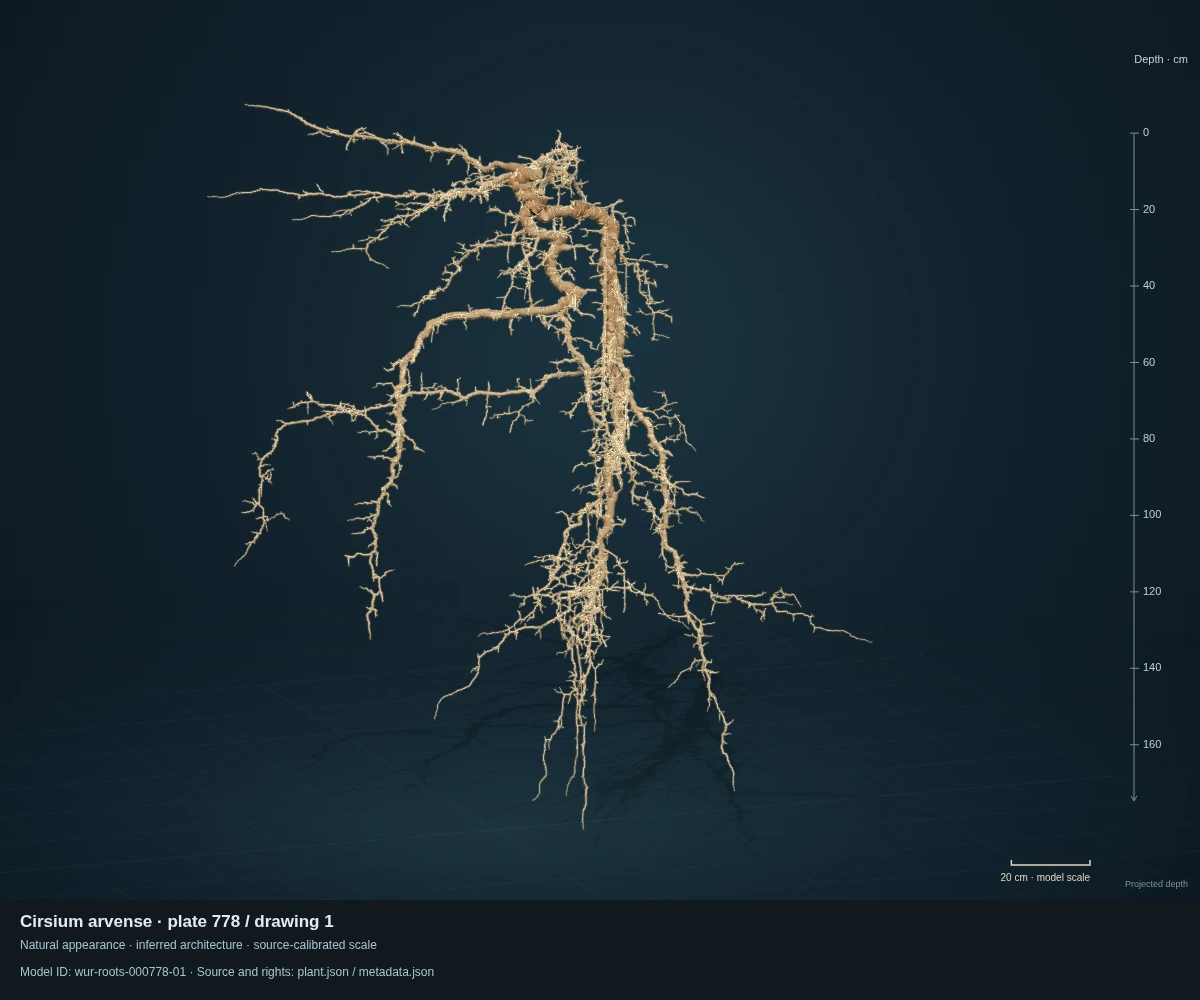
Reported dimensions and drawn scaled proportions appear inconsistent; both remain explicit.

Drawing observations

  • A bent thick shared basal axis leads into a central descending root and very long shallow lateral arms.
  • Dense fine branching surrounds the central root, with large left and right side branches descending at different positions.
  • Several long thin lower tips extend beyond 160 cm.

Biologically constrained spatial reconstruction from source morphology. Root azimuths, hidden placement, growth responses, circular sections, thickness and proposed connections are inferred. The separate source trace retains exact drawing coordinates. No measured 3D anatomy or observed growth sequence is claimed.

Source and attribution

Study 778 · Model 01

Cirsium arvense · Wageningen University & Research archive
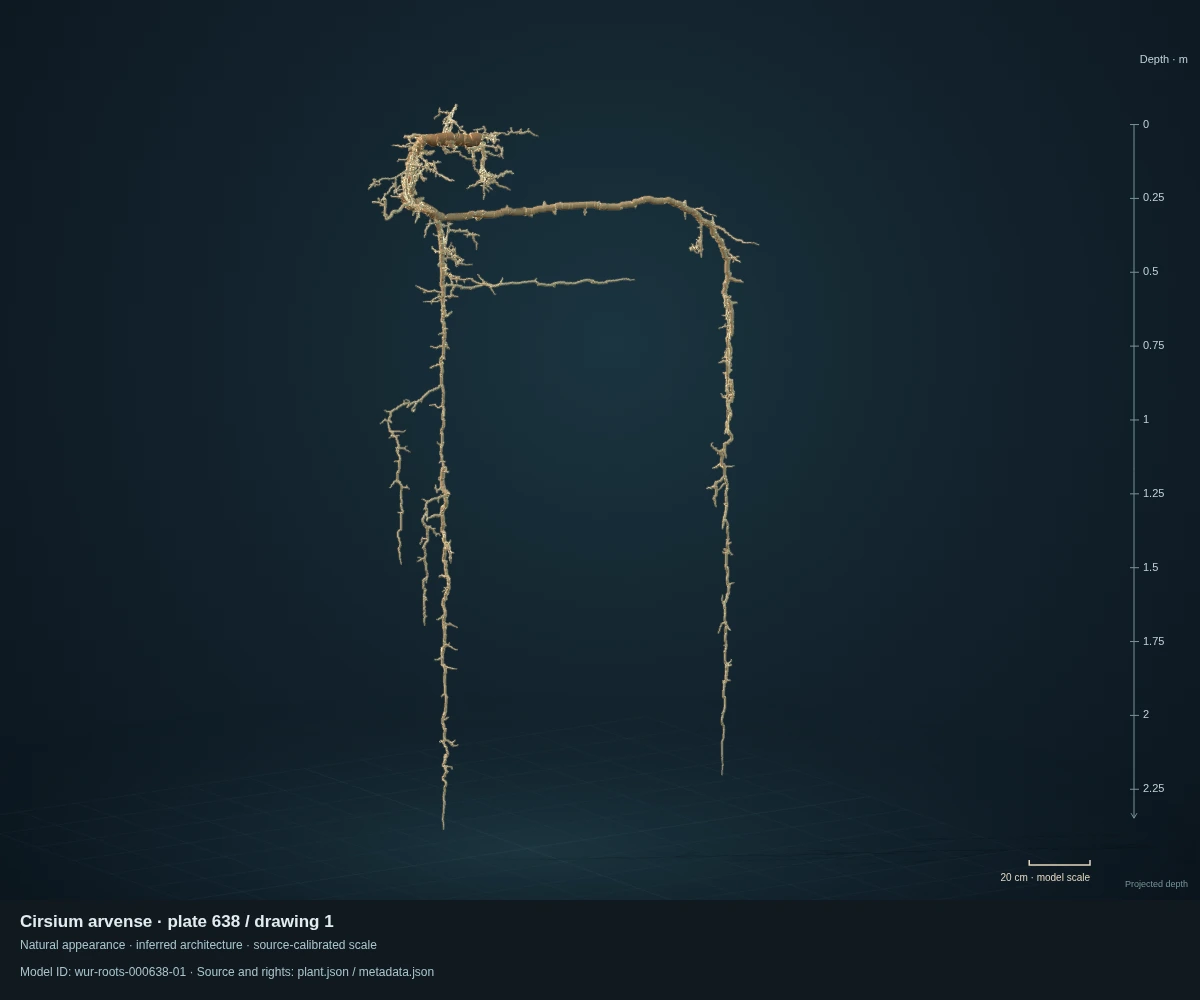
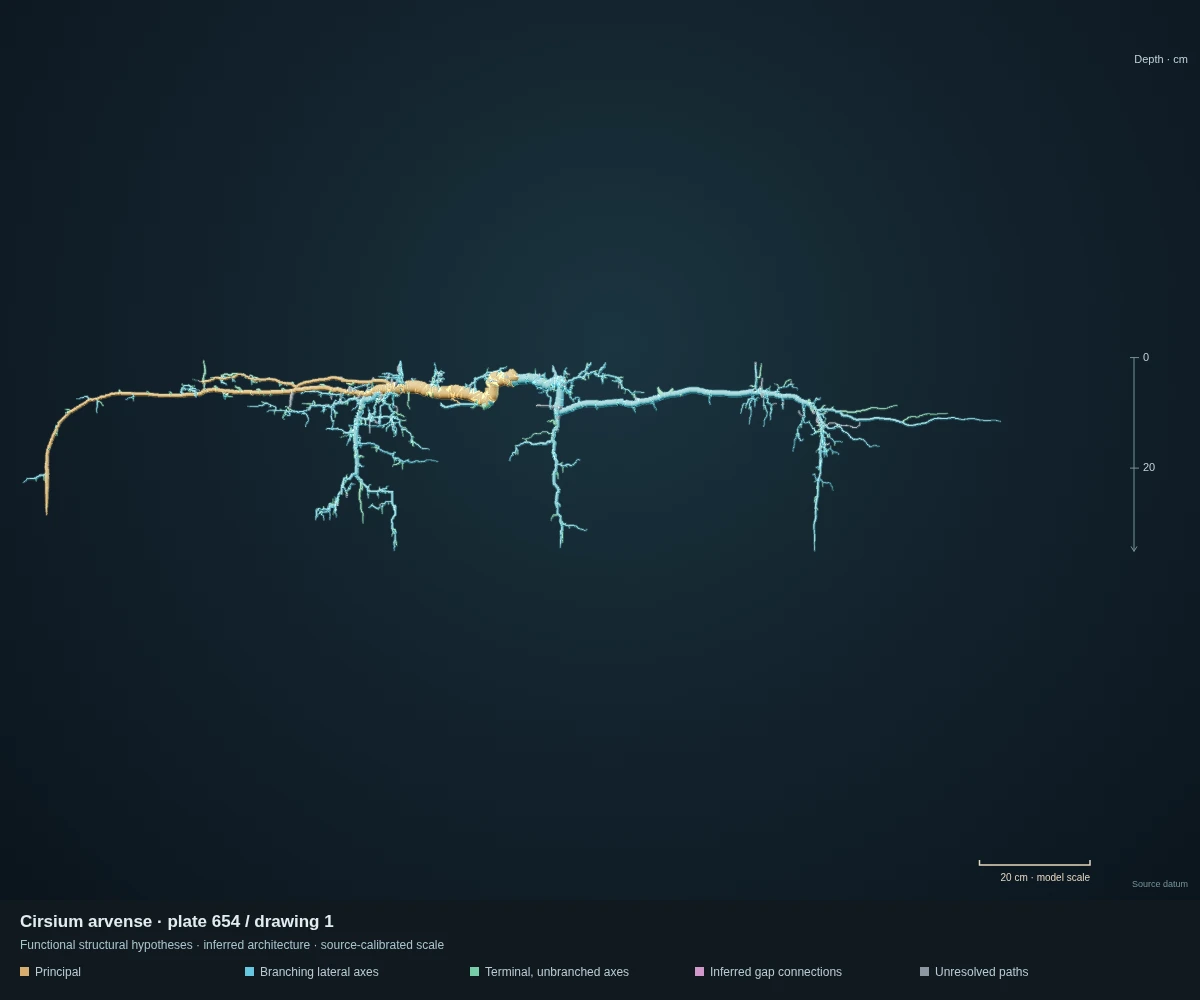
Functional view
Natural view
Source projection
Side view
Calibration
Source-calibrated
Vertical extent
1.19 m
Inferred axes
767
Model metrics and plate observations

Model metrics

Depth follows the printed scale. Equal horizontal scale and hidden depth are modeling assumptions; root thickness is illustrative.

Vertical extent
1.19 m
Horizontal span (x)
4.16 m
Horizontal span (z)
4.9 m
Centreline length
62.5 m
Inferred axes
767
Branching sites
749
Terminal paths
758
Mean modelled diameter
1.28 cm
Surface area proxy
2.57 m²
Volume proxy
15,800 cm³
Inferred connection length
0 cm
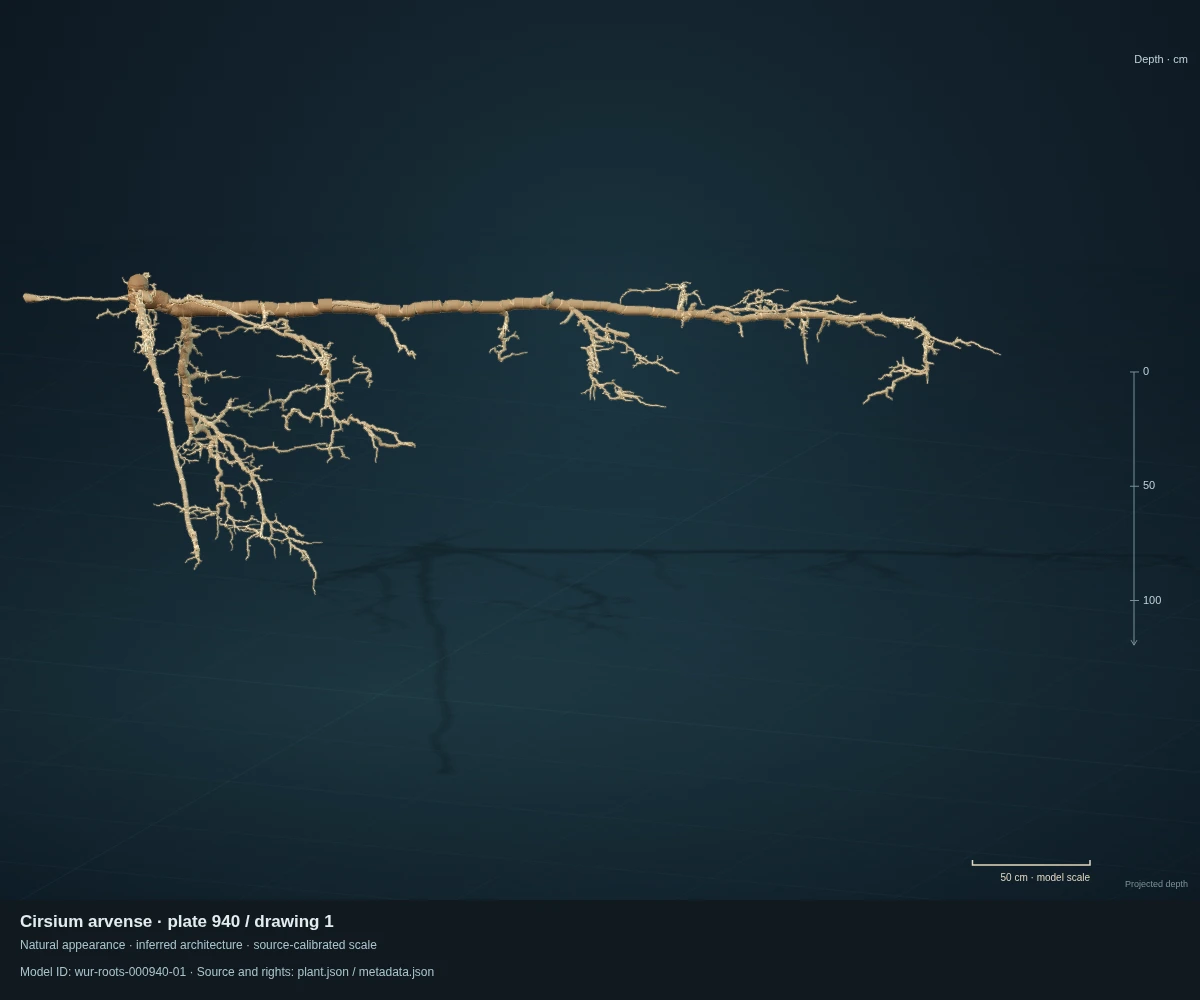
Projected length
46.6 m
Mean angle from vertical
62.4°

Drawing observations

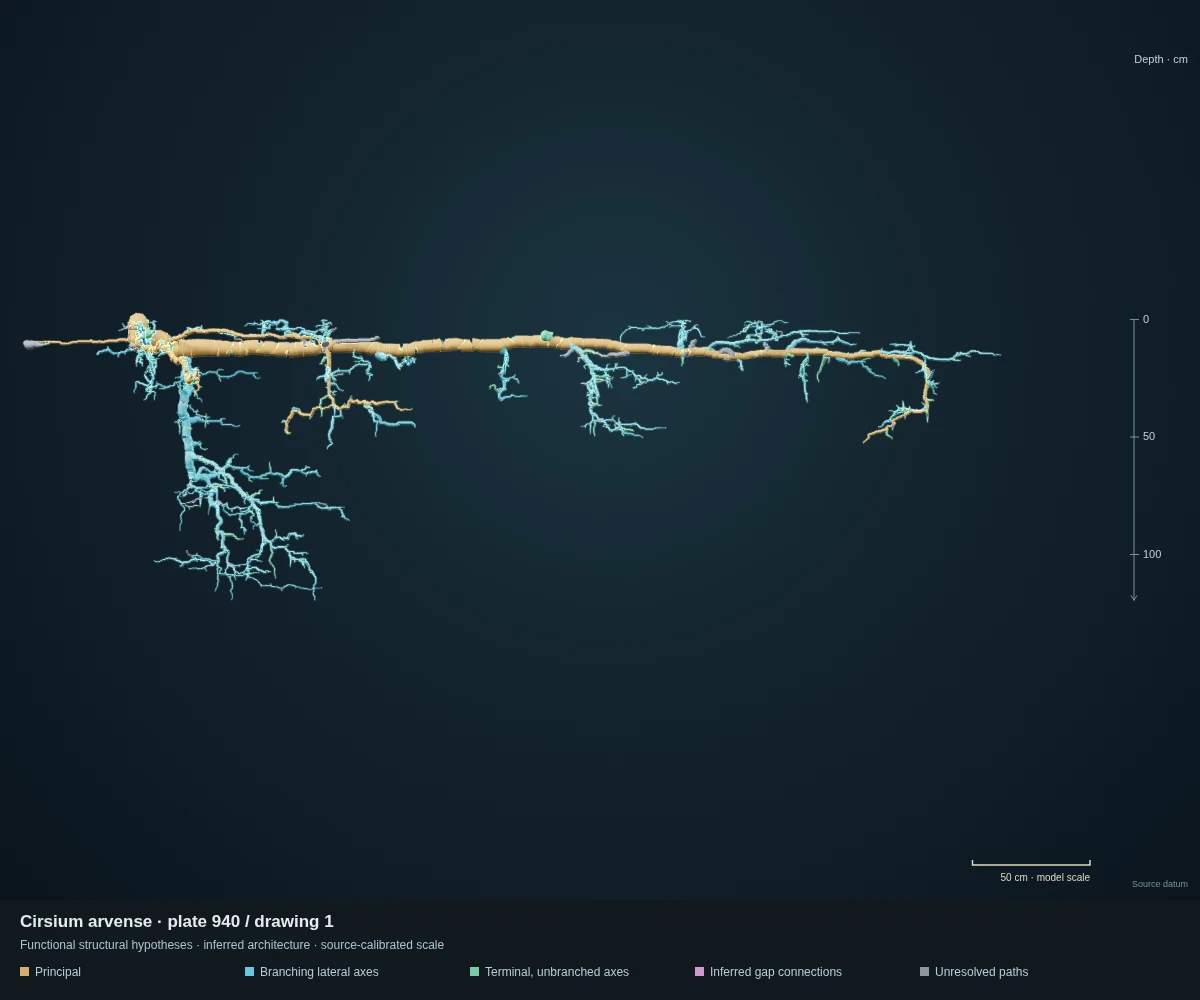
  • Several separate upright leafy shoots rise at spaced positions along a continuous below-ground horizontal framework, with three taller shoots clustered near the left-middle and others to the right. Some upper stems carry small closed head-like forms.
  • Shoot bases visibly join a long shallow horizontal underground axis; this drawing connection does not establish genetic identity or a time sequence.
  • A long shallow axis extends far left; beneath the central shoot group a strong root descends beyond the 112 cm level, with further shorter descending branched roots at right.

Biologically constrained spatial reconstruction from source morphology. Root azimuths, hidden placement, growth responses, circular sections, thickness and proposed connections are inferred. The separate source trace retains exact drawing coordinates. No measured 3D anatomy or observed growth sequence is claimed.

Source and attribution

Study 940 · Model 01

Cirsium arvense · Wageningen University & Research archive
Names & classification

Family
Asteraceae
Genus
Cirsium
Order
Asterales
Botanical authority
(L.) Scop.
Taxonomic rank
Species
Life form
perennial
Growth form
Herb
Native range
Temp. Eurasia, NW. Africa
Climate
temperate
Mean vegetative height (TRY)
0.74 m
Maximum recorded vegetative height (TRY)
1.5 m
Archive names
Cirsium arvense

European ecological indicators

Light (1–9, shade to sun)
8
Moisture (1–12, dry to submerged)
No single indicator
Soil reaction (1–9, acidic to base-rich)
6.1
Nutrients (1–9, poor to rich)
6.6
Tichý et al. (2023)