Arbor.guide

Genista tinctoria

Dyer's Greenweed

Root studies

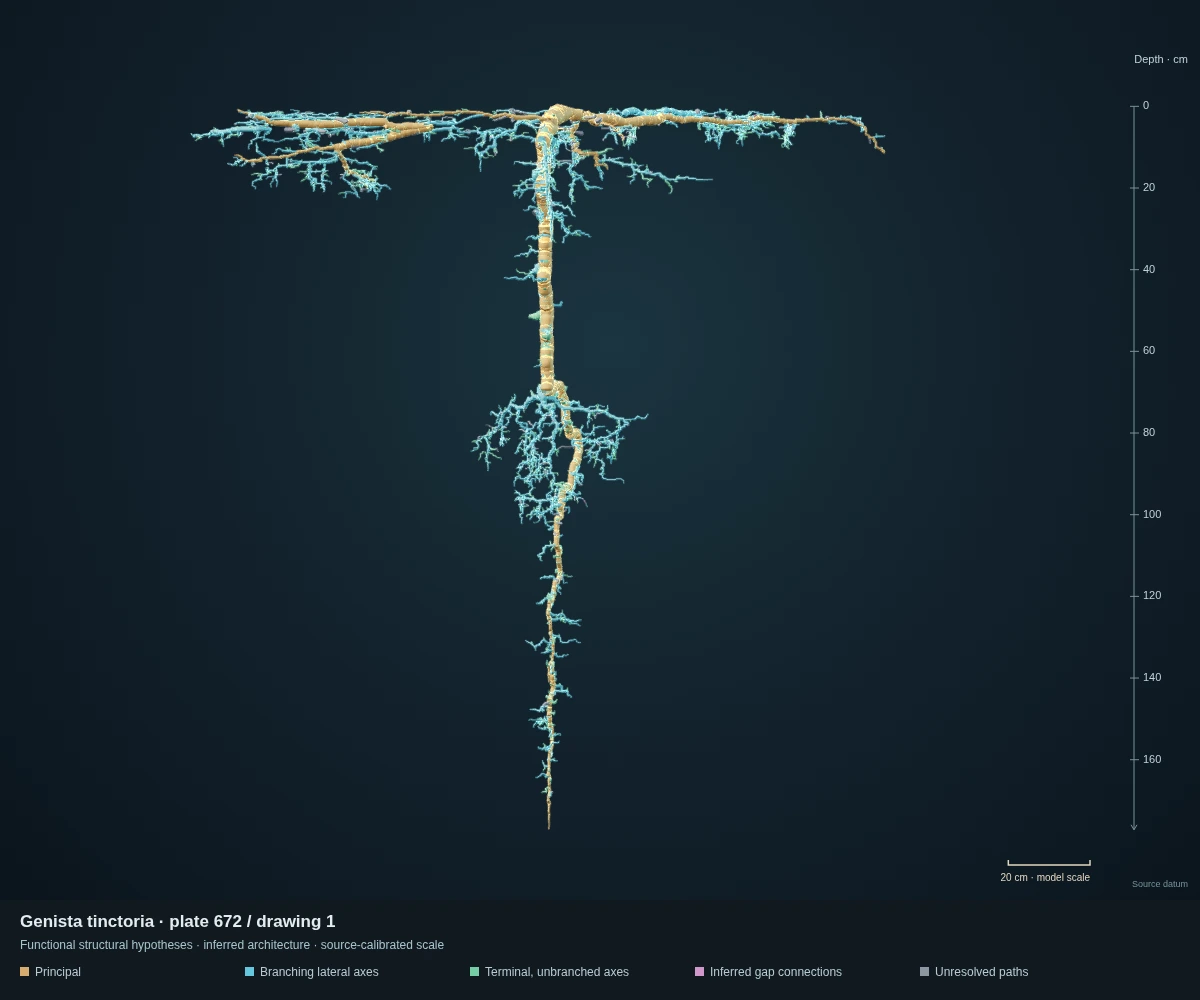
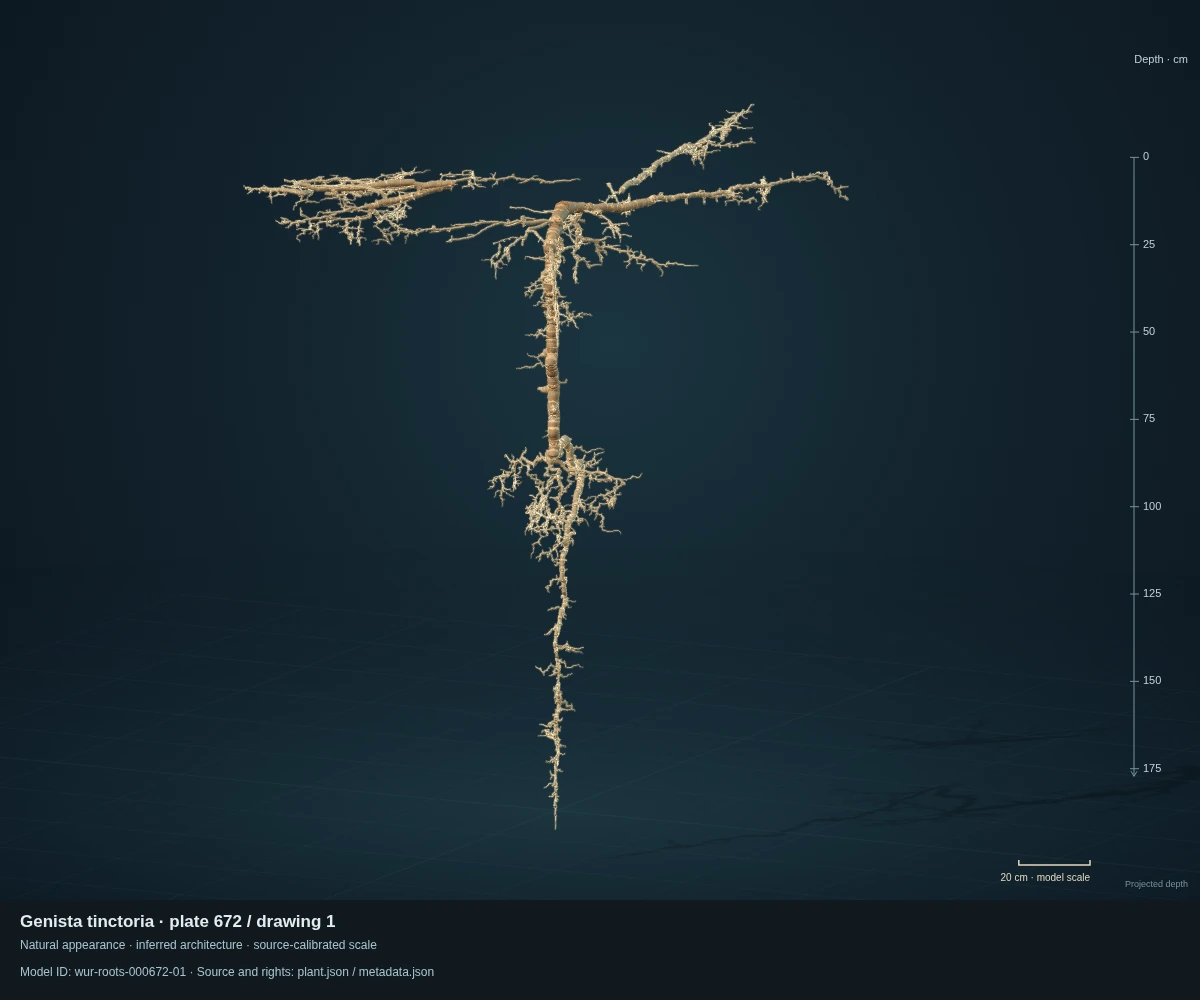
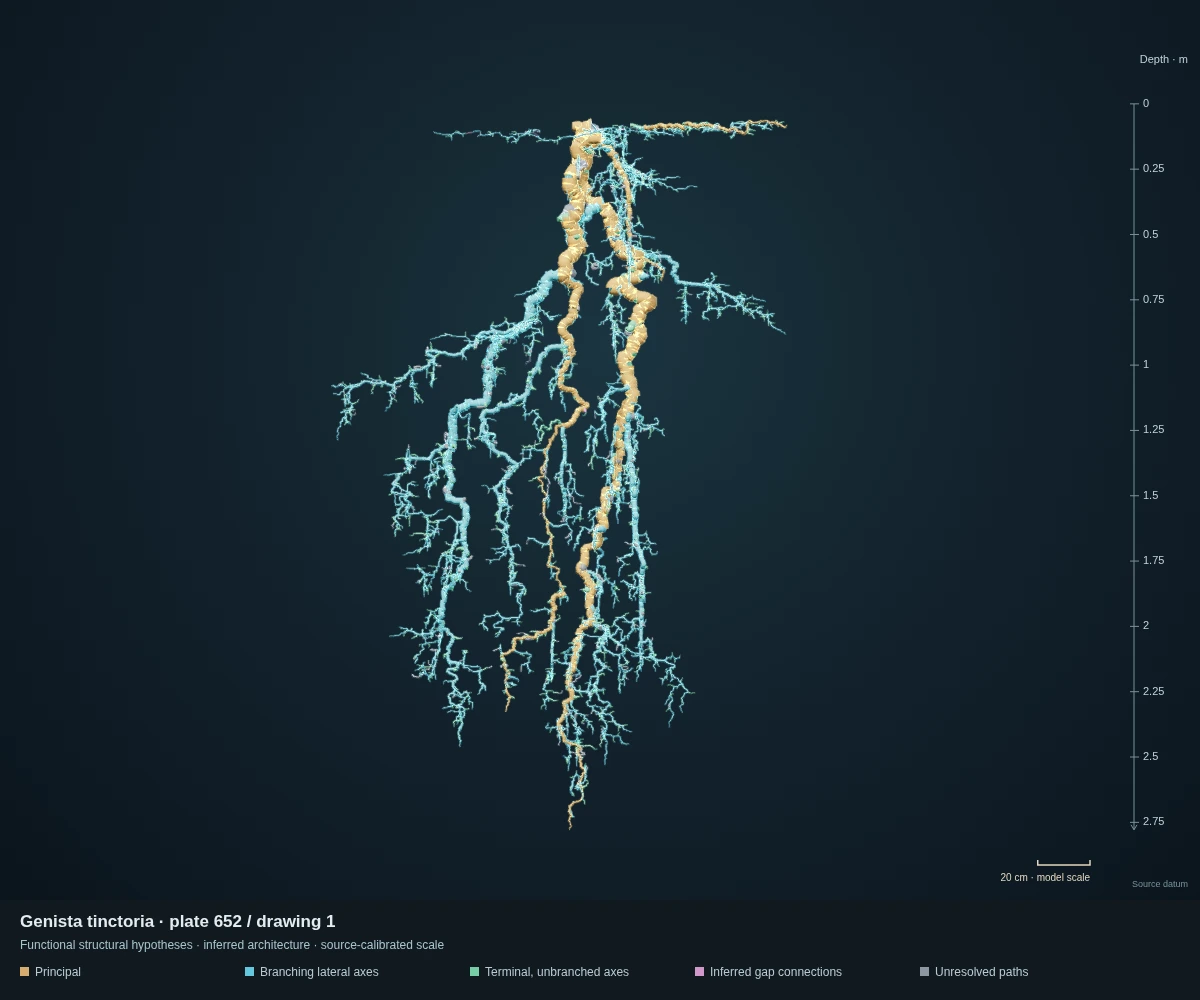
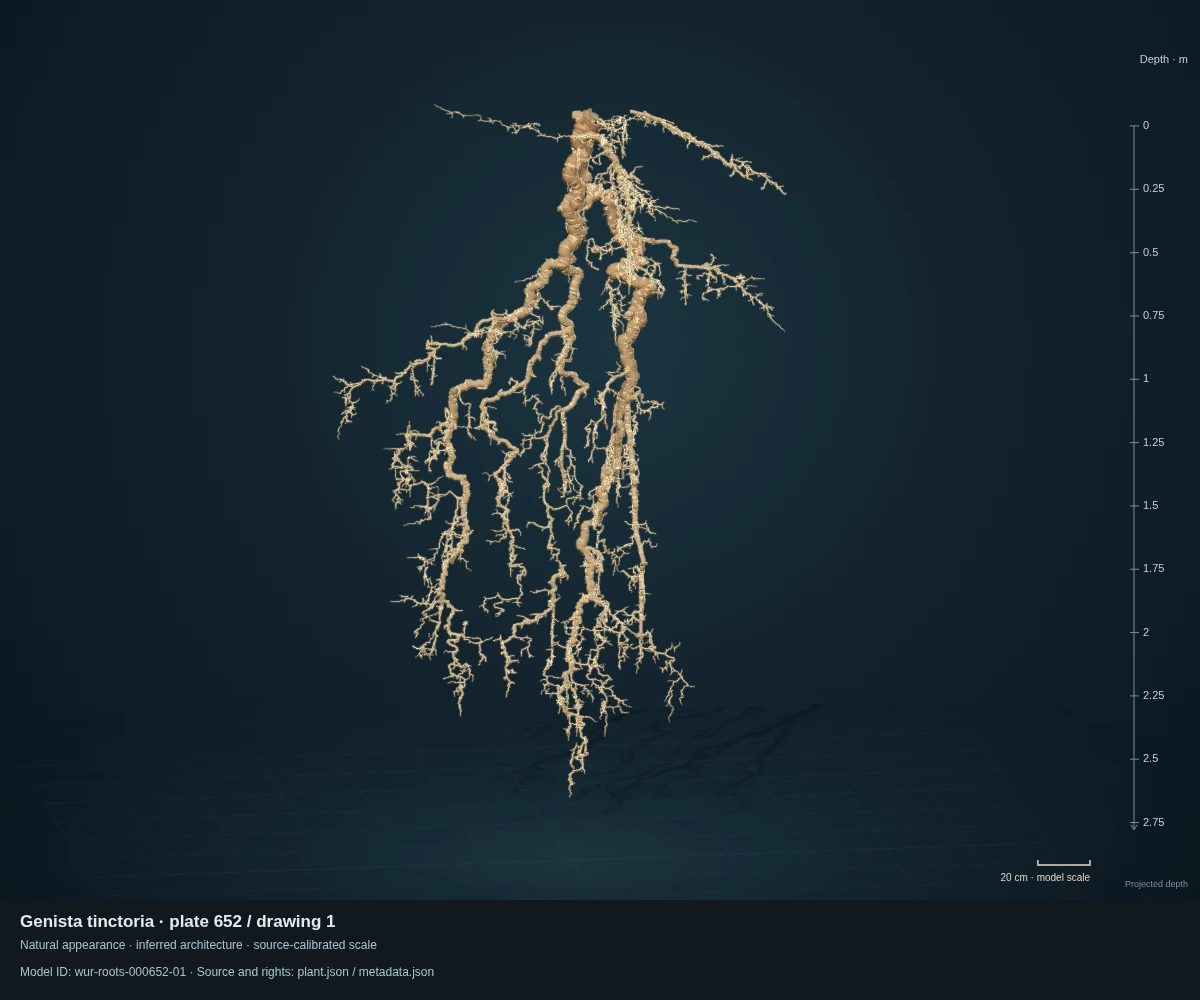
These reconstructions follow archived root drawings. Colour identifies the modelled structural role of each root.

Functional view
Natural view
Source projection
Side view
Calibration
Source-calibrated
Vertical extent
2.71 m
Inferred axes
3126
Model metrics and plate observations

Model metrics

Depth follows the printed scale. Equal horizontal scale and hidden depth are modeling assumptions; root thickness is illustrative.

Vertical extent
2.71 m
Horizontal span (x)
1.72 m
Horizontal span (z)
1.76 m
Centreline length
126 m
Inferred axes
3126
Branching sites
2933
Terminal paths
2958
Mean modelled diameter
7.71 mm
Surface area proxy
3.14 m²
Volume proxy
15,300 cm³
Inferred connection length
44.1 cm
Projected length
96.7 m
Mean angle from vertical
53.4°

Dimensions reported on the source plate

Plant height
22 cm plate_652
Root depth
276 cm plate_652
Root-system diameter
218 cm plate_652

Drawing observations

  • A low widely branched leafy crown connects to a very deep root system with a broad shallow band.
  • A strong central root descends beneath the crown and divides into long coarse paths.
  • A very wide near-surface band contrasts with a narrower deep root field carrying separated lateral clusters.
  • Fine branches form local groups along sinuous coarse roots with long sparsely branched intervals.

Biologically constrained spatial reconstruction from source morphology. Root azimuths, hidden placement, growth responses, circular sections, thickness and proposed connections are inferred. The separate source trace retains exact drawing coordinates. No measured 3D anatomy or observed growth sequence is claimed.

Source and attribution

Study 652 · Model 01

Genista tinctoria · Wageningen University & Research archive
Functional view
Natural view
Source projection
Side view
Calibration
Source-calibrated
Vertical extent
1.77 m
Inferred axes
2151
Model metrics and plate observations

Model metrics

Depth follows the printed scale. Equal horizontal scale and hidden depth are modeling assumptions; root thickness is illustrative.

Vertical extent
1.77 m
Horizontal span (x)
1.52 m
Horizontal span (z)
2.25 m
Centreline length
62 m
Inferred axes
2151
Branching sites
2045
Terminal paths
2065
Mean modelled diameter
5.71 mm
Surface area proxy
1.14 m²
Volume proxy
3,420 cm³
Inferred connection length
4.51 cm
Projected length
46.7 m
Mean angle from vertical
59.9°

Dimensions reported on the source plate

Plant height
46 cm plate_672
Root depth
177 cm plate_672
Root-system diameter
224 cm plate_672

Drawing observations

  • A branching leafy crown connects to an extremely wide shallow root band and a long narrow deep central root.
  • Several slender branches rise in a spreading upright crown without a clearly resolved flower.
  • Coarse upper roots spread nearly horizontally far to both sides of the compact base.
  • A strong central path descends through a narrow middle interval, widens into a local branch field around the middle-lower scale, then continues deeply as a narrow tapering path.
  • Fine branches are dense on shallow laterals and the local deep cluster, and sparser along intervening lengths.

Biologically constrained spatial reconstruction from source morphology. Root azimuths, hidden placement, growth responses, circular sections, thickness and proposed connections are inferred. The separate source trace retains exact drawing coordinates. No measured 3D anatomy or observed growth sequence is claimed.

Source and attribution

Study 672 · Model 01

Genista tinctoria · Wageningen University & Research archive
Names & classification

Family
Fabaceae
Genus
Genista
Order
Fabales
Botanical authority
L.
Taxonomic rank
Species
Life form
subshrub or shrub
Growth form
Herb
Native range
Europe to SW. Siberia and Afghanistan
Climate
temperate
Mean vegetative height (TRY)
0.594 m
Maximum recorded vegetative height (TRY)
2.0 m
Archive names
Genista tinctoria

European ecological indicators

Light (1–9, shade to sun)
7
Moisture (1–12, dry to submerged)
5.3
Soil reaction (1–9, acidic to base-rich)
No single indicator
Nutrients (1–9, poor to rich)
2.4
Tichý et al. (2023)