Arbor.guide

Hordeum vulgare

Six-rowed Barley

Root studies

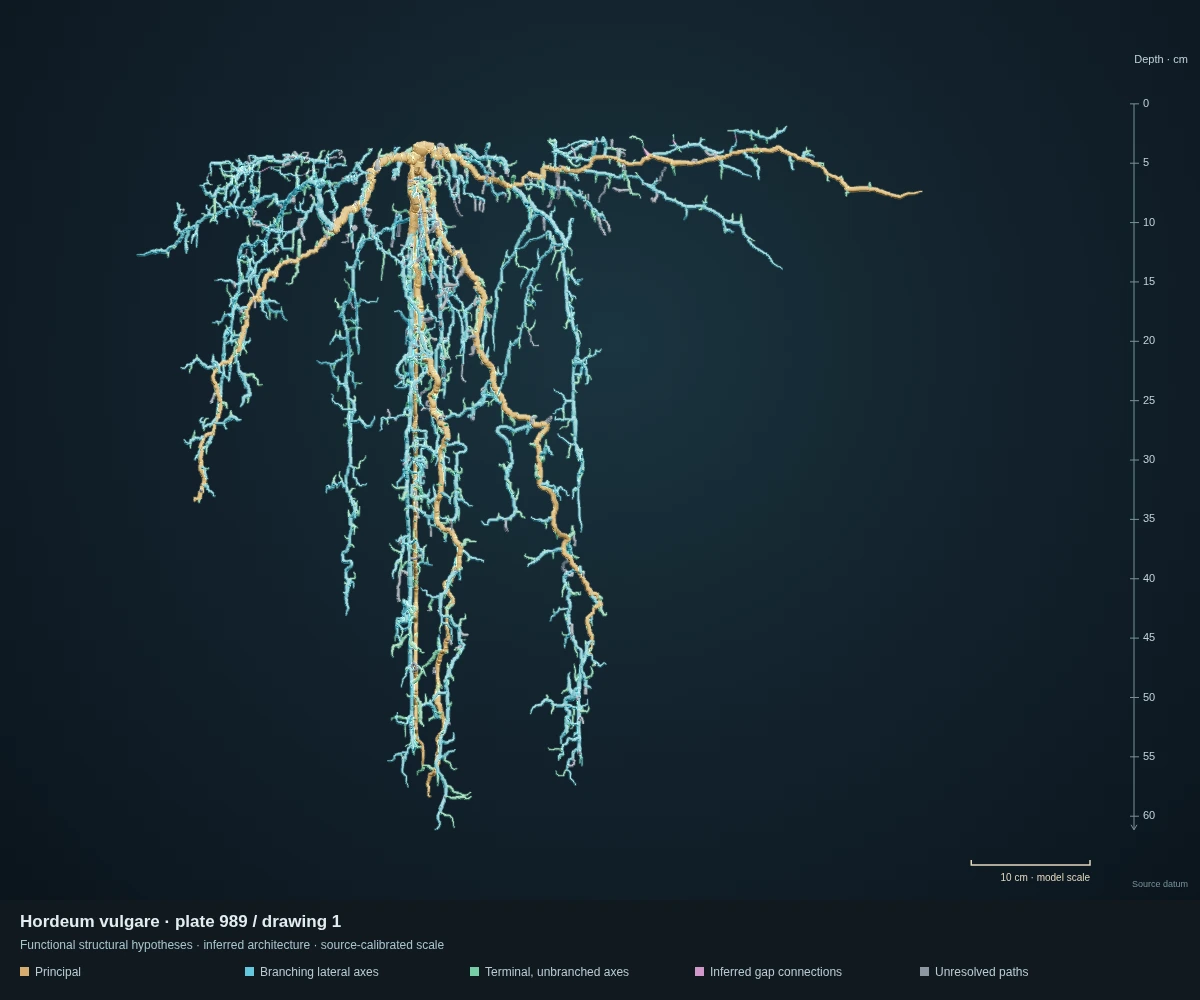
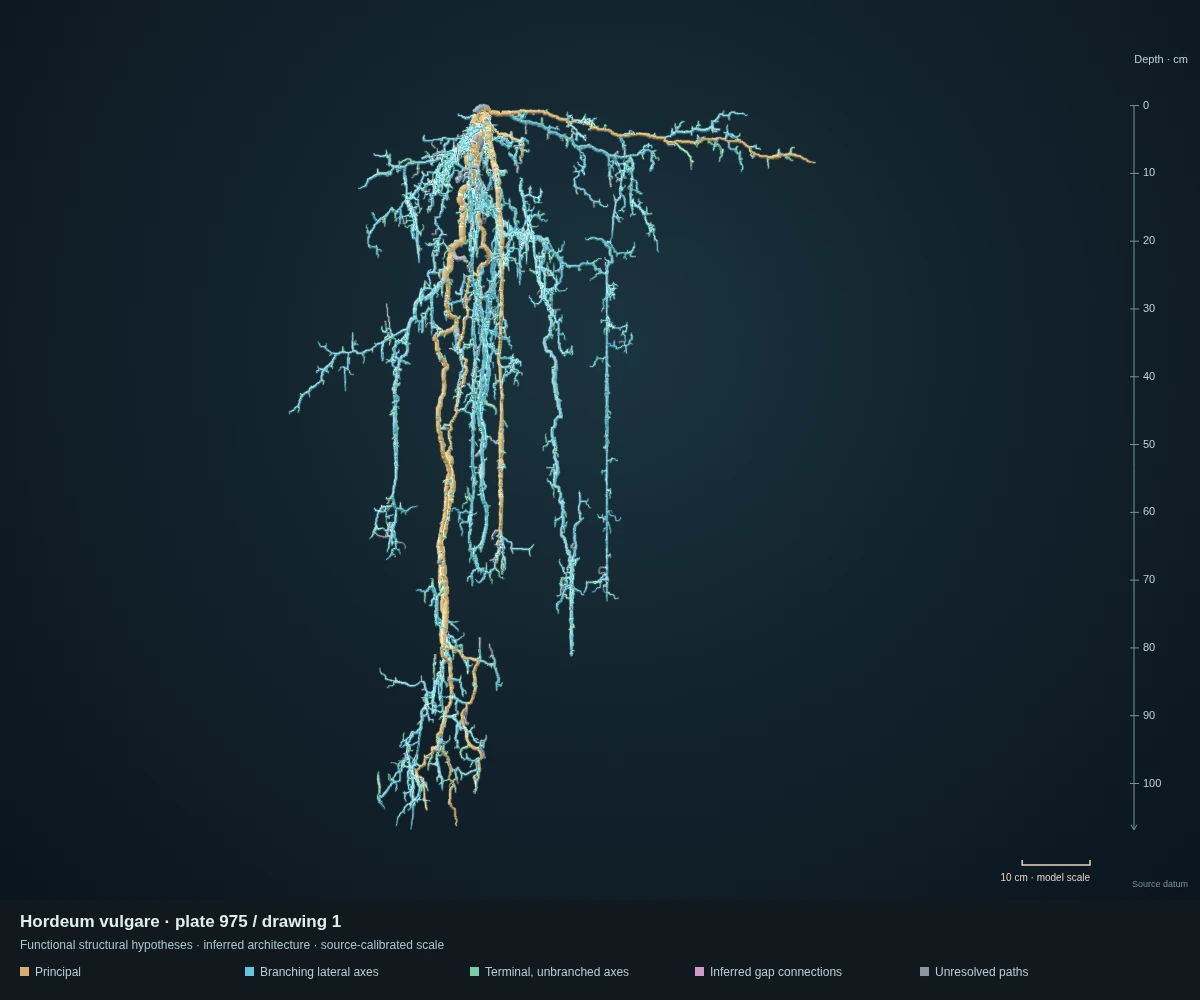
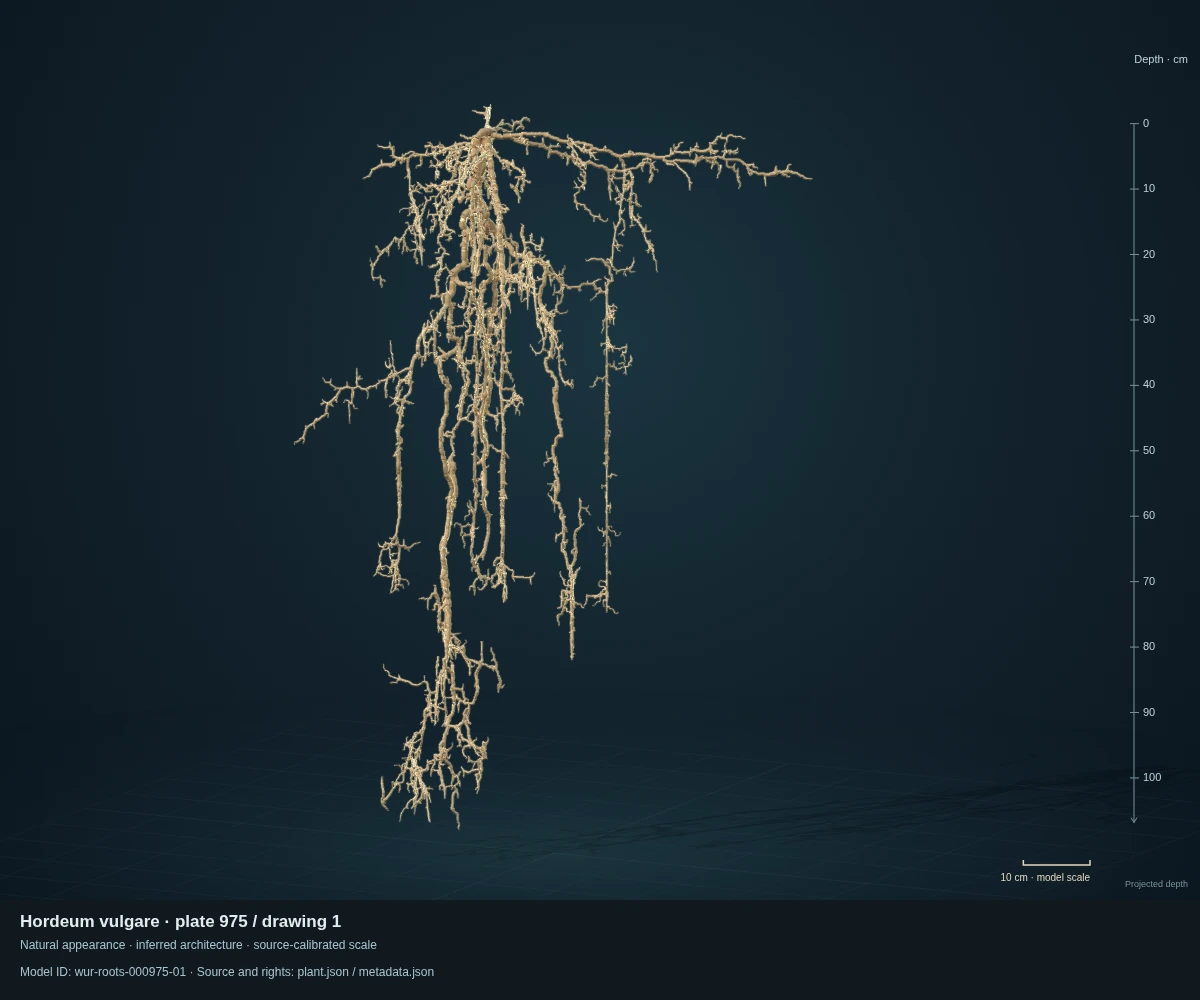
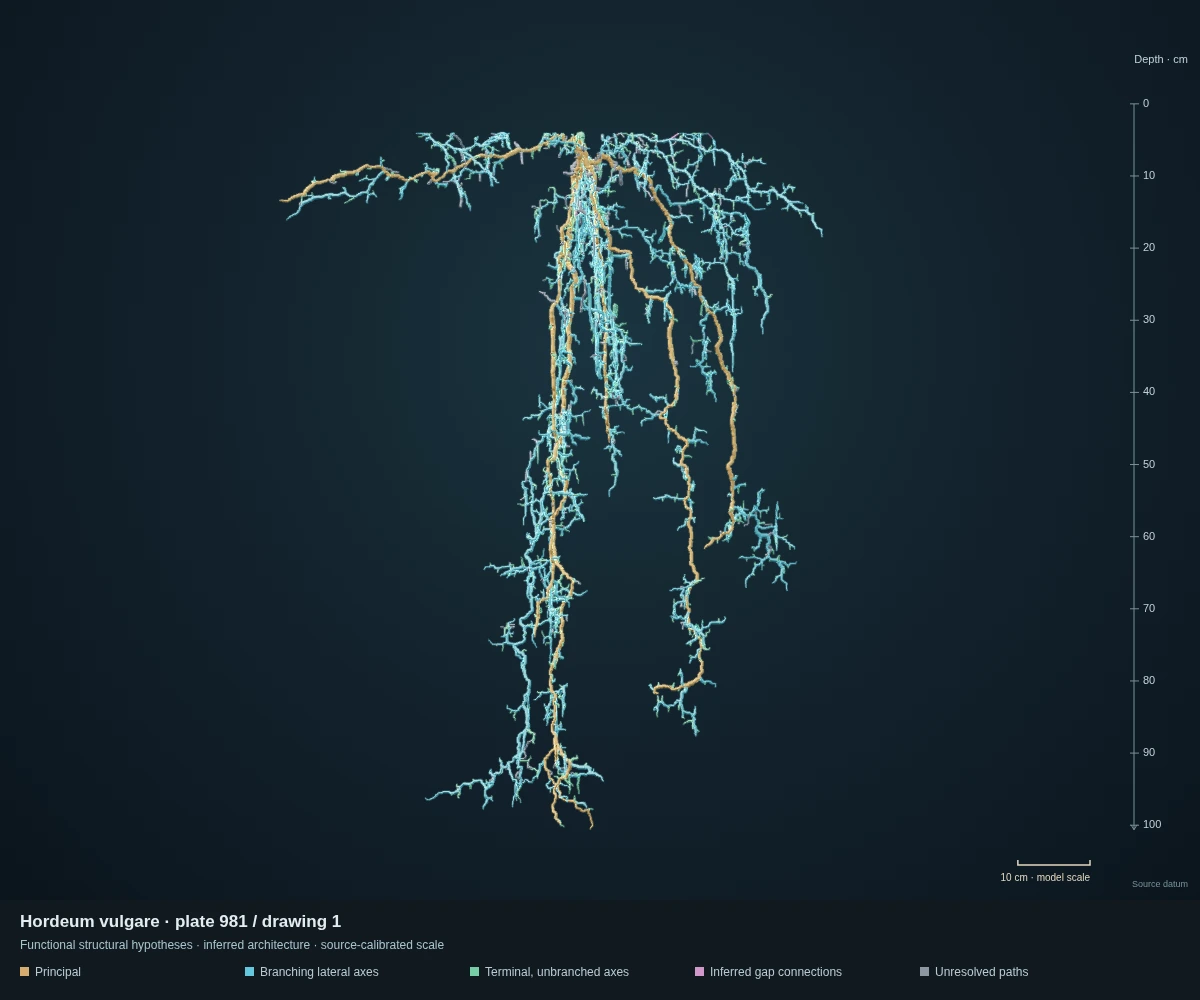
These reconstructions follow archived root drawings. Colour identifies the modelled structural role of each root.

Functional view
Natural view
Source projection
Side view
Calibration
Source-calibrated
Vertical extent
1.06 m
Inferred axes
2192
Model metrics and plate observations

Model metrics

Depth follows the printed scale. Equal horizontal scale and hidden depth are modeling assumptions; root thickness is illustrative.

Vertical extent
1.06 m
Horizontal span (x)
69.3 cm
Horizontal span (z)
74.9 cm
Centreline length
44.4 m
Inferred axes
2192
Branching sites
2062
Terminal paths
2074
Mean modelled diameter
3.11 mm
Surface area proxy
4,380 cm²
Volume proxy
472 cm³
Inferred connection length
1.22 cm
Projected length
40.4 m
Mean angle from vertical
44.0°

Drawing observations

  • Many roots fan outward near the surface; several descend well below 90, with both open lateral forks and localized dense short brush-like marks.
  • Some long root portions carry dense short brush-like marks beside more open forked branches.

Biologically constrained spatial reconstruction from source morphology. Root azimuths, hidden placement, growth responses, circular sections, thickness and proposed connections are inferred. The separate source trace retains exact drawing coordinates. No measured 3D anatomy or observed growth sequence is claimed.

Source and attribution

Study 975 · Model 01

Hordeum vulgare · Wageningen University & Research archive
Functional view
Natural view
Source projection
Side view
Calibration
Source-calibrated
Vertical extent
96.5 cm
Inferred axes
2146
Model metrics and plate observations

Model metrics

Depth follows the printed scale. Equal horizontal scale and hidden depth are modeling assumptions; root thickness is illustrative.

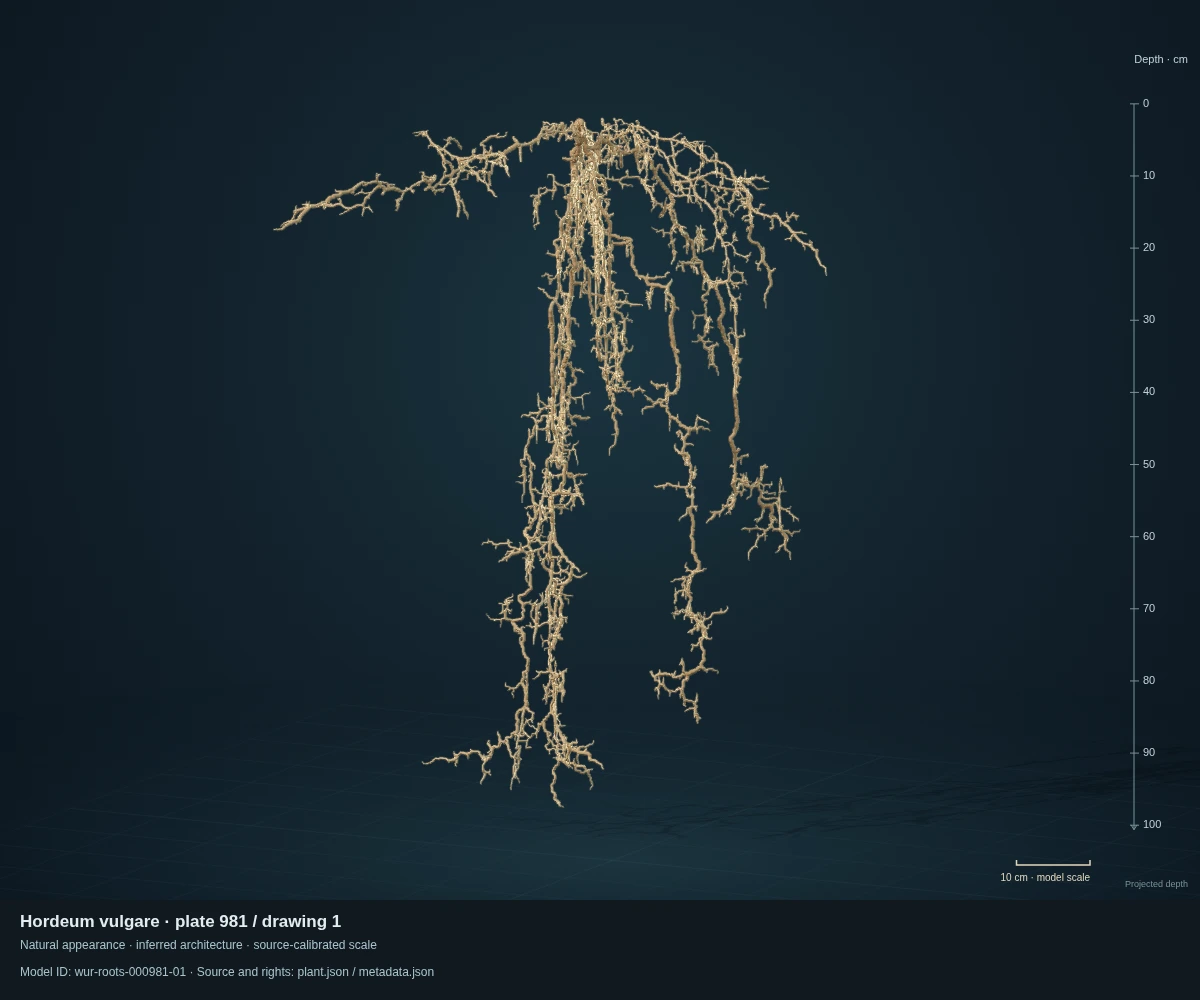
Vertical extent
96.5 cm
Horizontal span (x)
76.6 cm
Horizontal span (z)
78.4 cm
Centreline length
41.3 m
Inferred axes
2146
Branching sites
2061
Terminal paths
2070
Mean modelled diameter
2.74 mm
Surface area proxy
3,570 cm²
Volume proxy
295 cm³
Inferred connection length
8.53 cm
Projected length
37.1 m
Mean angle from vertical
45.0°

Drawing observations

  • Numerous roots spread across the upper profile and descend with fine irregular branches; several lower courses extend below 90.
  • Lower courses show irregular forks and localized short brush-like marks.

Biologically constrained spatial reconstruction from source morphology. Root azimuths, hidden placement, growth responses, circular sections, thickness and proposed connections are inferred. The separate source trace retains exact drawing coordinates. No measured 3D anatomy or observed growth sequence is claimed.

Source and attribution

Study 981 · Model 01

Hordeum vulgare · Wageningen University & Research archive
Functional view
Natural view
Source projection
Side view
Calibration
Source-calibrated
Vertical extent
59.3 cm
Inferred axes
1687
Model metrics and plate observations

Model metrics

Depth follows the printed scale. Equal horizontal scale and hidden depth are modeling assumptions; root thickness is illustrative.

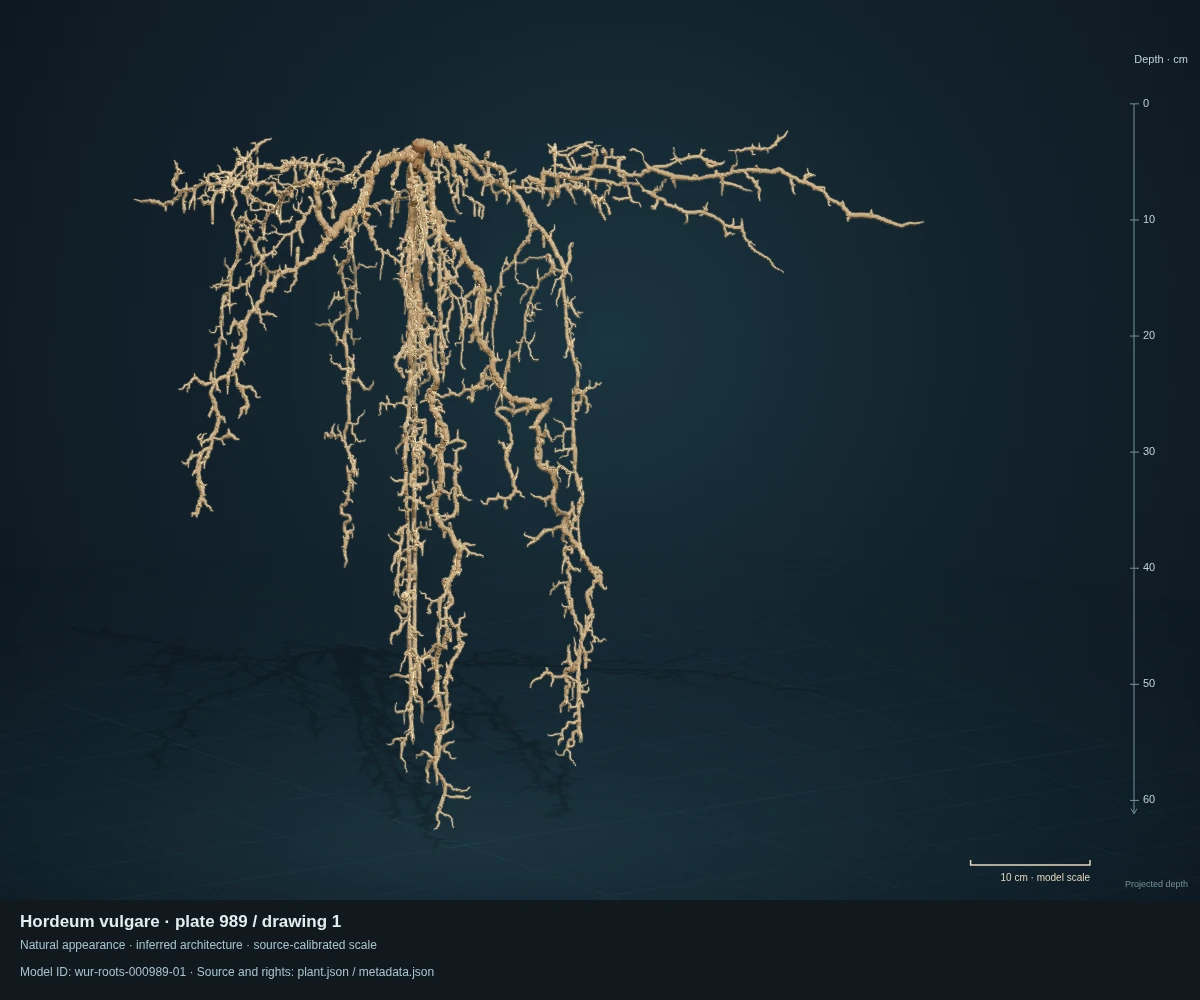
Vertical extent
59.3 cm
Horizontal span (x)
51 cm
Horizontal span (z)
62 cm
Centreline length
26.4 m
Inferred axes
1687
Branching sites
1569
Terminal paths
1583
Mean modelled diameter
2.33 mm
Surface area proxy
1,950 cm²
Volume proxy
146 cm³
Inferred connection length
6.12 cm
Projected length
24.6 m
Mean angle from vertical
43.2°

Drawing observations

  • Many roots spread shallowly to both sides, then divide into a dense descending fan with irregular side branches and tips near or below 60.
  • Lower roots taper into many irregular smaller forks near and below 60.

Biologically constrained spatial reconstruction from source morphology. Root azimuths, hidden placement, growth responses, circular sections, thickness and proposed connections are inferred. The separate source trace retains exact drawing coordinates. No measured 3D anatomy or observed growth sequence is claimed.

Source and attribution

Study 989 · Model 01

Hordeum vulgare · Wageningen University & Research archive
Names & classification

Family
Poaceae
Genus
Hordeum
Order
Poales
Botanical authority
L.
Taxonomic rank
Species
Life form
annual
Growth form
Graminoid
Native range
E. Medit. to C. Asia and China (Sichuan, Yunnan)
Climate
temperate
Mean vegetative height (TRY)
0.891 m
Maximum recorded vegetative height (TRY)
1.5 m
Archive names
Hordeum vulgare

European ecological indicators

Light (1–9, shade to sun)
8.3
Moisture (1–12, dry to submerged)
4.5
Soil reaction (1–9, acidic to base-rich)
6.8
Nutrients (1–9, poor to rich)
6.2
Tichý et al. (2023)