Arbor.guide

Juncus articulatus

Jointed Rush

Root studies

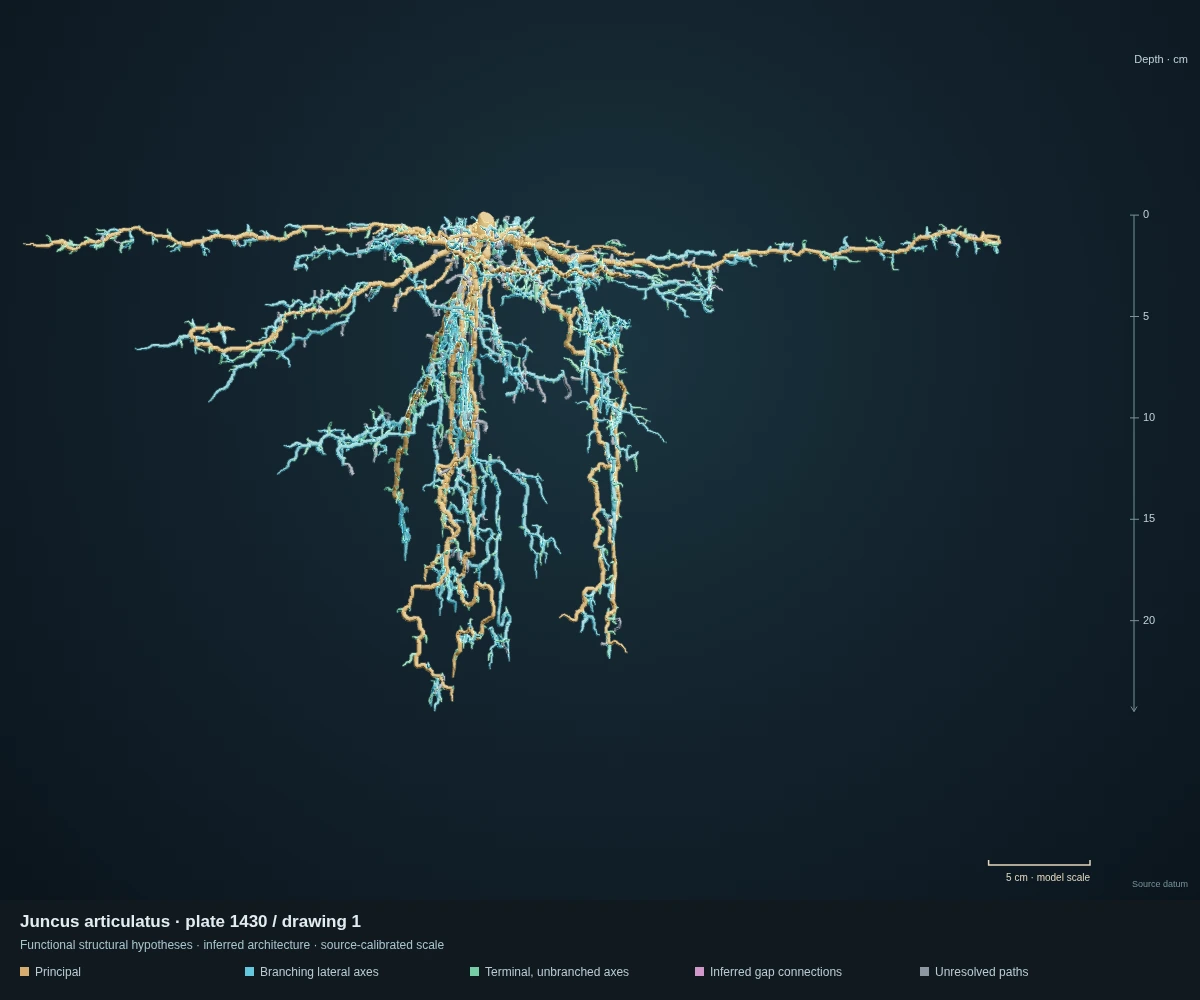
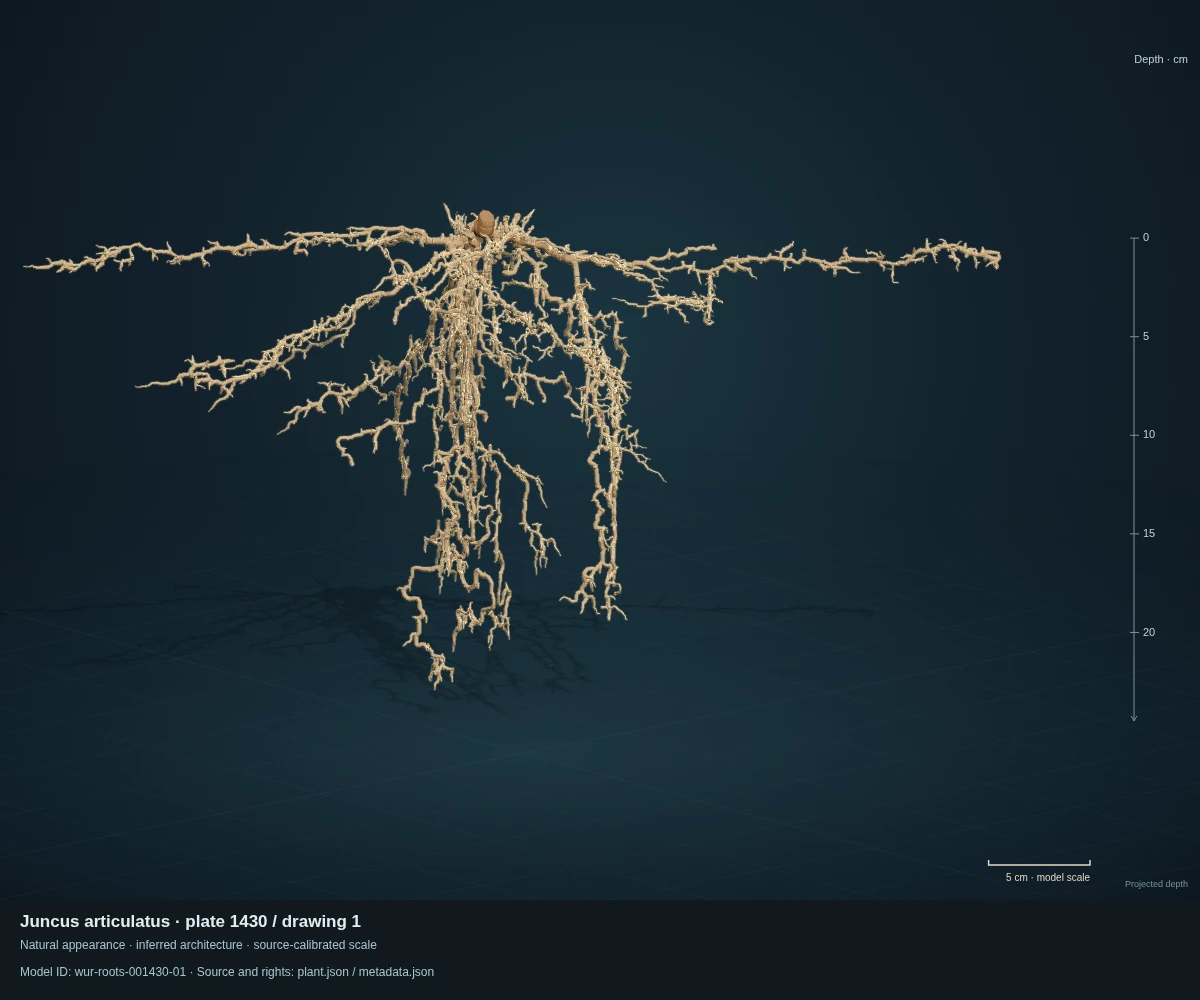
These reconstructions follow archived root drawings. Colour identifies the modelled structural role of each root.

Functional view
Natural view
Source projection
Side view
Calibration
Source-calibrated
Vertical extent
13.2 cm
Inferred axes
1259
Model metrics and plate observations

Model metrics

Depth follows the printed scale. Equal horizontal scale and hidden depth are modeling assumptions; root thickness is illustrative.

Vertical extent
13.2 cm
Horizontal span (x)
21.7 cm
Horizontal span (z)
17.9 cm
Centreline length
4.8 m
Inferred axes
1259
Branching sites
1197
Terminal paths
1201
Mean modelled diameter
0.688 mm
Surface area proxy
106 cm²
Volume proxy
2.8 cm³
Inferred connection length
1.76 cm
Projected length
4.22 m
Mean angle from vertical
52.0°

Dimensions reported on the source plate

Plant height
23 cm plate_346
Root depth
24 cm plate_346
Root-system diameter
47 cm plate_346

Drawing observations

  • Small leafy tuft with a terminal reproductive cluster above wide shallow roots and coarse deep descenders
  • A dense fine-branched upper field spreads very widely to both sides of the compact crown
  • Several much darker coarse sinuous roots descend through the central field with short fine side branches
  • Some coarse lower roots end in conspicuous hooks or S-like bends, at unequal levels

Biologically constrained spatial reconstruction from source morphology. Root azimuths, hidden placement, growth responses, circular sections, thickness and proposed connections are inferred. The separate source trace retains exact drawing coordinates. No measured 3D anatomy or observed growth sequence is claimed.

Source and attribution

Study 346 · Model 01

Juncus articulatus · Wageningen University & Research archive
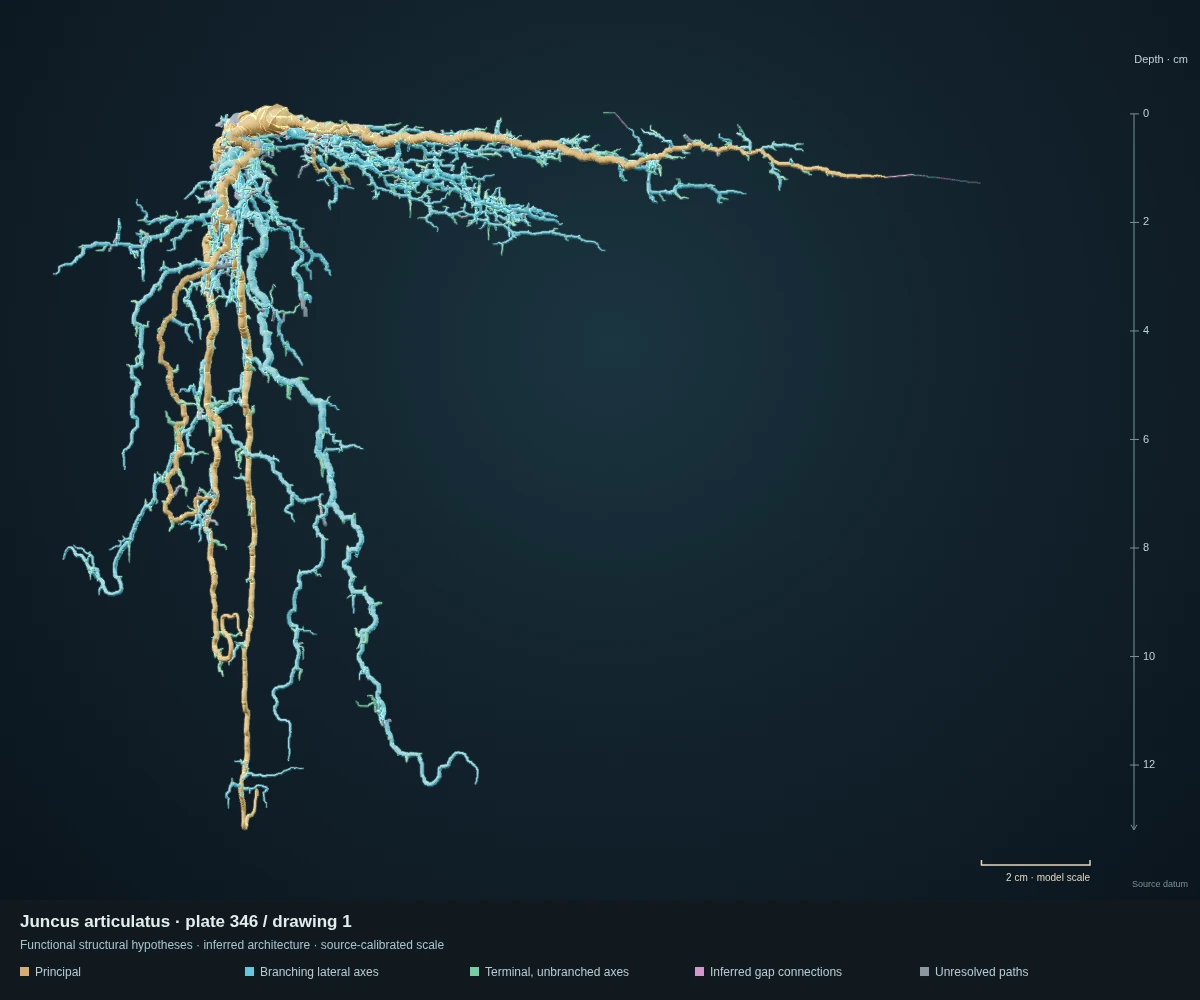
Functional view
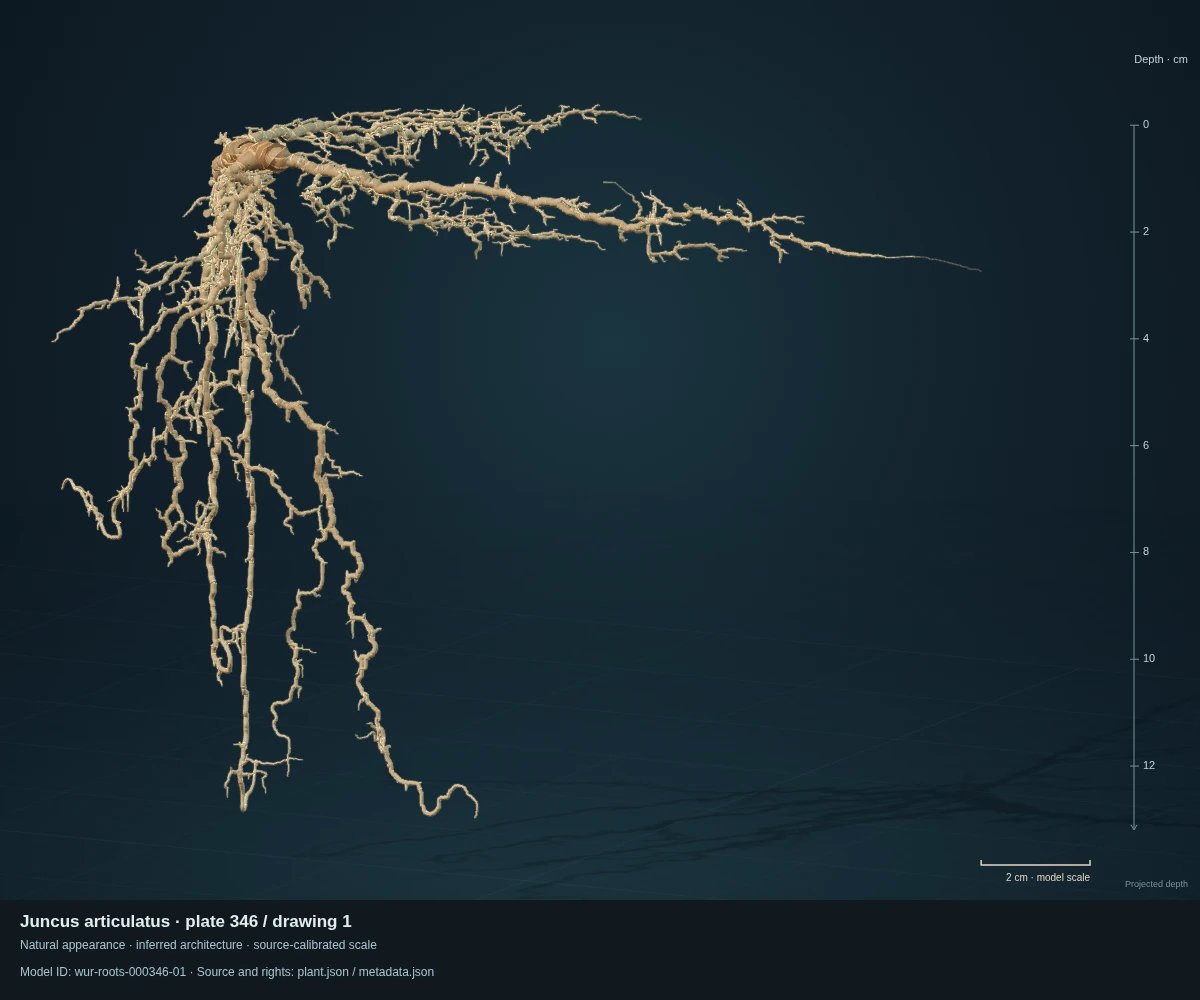
Natural view
Source projection
Side view
Calibration
Source-calibrated
Vertical extent
24.4 cm
Inferred axes
1711
Model metrics and plate observations

Model metrics

Depth follows the printed scale. Equal horizontal scale and hidden depth are modeling assumptions; root thickness is illustrative.

Vertical extent
24.4 cm
Horizontal span (x)
37.7 cm
Horizontal span (z)
36 cm
Centreline length
14.7 m
Inferred axes
1711
Branching sites
1611
Terminal paths
1625
Mean modelled diameter
1.41 mm
Surface area proxy
658 cm²
Volume proxy
29.3 cm³
Inferred connection length
2.22 cm
Projected length
13.7 m
Mean angle from vertical
47.9°

Dimensions reported on the source plate

Plant height
23 cm plate_1430
Root depth
24 cm plate_1430
Root-system diameter
47 cm plate_1430

Drawing observations

  • tufted herb with terminal branched heads above dense fibrous root profile
  • many similarly sized roots emerge from compact basal zone
  • long shallow laterals extend both left and right
  • dense sinuous descenders with short laterals and terminal forks

Biologically constrained spatial reconstruction from source morphology. Root azimuths, hidden placement, growth responses, circular sections, thickness and proposed connections are inferred. The separate source trace retains exact drawing coordinates. No measured 3D anatomy or observed growth sequence is claimed.

Source and attribution

Study 1430 · Model 01

Juncus articulatus · Wageningen University & Research archive
Names & classification

Family
Juncaceae
Genus
Juncus
Order
Poales
Botanical authority
L.
Taxonomic rank
Species
Life form
perennial or rhizomatous geophyte
Growth form
Graminoid
Native range
Temp. Northern Hemisphere
Climate
temperate
Mean vegetative height (TRY)
0.384 m
Maximum recorded vegetative height (TRY)
0.8 m
Archive names
Juncus articulatus

European ecological indicators

Light (1–9, shade to sun)
8
Moisture (1–12, dry to submerged)
8.6
Soil reaction (1–9, acidic to base-rich)
5.4
Nutrients (1–9, poor to rich)
3
Tichý et al. (2023)