Arbor.guide

Lotus pedunculatus

Greater Bird's-foot-trefoil

Root studies

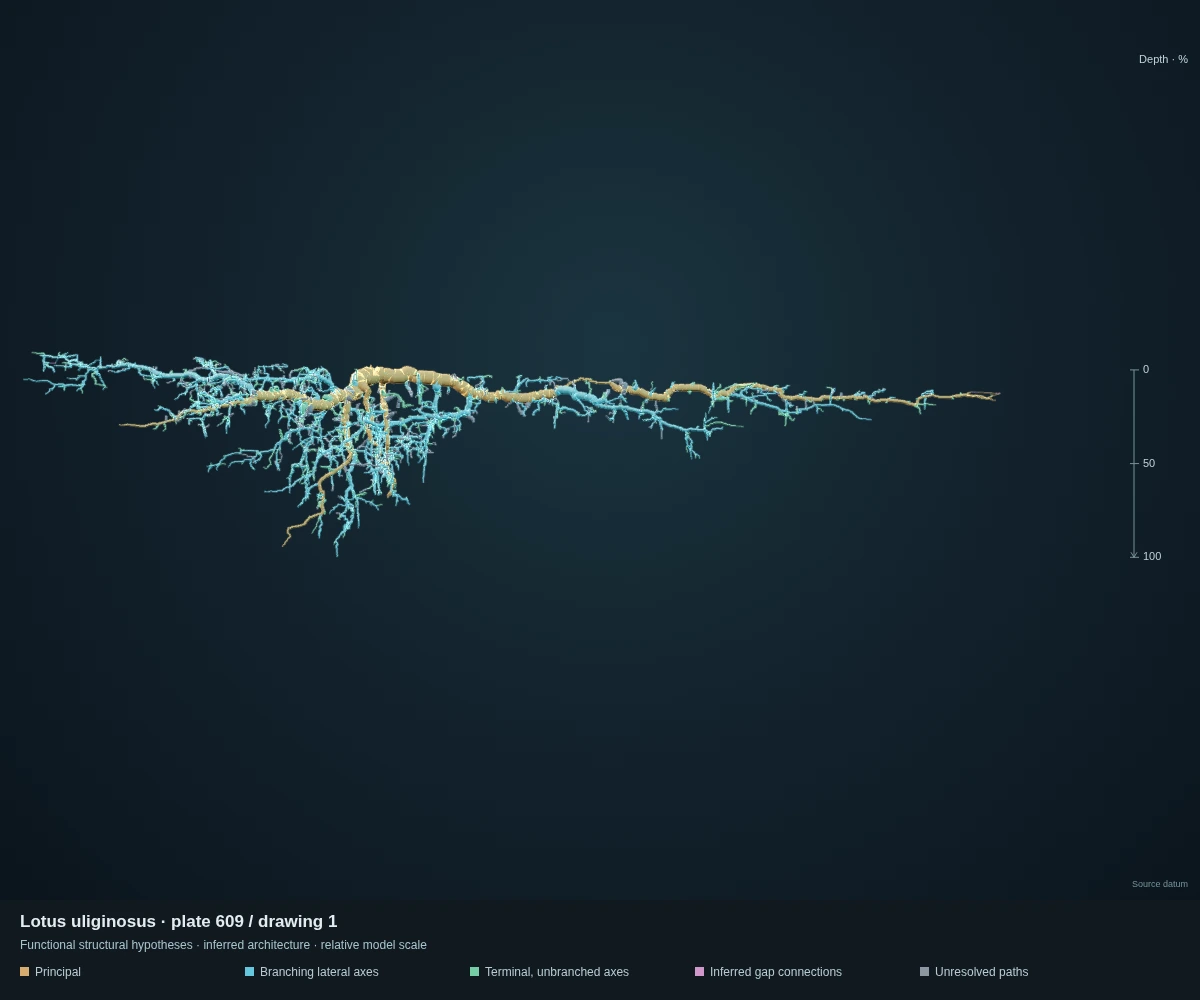
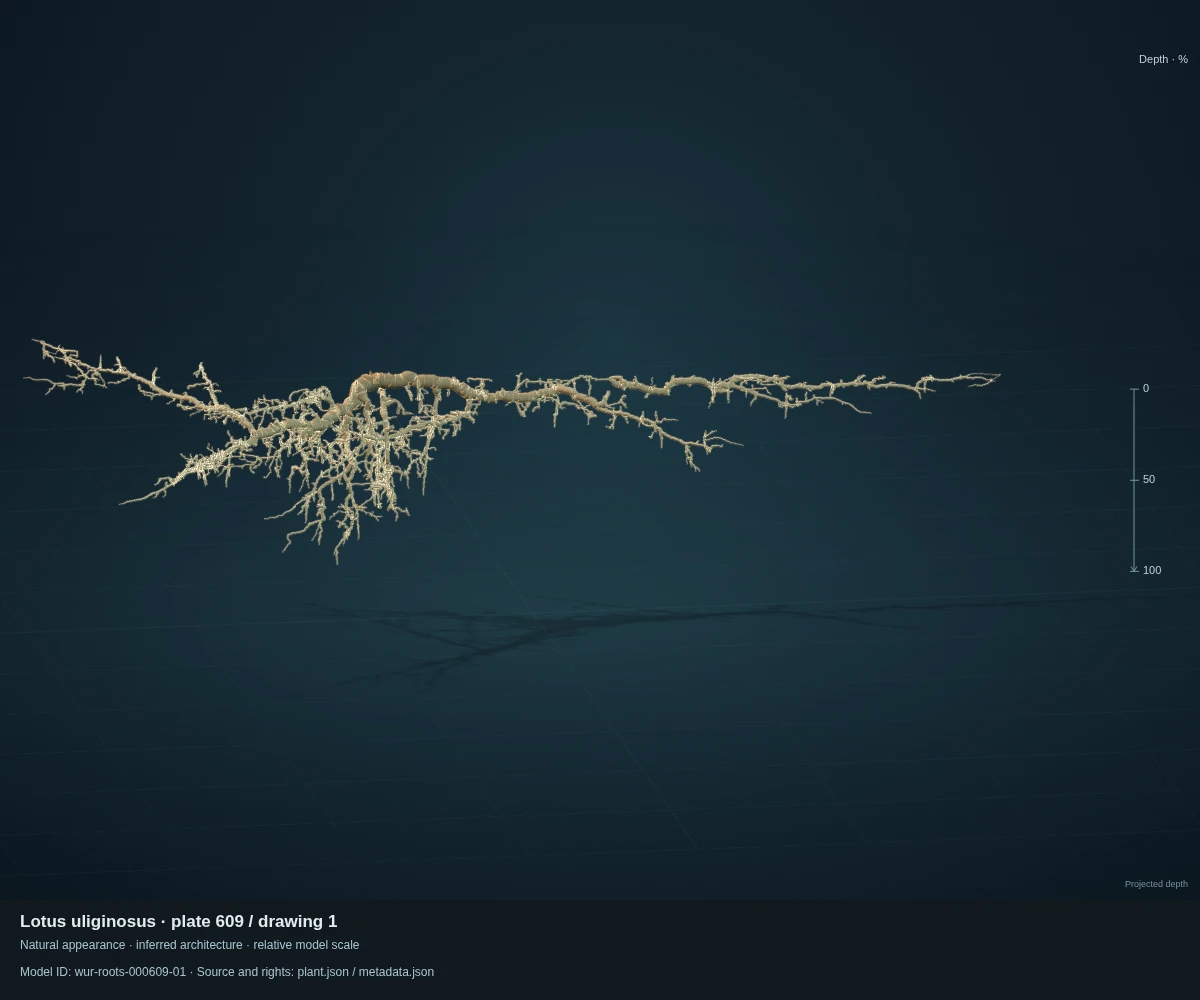
These reconstructions follow archived root drawings. Colour identifies the modelled structural role of each root.

Functional view
Natural view
Source projection
Side view
Calibration
Unresolved scale
Vertical extent
0.2 model units
Inferred axes
1710
Model metrics and plate observations

Model metrics

No metric calibration; values are in normalized model coordinates.

Vertical extent
0.2 model units
Horizontal span (x)
0.43 model units
Horizontal span (z)
0.957 model units
Centreline length
19 model units
Inferred axes
1710
Branching sites
1514
Terminal paths
1522
Mean modelled diameter
0.00207 model units
Surface area proxy
0.127 model units²
Volume proxy
0.000126 model units³
Inferred connection length
0.0244 model units
Projected length
15.8 model units
Mean angle from vertical
54.6°

Dimensions reported on the source plate

Plant height
10 cm plate_609
Root depth
30 cm plate_609
Root-system diameter
126 cm plate_609

Drawing observations

  • Low spreading flower-bearing shoots share a near-horizontal basal system above a broad root field.
  • Several coarse roots emerge at separated positions along the low basal axes.
  • Very long lateral roots extend both ways around a dense central branching field.
  • A narrower central group descends below most lateral roots and ends in fine forks.

Biologically constrained spatial reconstruction from source morphology. Root azimuths, hidden placement, growth responses, circular sections, thickness and proposed connections are inferred. The separate source trace retains exact drawing coordinates. No measured 3D anatomy or observed growth sequence is claimed.

Source and attribution

Study 609 · Model 01

Lotus uliginosus · Wageningen University & Research archive
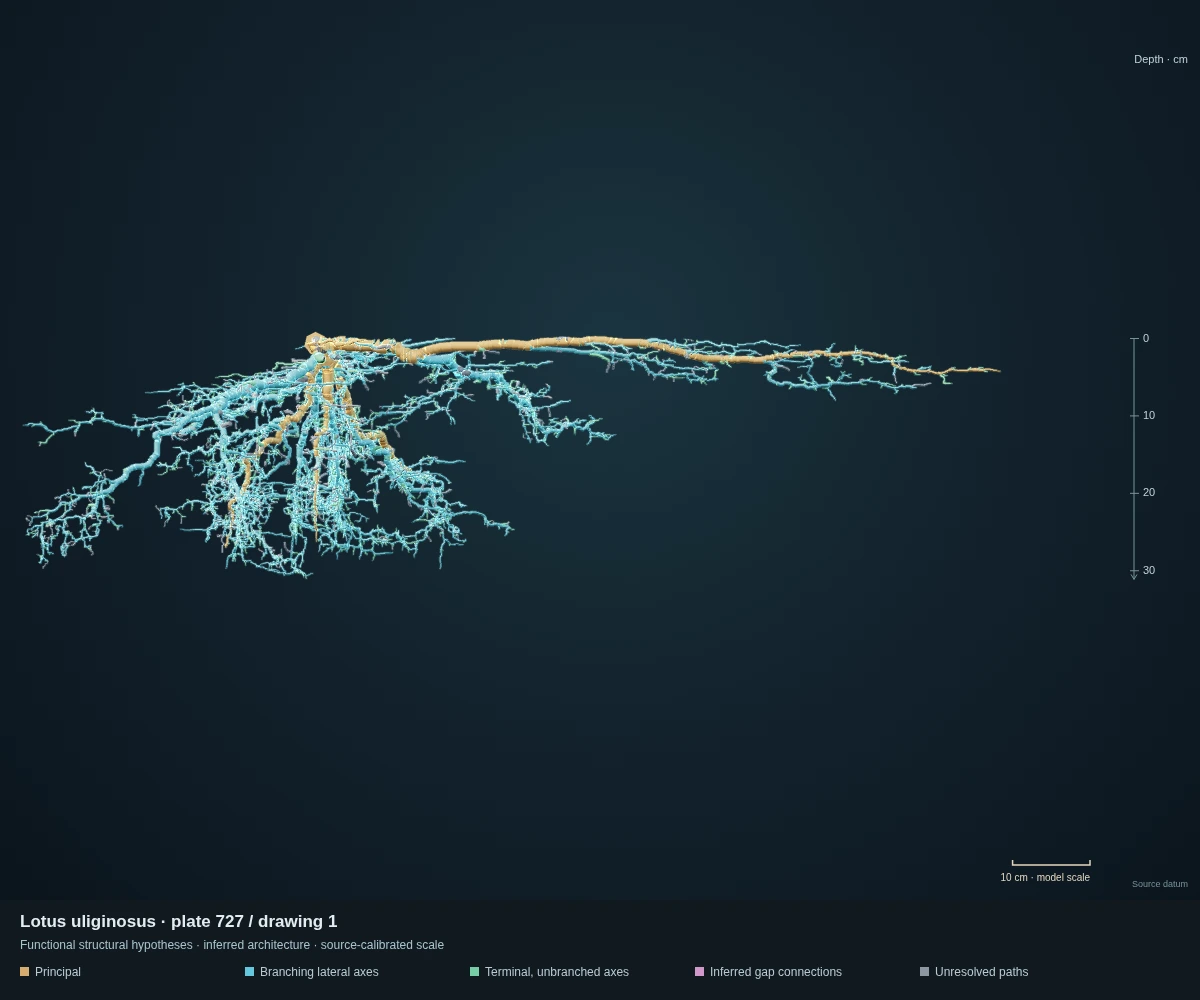
Functional view
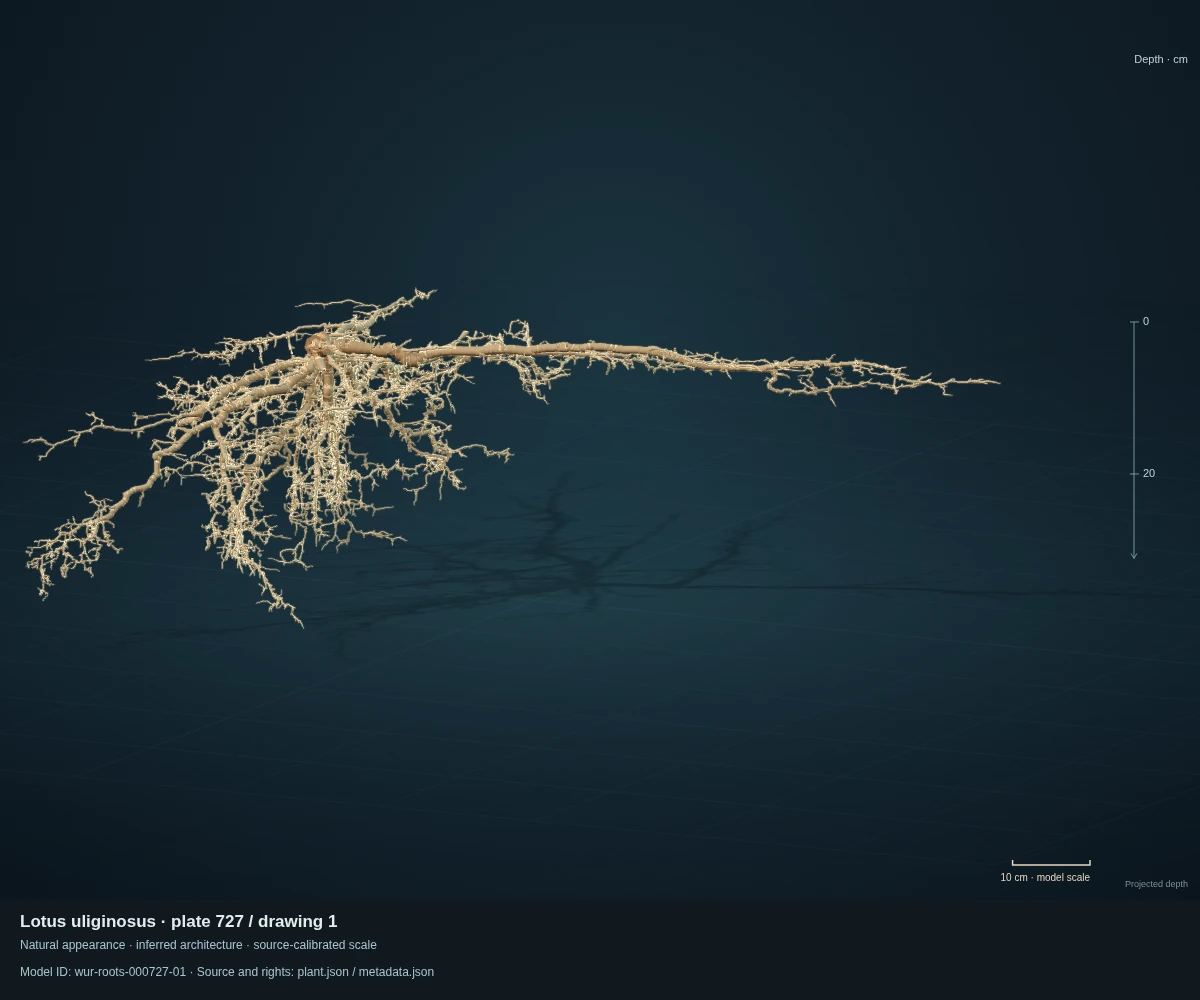
Natural view
Source projection
Side view
Calibration
Source-calibrated
Vertical extent
31.1 cm
Inferred axes
3891
Model metrics and plate observations

Model metrics

Depth follows the printed scale. Equal horizontal scale and hidden depth are modeling assumptions; root thickness is illustrative.

Vertical extent
31.1 cm
Horizontal span (x)
1.25 m
Horizontal span (z)
1.26 m
Centreline length
57.4 m
Inferred axes
3891
Branching sites
3395
Terminal paths
3413
Mean modelled diameter
2.77 mm
Surface area proxy
5,140 cm²
Volume proxy
703 cm³
Inferred connection length
3.08 cm
Projected length
46.6 m
Mean angle from vertical
57.8°

Dimensions reported on the source plate

Plant height
10 cm plate_727
Root depth
30 cm plate_727
Root-system diameter
126 cm plate_727

Drawing observations

  • one spreading flowering plant over very broad shallow root mat
  • root neck divides into many coarse axes
  • long nearly horizontal left and right roots
  • dense fine branched shallow network
  • unequal oblique and descending branches

Biologically constrained spatial reconstruction from source morphology. Root azimuths, hidden placement, growth responses, circular sections, thickness and proposed connections are inferred. The separate source trace retains exact drawing coordinates. No measured 3D anatomy or observed growth sequence is claimed.

Source and attribution

Study 727 · Model 01

Lotus uliginosus · Wageningen University & Research archive
Names & classification

Family
Fabaceae
Genus
Lotus
Order
Fabales
Taxonomic rank
Species
Life form
perennial
Native range
Macaronesia, N. Africa, Europe to Türkiye
Climate
subtropical
Archive names
Lotus uliginosus

European ecological indicators

Light (1–9, shade to sun)
7.3
Moisture (1–12, dry to submerged)
7.9
Soil reaction (1–9, acidic to base-rich)
4.9
Nutrients (1–9, poor to rich)
3.7
Tichý et al. (2023)