Arbor.guide

Phragmites australis

Common Reed

Root studies

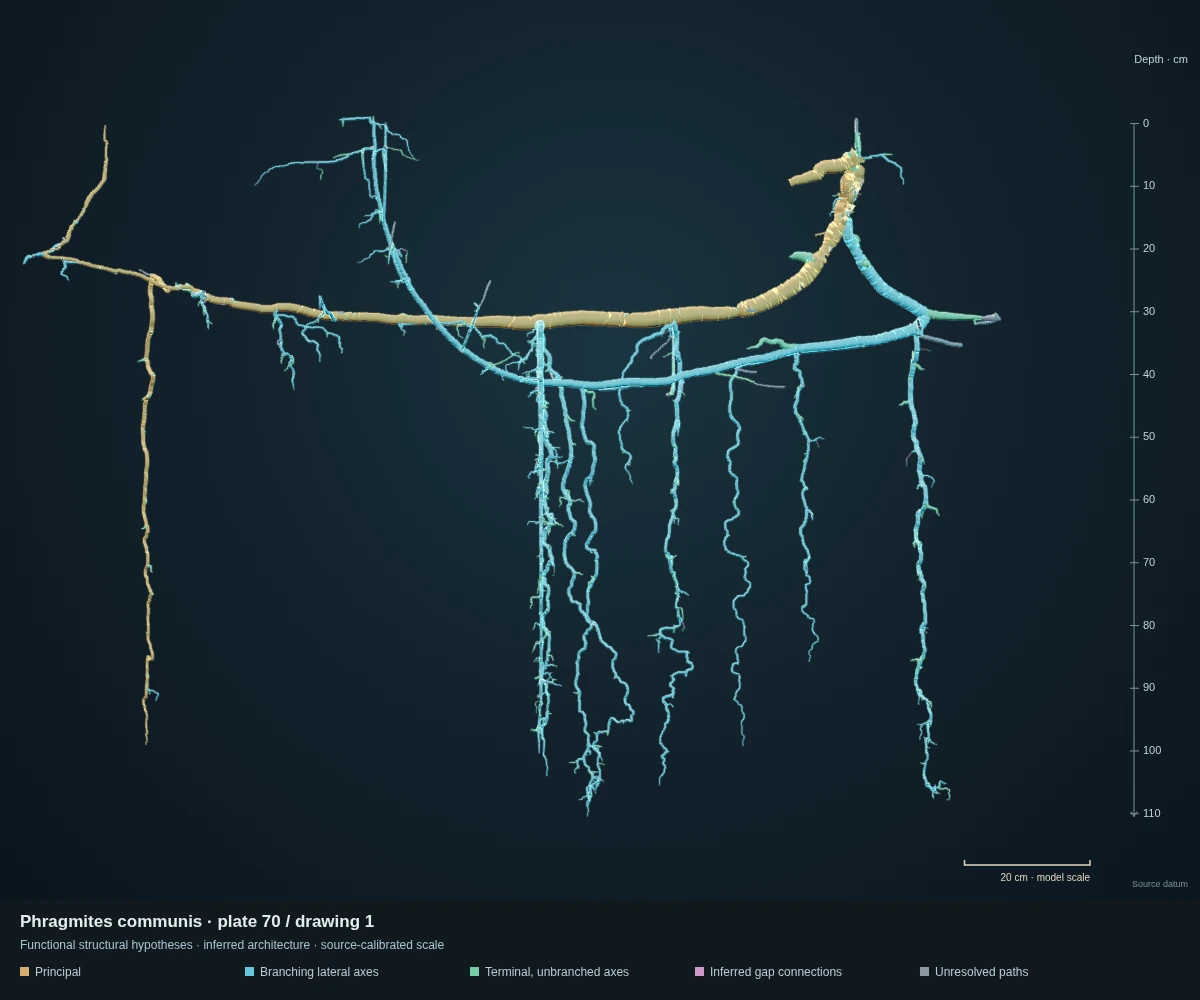
These reconstructions follow archived root drawings. Colour identifies the modelled structural role of each root.

Functional view
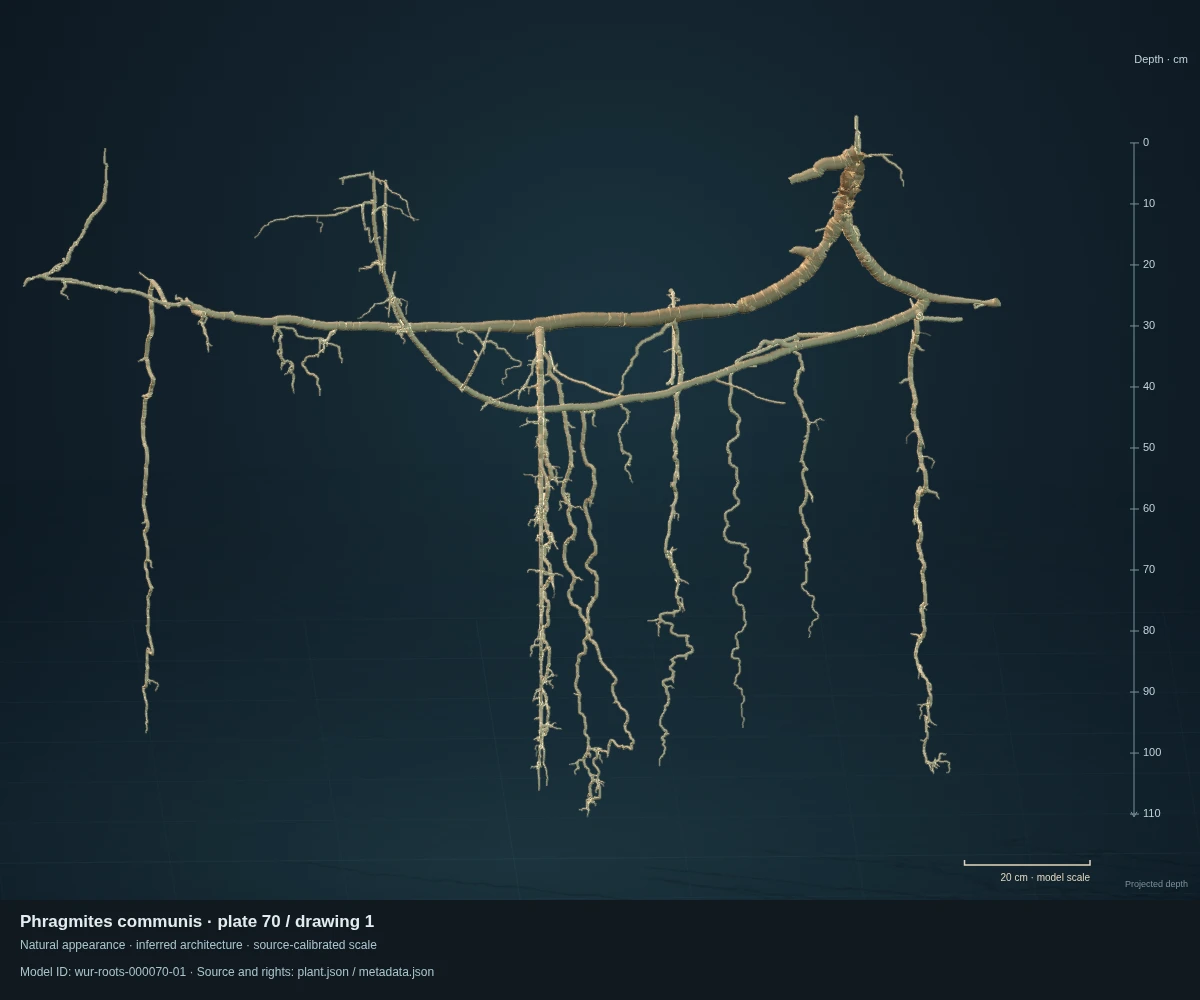
Natural view
Source projection
Side view
Calibration
Source-calibrated
Vertical extent
1.12 m
Inferred axes
679
Model metrics and plate observations

Model metrics

Depth follows the printed scale. Equal horizontal scale and hidden depth are modeling assumptions; root thickness is illustrative.

Vertical extent
1.12 m
Horizontal span (x)
62.8 cm
Horizontal span (z)
1.56 m
Centreline length
27.3 m
Inferred axes
679
Branching sites
637
Terminal paths
643
Mean modelled diameter
5.19 mm
Surface area proxy
4,570 cm²
Volume proxy
1,090 cm³
Inferred connection length
16.8 cm
Projected length
22.6 m
Mean angle from vertical
49.9°

Dimensions reported on the source plate

Root depth
180 cm plate_70
Root-system diameter
0 cm plate_70

Drawing observations

  • Three upright shoot axes connected to a jointed horizontal underground axis, with long descending roots.
  • Three unequal upright shoot axes connect to the horizontal system; their visible upper structures are narrow and pointed.
  • A coarse segmented horizontal underground axis connects separated upright shoots.
  • Fine roots leave several joints of the horizontal axis and a downward-directed jointed branch.
  • Long sparse roots descend almost vertically, with scattered short finer branches.

Biologically constrained spatial reconstruction from source morphology. Root azimuths, hidden placement, growth responses, circular sections, thickness and proposed connections are inferred. The separate source trace retains exact drawing coordinates. No measured 3D anatomy or observed growth sequence is claimed.

Source and attribution

Study 70 · Model 01

Phragmites communis · Wageningen University & Research archive
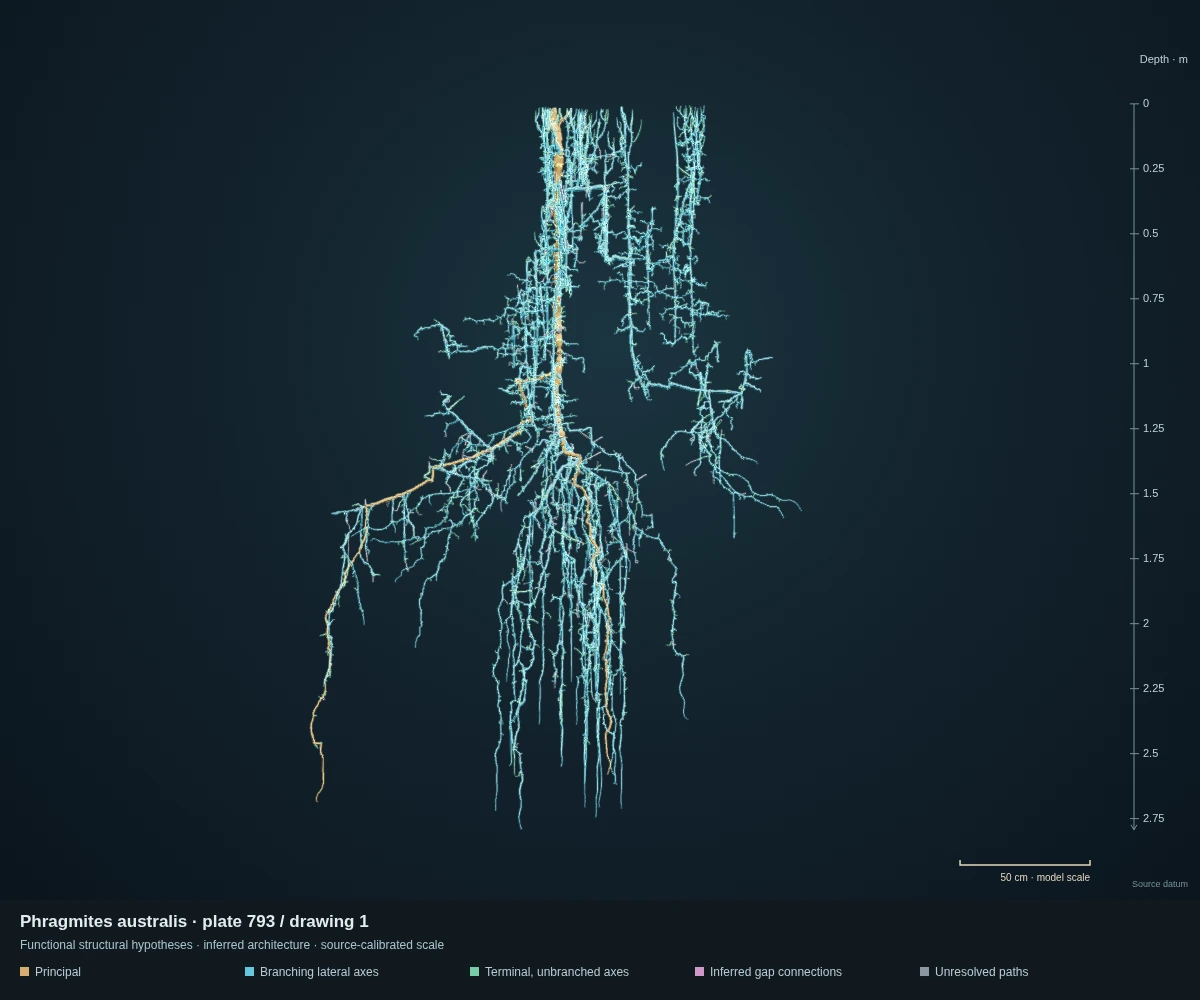
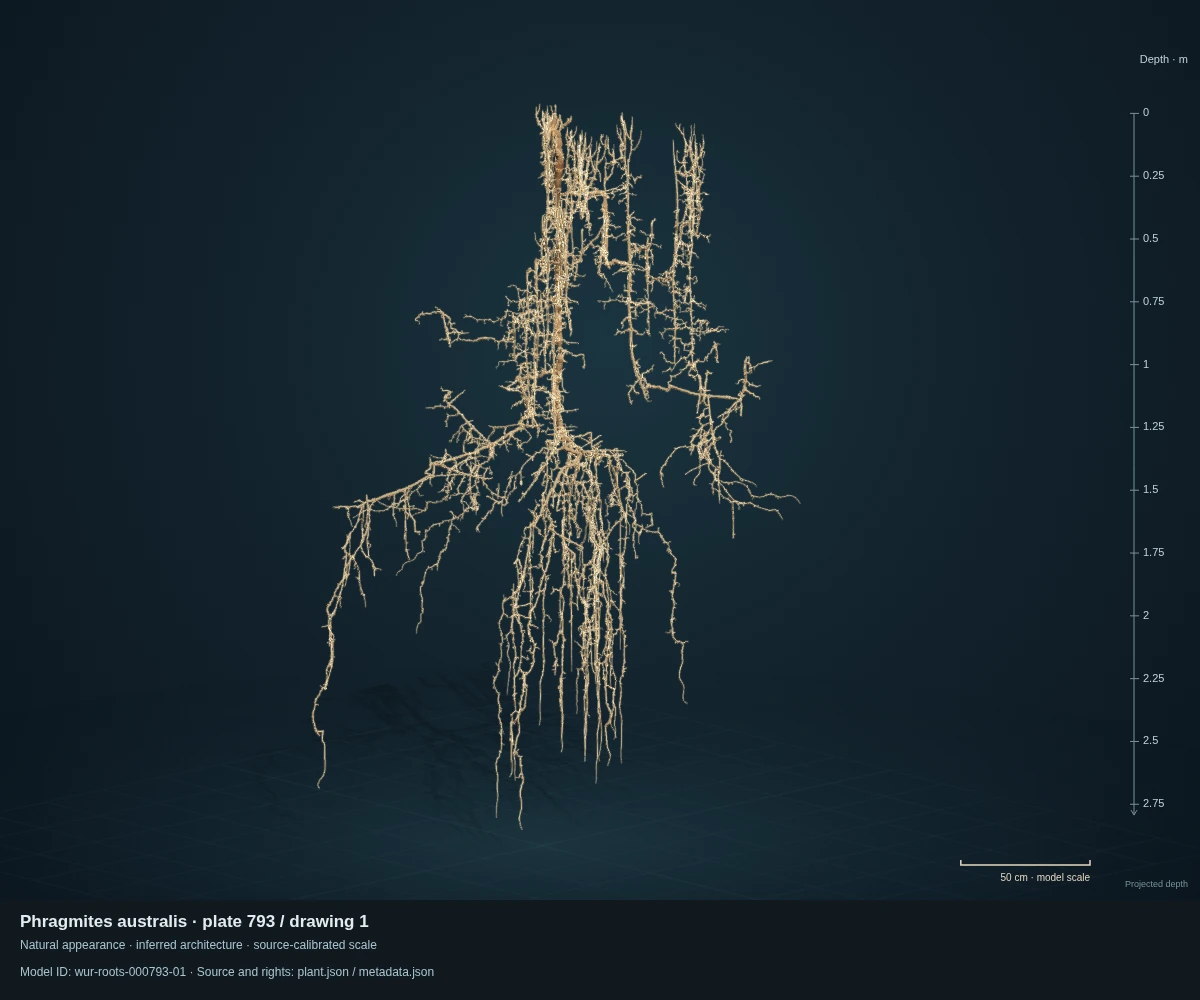
Functional view
Natural view
Source projection
Side view
Calibration
Source-calibrated
Vertical extent
2.79 m
Inferred axes
4742
Model metrics and plate observations

Model metrics

Depth follows the printed scale. Equal horizontal scale and hidden depth are modeling assumptions; root thickness is illustrative.

Vertical extent
2.79 m
Horizontal span (x)
1.54 m
Horizontal span (z)
1.75 m
Centreline length
185 m
Inferred axes
4742
Branching sites
4500
Terminal paths
4601
Mean modelled diameter
4.54 mm
Surface area proxy
2.67 m²
Volume proxy
4,610 cm³
Inferred connection length
44.9 cm
Projected length
164 m
Mean angle from vertical
43.2°

Drawing observations

  • A root-focused profile shows many long vertical jointed axes and crossing horizontal axes beneath a ground reference.
  • Fine roots arise repeatedly along long vertical and horizontal jointed axes.
  • A wide upper network continues into numerous long lower descending roots beneath several crossing horizontal axes.
  • Fine laterals occur at repeated positions on the upper axes and are sparser along the deepest long roots.

Biologically constrained spatial reconstruction from source morphology. Root azimuths, hidden placement, growth responses, circular sections, thickness and proposed connections are inferred. The separate source trace retains exact drawing coordinates. No measured 3D anatomy or observed growth sequence is claimed.

Source and attribution

Study 793 · Model 01

Phragmites australis · Wageningen University & Research archive
Names & classification

Family
Poaceae
Genus
Phragmites
Order
Poales
Botanical authority
(Cav.) Trin. ex Steud.
Taxonomic rank
Species
Life form
helophyte or rhizomatous hydrogeophyte
Growth form
Graminoid
Native range
Temp. & Subtrop. to Trop. Mts.
Climate
temperate
Mean vegetative height (TRY)
1.64 m
Maximum recorded vegetative height (TRY)
4.0 m
Archive names
Phragmites communis · Phragmites australis

European ecological indicators

Light (1–9, shade to sun)
7.2
Moisture (1–12, dry to submerged)
9.7
Soil reaction (1–9, acidic to base-rich)
6.9
Nutrients (1–9, poor to rich)
6.1
Tichý et al. (2023)