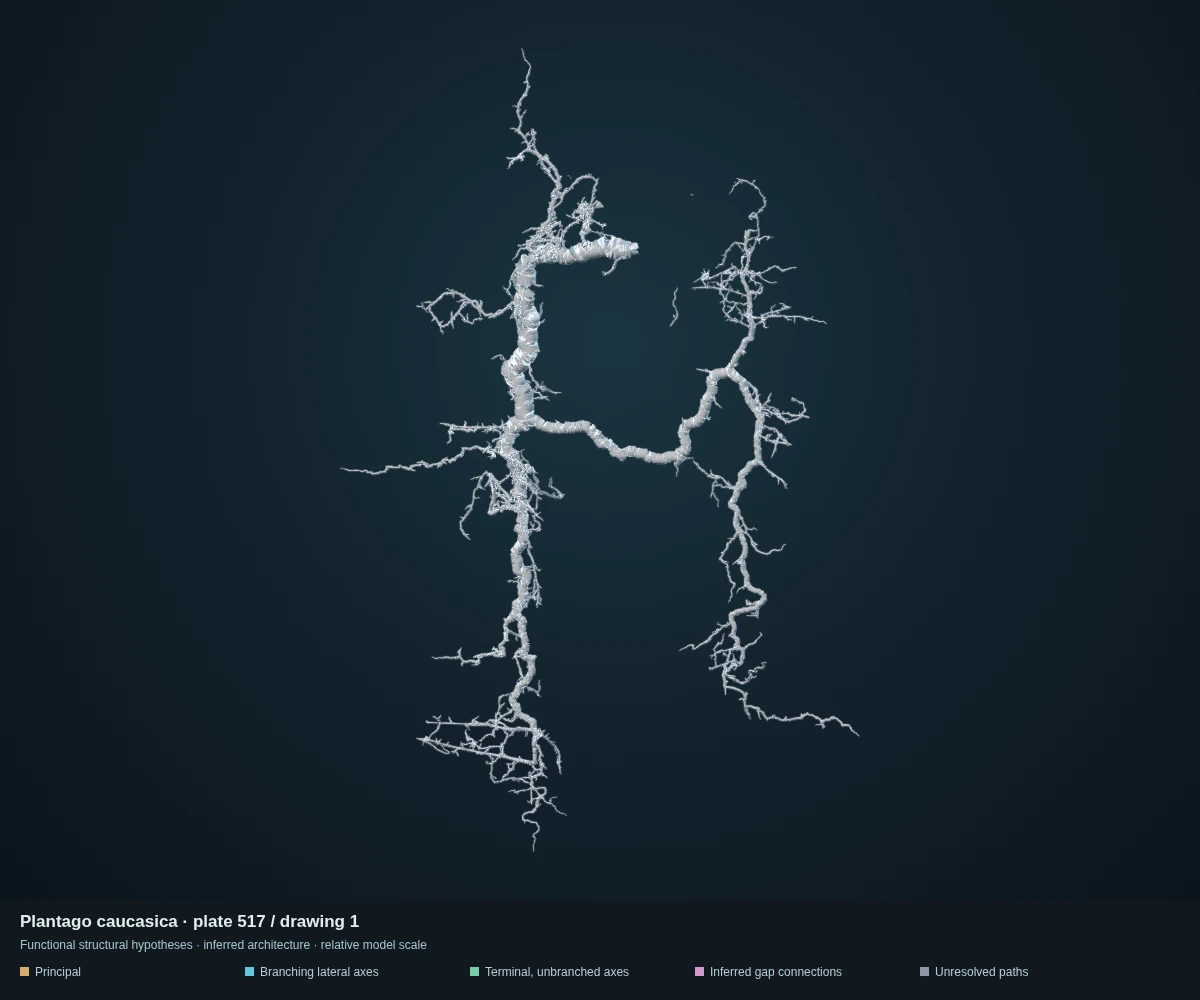
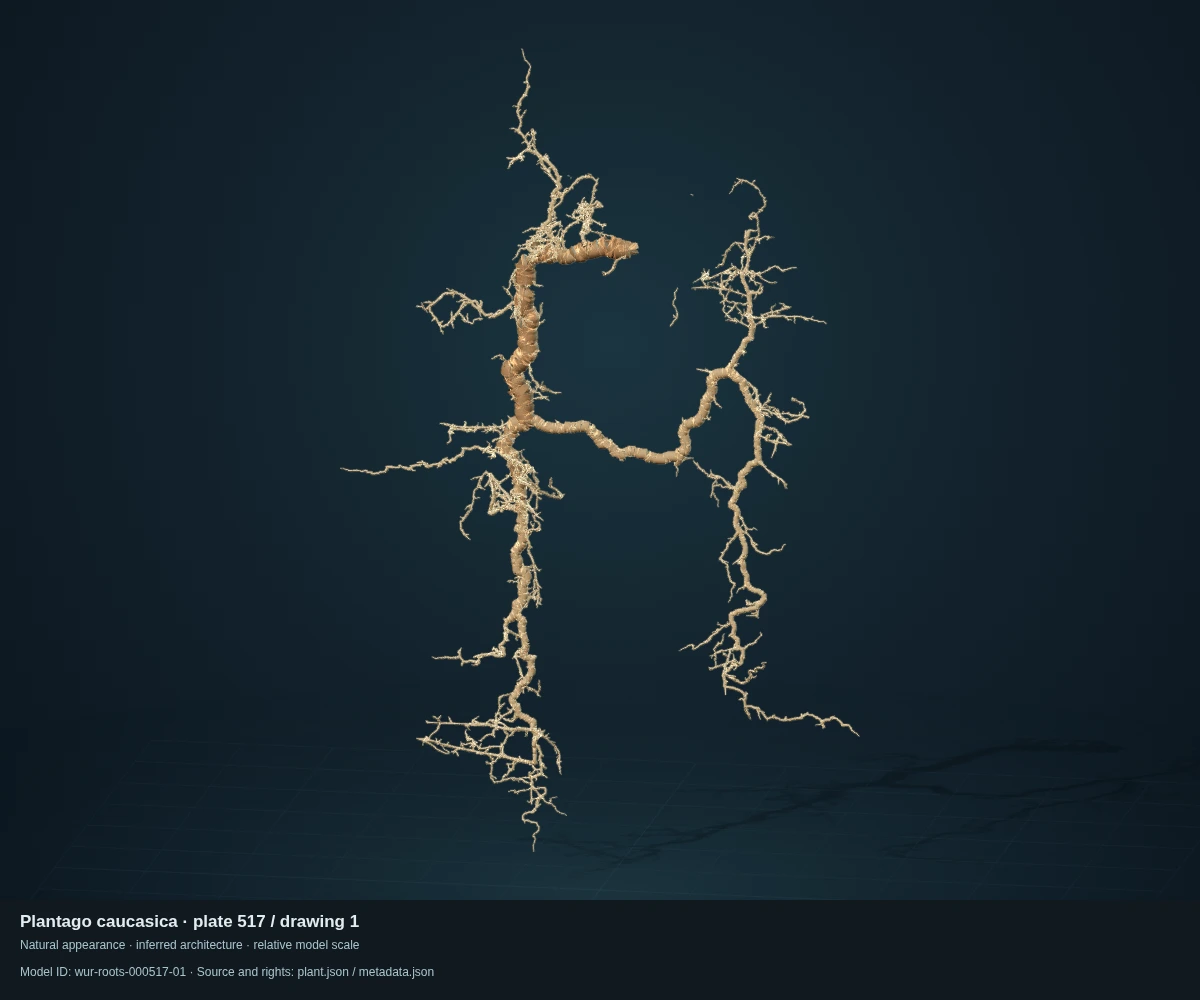
- Source projection
- Compound plate
- Calibration
- Ambiguous scale
- Vertical extent
- 1.22 model units
- Inferred axes
- 2442
Model metrics and plate observations
Model metrics
No metric calibration; values are in normalized model coordinates.
- Vertical extent
- 1.22 model units
- Horizontal span (x)
- 0.776 model units
- Horizontal span (z)
- 0.305 model units
- Centreline length
- 32.8 model units
- Inferred axes
- 2442
- Branching sites
- 2343
- Terminal paths
- 2373
- Mean modelled diameter
- 0.00346 model units
- Surface area proxy
- 0.383 model units²
- Volume proxy
- 0.000796 model units³
- Inferred connection length
- 0 model units
- Projected length
- 32.8 model units
- Mean angle from vertical
- 57.1°
Drawing observations
- Each depicted profile has a strong central descending root below its own shoot crown.
- Both root fields have repeated long lateral branches and deeper descenders; their lateral paths overlap near the 40 cm reference.
- Fine branches and local dense clusters recur on the sinuous coarse roots; overlapping projected strokes do not establish a biological connection.
- Several proximal axes converge into a strong central descending root.
- Lateral branches occur repeatedly at many depths, with broad upper and lower groups.
- Short fine laterals crowd the upper neck and form many local clusters down the root.
- A central coarse root descends from the compact crown.
- Strong lateral branches spread at several levels and become more separated with depth.
- Short finer branches occur repeatedly along the coarse sinuous axes.
Biologically constrained spatial reconstruction from source morphology. Root azimuths, hidden placement, growth responses, circular sections, thickness and proposed connections are inferred. The separate source trace retains exact drawing coordinates. No measured 3D anatomy or observed growth sequence is claimed.
Source and attribution
Study 517 · Model 01
Plantago caucasica · Wageningen University & Research archive