- Source projection
- Compound plate
- Calibration
- Ambiguous scale
- Vertical extent
- 0.325 model units
- Inferred axes
- 1233
Model metrics and plate observations
Model metrics
No metric calibration; values are in normalized model coordinates.
- Vertical extent
- 0.325 model units
- Horizontal span (x)
- 0.93 model units
- Horizontal span (z)
- 0.233 model units
- Centreline length
- 16.8 model units
- Inferred axes
- 1233
- Branching sites
- 1121
- Terminal paths
- 1140
- Mean modelled diameter
- 0.00218 model units
- Surface area proxy
- 0.117 model units²
- Volume proxy
- 0.000119 model units³
- Inferred connection length
- 0 model units
- Projected length
- 16.8 model units
- Mean angle from vertical
- 58.7°
Drawing observations
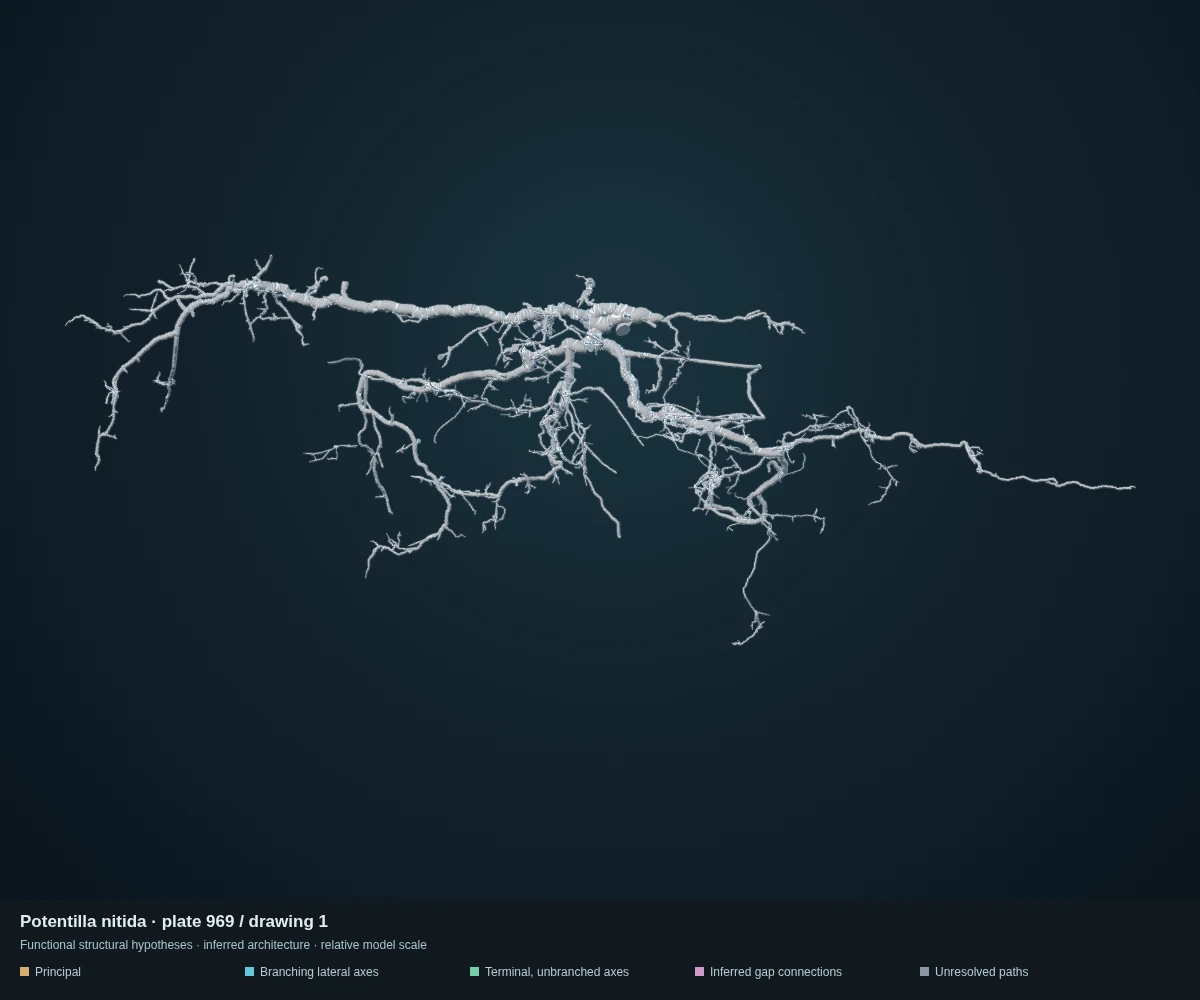
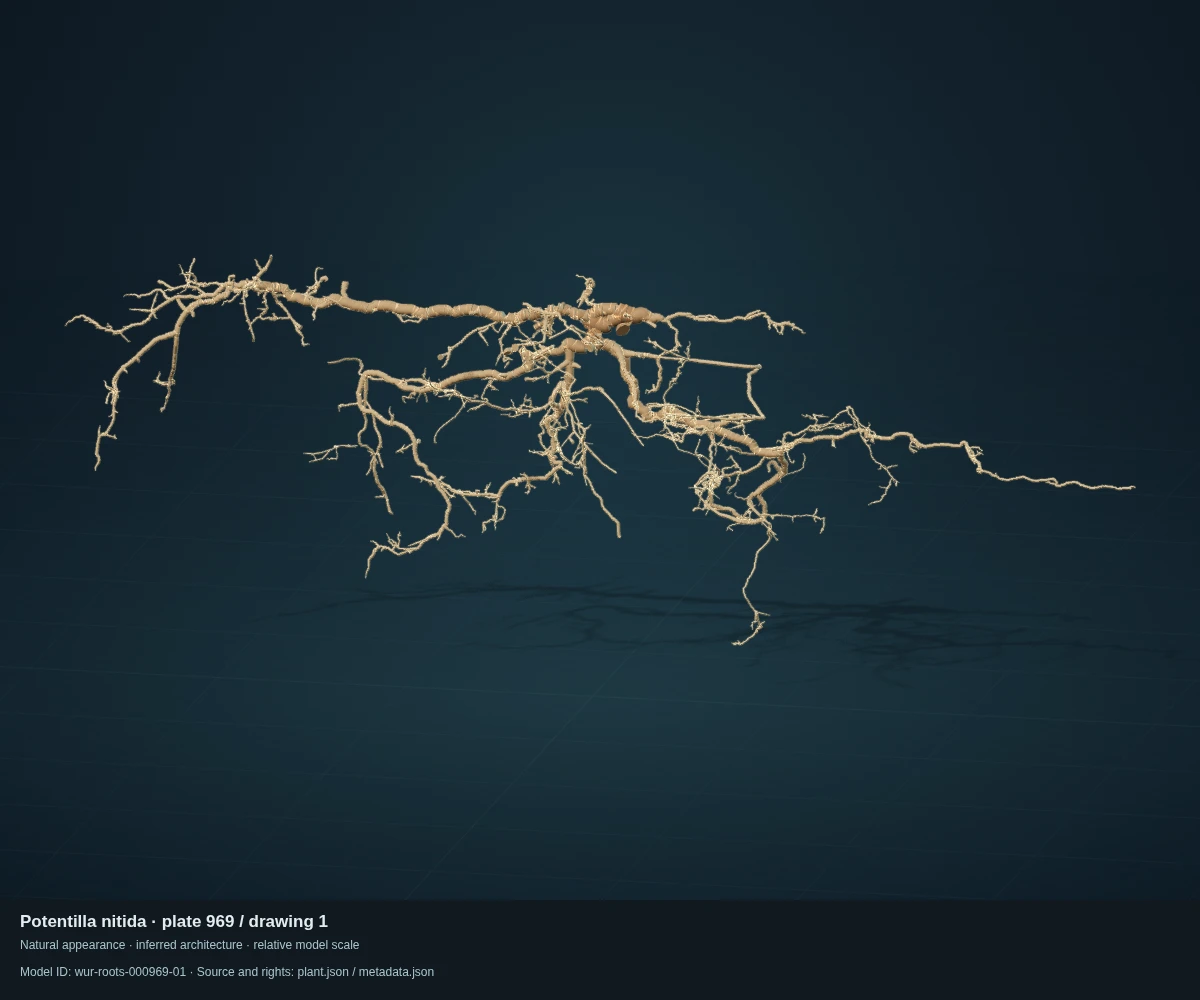
- Coarse roots descend from each flat cushion; very long rightward courses cross and interleave with sparse finer branches.
- Long coarse roots overlap in projection without a clear connecting join at crossings.
Biologically constrained spatial reconstruction from source morphology. Root azimuths, hidden placement, growth responses, circular sections, thickness and proposed connections are inferred. The separate source trace retains exact drawing coordinates. No measured 3D anatomy or observed growth sequence is claimed.
Source and attribution
Study 969 · Model 01
Potentilla nitida · Wageningen University & Research archive