- Source projection
- Compound plate
- Calibration
- Ambiguous scale
- Vertical extent
- 0.277 model units
- Inferred axes
- 427
Model metrics and plate observations
Model metrics
No metric calibration; values are in normalized model coordinates.
- Vertical extent
- 0.277 model units
- Horizontal span (x)
- 0.993 model units
- Horizontal span (z)
- 0.24 model units
- Centreline length
- 7.43 model units
- Inferred axes
- 427
- Branching sites
- 414
- Terminal paths
- 424
- Mean modelled diameter
- 0.00271 model units
- Surface area proxy
- 0.0634 model units²
- Volume proxy
- 0.0000724 model units³
- Inferred connection length
- 0 model units
- Projected length
- 7.43 model units
- Mean angle from vertical
- 60.4°
Dimensions reported on the source plate
- Plant height
- 21 cm plate_658
- Root depth
- 8 cm plate_658
- Root-system diameter
- 29 cm plate_658
Drawing observations
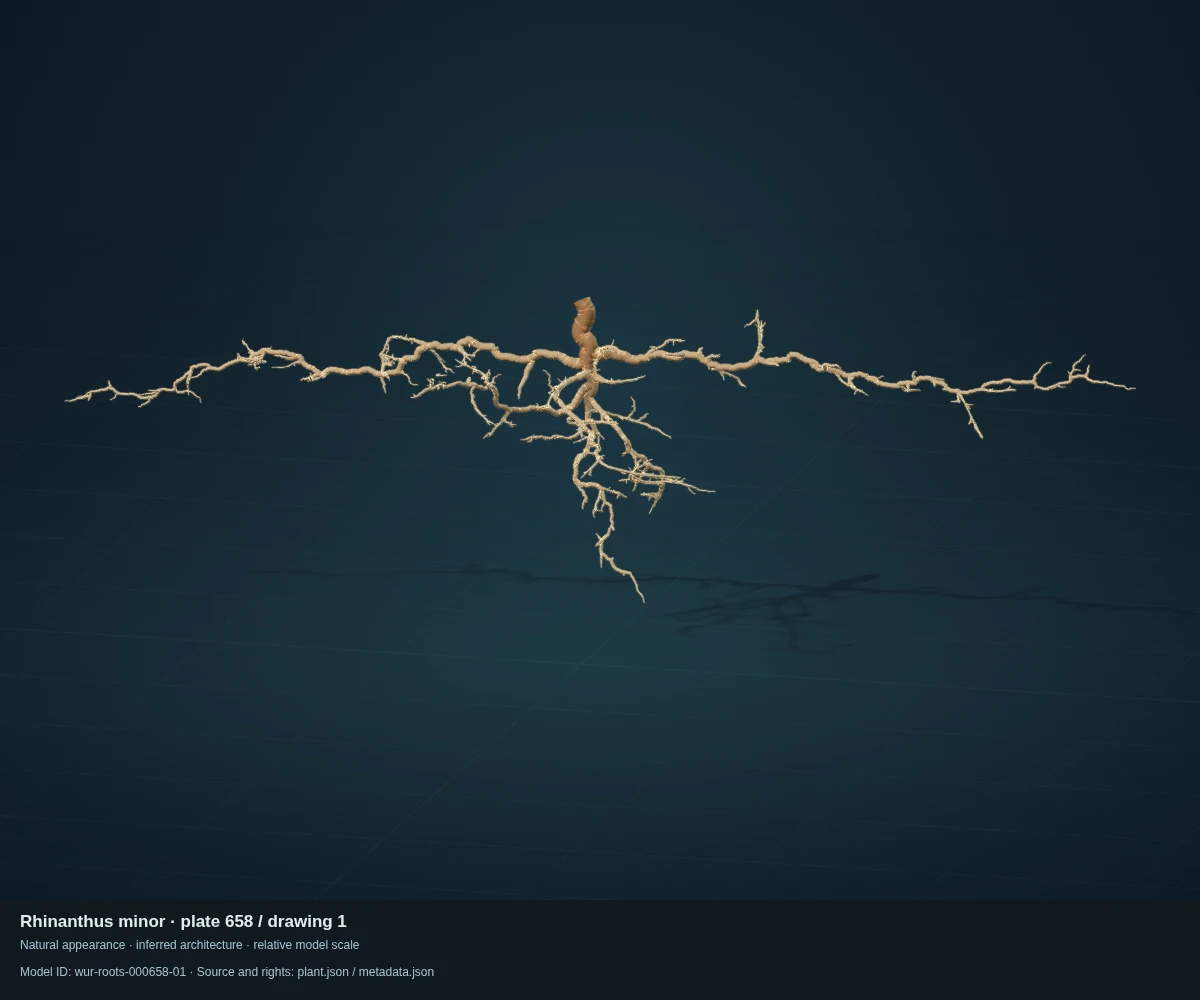
- One tall flowering broad-leaved shoot and two small narrow-bladed companion views share a shallow root drawing.
- A central descending root gives off long upper side paths; small roots occur beneath both flanking shoot bases.
- The lateral paths spread widely, with a shorter central descending group.
- Fine short branches and forks occur along the shallow roots; apparent contacts with side-root portions require native inspection.
- Small darkened contact-like marks occur where coarse side paths meet or cross fine roots beneath the two flanking shoot regions; the marks alone do not establish anatomical fusion or a biological interaction.
- A strong central root descends below the stem.
- Long shallow side roots spread toward both flanking depicted regions, with a shorter central descending group.
- Fine laterals and several small darkened contact-like marks accompany the coarse paths.
- Several small roots descend from the compact base.
- A fine descending path meets or crosses the long shallow coarse root at a small darkened mark.
- Fine short branching occurs around the small root fan.
- A fine root descends beneath the small basal stem.
- The path crosses a long shallow coarse root at a small darkened mark.
- Short fine laterals occur along the descending root.
Biologically constrained spatial reconstruction from source morphology. Root azimuths, hidden placement, growth responses, circular sections, thickness and proposed connections are inferred. The separate source trace retains exact drawing coordinates. No measured 3D anatomy or observed growth sequence is claimed.
Source and attribution
Study 658 · Model 01
Rhinanthus minor · Wageningen University & Research archive