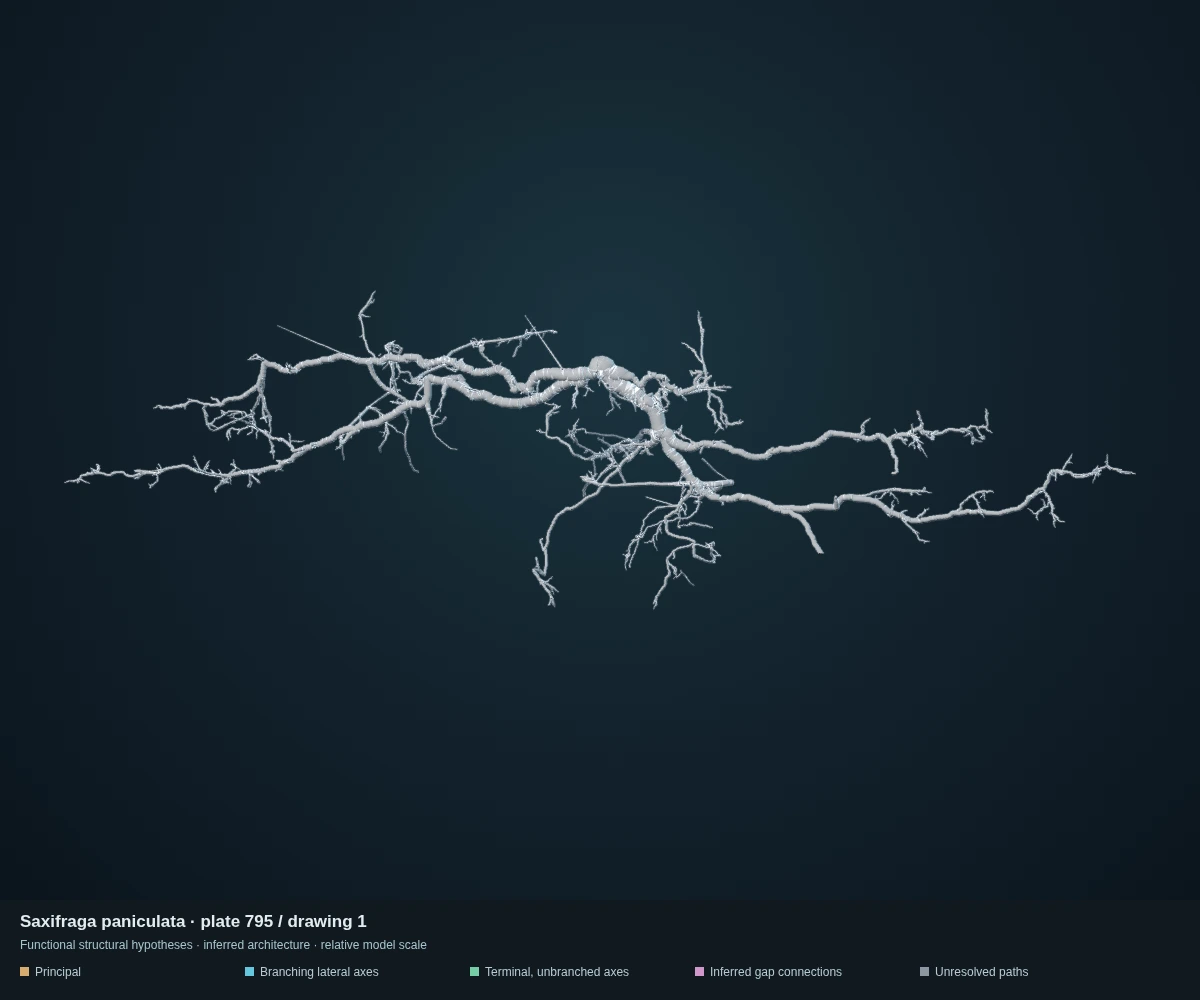
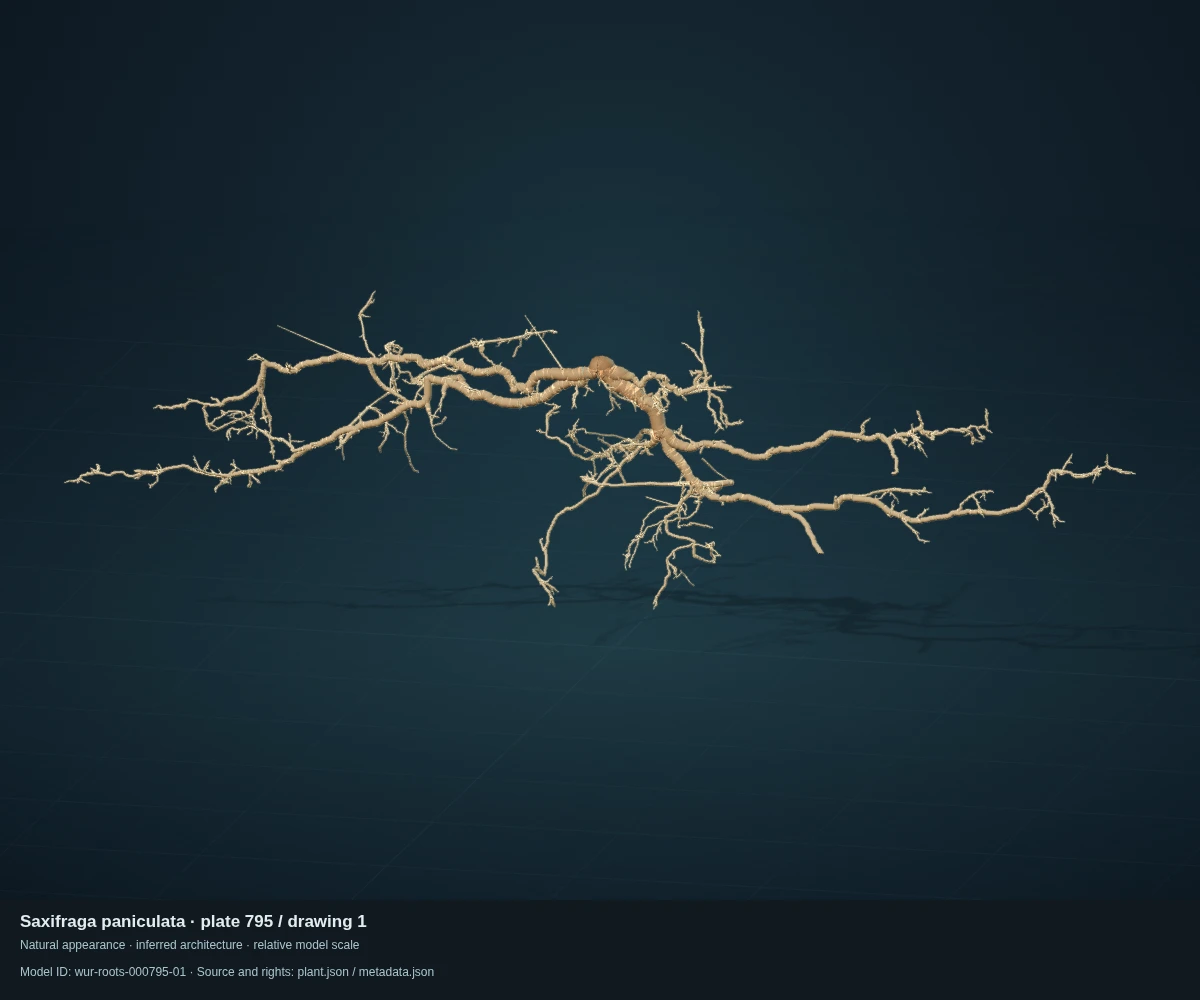
- Source projection
- Compound plate
- Calibration
- Ambiguous scale
- Vertical extent
- 0.28 model units
- Inferred axes
- 961
Model metrics and plate observations
Model metrics
No metric calibration; values are in normalized model coordinates.
- Vertical extent
- 0.28 model units
- Horizontal span (x)
- 0.998 model units
- Horizontal span (z)
- 0.219 model units
- Centreline length
- 13.8 model units
- Inferred axes
- 961
- Branching sites
- 891
- Terminal paths
- 907
- Mean modelled diameter
- 0.0025 model units
- Surface area proxy
- 0.11 model units²
- Volume proxy
- 0.000127 model units³
- Inferred connection length
- 0 model units
- Projected length
- 13.8 model units
- Mean angle from vertical
- 59.8°
Drawing observations
- Strong roots descend beneath several separated crown regions.
- Long lateral paths overlap across the page, forming a wide shallow field with deeper local branches.
- Fine forks form separated clusters on long sparsely branched coarse roots.
- A slender strong root descends beneath the small crown.
- Its longer left and downward paths interdigitate with projected roots from the middle region.
- A textured root descends beneath the middle rosette group.
- Several long coarse paths bend outward and cross projected paths from neighboring regions.
- Strong curved roots descend beneath several positions in the right crown group.
- Long laterals and lower paths overlap the middle field; crossing strokes do not establish biological connection.
Biologically constrained spatial reconstruction from source morphology. Root azimuths, hidden placement, growth responses, circular sections, thickness and proposed connections are inferred. The separate source trace retains exact drawing coordinates. No measured 3D anatomy or observed growth sequence is claimed.
Source and attribution
Study 795 · Model 01
Saxifraga paniculata · Wageningen University & Research archive