Arbor.guide

Botanical field guide

Pinus sylvestris

Scots pine

0895 / 2,347

Tree / Pinaceae

The plant, in detail

Light-demanding woodland pioneer, often on well-drained, relatively nutrient-poor soils.

Reference height
20–35 m
Foliage habit
Evergreen
USDA zones
2–7
Light
Not documented

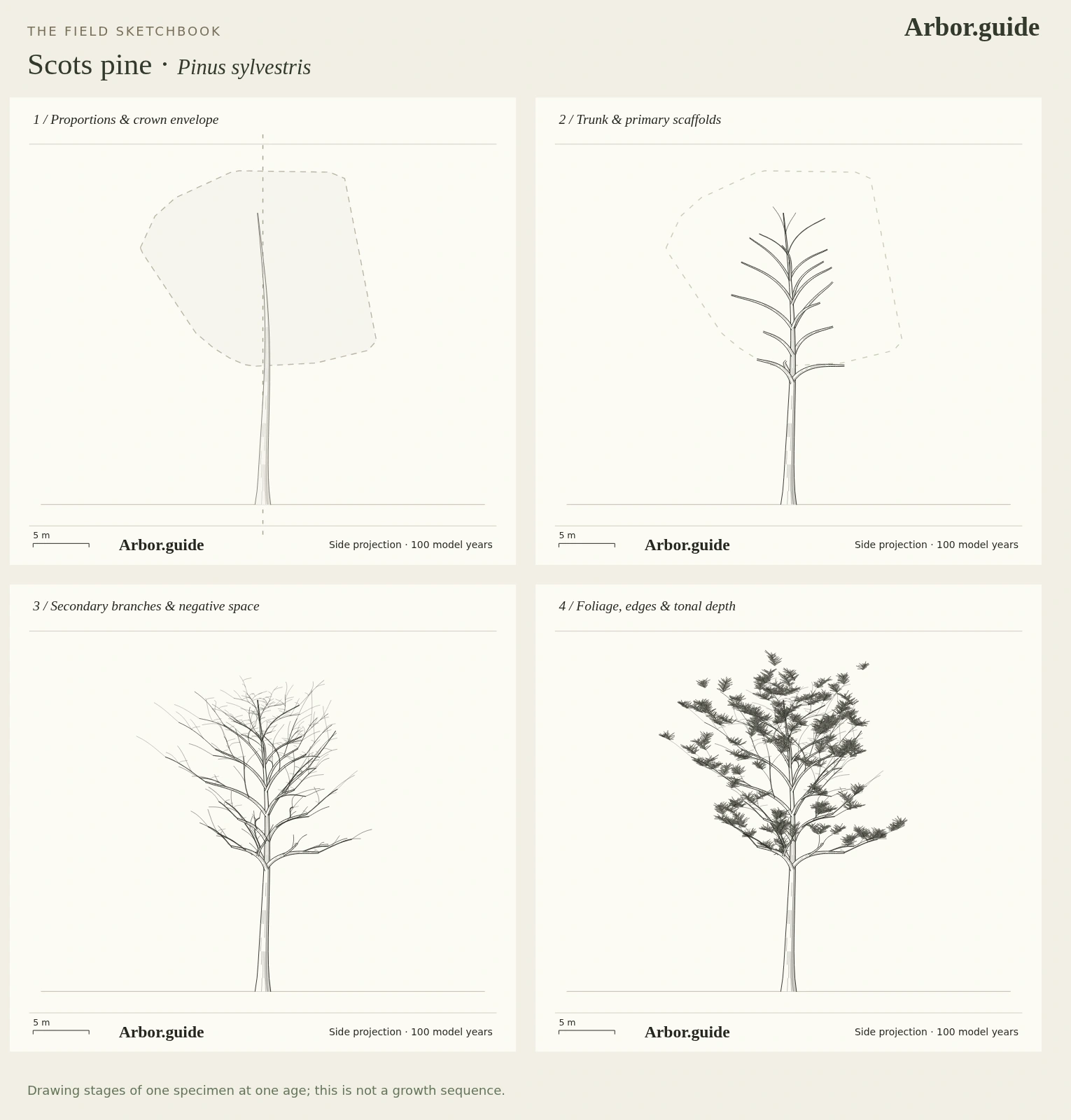
The growing reconstruction extends one ArborAI framework; it does not simulate every annual flush, dormant bud, branch death, injury or pruning response. Juvenile and mature crown forms vary with growing space. Model age is not a branch-order clock or a forestry yield forecast.

Crown

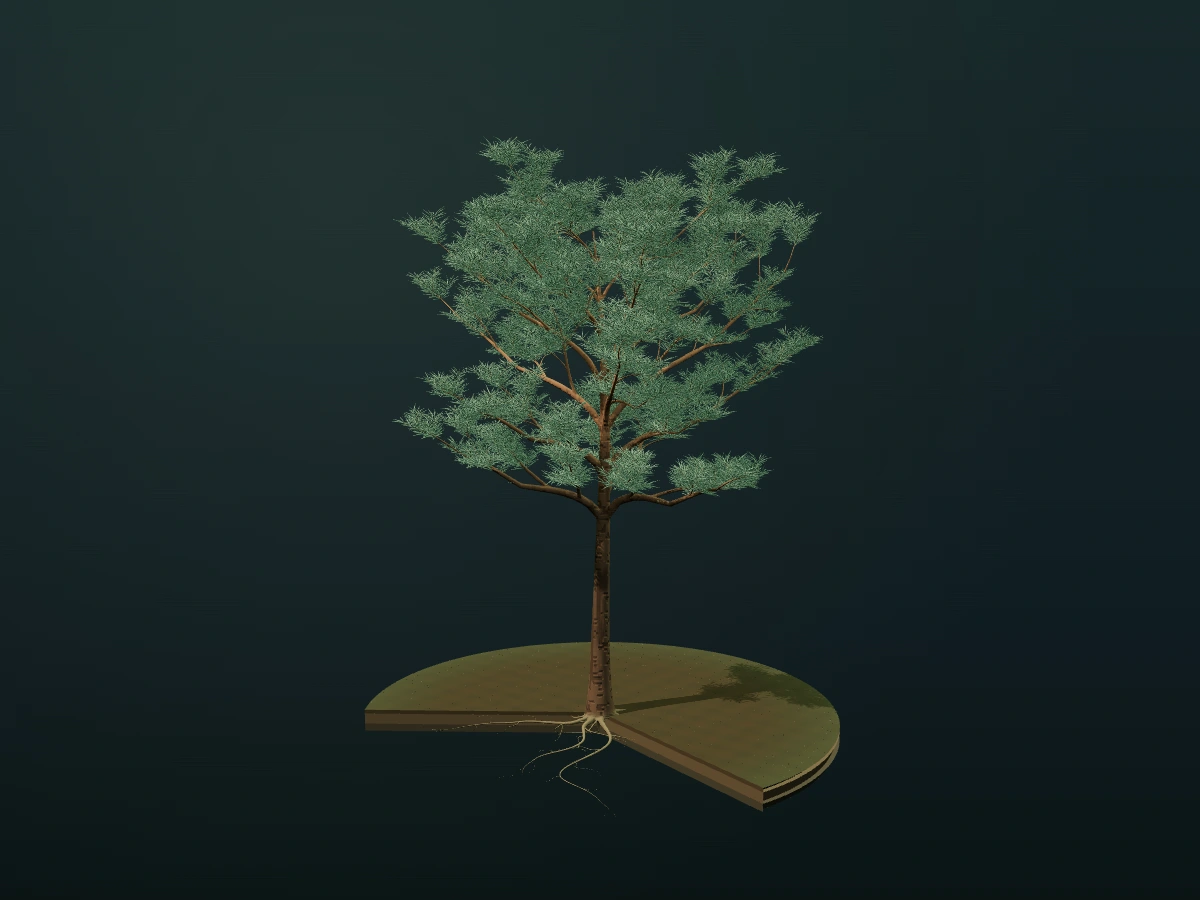
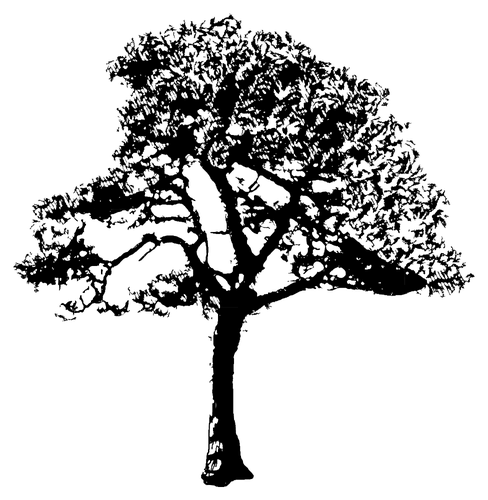
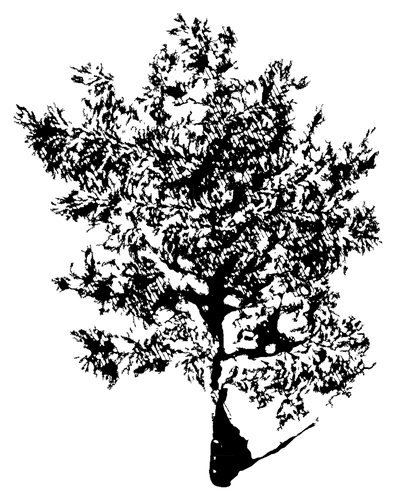
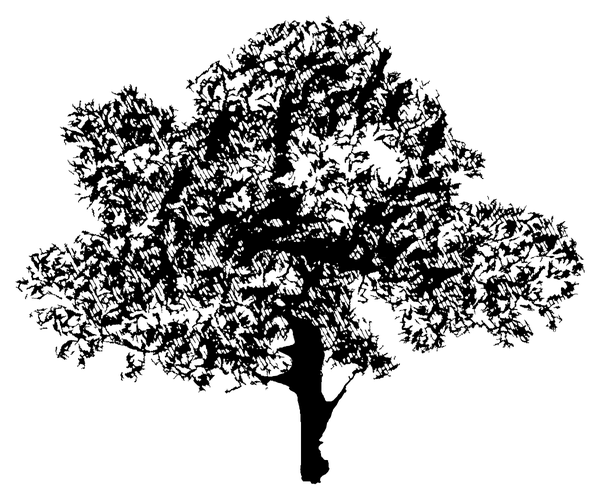
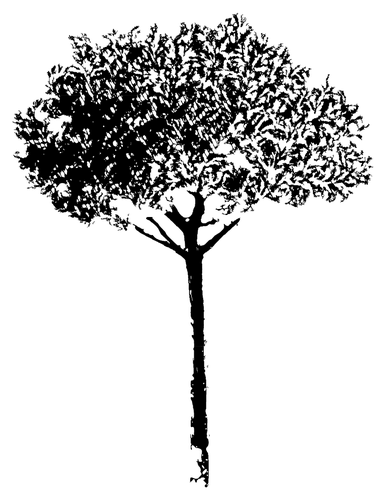
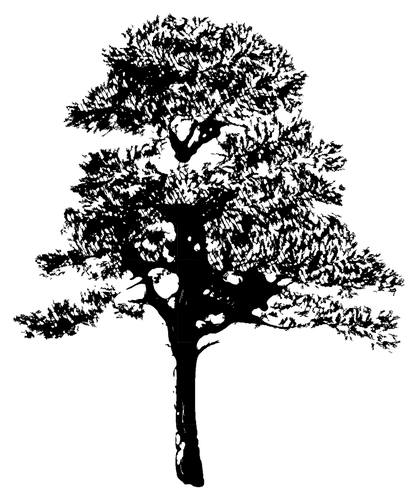
The juvenile crown is conical around a dominant leader. Mature trees often have a high, open, irregular crown, especially after shaded lower branches die. Open-grown trees may retain a much broader crown.

Branching

Clustered lateral shoots develop near extension tips. The dominant young leader and recognizable branch groups become less regular as limbs survive and extend unequally. Visible whorls are not an exact age clock for mature trees.

Bark

Orange to cinnamon, flaking bark is conspicuous high on the trunk and branches. The lower trunk develops darker, thicker, furrowed bark. Showing the entire mature trunk as white or smooth would miss a key character.

Roots

Permeable soils can support a strong descending axis and sinker roots from laterals. Waterlogging, rock or compact layers restrict depth and redirect growth. Fine roots occupy suitable soil patches rather than filling a uniform underground cone.

The shape of growth

Stylized real-world examples

  • Tree silhouette 1
  • Tree silhouette 2
  • Tree silhouette 3
  • Tree silhouette 4
  • Tree silhouette 5

Silhouettes are sized independently.

Root studies

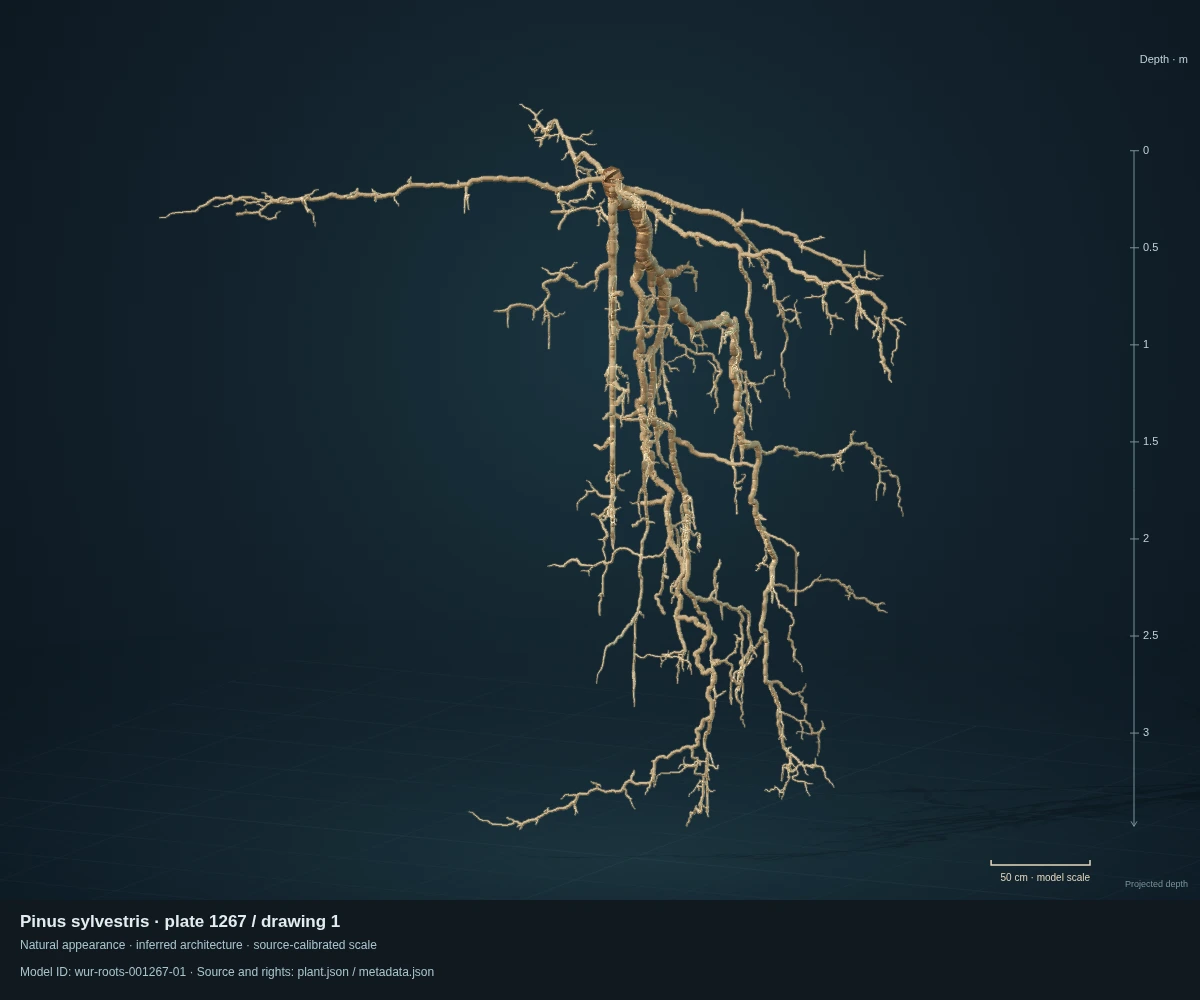
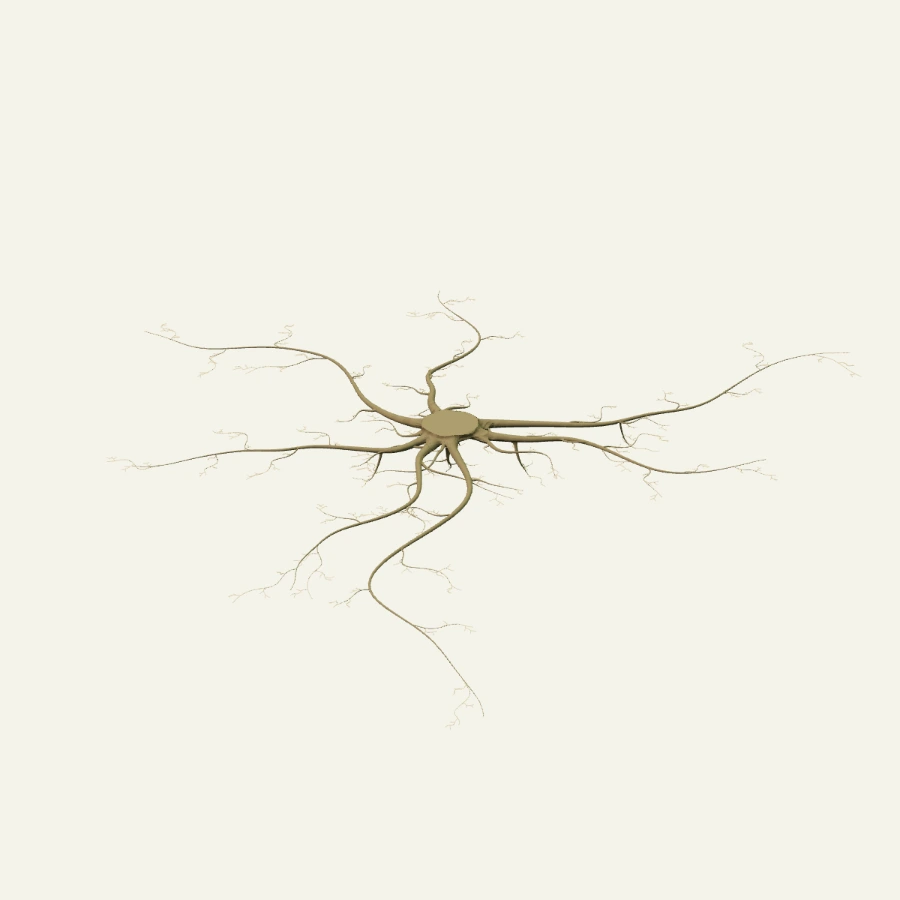
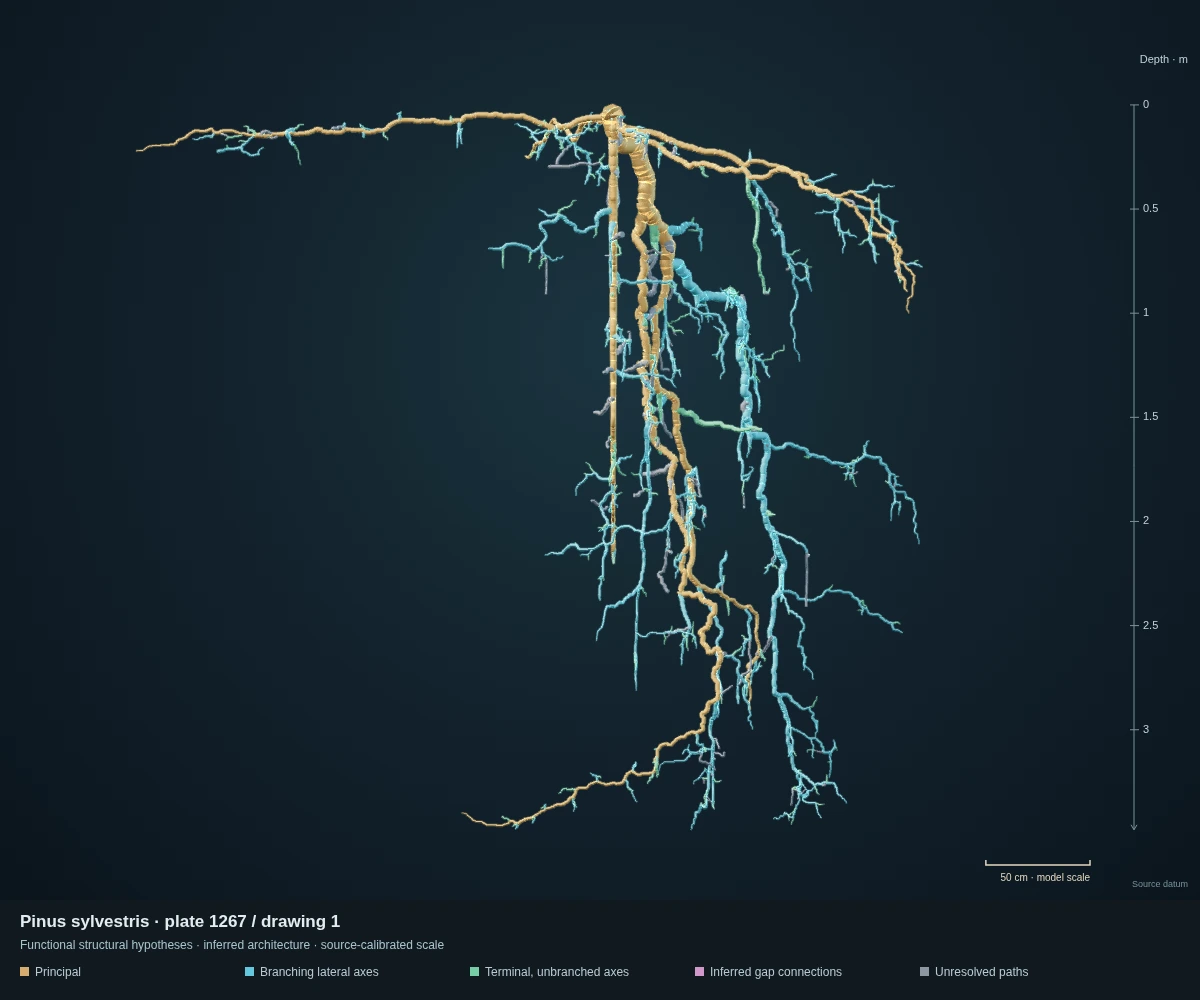
These reconstructions follow archived root drawings. Colour identifies the modelled structural role of each root.

Functional view
Natural view
Source projection
Side view
Calibration
Source-calibrated
Vertical extent
3.47 m
Inferred axes
625
Model metrics and plate observations

Model metrics

Depth follows the printed scale. Equal horizontal scale and hidden depth are modeling assumptions; root thickness is illustrative.

Vertical extent
3.47 m
Horizontal span (x)
3.71 m
Horizontal span (z)
3.28 m
Centreline length
92.4 m
Inferred axes
625
Branching sites
599
Terminal paths
603
Mean modelled diameter
1.55 cm
Surface area proxy
4.56 m²
Volume proxy
28,100 cm³
Inferred connection length
0 cm
Projected length
86.6 m
Mean angle from vertical
47.1°

Dimensions reported on the source plate

Plant height
225 cm plate_1267
Root depth
346 cm plate_1267
Root-system diameter
415 cm plate_1267

Drawing observations

  • approximately horizontal
  • lateral groups at separated levels
  • thick axis continues downward from stem before tapering and branching
  • long near horizontal and oblique roots to both sides
  • several long descending axes with side branches at multiple depths
  • turns strongly right near 150 cm level
  • several long axes extend below 300 cm tick
  • predominantly to right of stem axis
  • localized groups separated by long less branched axis sections

Biologically constrained spatial reconstruction from source morphology. Root azimuths, hidden placement, growth responses, circular sections, thickness and proposed connections are inferred. The separate source trace retains exact drawing coordinates. No measured 3D anatomy or observed growth sequence is claimed.

Source and attribution

Study 1267 · Model 01

Pinus sylvestris · Wageningen University & Research archive
02 / Seasons

Through the seasons

Four portraits. One plant.

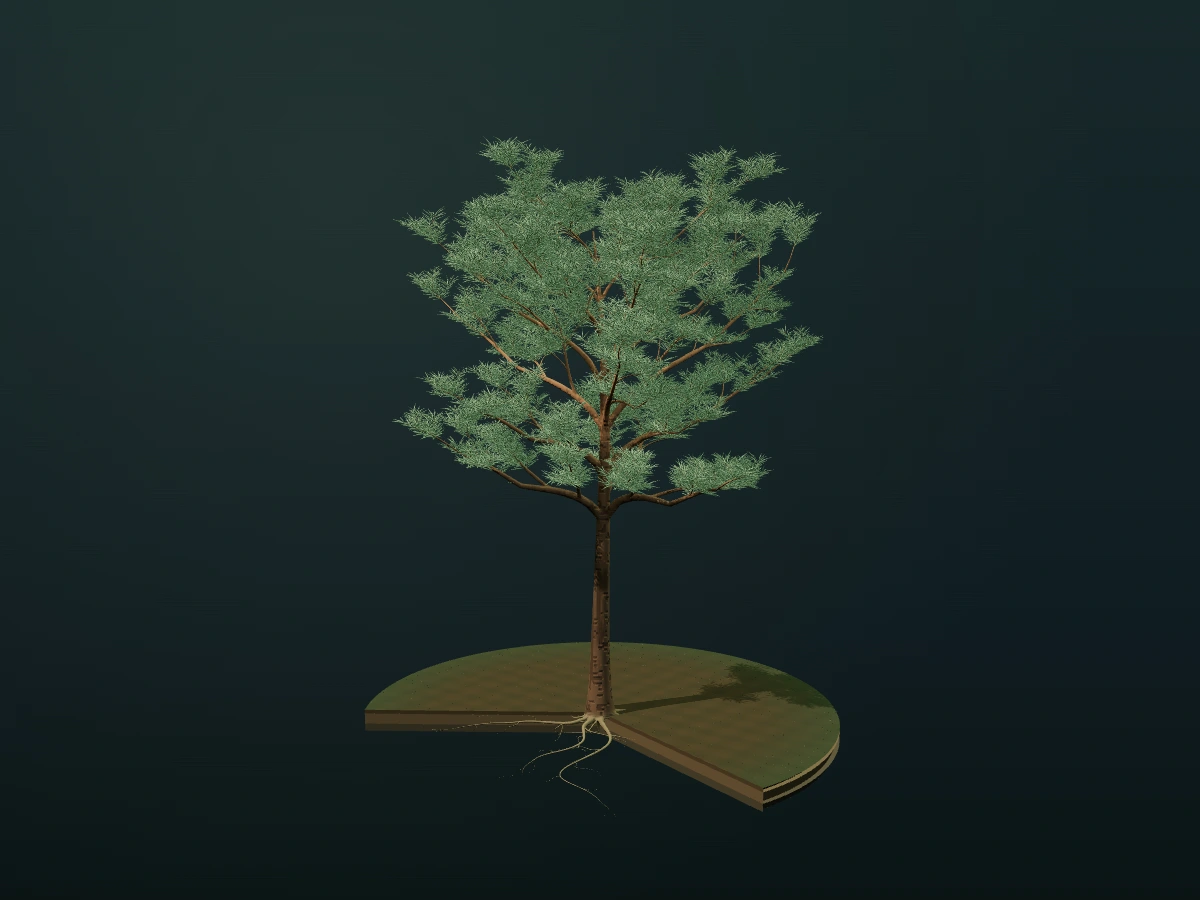
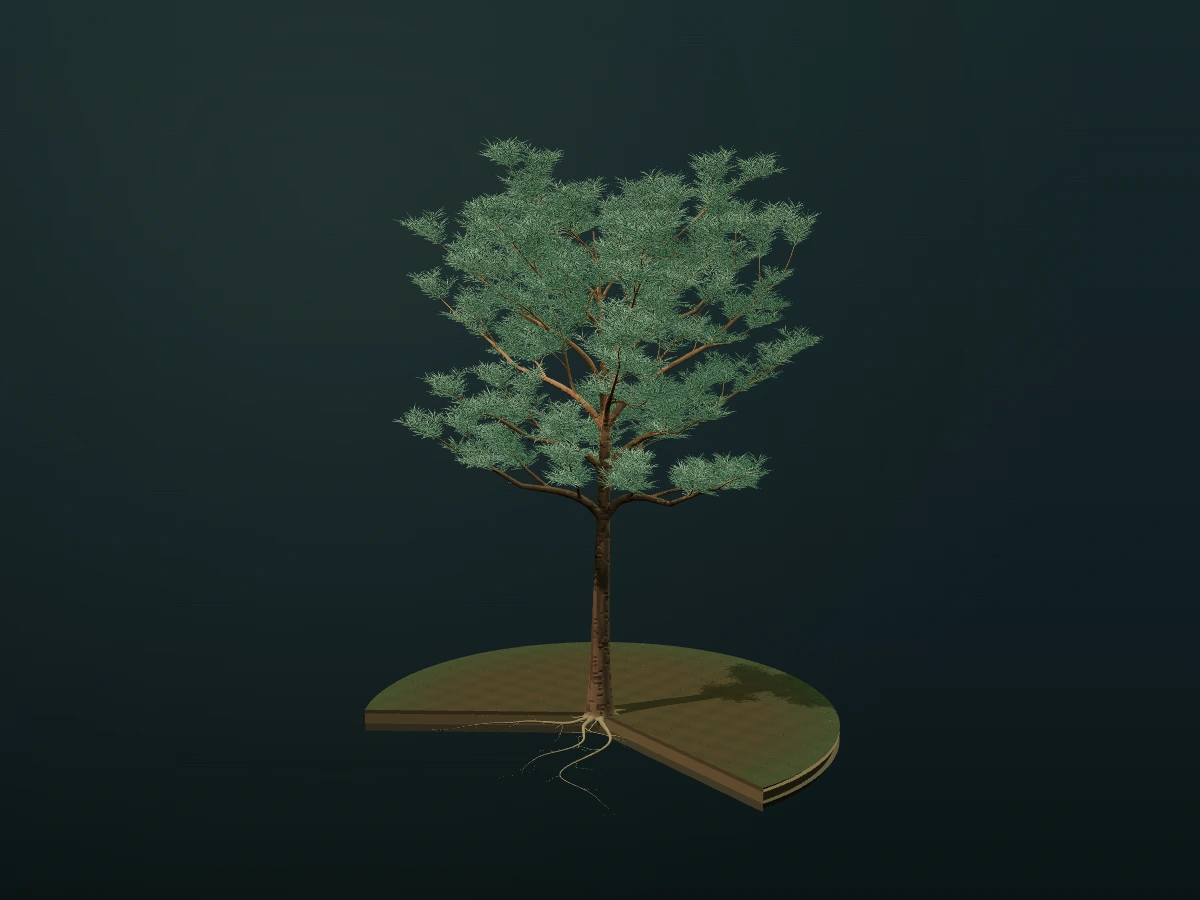
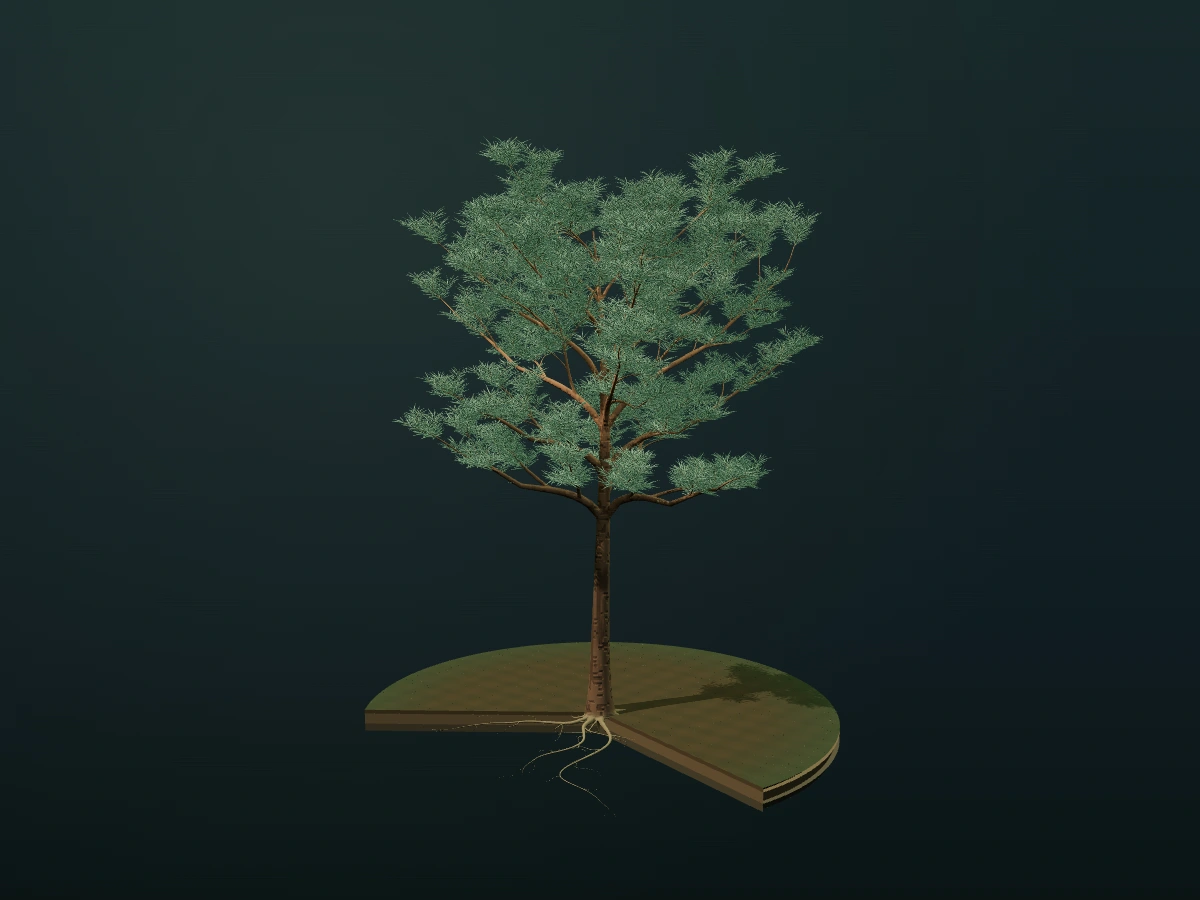
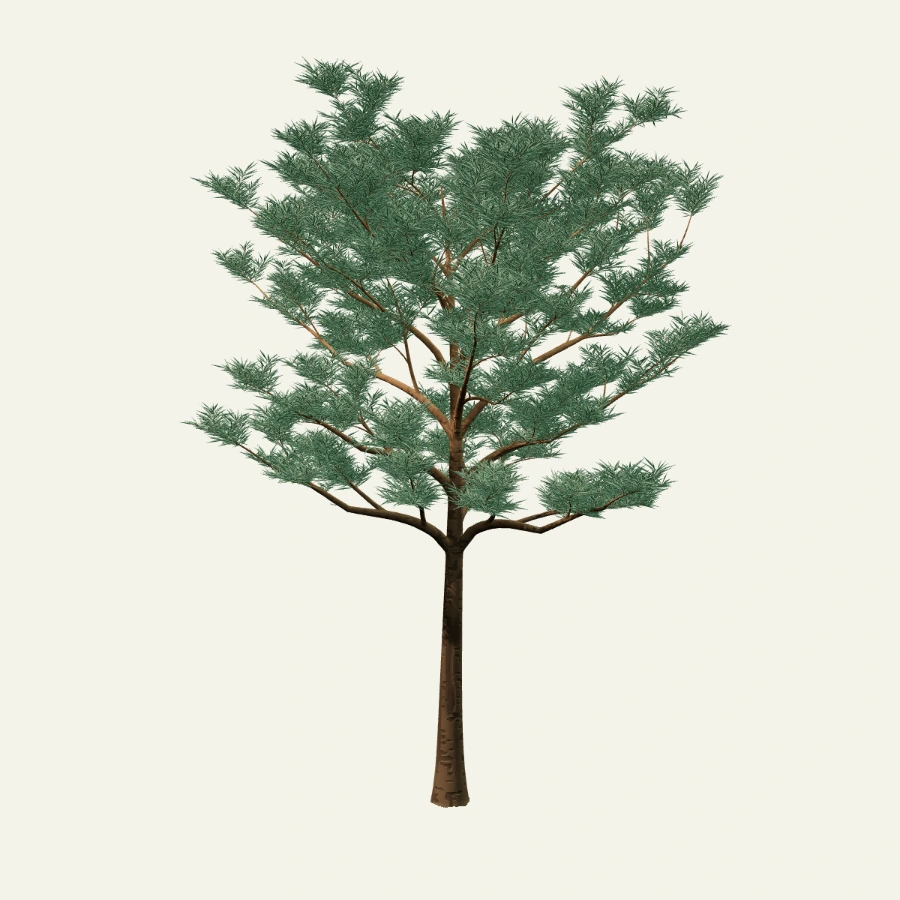
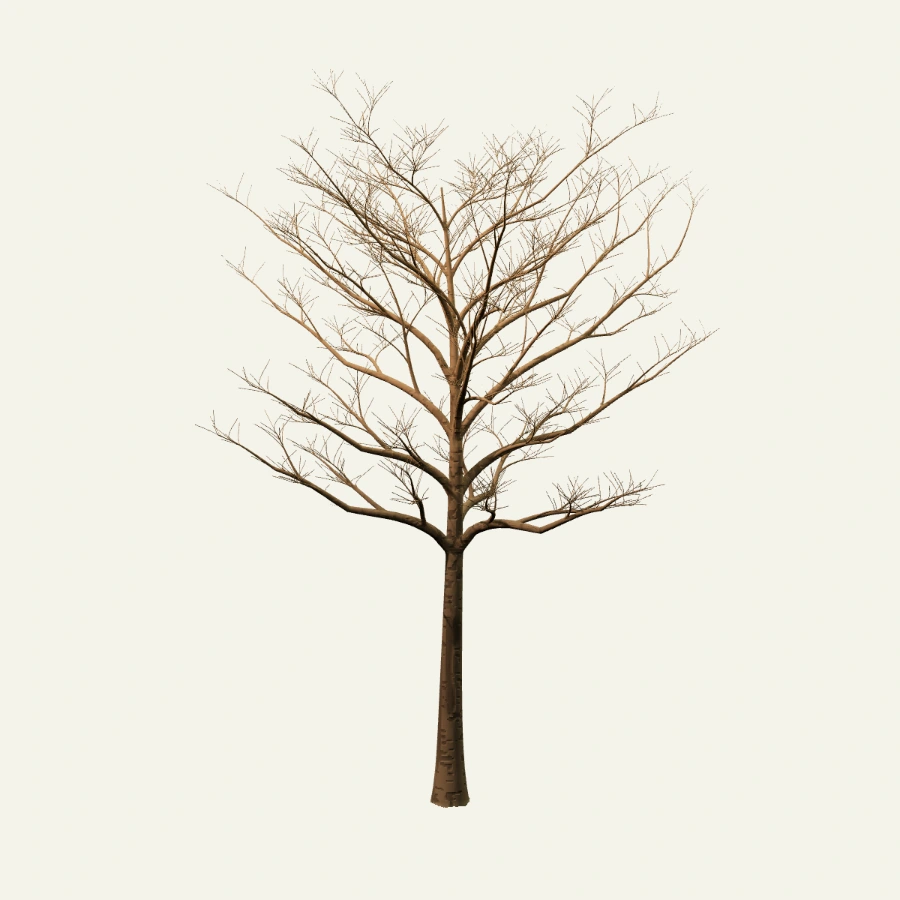
Read the crown, foliage and reproductive structures together. The four views compare seasonal appearances; the reference notes explain what is actually documented.

Seasonal illustration; the same plant, age and camera across four views.

Seasonal record

North Carolina botanical account

Flowering
This is a gymnosperm. Seeds and/or cones are its reproductive structures; they are not flowers or botanical fruits.[2]
Seed / cone development
Autumn[1]

Leaf renewal

Evergreen[1]

A green canopy can persist while individual leaves age and are replaced. Evergreen does not mean that every leaf lasts indefinitely or that flowering and fruiting are continuous.

Reading these views

Season names organize these four views, not a universal calendar. Hemisphere, local climate, cultivar and management can change timing; months are shown only when explicitly recorded.

The views emphasize crown structure. Buds, small flowers, individual retained leaves and fine reproductive changes may be unresolved; model age and fruit count are not production forecasts.

No separate on-tree fruit display is configured for this record.

Seasonal references

  1. NC State Extension · Scots pine ↗plants.ces.ncsu.edu
  2. Forest Research · Scots pine ↗www.forestresearch.gov.uk
  3. www.conifers.org ↗www.conifers.org

03 / Foliage

A closer look at the organs

Leaves

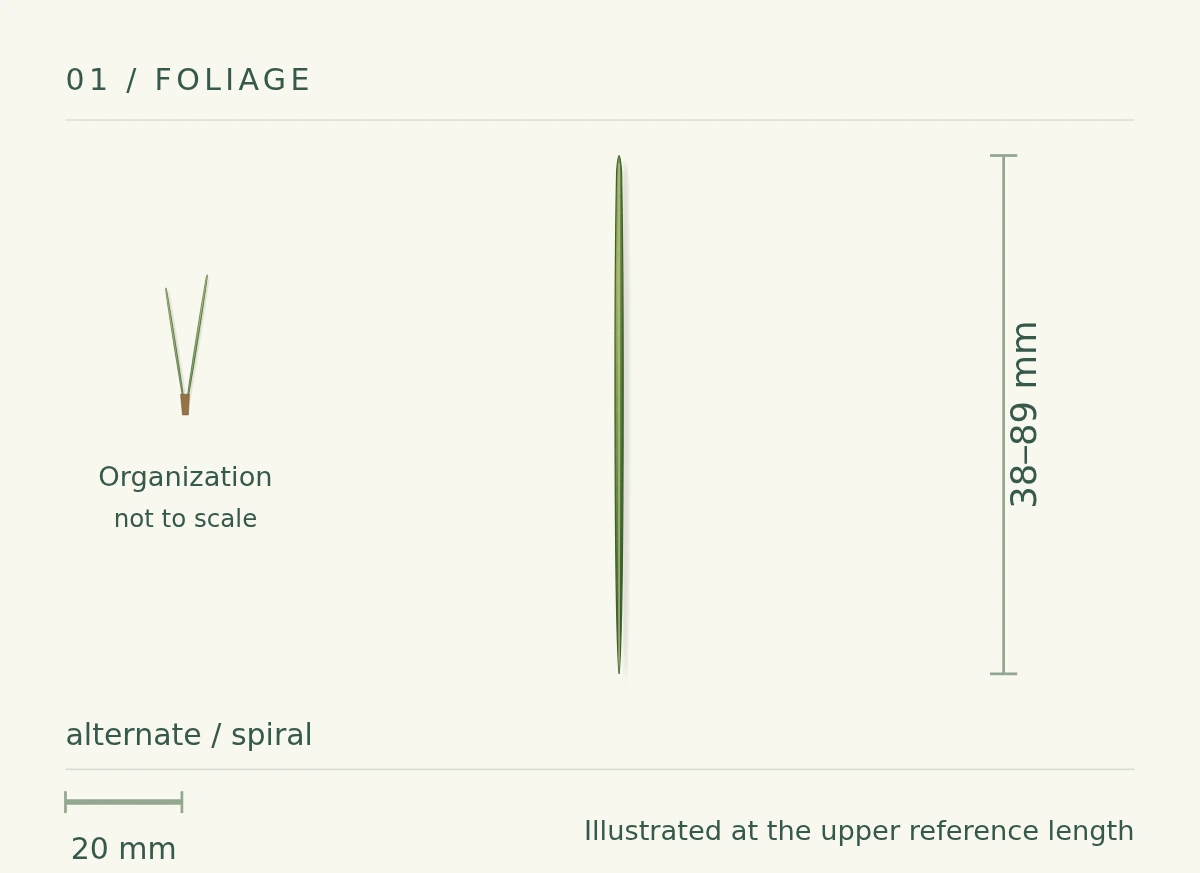
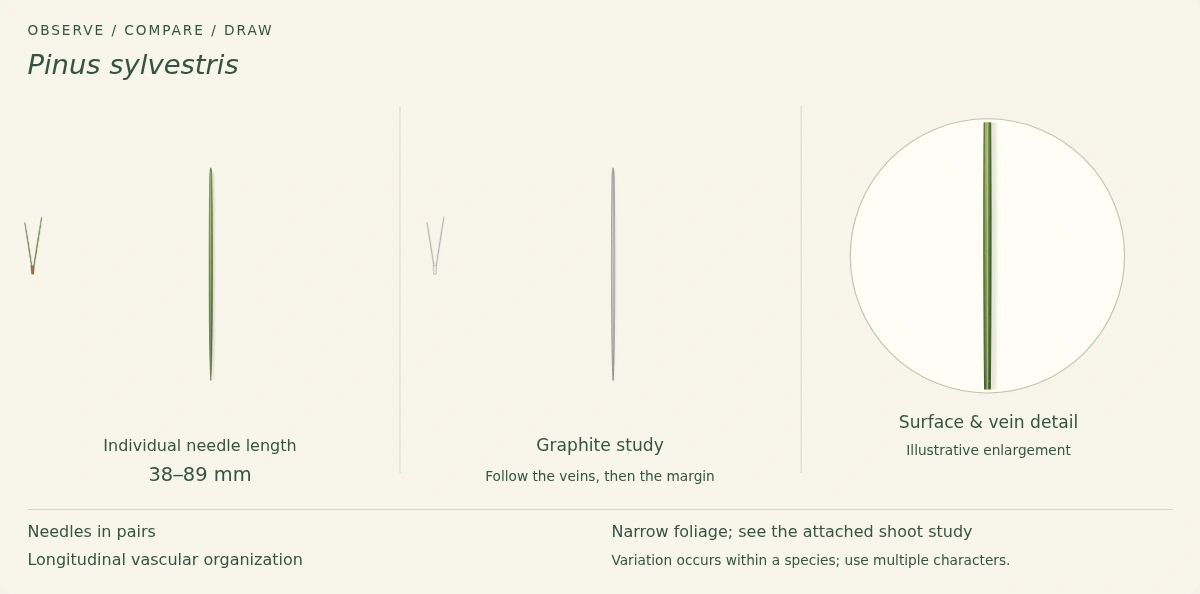
Individual needle length
38–89 mmSource notes

Short, often twisted blue-green needles occur in pairs within a fascicle. Multiple needle cohorts coexist; evergreen means the tree retains foliage across seasons, not that each needle is permanent.

Needles in pairs · Narrow foliage; see the attached shoot study · Longitudinal vascular organization · alternate / spiral

Seasonal notes

A green crown persists while older leaf cohorts are replaced. The small ochre patches illustrate turnover; their size and timing are not measured.

04 / Fruit & seed

Named structures, separate scales

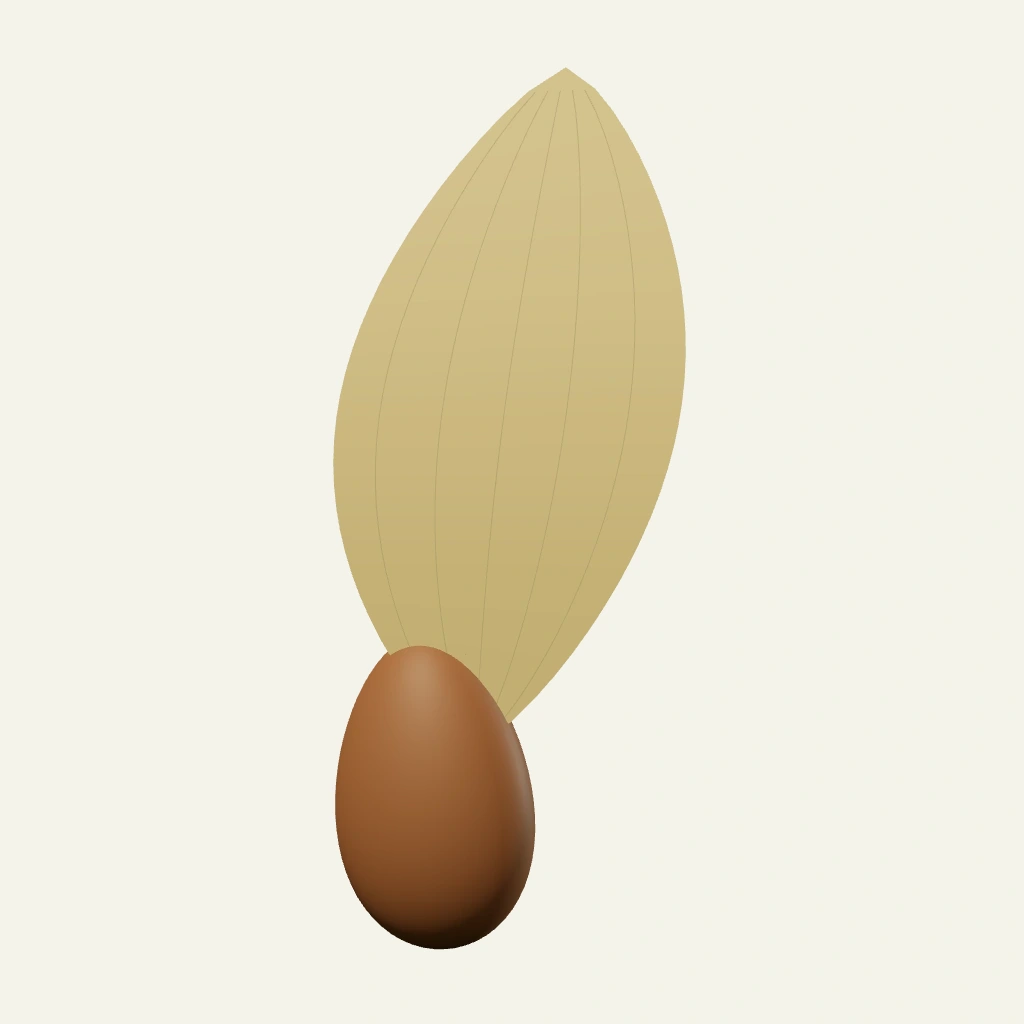
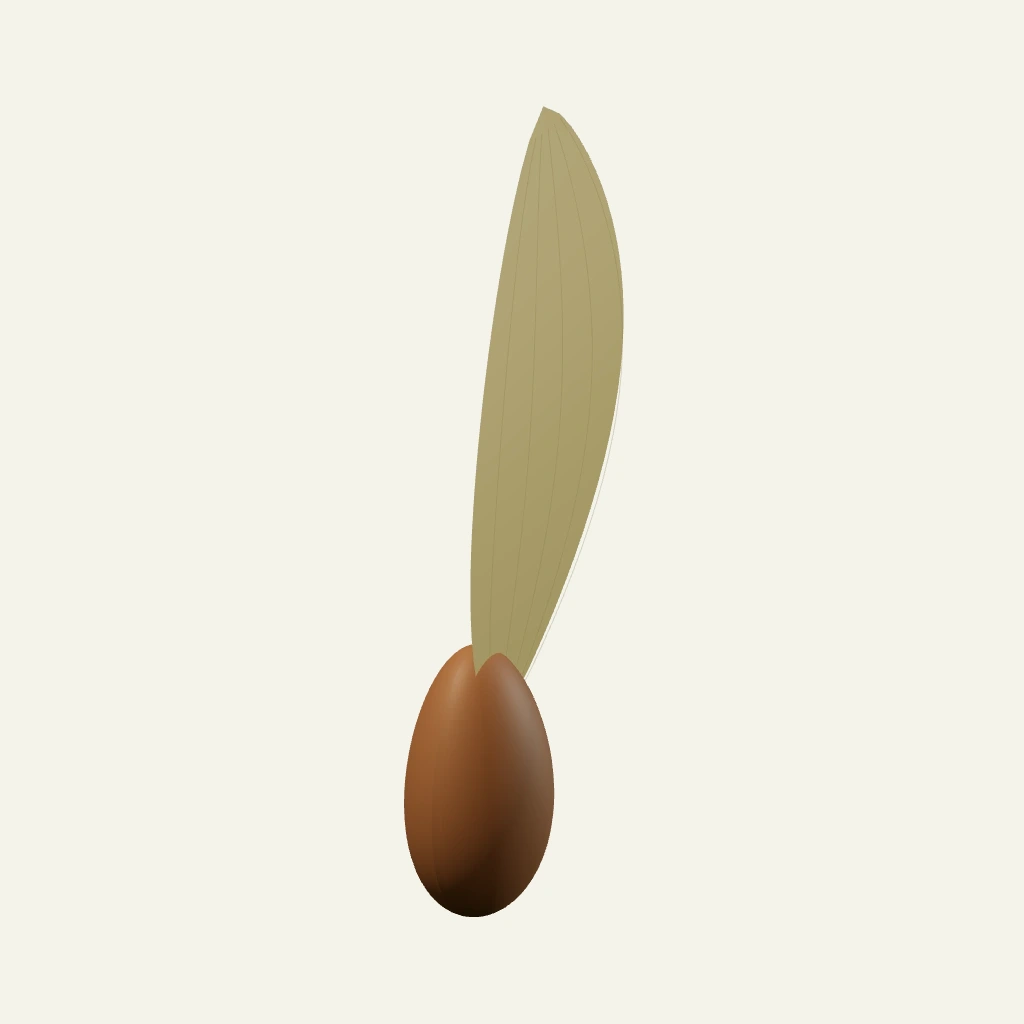
Seed

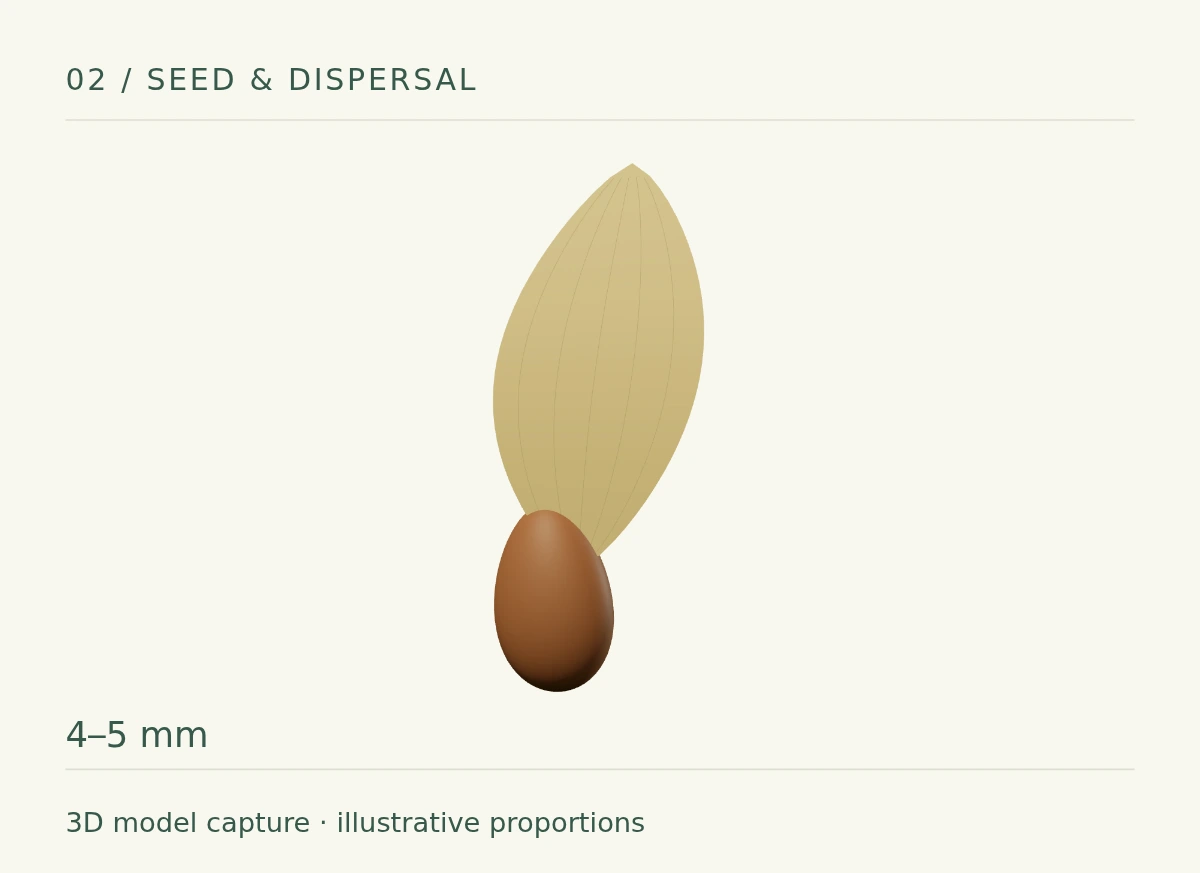
Seed body length
4–5 mmSource notes

The papery wing aids dispersal. The seed body is the compact darker part.

Fruiting reference
Autumn

North Carolina botanical account

Organs are enlarged independently. Refer to the named measurement, not image size.

05 / Habitat

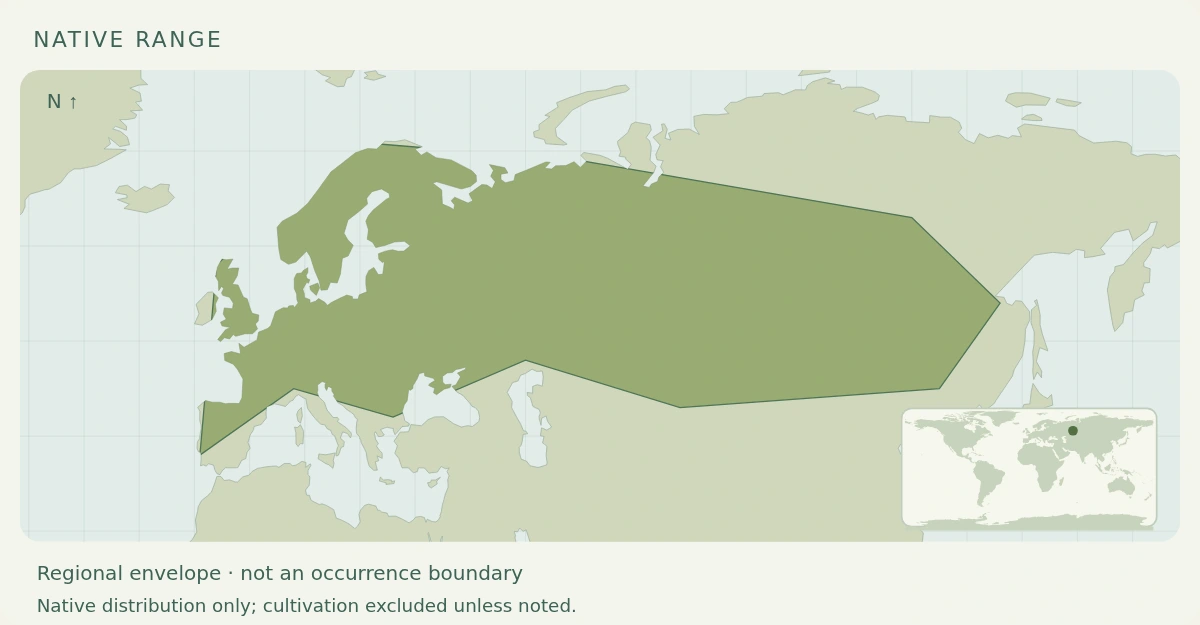
Native range & growing context

Native range & growing context

A broad Eurasian range, from Scotland and Iberia across northern Europe into Asia.

Reference spread
Not documented
Moisture
Not documented
Growth tendency
Moderate
Life span
Can live for several centuries; longevity varies strongly with site.

Regional context, not a measured occurrence or suitability map.

06 / Sources & interpretation

Read the evidence behind the illustration

Names & classification

Family
Pinaceae
Genus
Pinus
Synonyms
—
  • Needles occur in pairs, unlike the individually attached needles of spruce.
  • An orange upper trunk is a useful field character.
  • Seed provenance and local site conditions materially influence growth and form.

The growing reconstruction extends one ArborAI framework; it does not simulate every annual flush, dormant bud, branch death, injury or pruning response. Juvenile and mature crown forms vary with growing space. Model age is not a branch-order clock or a forestry yield forecast.

Source-informed teaching reconstruction. Scaffold groups, branch numbers, insertion positions, crown proportions and emergence schedules are ArborAI. Group counts are not annual whorls. Leaf fascicles follow the species description; foliage symbols are enlarged and sampled. Branch death, pruning and dormant-bud activation are not simulated.

  1. Forest Research · Scots pine ↗www.forestresearch.gov.uk
  2. NC State Extension · Scots pine ↗plants.ces.ncsu.edu
  3. European Commission JRC · Scots pine ↗forest.jrc.ec.europa.eu
  4. Forestry Commission · Root development ↗cdn.forestresearch.gov.uk
  5. Forestry Commission · Conifers · Scots pine, p. 49 ↗cdn.forestresearch.gov.uk
Plant data and references · 7
Native rangeA broad Eurasian range, from Scotland and Iberia across northern Europe into Asia.Transferred from the existing catalogue; independent botanical review remains pending.plants.ces.ncsu.edu
Leaf lengthmm[38, 89]Transferred from the existing catalogue; independent botanical review remains pending.plants.ces.ncsu.edu
Seed lengthmm[4, 5]Transferred from the existing catalogue; independent botanical review remains pending.www.conifers.org
Branching architectureClustered lateral shoots develop near extension tips. The dominant young leader and recognizable branch groups become less regular as limbs survive and extend unequally. Visible whorls are not an exact age clock for mature trees.Species-level habit; individuals, growing space, age and cultivars vary. This supports descriptive morphology, not the procedural coordinates or timing.plants.ces.ncsu.edu · cdn.forestresearch.gov.uk
Crown architectureThe juvenile crown is conical around a dominant leader. Mature trees often have a high, open, irregular crown, especially after shaded lower branches die. Open-grown trees may retain a much broader crown.Species-level habit; individuals, growing space, age and cultivars vary. This supports descriptive morphology, not the procedural coordinates or timing.plants.ces.ncsu.edu
Reference phenologycategory{"flowering": {"seasons": ["spring"]}, "fruiting": {"seasons": ["autumn"]}, "reference": "North Carolina botanical account", "source": "https://plants.ces.ncsu.edu/plants/pinus-sylvestris/", "reviewed": "2026-10-16"}Regional observations. Fruit display may include persistence and is not automatically ripening. Missing dates remain unspecified. Independent botanical review remains pending.plants.ces.ncsu.edu
Usda hardinesscategory{"system": "USDA", "zones": [2, 7], "source": "usda-hardiness", "subzones": ["2a", "7b"]}Reported horticultural recommendation; winter minimum only, not a heat or overall suitability limitplants.ces.ncsu.edu