Arbor.guide

Urtica dioica

Common Nettle

Root studies

These reconstructions follow archived root drawings. Colour identifies the modelled structural role of each root.

Functional view
Natural view
Source projection
Top view
Calibration
Unresolved scale
Vertical extent
0.257 model units
Inferred axes
6697
Model metrics and plate observations

Model metrics

No metric calibration; values are in normalized model coordinates.

Vertical extent
0.257 model units
Horizontal span (x)
0.934 model units
Horizontal span (z)
0.998 model units
Centreline length
69.8 model units
Inferred axes
6697
Branching sites
5988
Terminal paths
6071
Mean modelled diameter
0.00256 model units
Surface area proxy
0.58 model units²
Volume proxy
0.000637 model units³
Inferred connection length
1.04 model units
Projected length
67 model units
Mean angle from vertical
77.1°

Dimensions reported on the source plate

Plant height
150 cm plate_155
Root depth
15 cm plate_155
Root-system diameter
128 cm plate_155

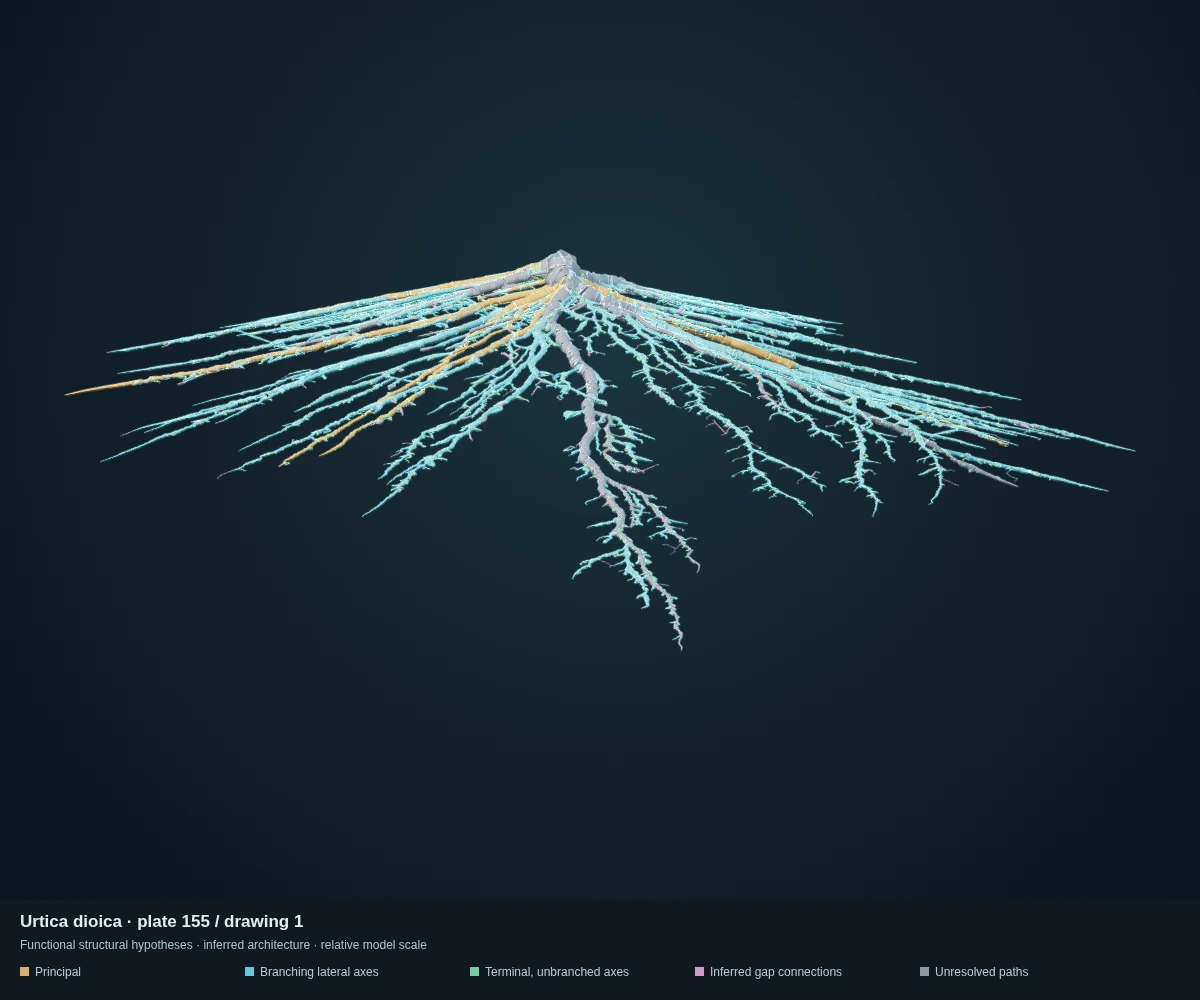
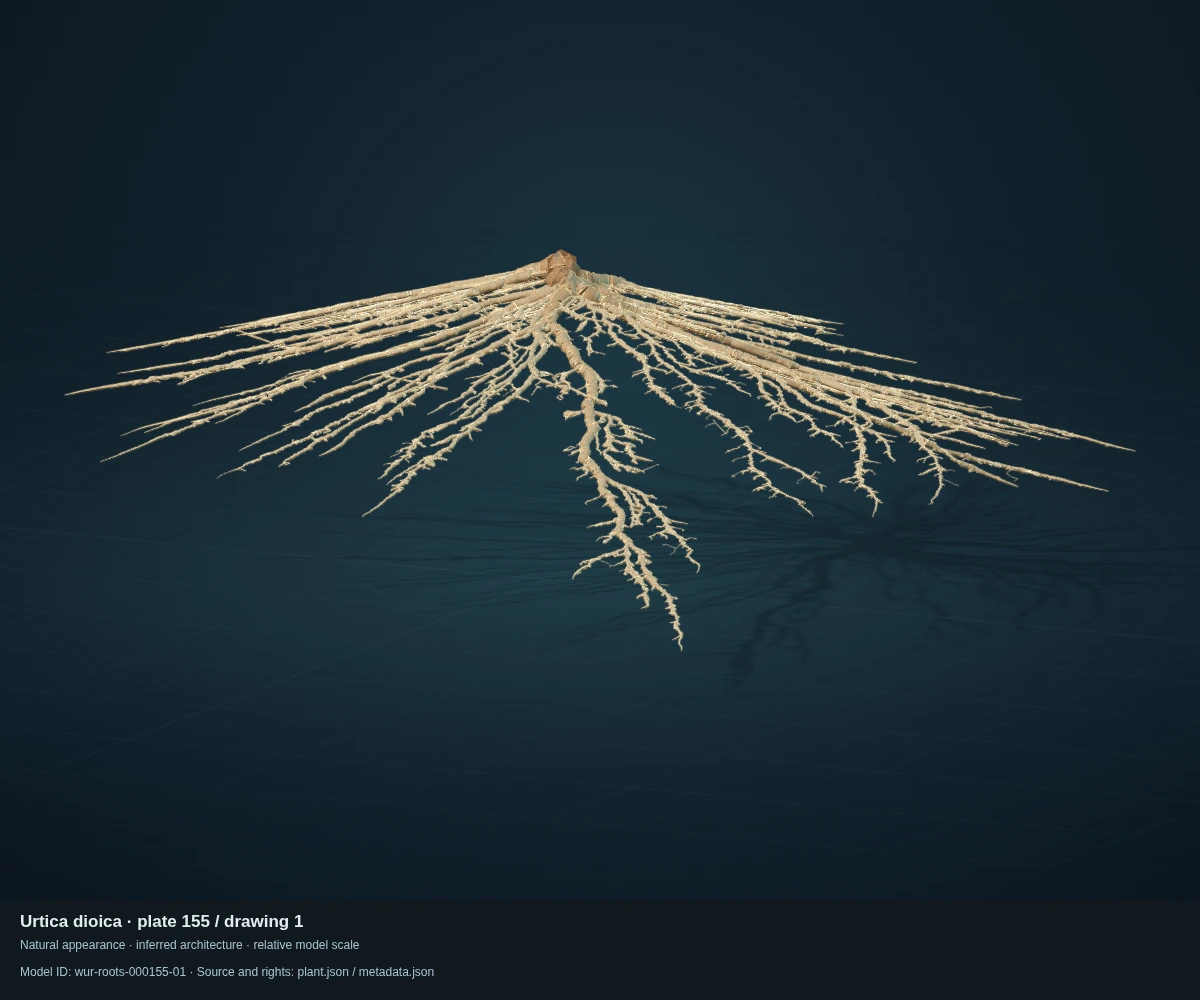
Drawing observations

  • thick continuous axis links two dense root origin zones
  • many long unequal coarse roots extend to all sides
  • dense short wavy and loop like branches along long roots
  • many coarse and fine crossing paths between origin zones
  • long finer sparse terminal extensions

Biologically constrained spatial reconstruction from source morphology. Root azimuths, hidden placement, growth responses, circular sections, thickness and proposed connections are inferred. The separate source trace retains exact drawing coordinates. No measured 3D anatomy or observed growth sequence is claimed.
Source and attribution

Study 155 · Model 01

Urtica dioica · Wageningen University & Research archive

Functional view
Natural view
Source projection
Side view
Calibration
Source-calibrated
Vertical extent
76.5 cm
Inferred axes
9069
Model metrics and plate observations

Model metrics

Depth follows the printed scale. Equal horizontal scale and hidden depth are modeling assumptions; root thickness is illustrative.

Vertical extent
76.5 cm
Horizontal span (x)
1.03 m
Horizontal span (z)
63.6 cm
Centreline length
101 m
Inferred axes
9069
Branching sites
8168
Terminal paths
8222
Mean modelled diameter
2.47 mm
Surface area proxy
8,340 cm²
Volume proxy
1,200 cm³
Inferred connection length
41.8 cm
Projected length
97.5 m
Mean angle from vertical
41.4°

Dimensions reported on the source plate

Plant height
59 cm plate_635
Root depth
80 cm plate_635
Root-system diameter
103 cm plate_635

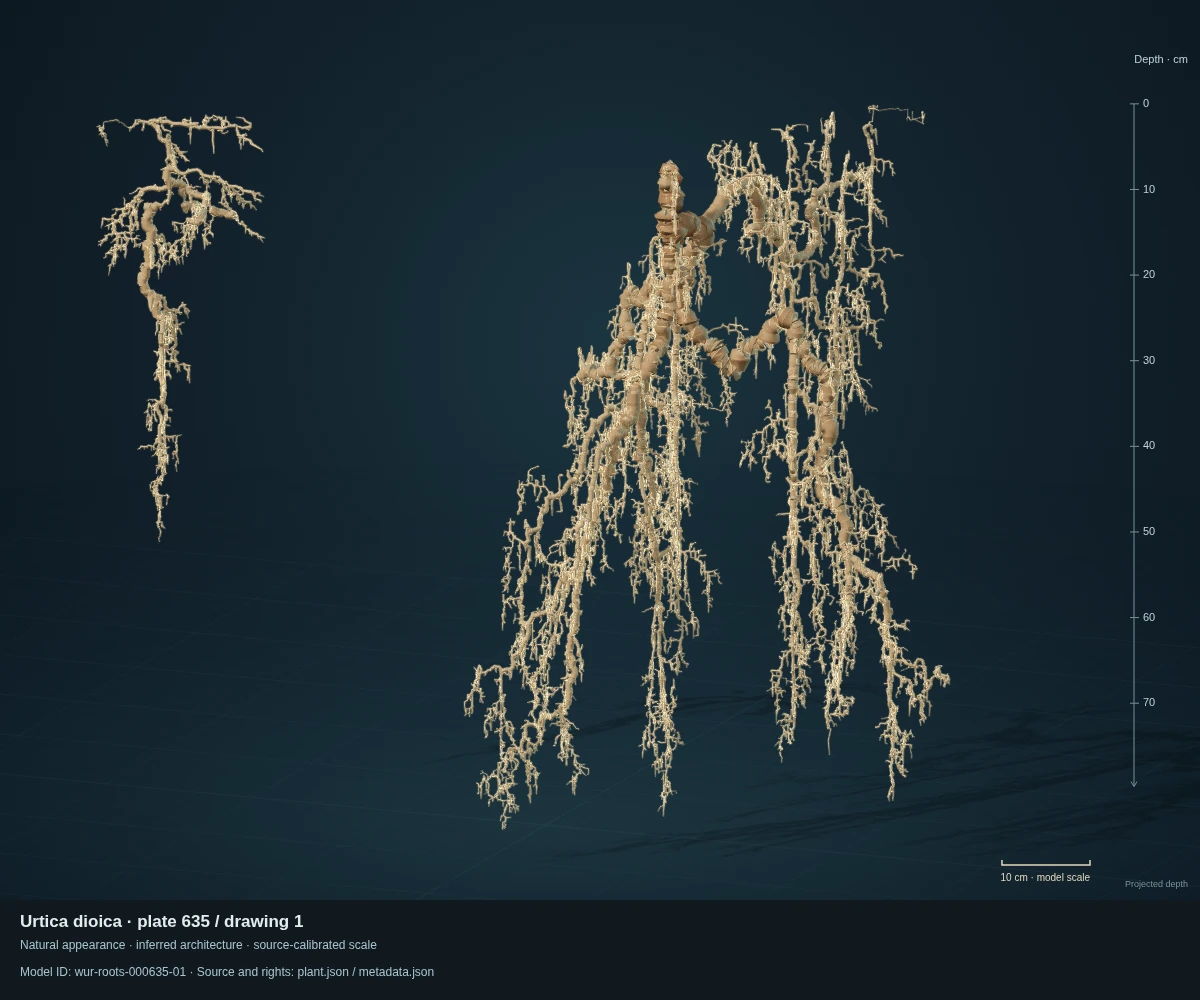
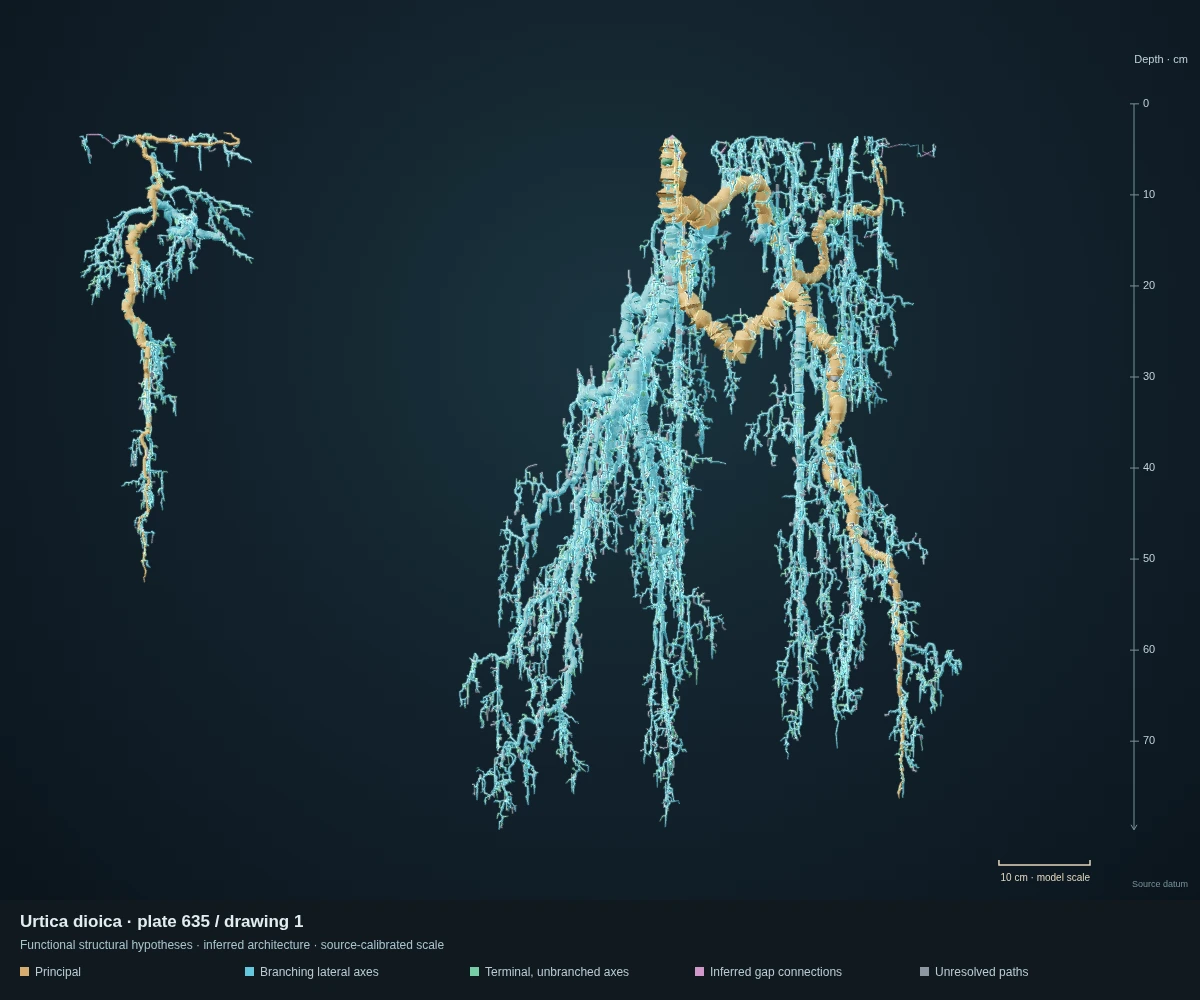
Drawing observations

  • Six unequal upright leafy shoots occur along a long horizontal basal system over several dense root columns.
  • A continuous thick horizontal network links shoot origins and bears repeated root origins, including upright bare stubs.
  • A fine shallow mat extends along the basal system, while coarse descenders form separated deeply branching columns.
  • The left-central and broader right columns end near 80 cm, with many fine repeatedly branched tips.

Biologically constrained spatial reconstruction from source morphology. Root azimuths, hidden placement, growth responses, circular sections, thickness and proposed connections are inferred. The separate source trace retains exact drawing coordinates. No measured 3D anatomy or observed growth sequence is claimed.
Source and attribution

Study 635 · Model 01

Urtica dioica · Wageningen University & Research archive

Names & classification

Family
Urticaceae
Genus
Urtica
Order
Rosales
Botanical authority
L.
Taxonomic rank
Species
Life form
perennial or rhizomatous geophyte
Growth form
Herb
Native range
Europe to Siberia and W. China, NW. Africa
Climate
temperate
Mean vegetative height (TRY)
0.998 m
Maximum recorded vegetative height (TRY)
2.5 m
Archive names
Urtica dioica

European ecological indicators

Light (1–9, shade to sun)
6.2
Moisture (1–12, dry to submerged)
No single indicator
Soil reaction (1–9, acidic to base-rich)
6.9
Nutrients (1–9, poor to rich)
8.5
Tichý et al. (2023)