Botanical field guide
Salix babylonica
Weeping willow
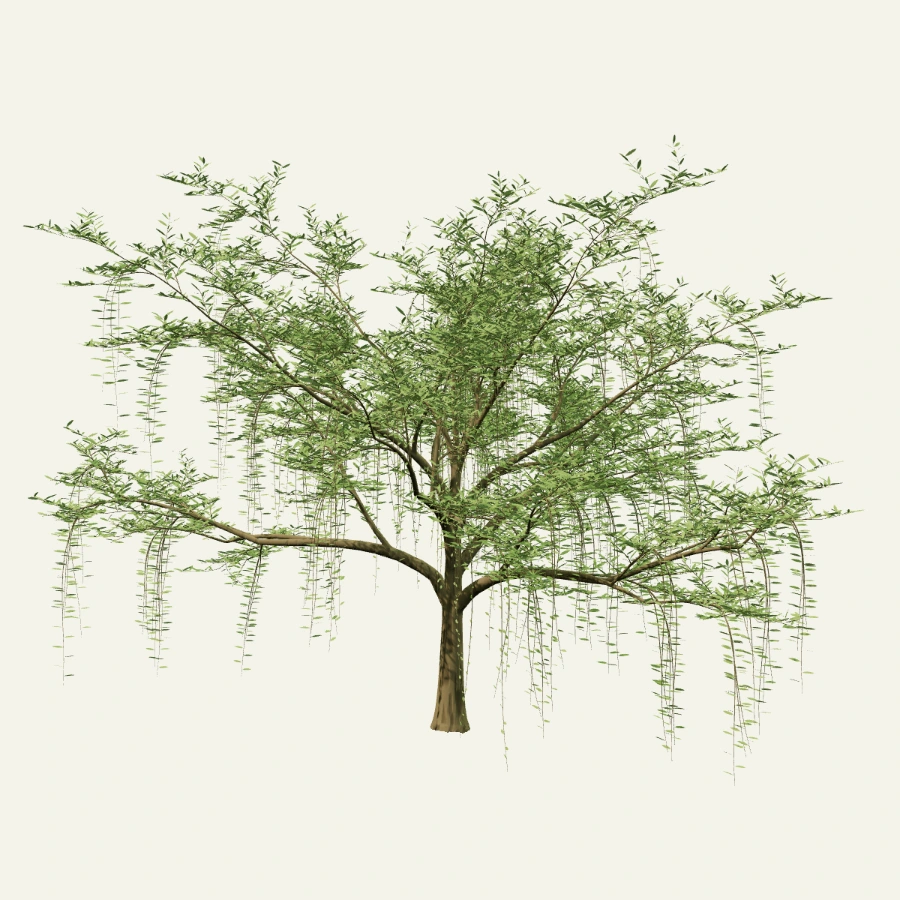
Tree / Salicaceae
The plant, in detail
Moist, well-lit ground and water margins; widely planted beyond its native range.
- Reference height
- 9–15 m
- Foliage habit
- Deciduous
- USDA zones
- 6–8
- Light
- Not documented
The rendering represents the familiar weeping form. Cultivated hybrids and clones may differ substantially. Wind is decorative motion, not a measured flexibility or breakage model.
Crown
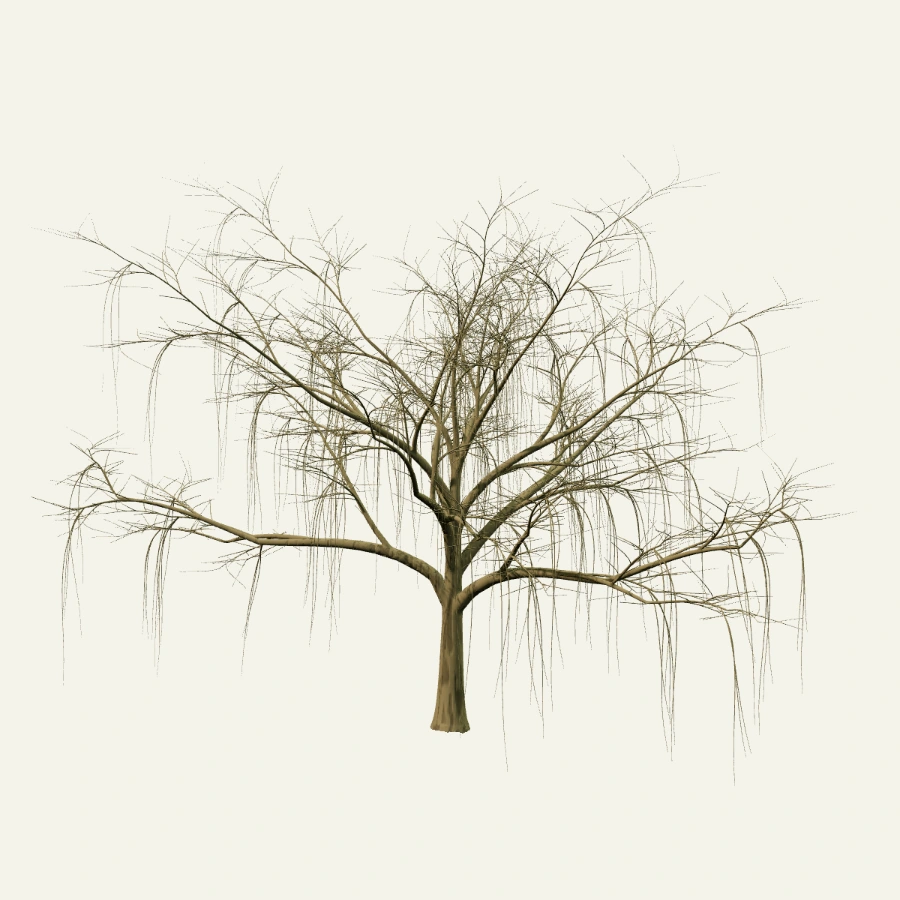
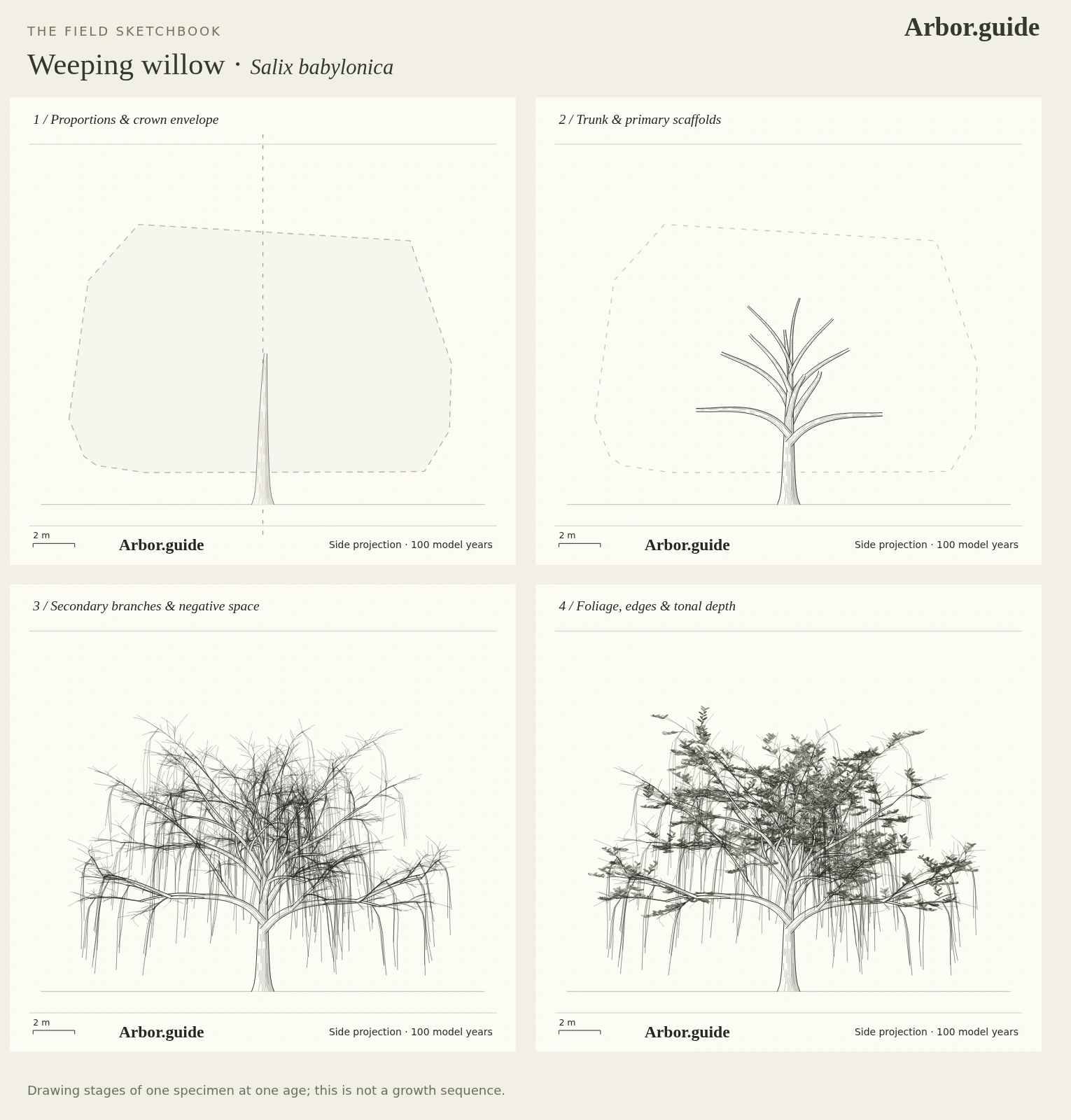
A broad, rounded framework carries long pendulous branchlets. The drooping curtain belongs mainly to flexible outer shoots; the main structural limbs are not all hanging vertically from the trunk.
Branching
Ascending and spreading main branches support increasingly slender, descending shoots. Rapid extension and relatively weak wood make crown breakage relevant to real form. The moving illustration does not model mechanical failure.
Bark
The trunk becomes gray-brown and furrowed. Younger twigs are much thinner and can appear yellowish to reddish-brown, creating a useful visual distinction between supporting framework and hanging shoots.
Roots
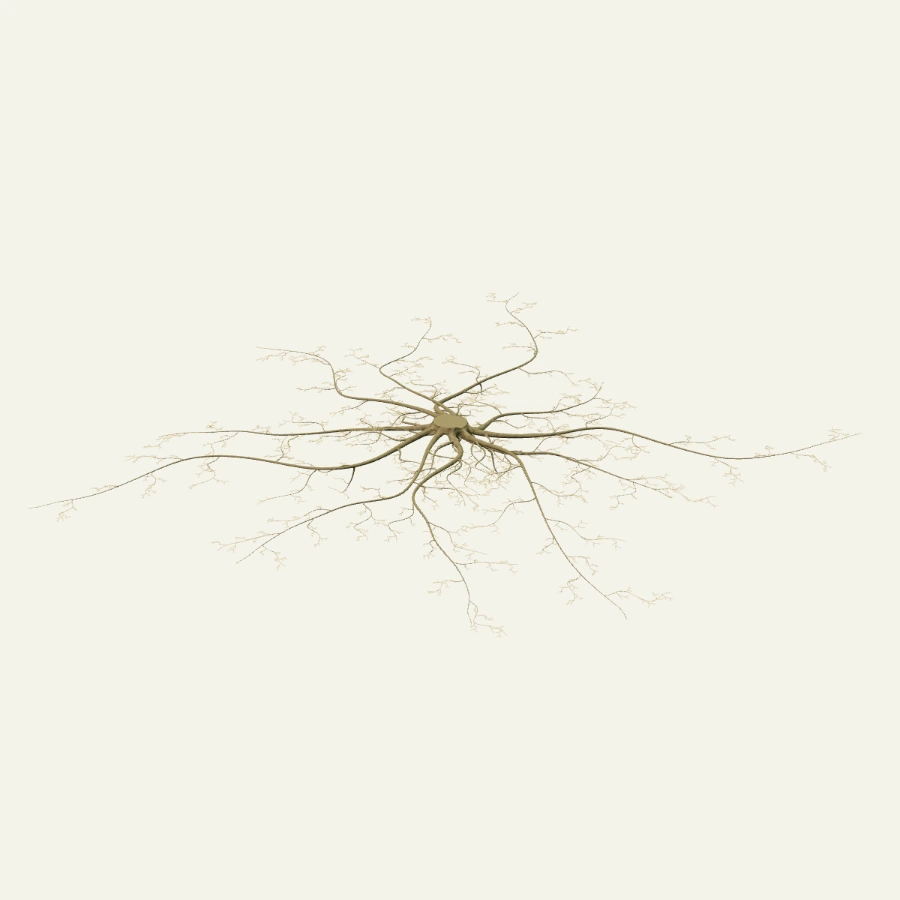
A vigorous spreading root system exploits moist soil. Root proliferation depends on available water and oxygen; roots do not simply trace a water source from a distance. The diagram provides no safe planting distance or pipe-risk assessment.
The shape of growth
Stylized real-world examples

Silhouettes are sized independently.
02 / Seasons
Through the seasons
Four portraits. One plant.
Read the crown, foliage and reproductive structures together. The four views compare seasonal appearances; the reference notes explain what is actually documented.
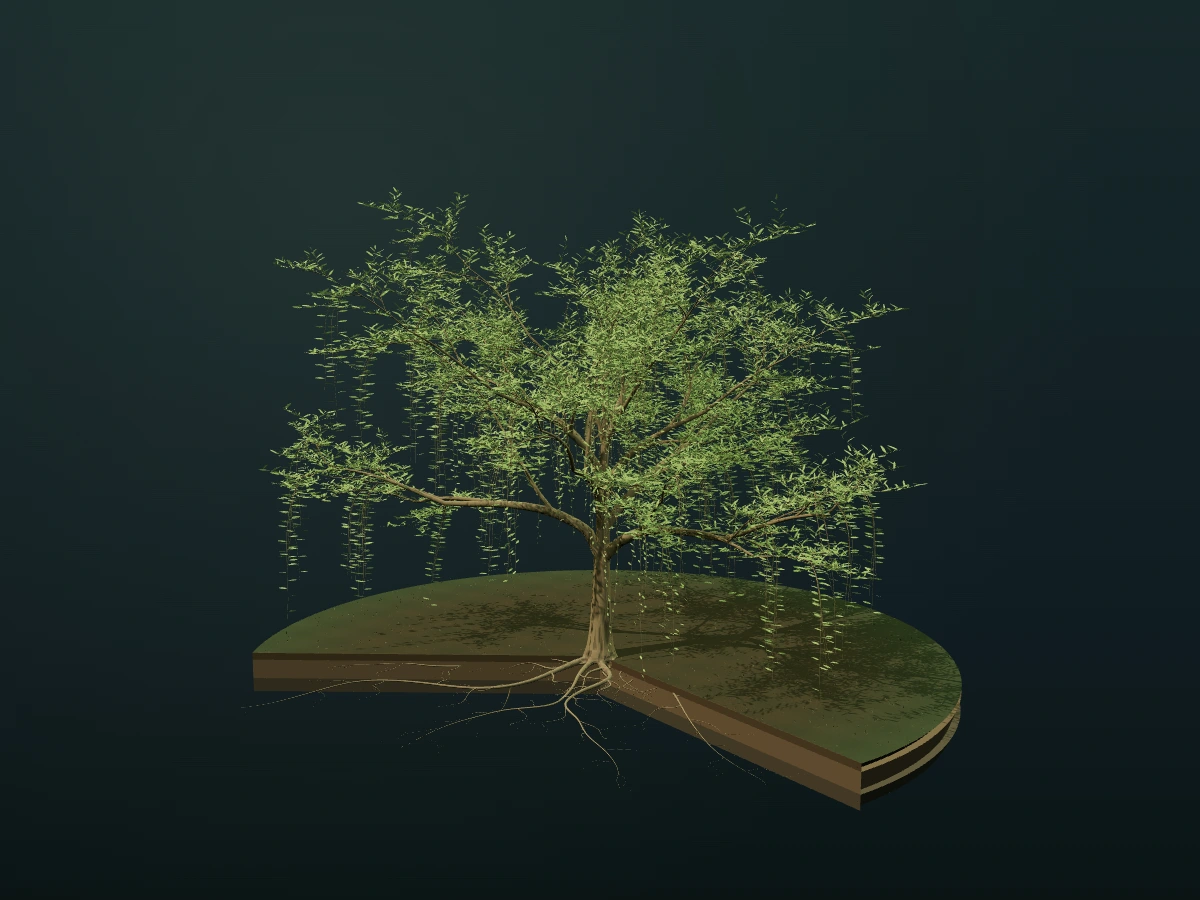
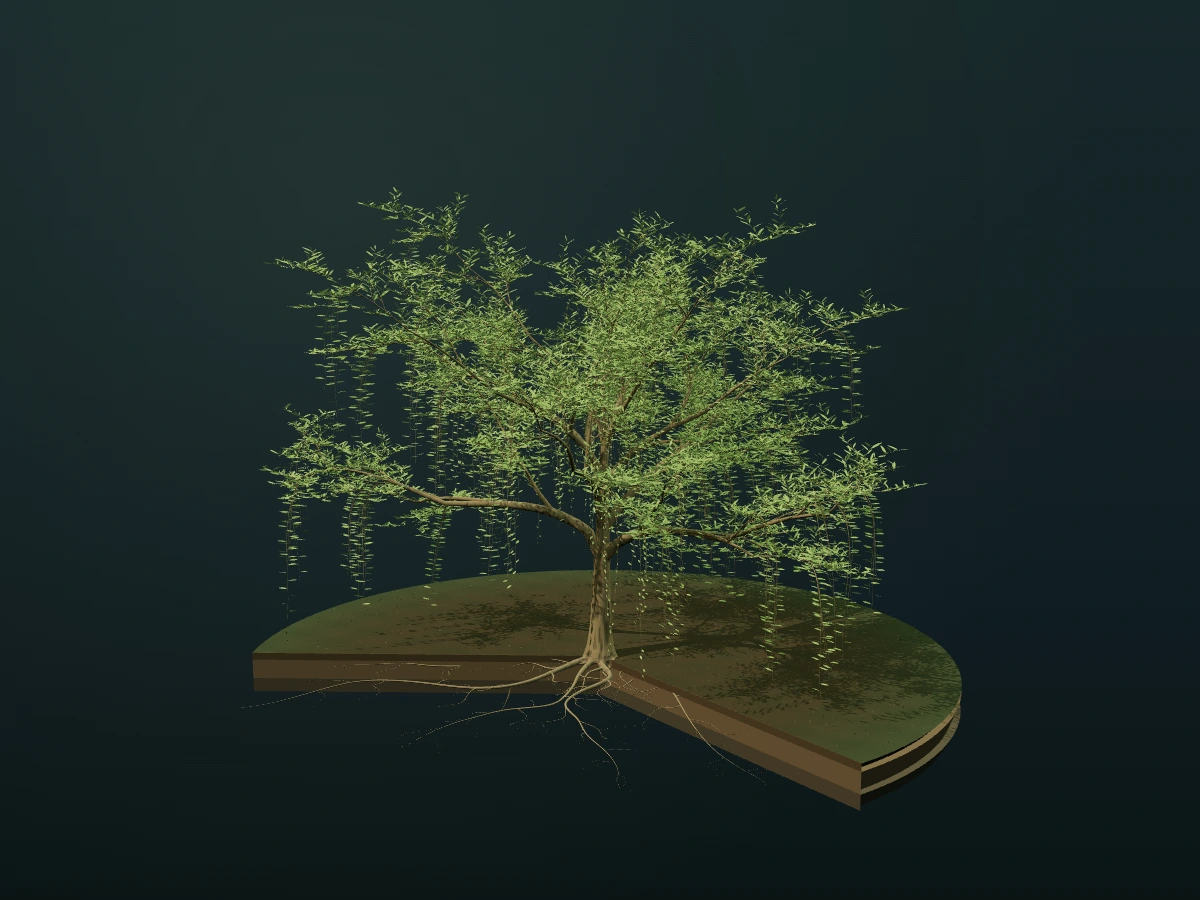
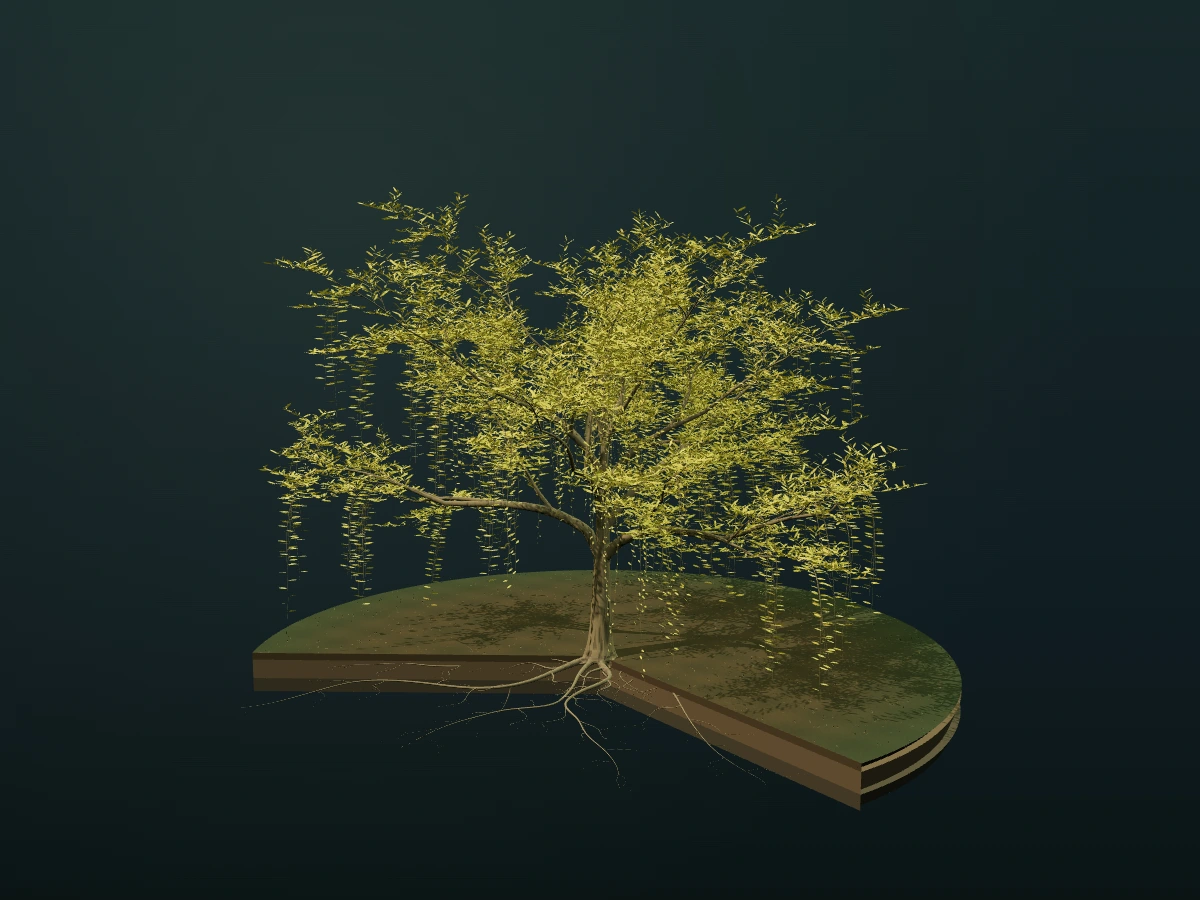
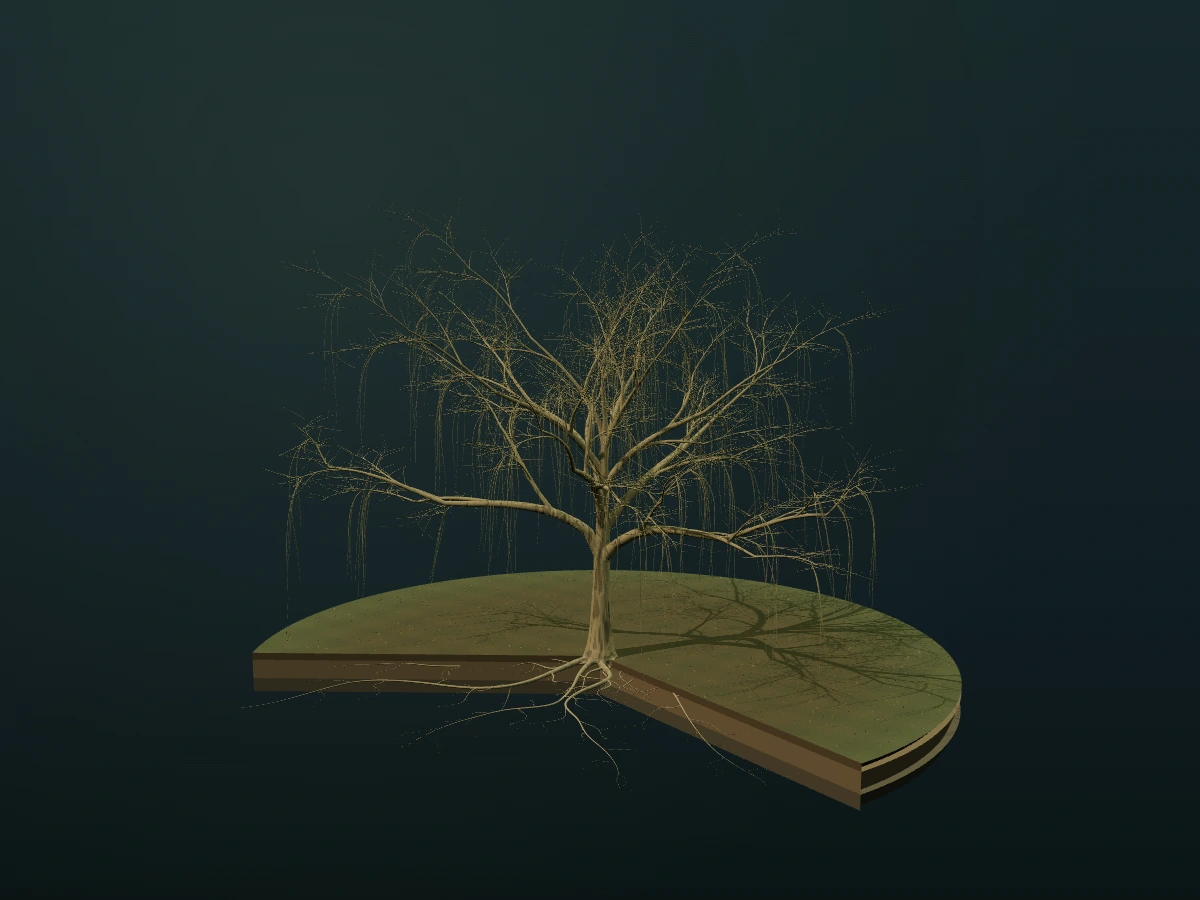
Seasonal illustration; the same plant, age and camera across four views.
Seasonal record
North Carolina botanical account
Leaf renewal
Deciduous[1]
The record describes a deciduous plant: foliage is renewed after a leafless or reduced-leaf phase. The named views illustrate that cycle without fixing its dates at a planting site.
Colour notes
Gold / yellow[1]
These are recorded colour possibilities. The shades and their distribution are illustrative; a particular autumn can look different.
Reading these views
Season names organize these four views, not a universal calendar. Hemisphere, local climate, cultivar and management can change timing; months are shown only when explicitly recorded.
The views emphasize crown structure. Buds, small flowers, individual retained leaves and fine reproductive changes may be unresolved; model age and fruit count are not production forecasts.
No separate on-tree fruit display is configured for this record.
Seasonal references
- NC State Extension · Weeping willow ↗plants.ces.ncsu.edu
- www.efloras.org ↗www.efloras.org
03 / Leaves & flowers
A closer look at the organs
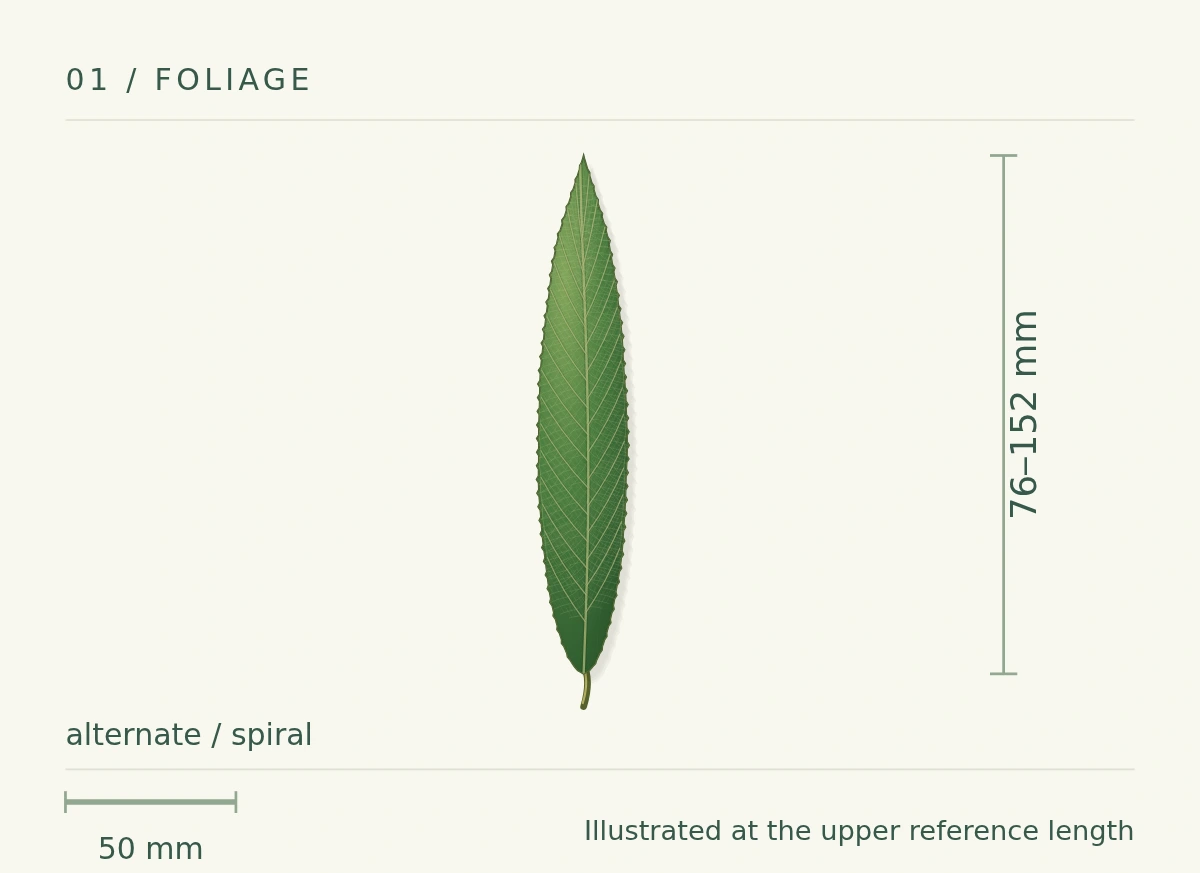
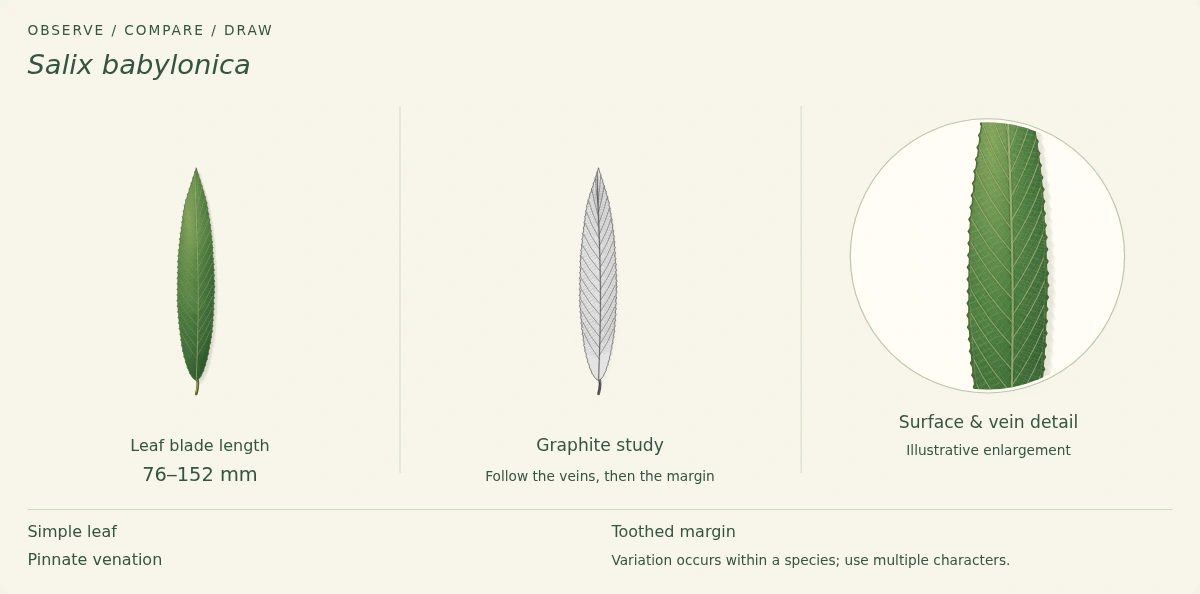
Leaves
- Leaf blade length
- 76–152 mmSource notes
Narrow, pointed, alternate leaves have finely toothed margins and a paler underside. Their distribution along slender shoots produces the characteristic fine-textured curtain. Leaves commonly turn yellow before falling.
Simple leaf · Toothed margin · Pinnate venation · alternate / spiral
Seasonal notes
Colour varies with genotype, site, weather and leaf exposure. Phases show a plausible sequence, without assigning dates or predicting intensity.
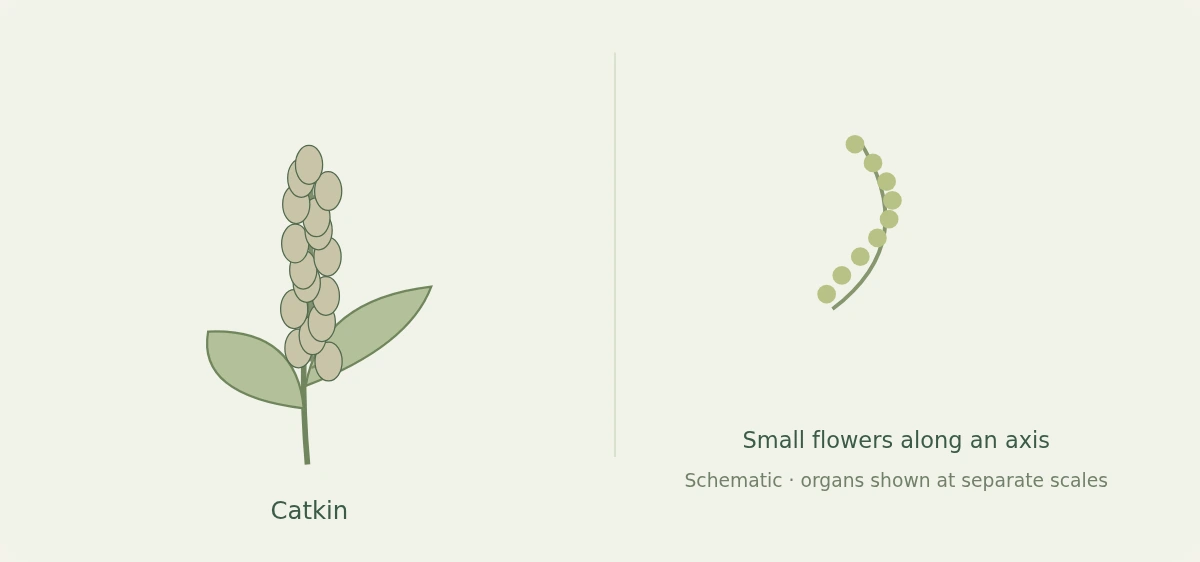
- Flowering reference
- Spring
04 / Fruit & seed
Named structures, separate scales
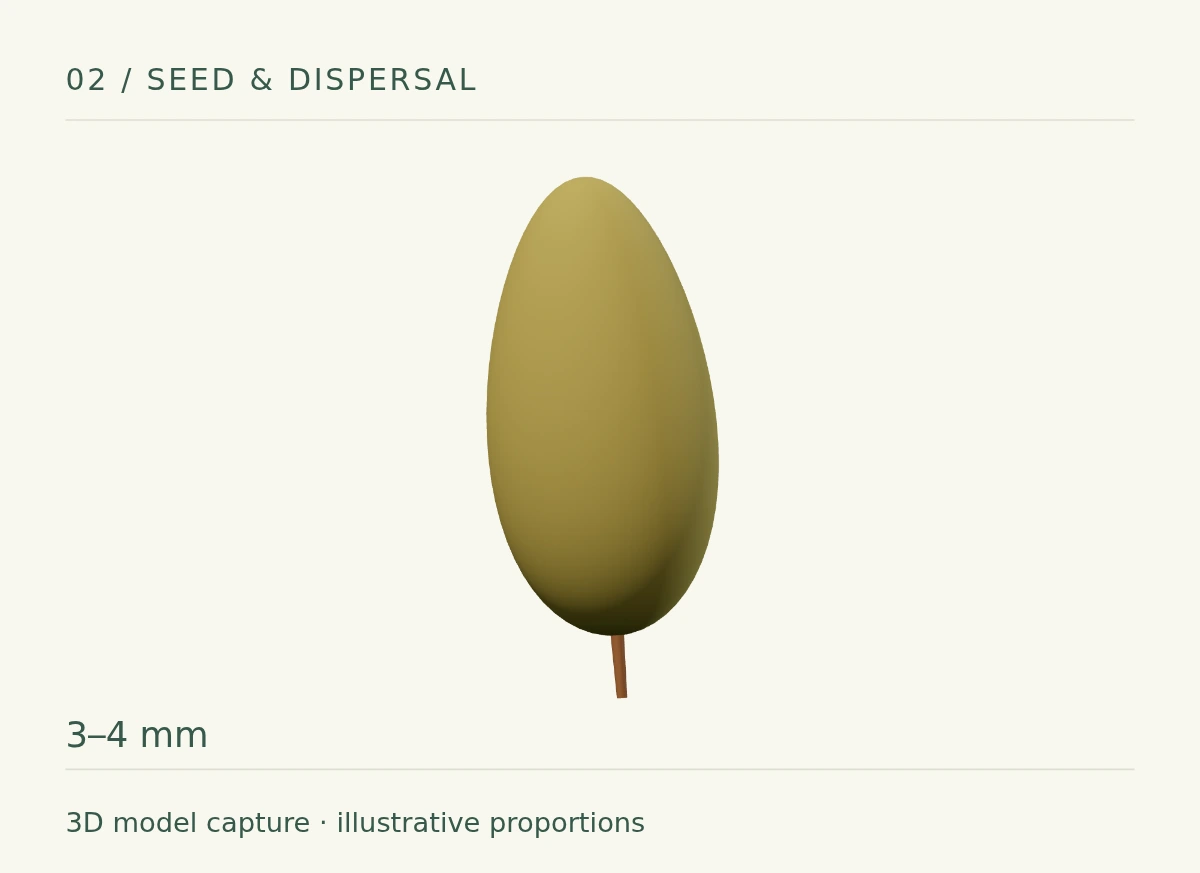
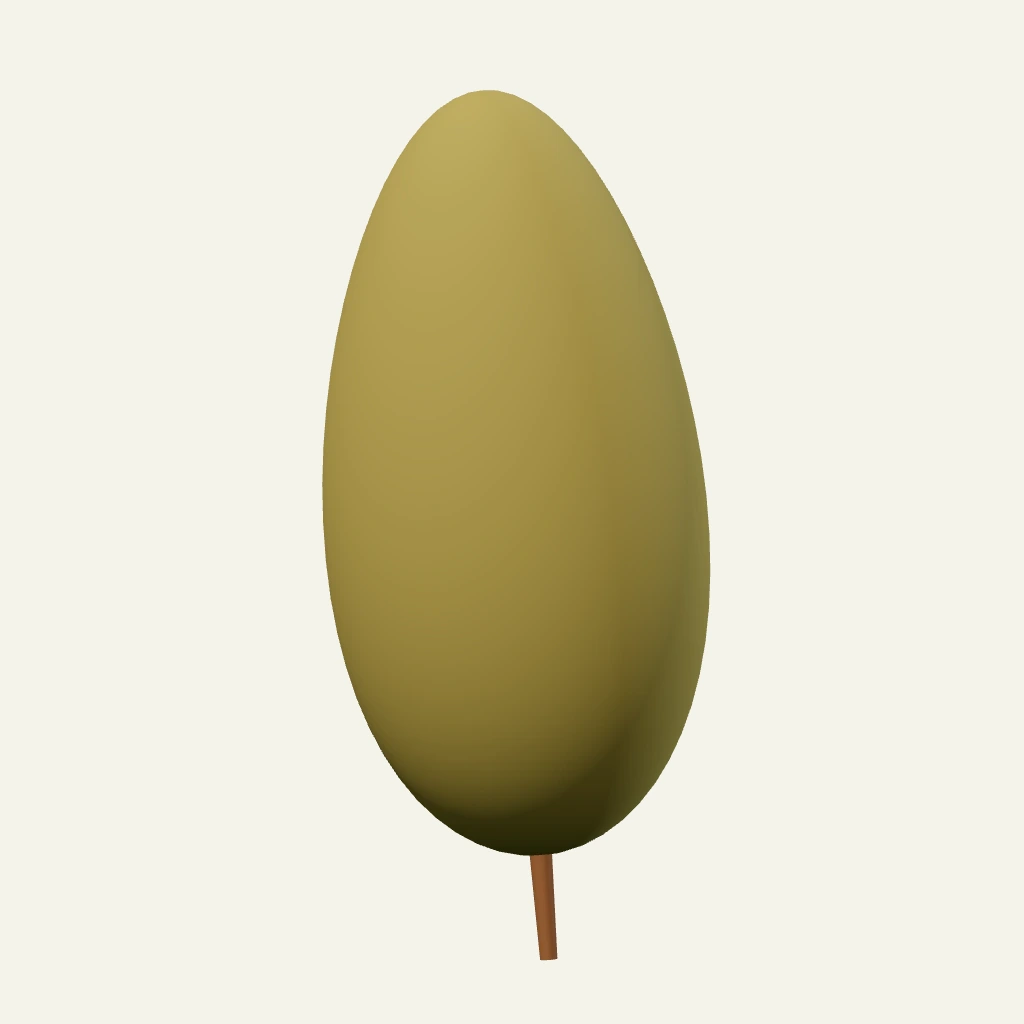
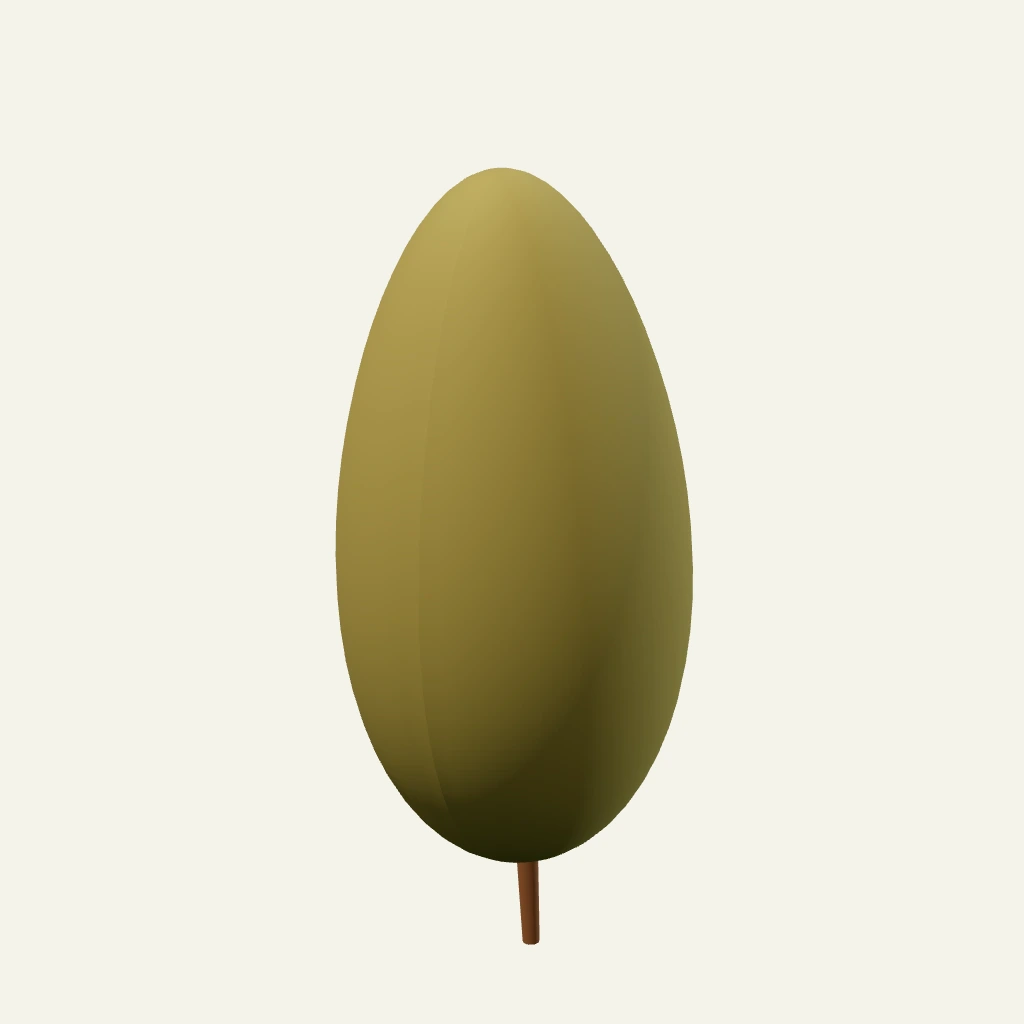
Fruit / dispersal unit
- Whole capsule length
- 3–4 mmSource notes
Tiny seeds carry silky hairs and are released from opening capsules. The capsule is not the seed.
- Fruiting reference
- Spring
North Carolina botanical account
Organs are enlarged independently. Refer to the named measurement, not image size.
05 / Habitat
Native range & growing context
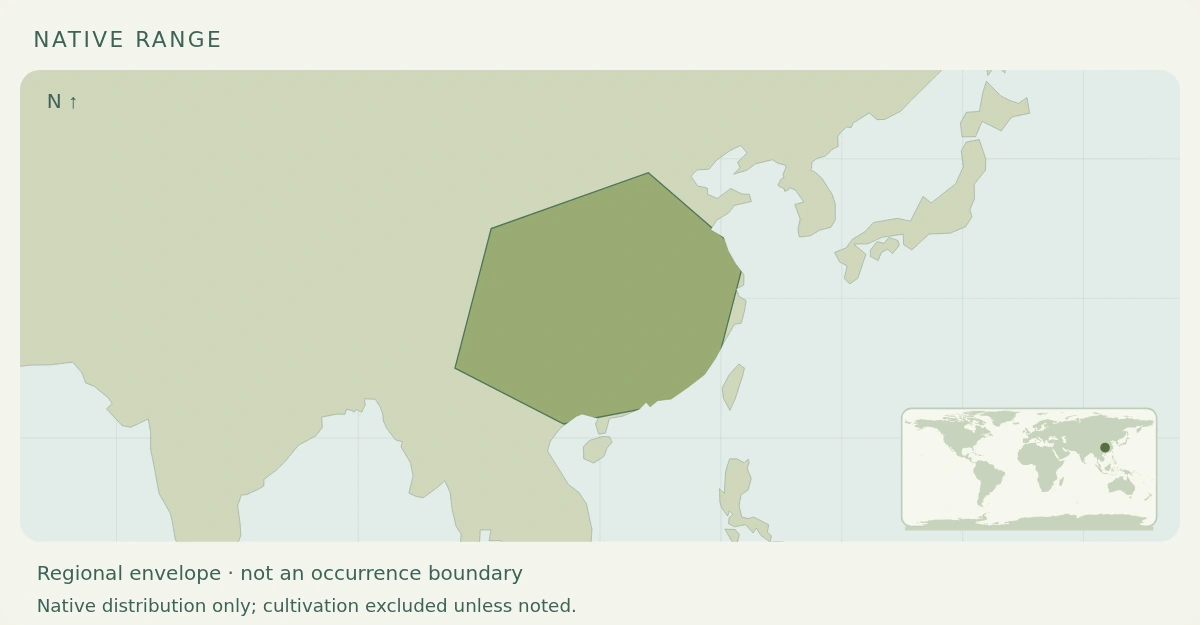
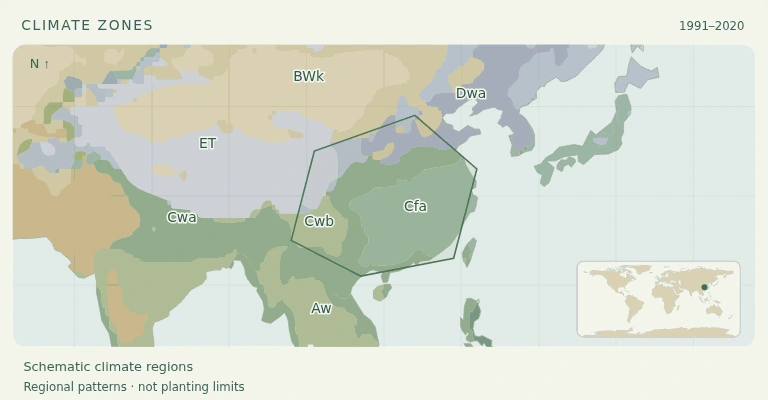
Native range & growing context
China and adjacent eastern Asian regions; cultivated widely.
- Reference spread
- Not documented
- Moisture
- Not documented
- Growth tendency
- Fast
- Life span
- Relatively short-lived; breakage, disease and site conditions strongly influence survival.
Regional context, not a measured occurrence or suitability map.
06 / Sources & interpretation
Read the evidence behind the illustration
Names & classification
- Family
- Salicaceae
- Genus
- Salix
- Synonyms
- —
- The name babylonica reflects a historical geographical misunderstanding.
- A weeping silhouette is not enough to identify a willow to species.
- Vegetative propagation can produce many trees of the same clone.
The rendering represents the familiar weeping form. Cultivated hybrids and clones may differ substantially. Wind is decorative motion, not a measured flexibility or breakage model.
ArborAI teaching geometry; coefficients and ages are not measured species constants.
- NC State Extension · Weeping willow ↗plants.ces.ncsu.edu
- University of Florida · Weeping willow ↗ask.ifas.ufl.edu
- RHS · Willow species and hybrids ↗www.rhs.org.uk
Plant data and references · 5
| Native range | China and adjacent eastern Asian regions; cultivated widely.Transferred from the existing catalogue; independent botanical review remains pending.plants.ces.ncsu.edu |
|---|---|
| Leaf lengthmm | [76, 152]Transferred from the existing catalogue; independent botanical review remains pending.plants.ces.ncsu.edu |
| Seed lengthmm | [3, 4]Transferred from the existing catalogue; independent botanical review remains pending.www.efloras.org |
| Reference phenologycategory | {"flowering": {"seasons": ["spring"]}, "fruiting": {"seasons": ["spring"]}, "reference": "North Carolina botanical account", "source": "https://plants.ces.ncsu.edu/plants/salix-babylonica/", "reviewed": "2026-10-16"}Regional observations. Fruit display may include persistence and is not automatically ripening. Missing dates remain unspecified. Independent botanical review remains pending.plants.ces.ncsu.edu |
| Usda hardinesscategory | {"system": "USDA", "zones": [6, 8], "source": "usda-hardiness", "subzones": ["6a", "8b"]}Reported horticultural recommendation; winter minimum only, not a heat or overall suitability limitplants.ces.ncsu.edu |