Arbor.guide

Bistorta officinalis

Common Bistort

Root studies

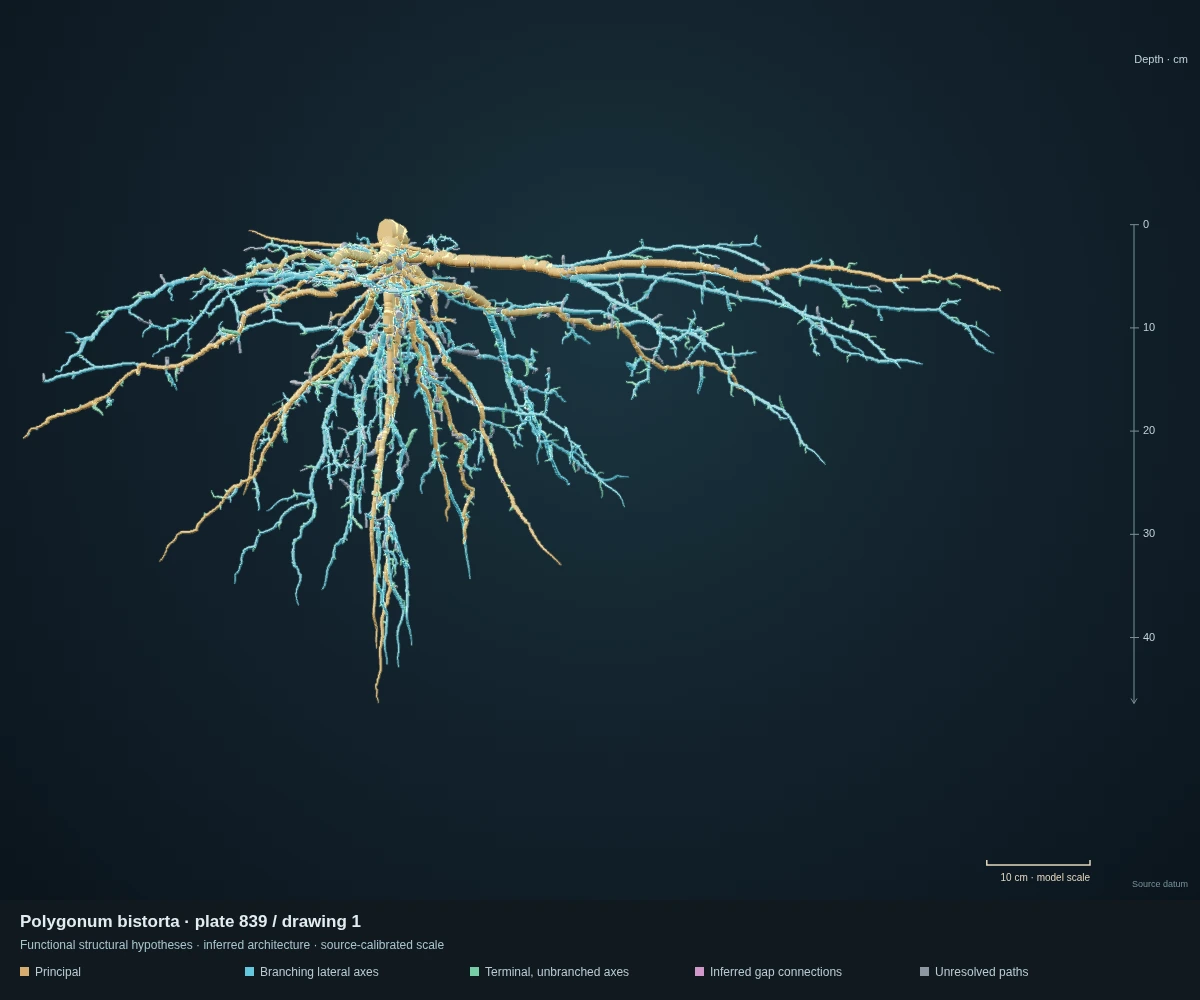
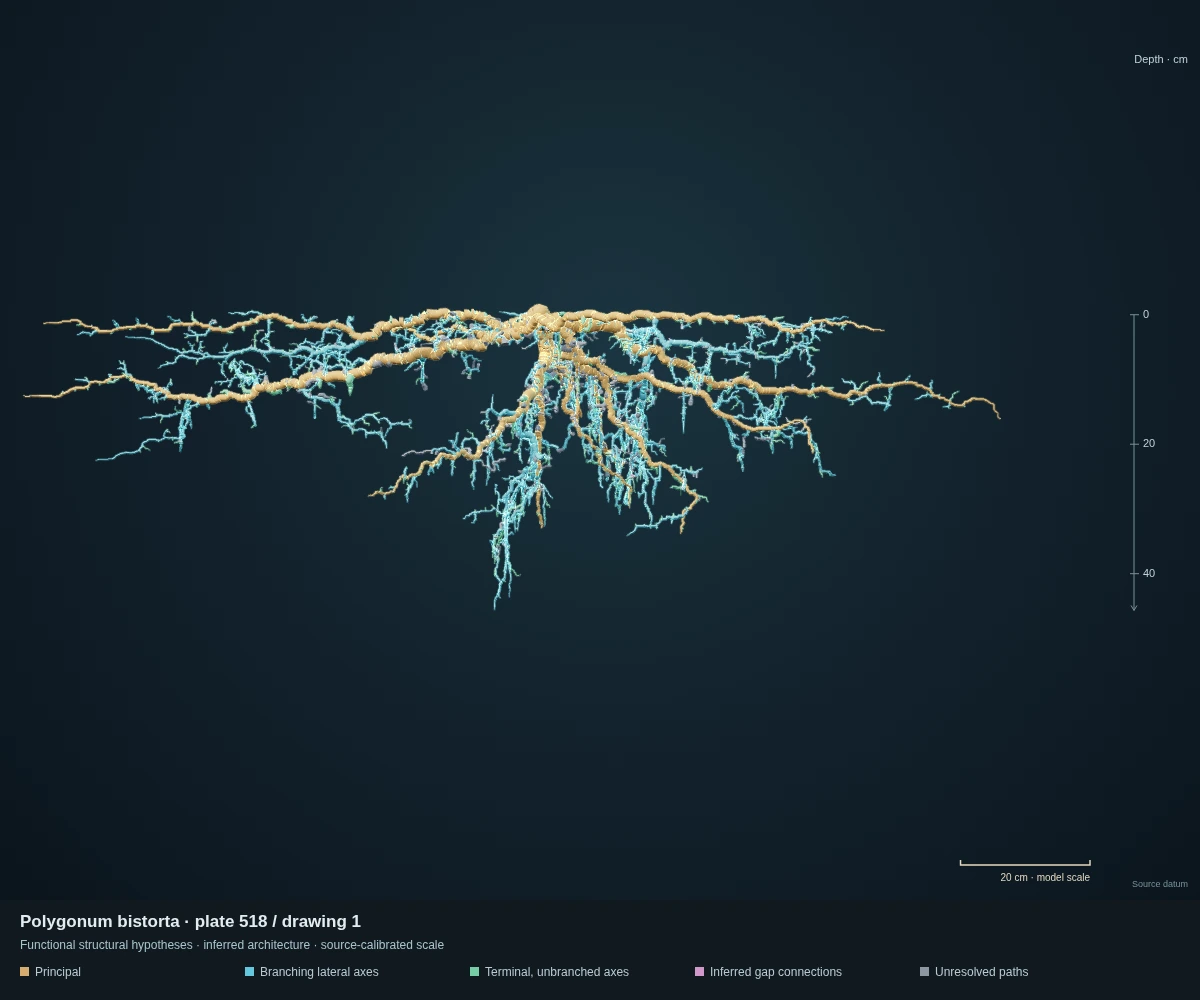
These reconstructions follow archived root drawings. Colour identifies the modelled structural role of each root.

Functional view
Natural view
Source projection
Side view
Calibration
Source-calibrated
Vertical extent
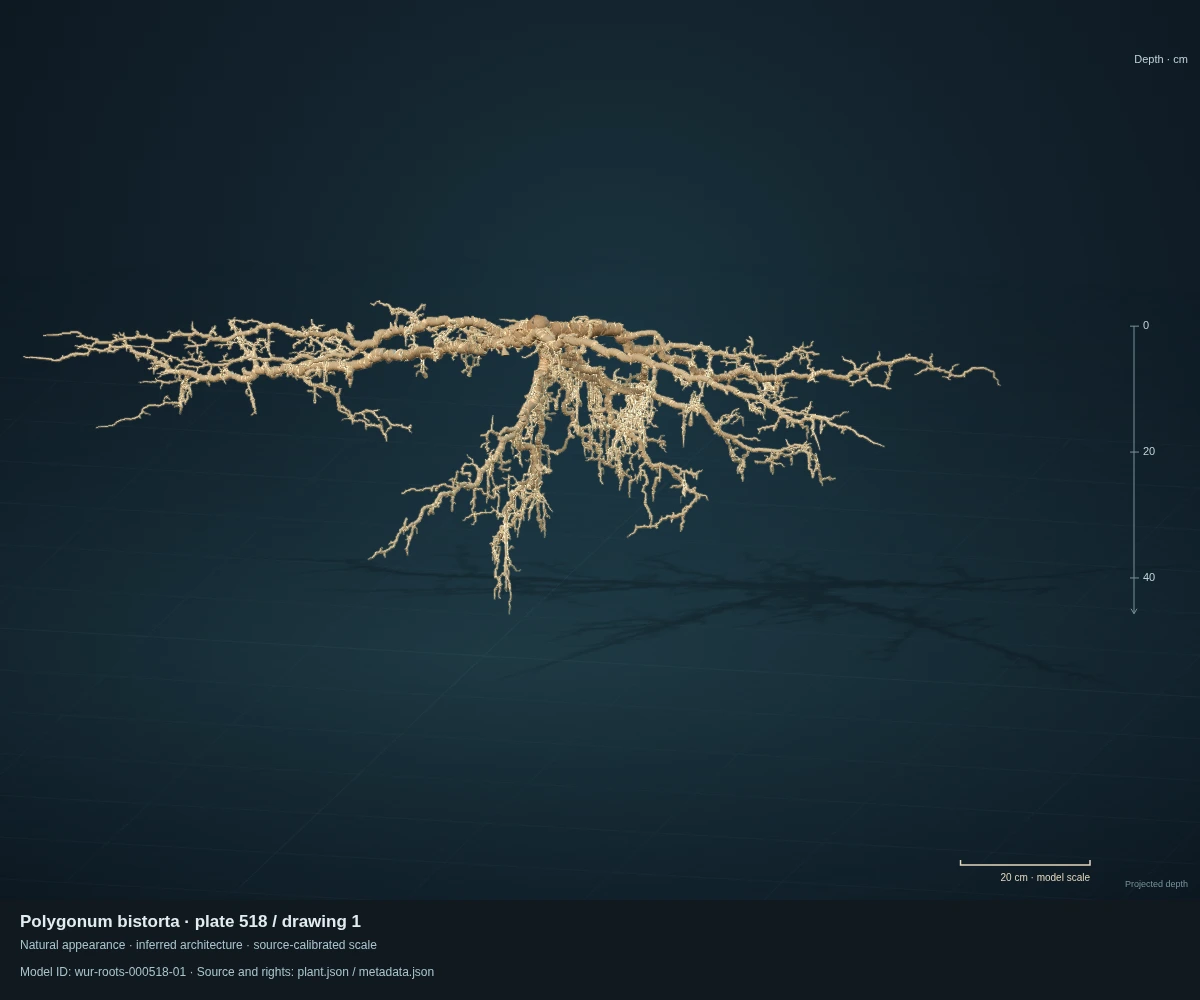
46.4 cm
Inferred axes
2625
Model metrics and plate observations

Model metrics

Depth follows the printed scale. Equal horizontal scale and hidden depth are modeling assumptions; root thickness is illustrative.

Vertical extent
46.4 cm
Horizontal span (x)
1.53 m
Horizontal span (z)
1.05 m
Centreline length
48.9 m
Inferred axes
2625
Branching sites
2399
Terminal paths
2415
Mean modelled diameter
4.18 mm
Surface area proxy
6,630 cm²
Volume proxy
1,230 cm³
Inferred connection length
5.95 cm
Projected length
45.5 m
Mean angle from vertical
51.9°

Dimensions reported on the source plate

Plant height
50 cm plate_518
Root depth
47 cm plate_518
Root-system diameter
169 cm plate_518

Drawing observations

  • Many fine roots arise along the thick contorted jointed axis beneath the crown.
  • A very wide upper field narrows into a deeper central fan.
  • Repeated fine forks form dense branching throughout most of the field.

Biologically constrained spatial reconstruction from source morphology. Root azimuths, hidden placement, growth responses, circular sections, thickness and proposed connections are inferred. The separate source trace retains exact drawing coordinates. No measured 3D anatomy or observed growth sequence is claimed.

Source and attribution

Study 518 · Model 01

Polygonum bistorta · Wageningen University & Research archive
Functional view
Natural view
Source projection
Side view
Calibration
Source-calibrated
Vertical extent
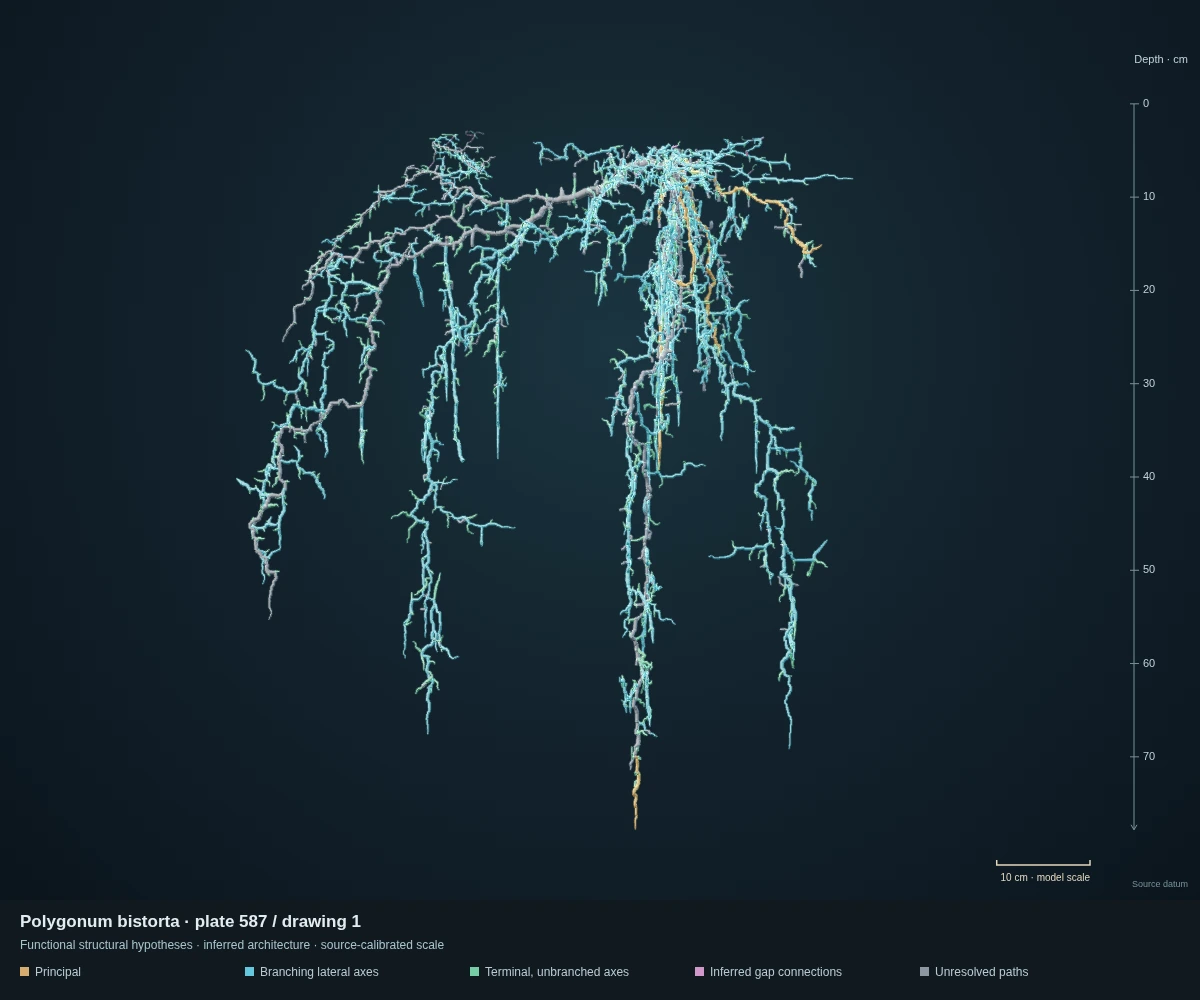
74.8 cm
Inferred axes
2175
Model metrics and plate observations

Model metrics

Depth follows the printed scale. Equal horizontal scale and hidden depth are modeling assumptions; root thickness is illustrative.

Vertical extent
74.8 cm
Horizontal span (x)
81.4 cm
Horizontal span (z)
63.9 cm
Centreline length
39.2 m
Inferred axes
2175
Branching sites
2060
Terminal paths
2073
Mean modelled diameter
2.23 mm
Surface area proxy
2,760 cm²
Volume proxy
183 cm³
Inferred connection length
12.1 cm
Projected length
34.6 m
Mean angle from vertical
46.2°

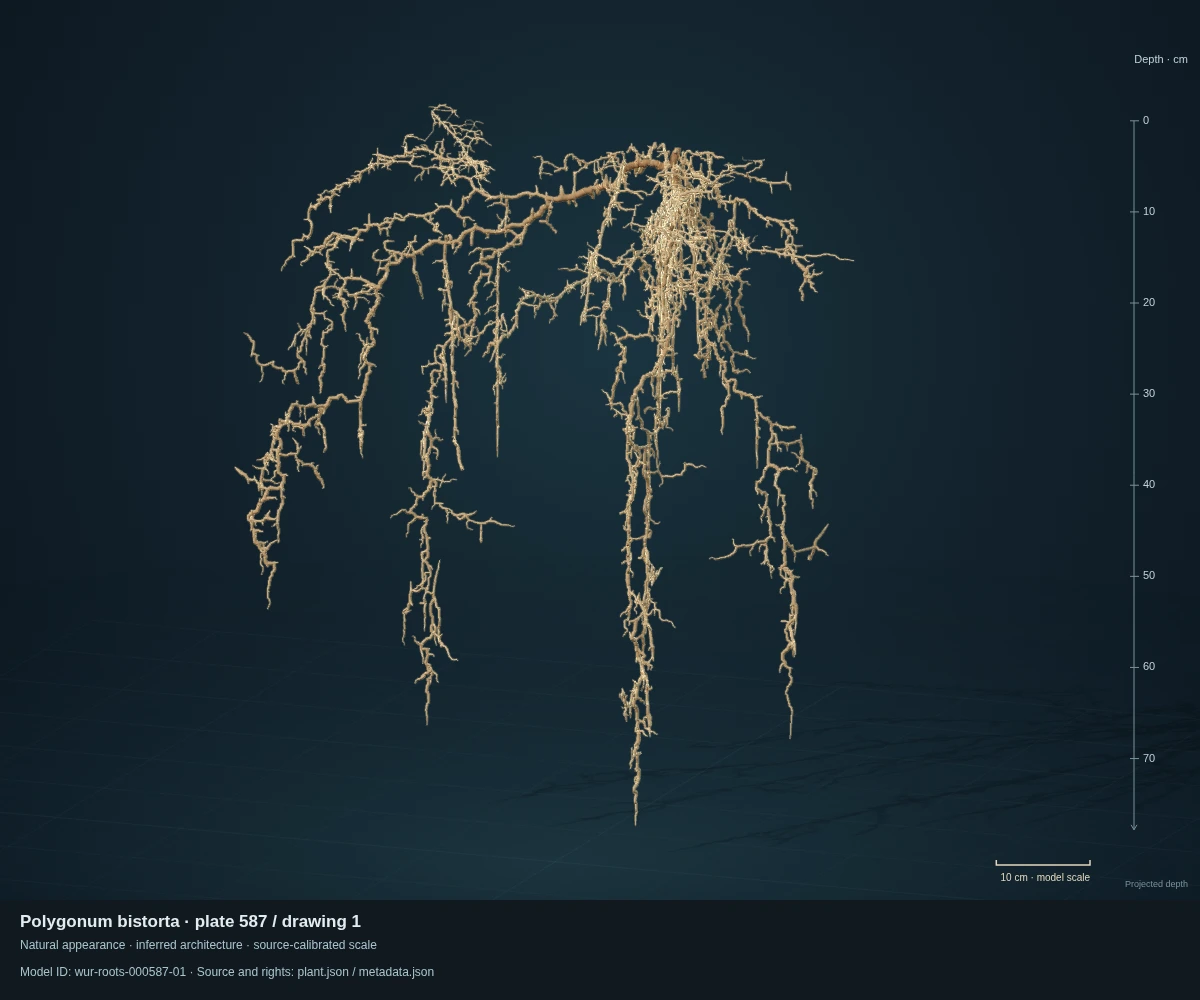
Dimensions reported on the source plate

Plant height
21 cm plate_587
Root depth
77 cm plate_587
Root-system diameter
102 cm plate_587

Drawing observations

  • two dense terminal spikes and broad foliage over bent horizontal rooting axis
  • thick striated horizontal axis with sharp downward U shaped bend
  • many roots depart along horizontal axis and bend
  • wide upper fan and many long central descenders
  • dense short fine laterals and unequal forks

Biologically constrained spatial reconstruction from source morphology. Root azimuths, hidden placement, growth responses, circular sections, thickness and proposed connections are inferred. The separate source trace retains exact drawing coordinates. No measured 3D anatomy or observed growth sequence is claimed.

Source and attribution

Study 587 · Model 01

Polygonum bistorta · Wageningen University & Research archive
Functional view
Natural view
Source projection
Side view
Calibration
Source-calibrated
Vertical extent
45.8 cm
Inferred axes
1807
Model metrics and plate observations

Model metrics

Depth follows the printed scale. Equal horizontal scale and hidden depth are modeling assumptions; root thickness is illustrative.

Vertical extent
45.8 cm
Horizontal span (x)
1.02 m
Horizontal span (z)
1.08 m
Centreline length
30.3 m
Inferred axes
1807
Branching sites
1647
Terminal paths
1660
Mean modelled diameter
3.04 mm
Surface area proxy
2,960 cm²
Volume proxy
343 cm³
Inferred connection length
2.69 cm
Projected length
27.2 m
Mean angle from vertical
52.3°

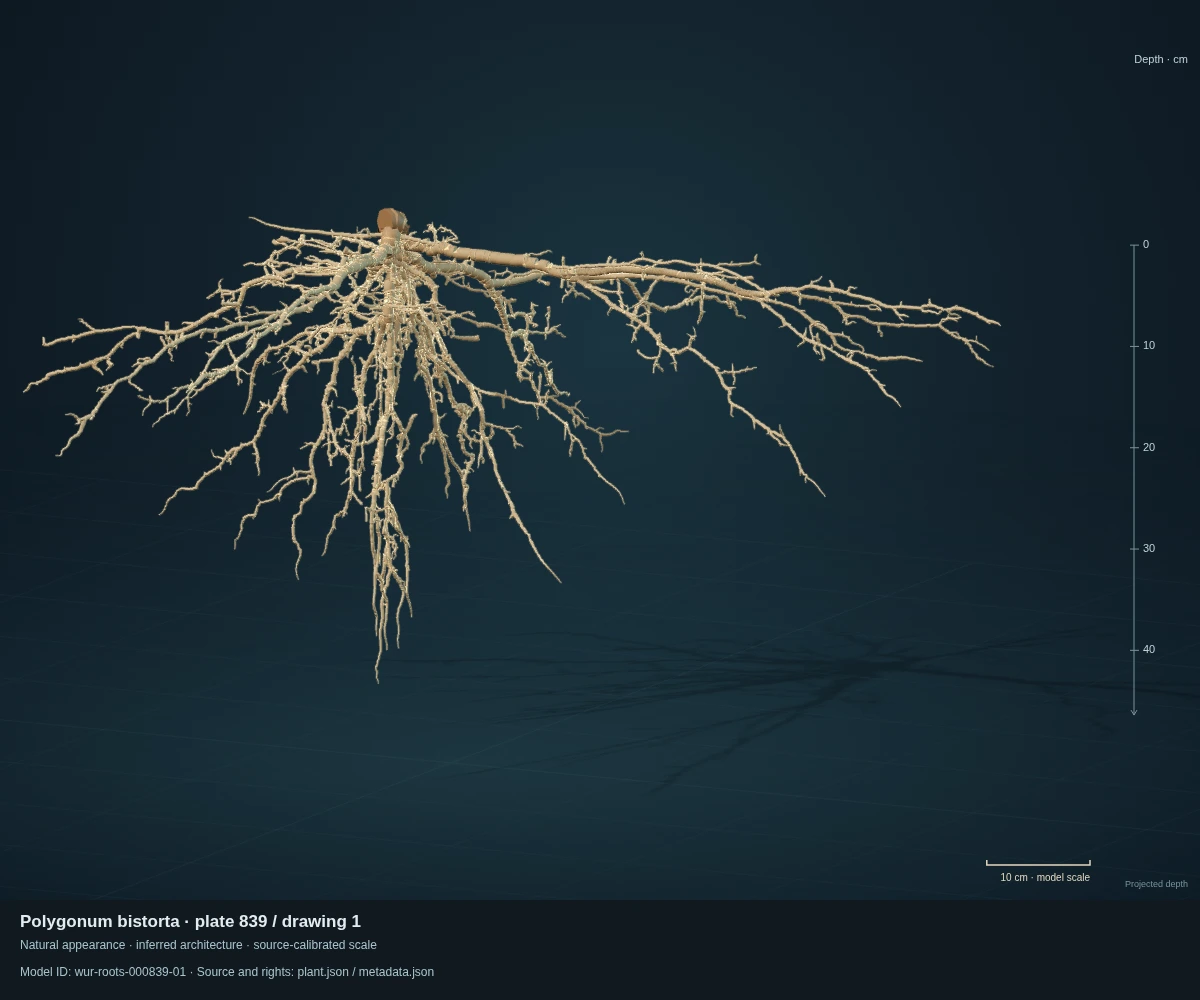
Drawing observations

  • Two headed stalks and broad basal leaves above a knotted base and broad fibrous root fan
  • Many coarse and fine roots emerge from a short knotted textured base
  • Roots spread widely near the surface and descend in a dense central fan
  • Long lower roots end in unequal tapering tips below 30 cm

Biologically constrained spatial reconstruction from source morphology. Root azimuths, hidden placement, growth responses, circular sections, thickness and proposed connections are inferred. The separate source trace retains exact drawing coordinates. No measured 3D anatomy or observed growth sequence is claimed.

Source and attribution

Study 839 · Model 01

Polygonum bistorta · Wageningen University & Research archive
Names & classification

Family
Polygonaceae
Genus
Bistorta
Order
Caryophyllales
Botanical authority
Delarbre
Taxonomic rank
Species
Life form
perennial or rhizomatous geophyte
Growth form
Herb
Native range
Temp. Eurasia, Morocco
Climate
temperate
Archive names
Polygonum bistorta

European ecological indicators

Light (1–9, shade to sun)
7.1
Moisture (1–12, dry to submerged)
7
Soil reaction (1–9, acidic to base-rich)
5.1
Nutrients (1–9, poor to rich)
No single indicator
Tichý et al. (2023)