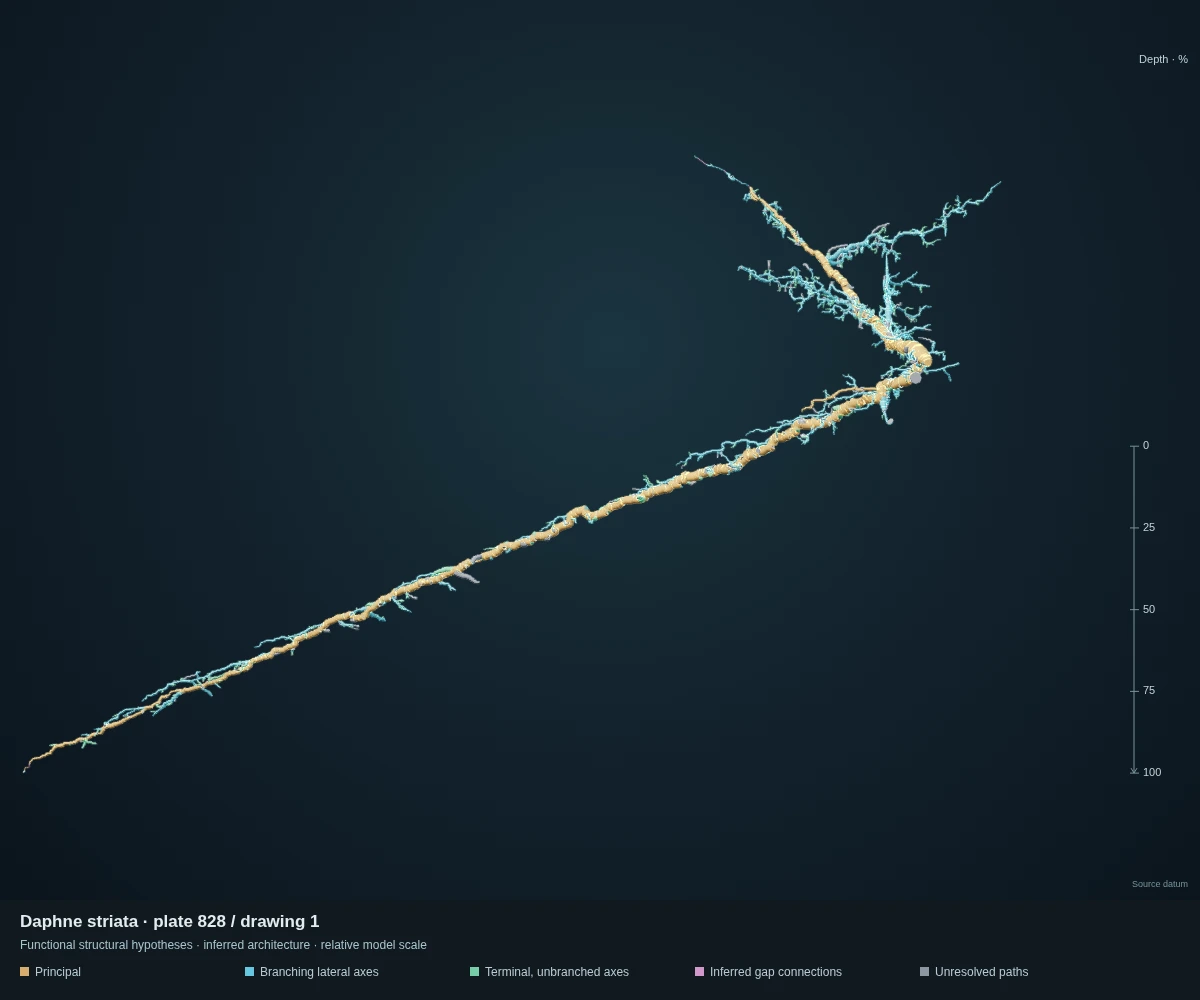
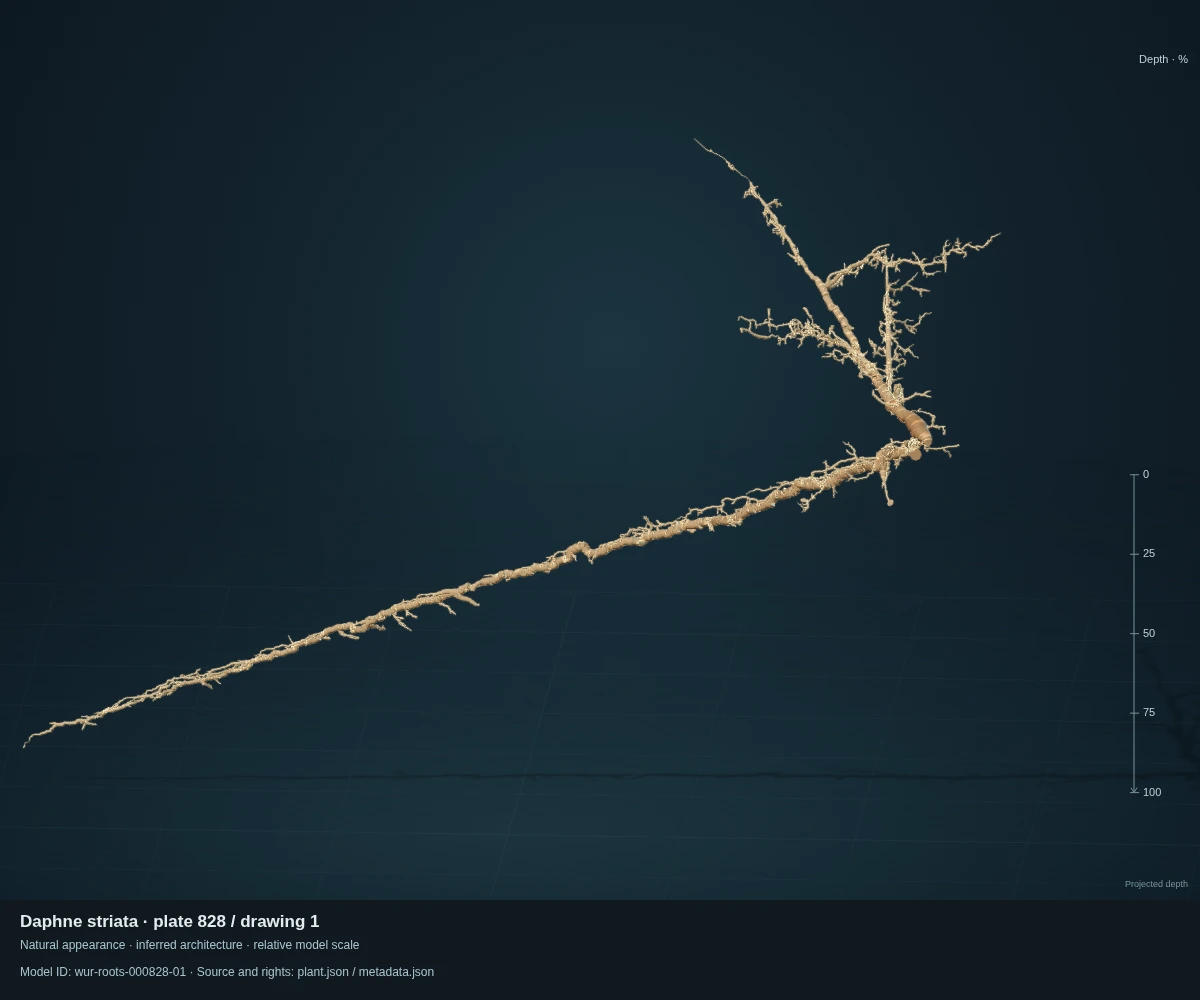
- Source projection
- Side view
- Calibration
- Unresolved scale
- Vertical extent
- 0.603 model units
- Inferred axes
- 1115
Model metrics and plate observations
Model metrics
No metric calibration; values are in normalized model coordinates.
- Vertical extent
- 0.603 model units
- Horizontal span (x)
- 0.97 model units
- Horizontal span (z)
- 0.476 model units
- Centreline length
- 12.1 model units
- Inferred axes
- 1115
- Branching sites
- 994
- Terminal paths
- 999
- Mean modelled diameter
- 0.00265 model units
- Surface area proxy
- 0.105 model units²
- Volume proxy
- 0.000127 model units³
- Inferred connection length
- 0.0268 model units
- Projected length
- 9.82 model units
- Mean angle from vertical
- 57.2°
Drawing observations
- Coarse interlacing roots beneath the leafy zone carry abundant finer lateral branches
- Several fine roots form a narrow branched strip extending far downhill beneath the surface
- Thick continuous spreading axes link numerous short upright leafy branches along the slope
Biologically constrained spatial reconstruction from source morphology. Root azimuths, hidden placement, growth responses, circular sections, thickness and proposed connections are inferred. The separate source trace retains exact drawing coordinates. No measured 3D anatomy or observed growth sequence is claimed.