Arbor.guide

Daucus carota

Carrots

Root studies

These reconstructions follow archived root drawings. Colour identifies the modelled structural role of each root.

Functional view
Natural view
Source projection
Side view
Calibration
Source-calibrated
Vertical extent
60 cm
Inferred axes
869
Model metrics and plate observations

Model metrics

Depth follows the printed scale. Equal horizontal scale and hidden depth are modeling assumptions; root thickness is illustrative.

Vertical extent
60 cm
Horizontal span (x)
19.7 cm
Horizontal span (z)
28.1 cm
Centreline length
9.64 m
Inferred axes
869
Branching sites
773
Terminal paths
796
Mean modelled diameter
1.99 mm
Surface area proxy
616 cm²
Volume proxy
62.7 cm³
Inferred connection length
32.1 cm
Projected length
9.06 m
Mean angle from vertical
42.2°

Dimensions reported on the source plate

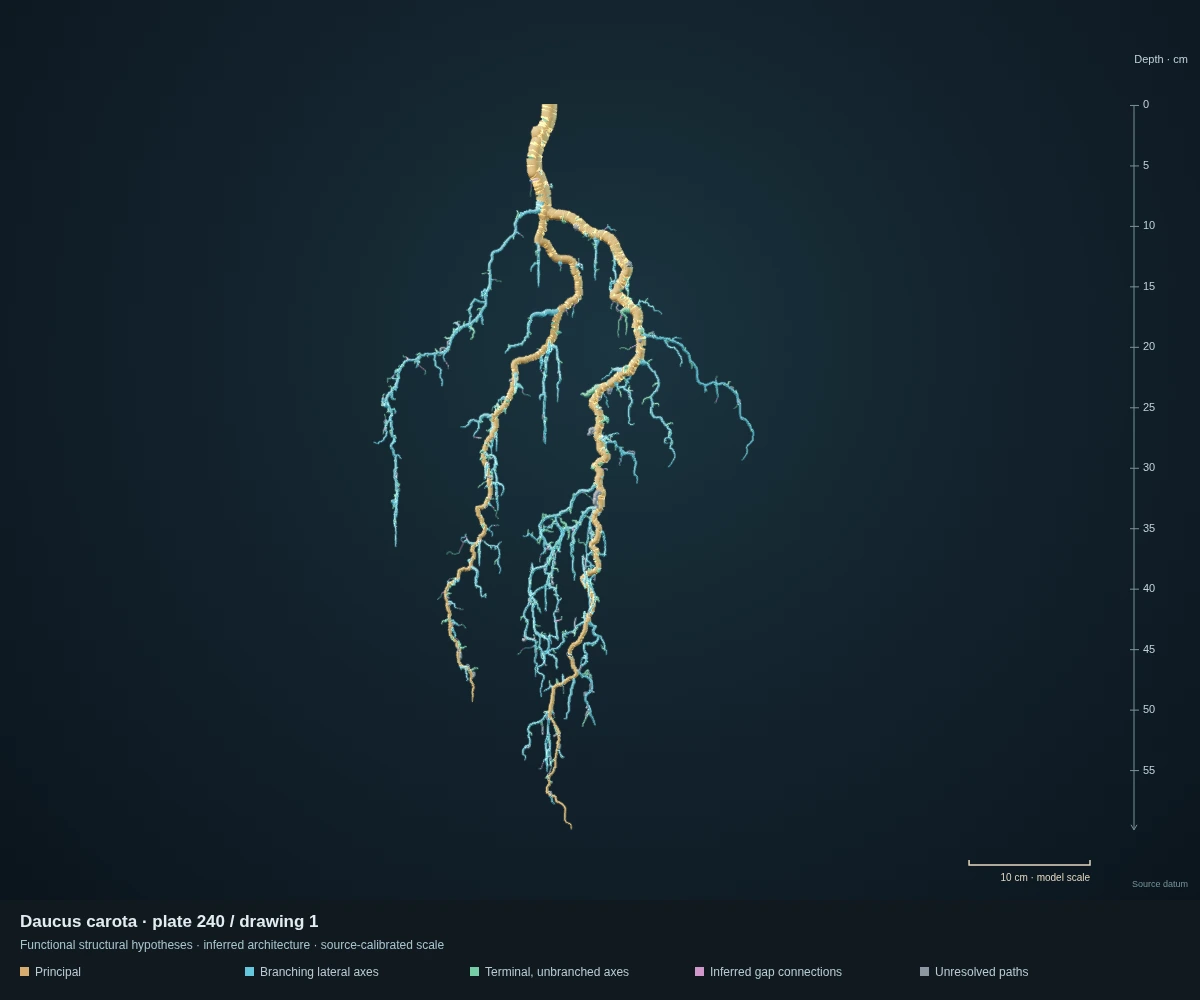
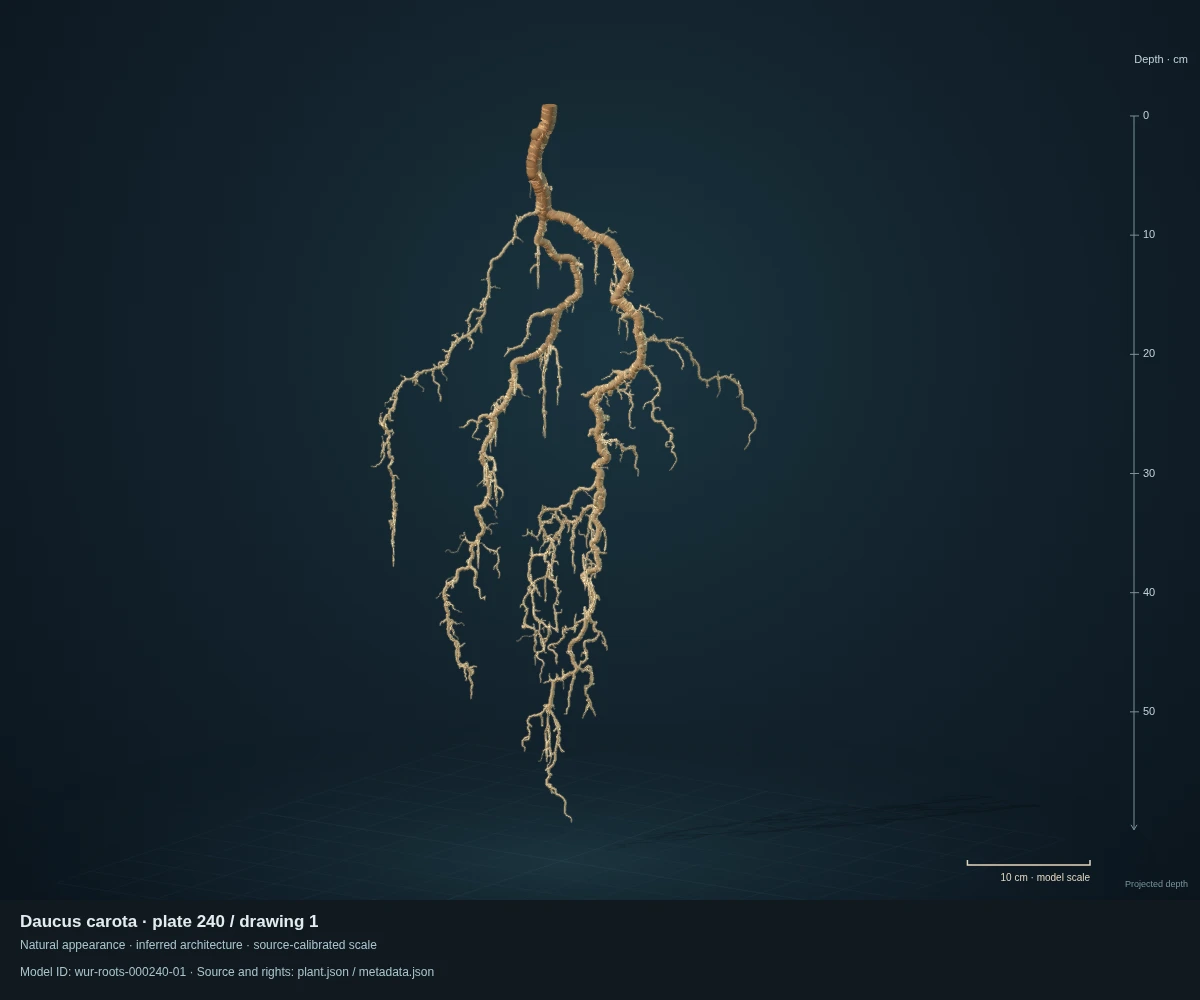
Plant height
80 cm plate_240
Root depth
60 cm plate_240
Root-system diameter
20 cm plate_240

Drawing observations

  • A thick curved proximal root has relatively sparse branches until its lower division.
  • The coarse central path divides into several long descending roots.
  • Sinuous descending paths bear scattered finer lateral branches, denser around some rightward forks.

Biologically constrained spatial reconstruction from source morphology. Root azimuths, hidden placement, growth responses, circular sections, thickness and proposed connections are inferred. The separate source trace retains exact drawing coordinates. No measured 3D anatomy or observed growth sequence is claimed.
Source and attribution

Study 240 · Model 01

Daucus carota · Wageningen University & Research archive

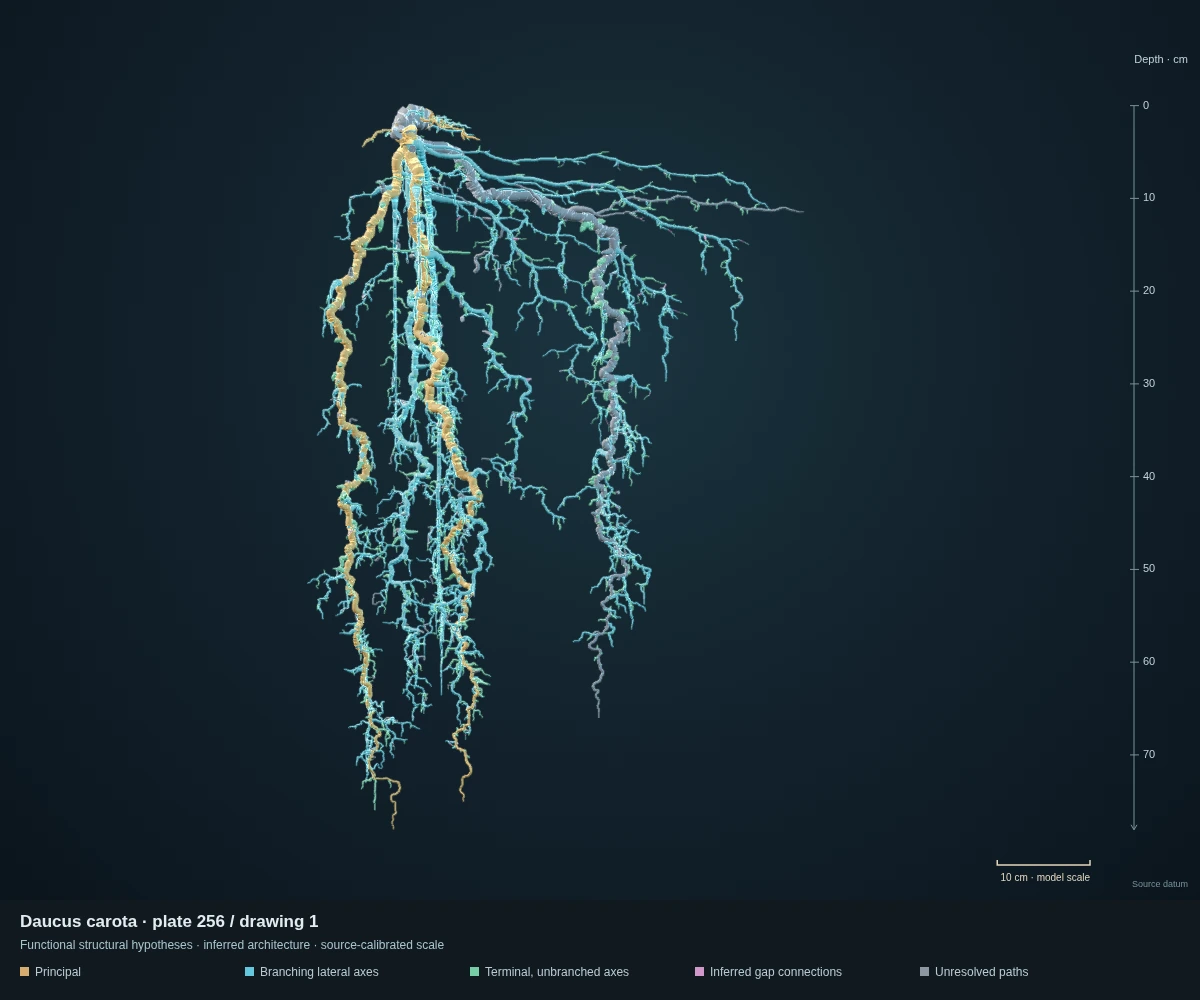
Functional view
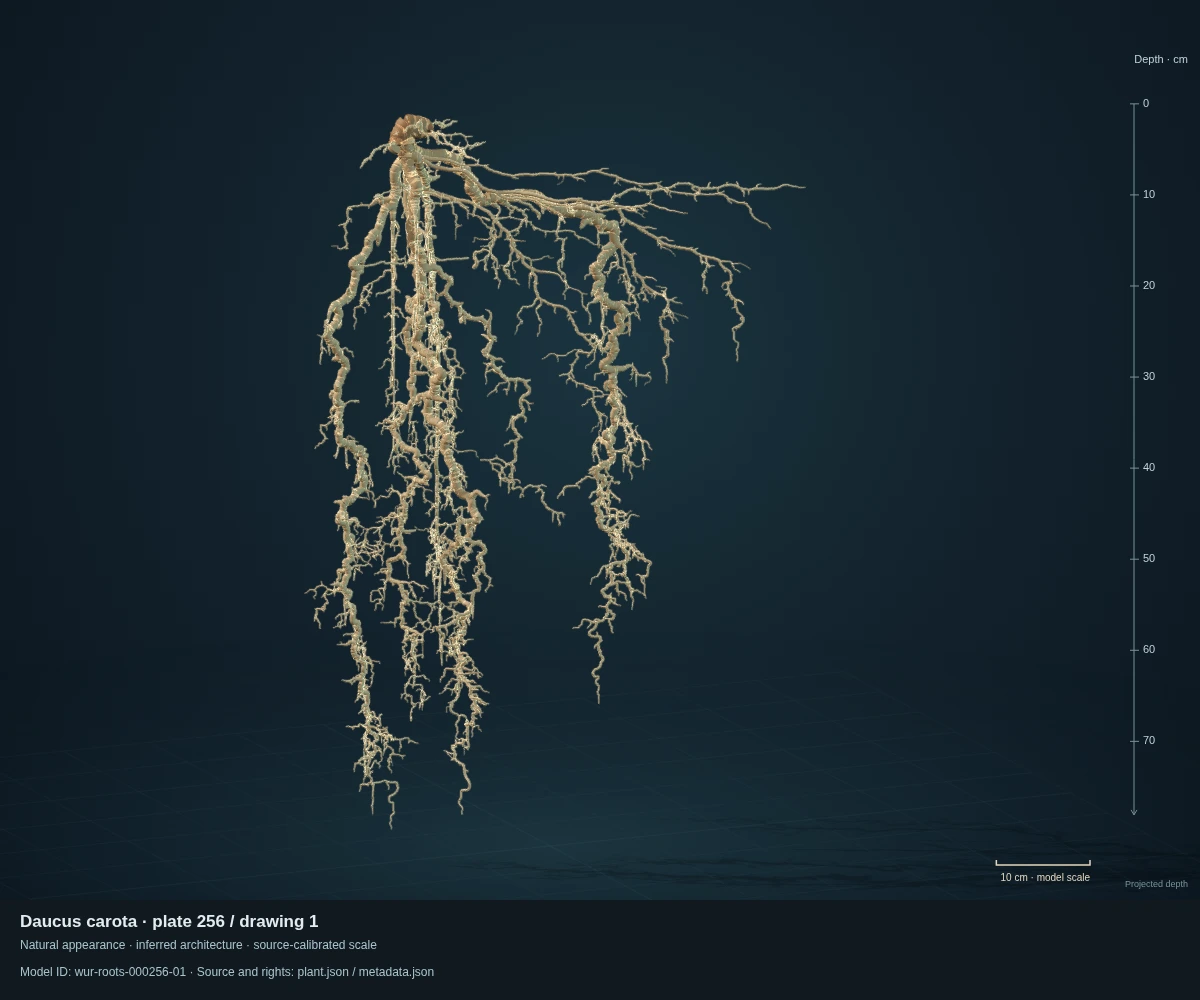
Natural view
Source projection
Side view
Calibration
Source-calibrated
Vertical extent
78 cm
Inferred axes
2093
Model metrics and plate observations

Model metrics

Depth follows the printed scale. Equal horizontal scale and hidden depth are modeling assumptions; root thickness is illustrative.

Vertical extent
78 cm
Horizontal span (x)
41.2 cm
Horizontal span (z)
57.7 cm
Centreline length
37.9 m
Inferred axes
2093
Branching sites
2021
Terminal paths
2034
Mean modelled diameter
2.65 mm
Surface area proxy
3,220 cm²
Volume proxy
425 cm³
Inferred connection length
21.3 cm
Projected length
30.7 m
Mean angle from vertical
50.5°

Dimensions reported on the source plate

Root depth
79 cm plate_256
Root-system diameter
60 cm plate_256

Drawing observations

  • fine roots leave upper neck and coarse roots fan out from lower neck
  • long bilateral oblique roots with many short fine forks
  • multiple long sinuous descenders with dense local forked patches
  • unequal bare tips with a central path reaching farthest down

Biologically constrained spatial reconstruction from source morphology. Root azimuths, hidden placement, growth responses, circular sections, thickness and proposed connections are inferred. The separate source trace retains exact drawing coordinates. No measured 3D anatomy or observed growth sequence is claimed.
Source and attribution

Study 256 · Model 01

Daucus carota · Wageningen University & Research archive

Functional view
Natural view
Source projection
Side view
Calibration
Source-calibrated
Vertical extent
1.07 m
Inferred axes
2051
Model metrics and plate observations

Model metrics

Depth follows the printed scale. Equal horizontal scale and hidden depth are modeling assumptions; root thickness is illustrative.

Vertical extent
1.07 m
Horizontal span (x)
43 cm
Horizontal span (z)
27.4 cm
Centreline length
30.7 m
Inferred axes
2051
Branching sites
1943
Terminal paths
1953
Mean modelled diameter
3.45 mm
Surface area proxy
3,550 cm²
Volume proxy
694 cm³
Inferred connection length
4.66 cm
Projected length
28.8 m
Mean angle from vertical
44.5°

Dimensions reported on the source plate

Plant height
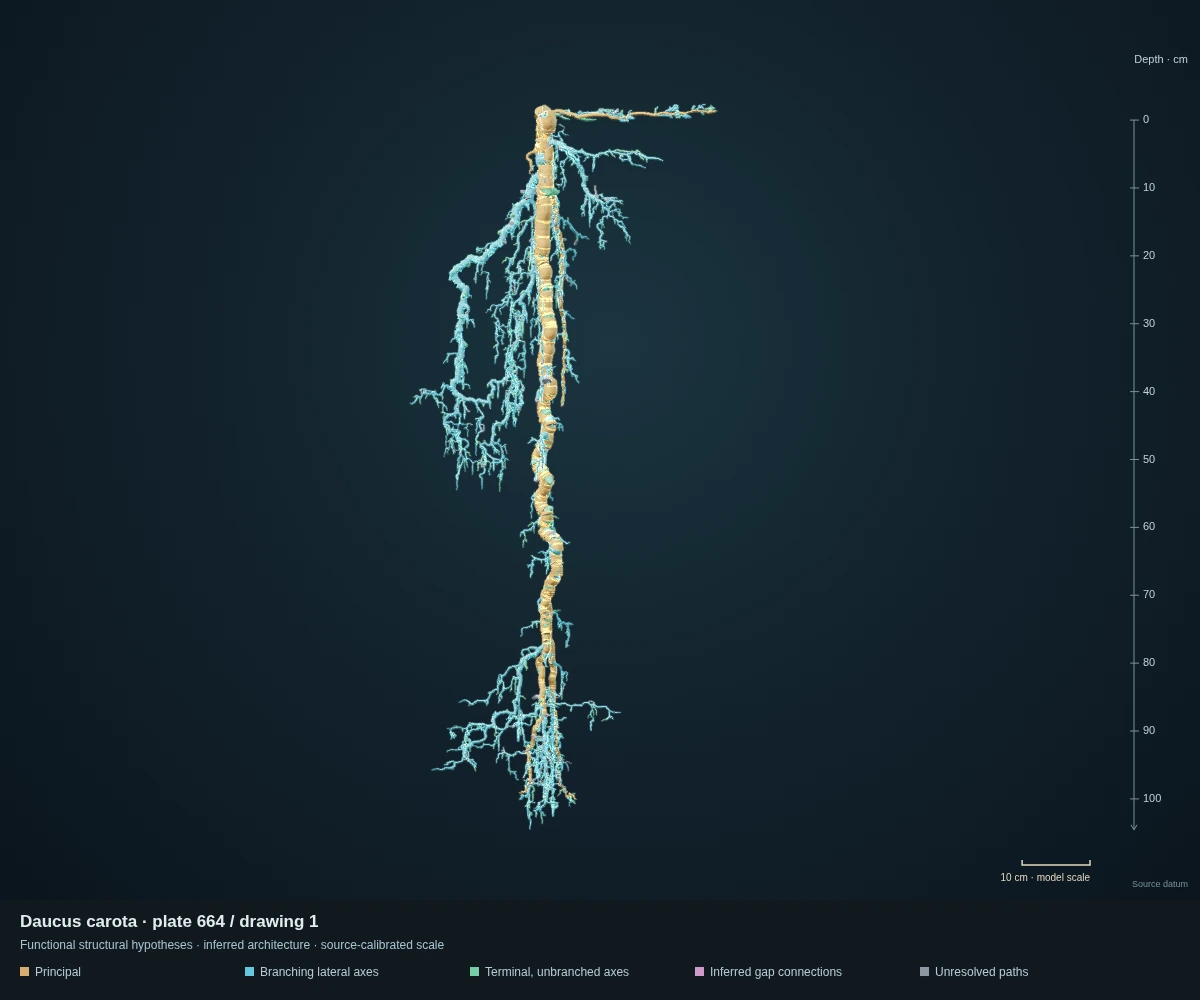
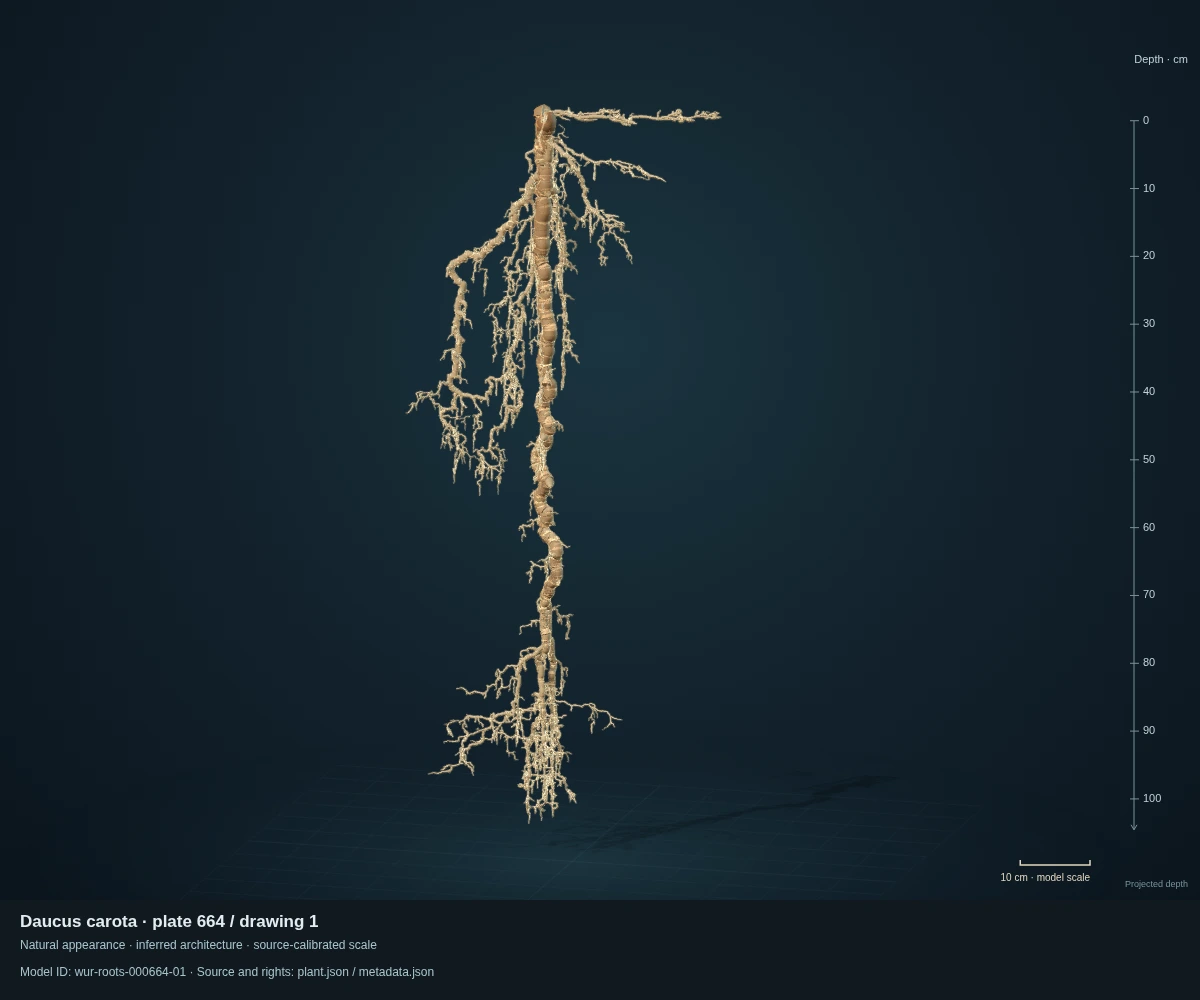
10 cm plate_664
Root depth
105 cm plate_664
Root-system diameter
43 cm plate_664

Drawing observations

  • The low spreading crown has no visible flowering stalk.
  • A thick textured cylindrical upper root narrows into a strong descending central path.
  • Broad upper laterals give way to a narrow middle interval and a dense branching terminal field below the 80 cm mark.
  • Fine forks occur along upper and lower groups with comparatively sparse middle branches.

Biologically constrained spatial reconstruction from source morphology. Root azimuths, hidden placement, growth responses, circular sections, thickness and proposed connections are inferred. The separate source trace retains exact drawing coordinates. No measured 3D anatomy or observed growth sequence is claimed.
Source and attribution

Study 664 · Model 01

Daucus carota · Wageningen University & Research archive

Names & classification

Family
Apiaceae
Genus
Daucus
Order
Apiales
Botanical authority
L.
Taxonomic rank
Species
Life form
biennial
Growth form
Herb
Native range
Macaronesia to N. Africa and Ethiopia, Europe to S. China
Climate
temperate
Mean vegetative height (TRY)
0.547 m
Maximum recorded vegetative height (TRY)
1.07 m
Archive names
Daucus carota

European ecological indicators

Light (1–9, shade to sun)
8.1
Moisture (1–12, dry to submerged)
4.1
Soil reaction (1–9, acidic to base-rich)
6.6
Nutrients (1–9, poor to rich)
No single indicator
Tichý et al. (2023)