Arbor.guide

Epilobium dodonaei

Root studies

These reconstructions follow archived root drawings. Colour identifies the modelled structural role of each root.

Functional view
Natural view
Source projection
Compound plate
Calibration
Ambiguous scale
Vertical extent
1.05 model units
Inferred axes
1023
Model metrics and plate observations

Model metrics

No metric calibration; values are in normalized model coordinates.

Vertical extent
1.05 model units
Horizontal span (x)
0.94 model units
Horizontal span (z)
0.442 model units
Centreline length
19.8 model units
Inferred axes
1023
Branching sites
959
Terminal paths
990
Mean modelled diameter
0.00334 model units
Surface area proxy
0.213 model units²
Volume proxy
0.000306 model units³
Inferred connection length
0 model units
Projected length
19.8 model units
Mean angle from vertical
57.8°

Drawing observations

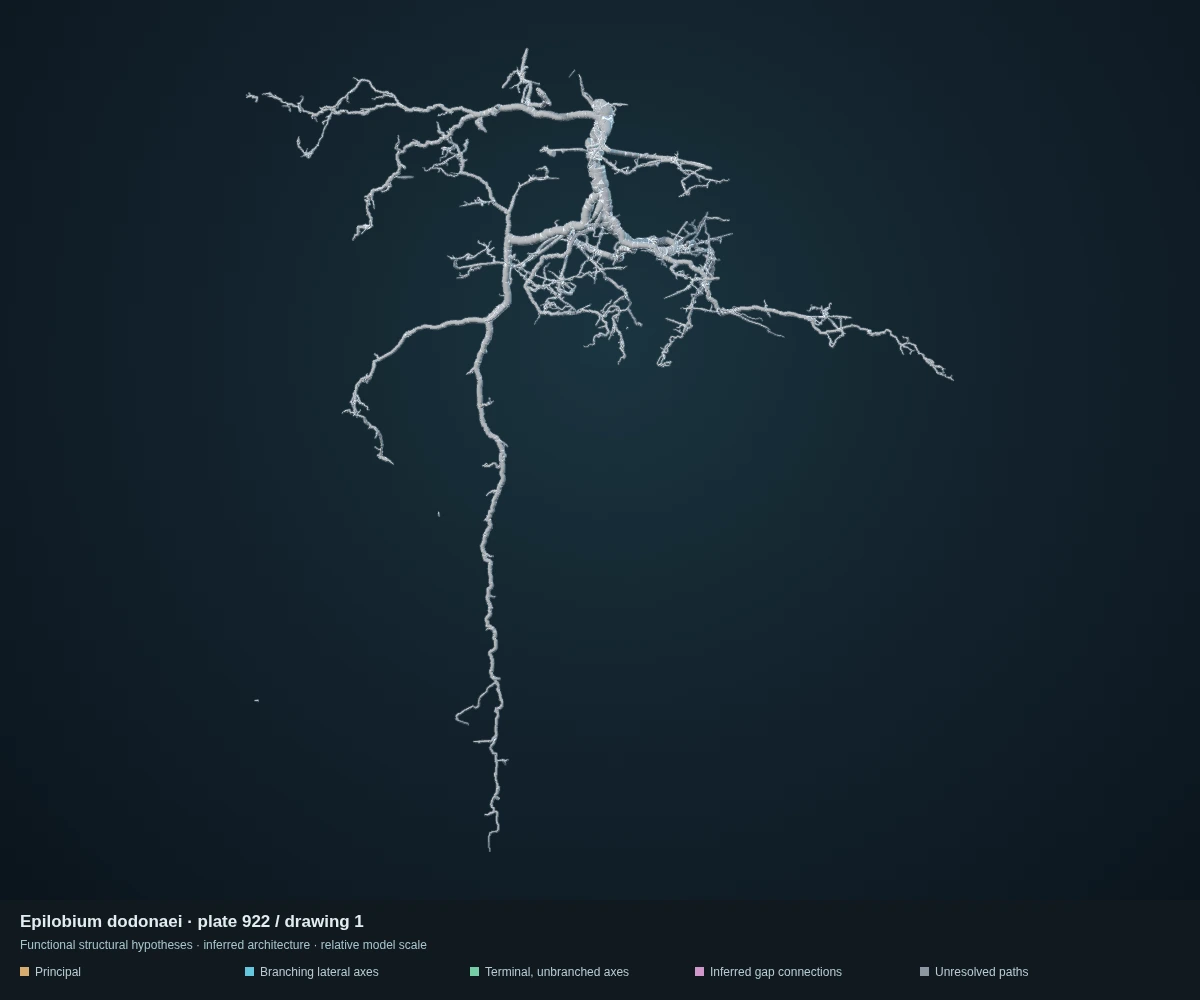
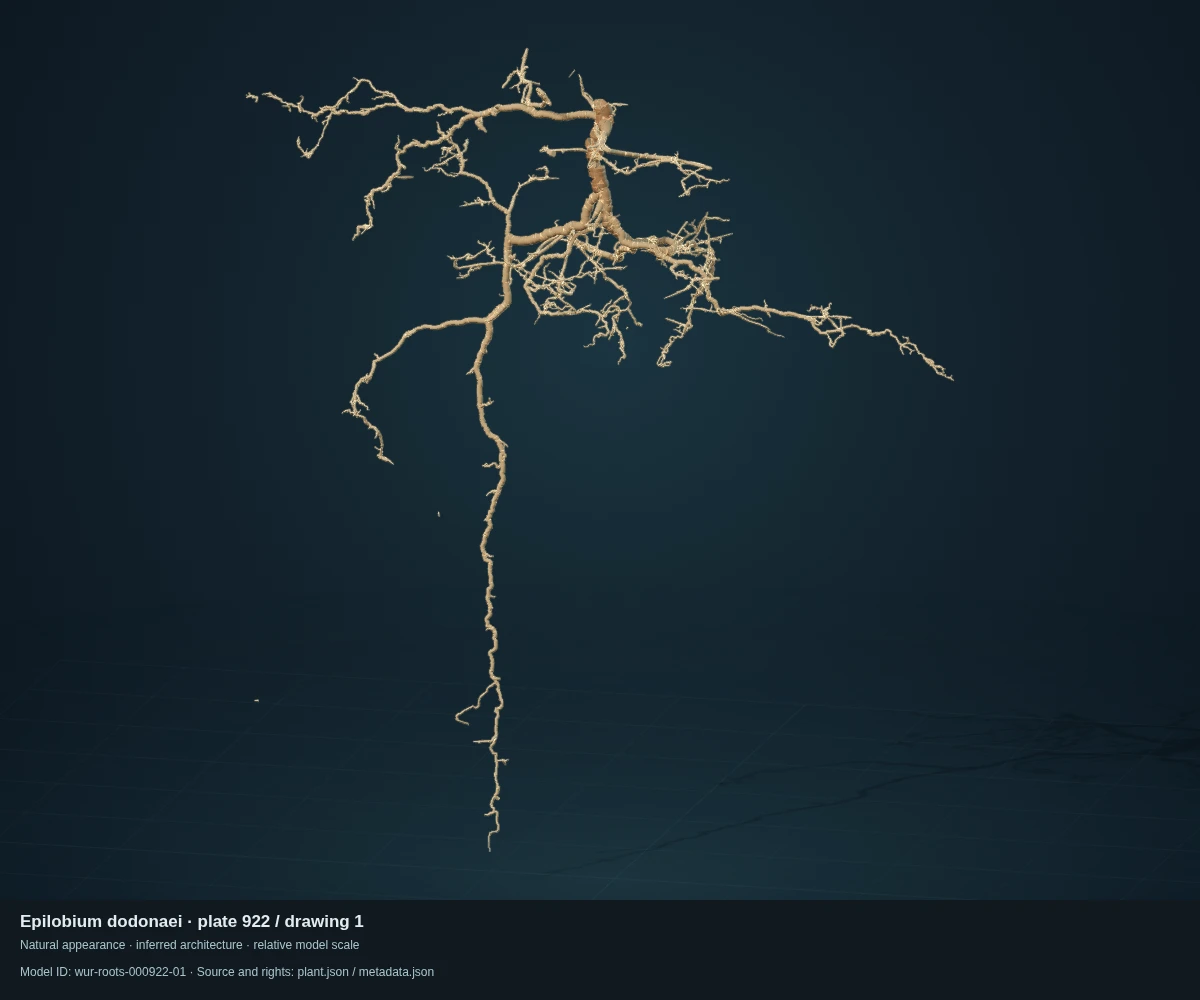
  • Thick textured descending axes occur beneath both shoot-bearing regions.
  • Long shallow and intermediate laterals cross between the regions, with sparse deep paths extending below 120.
  • Fine side branches occur in repeated patches along the coarser paths.
  • A thick textured axis descends under the left stem group.
  • Its projected lateral paths enter the crossing field shared with the right region; exclusive ownership of crossed paths is unresolved.
  • A textured descending axis occurs below the taller stem group.
  • Long lateral paths cross toward the left and deeper paths continue below the 120 reference; the crossing does not establish a biological union.

Biologically constrained spatial reconstruction from source morphology. Root azimuths, hidden placement, growth responses, circular sections, thickness and proposed connections are inferred. The separate source trace retains exact drawing coordinates. No measured 3D anatomy or observed growth sequence is claimed.

Source and attribution

Study 922 · Model 01

Epilobium dodonaei · Wageningen University & Research archive
Functional view
Natural view
Source projection
Side view
Calibration
Source-calibrated
Vertical extent
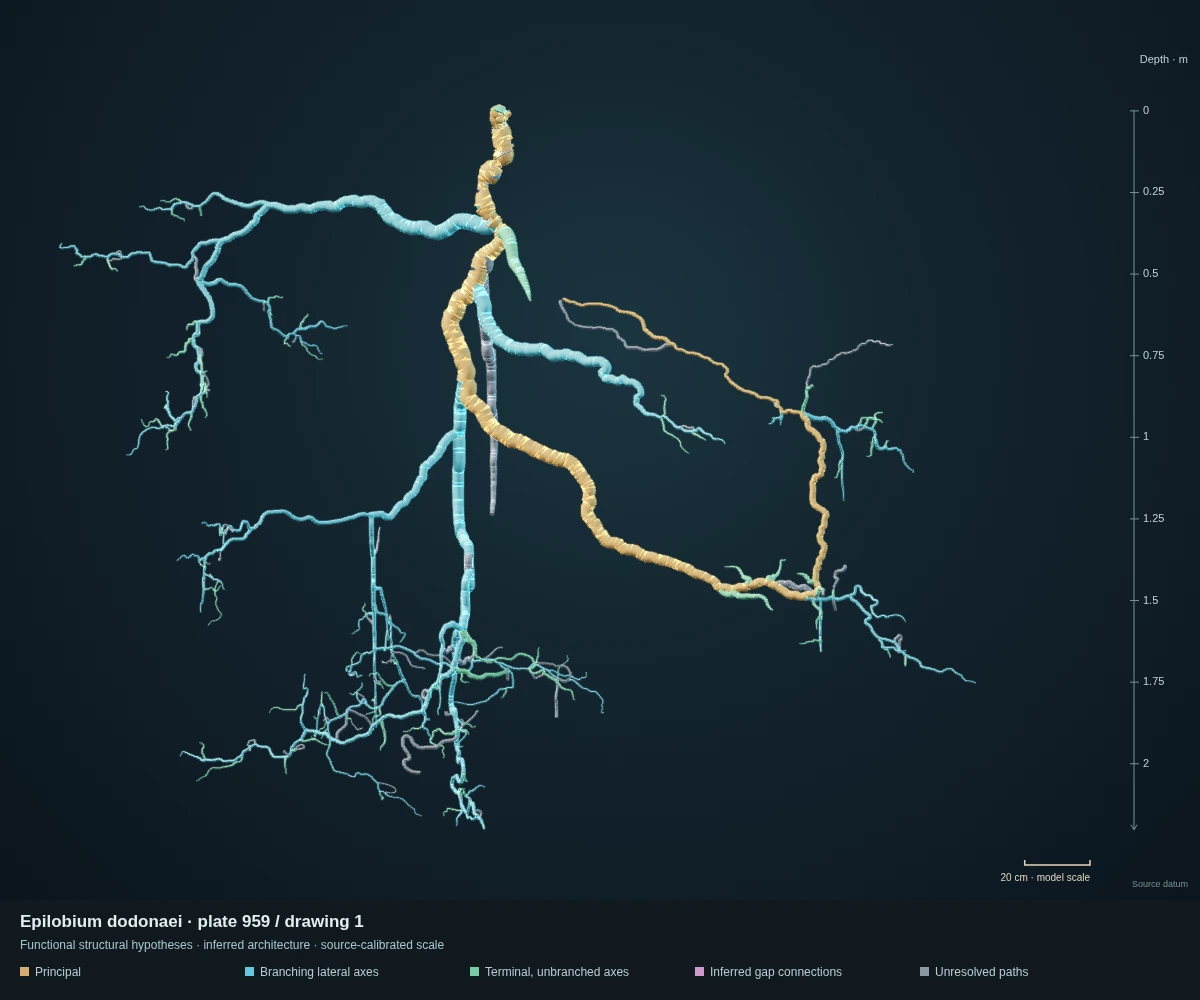
2.2 m
Inferred axes
291
Model metrics and plate observations

Model metrics

Depth follows the printed scale. Equal horizontal scale and hidden depth are modeling assumptions; root thickness is illustrative.

Vertical extent
2.2 m
Horizontal span (x)
2.54 m
Horizontal span (z)
2.1 m
Centreline length
44 m
Inferred axes
291
Branching sites
271
Terminal paths
275
Mean modelled diameter
1.26 cm
Surface area proxy
1.77 m²
Volume proxy
10,900 cm³
Inferred connection length
0 cm
Projected length
43 m
Mean angle from vertical
52.0°

Drawing observations

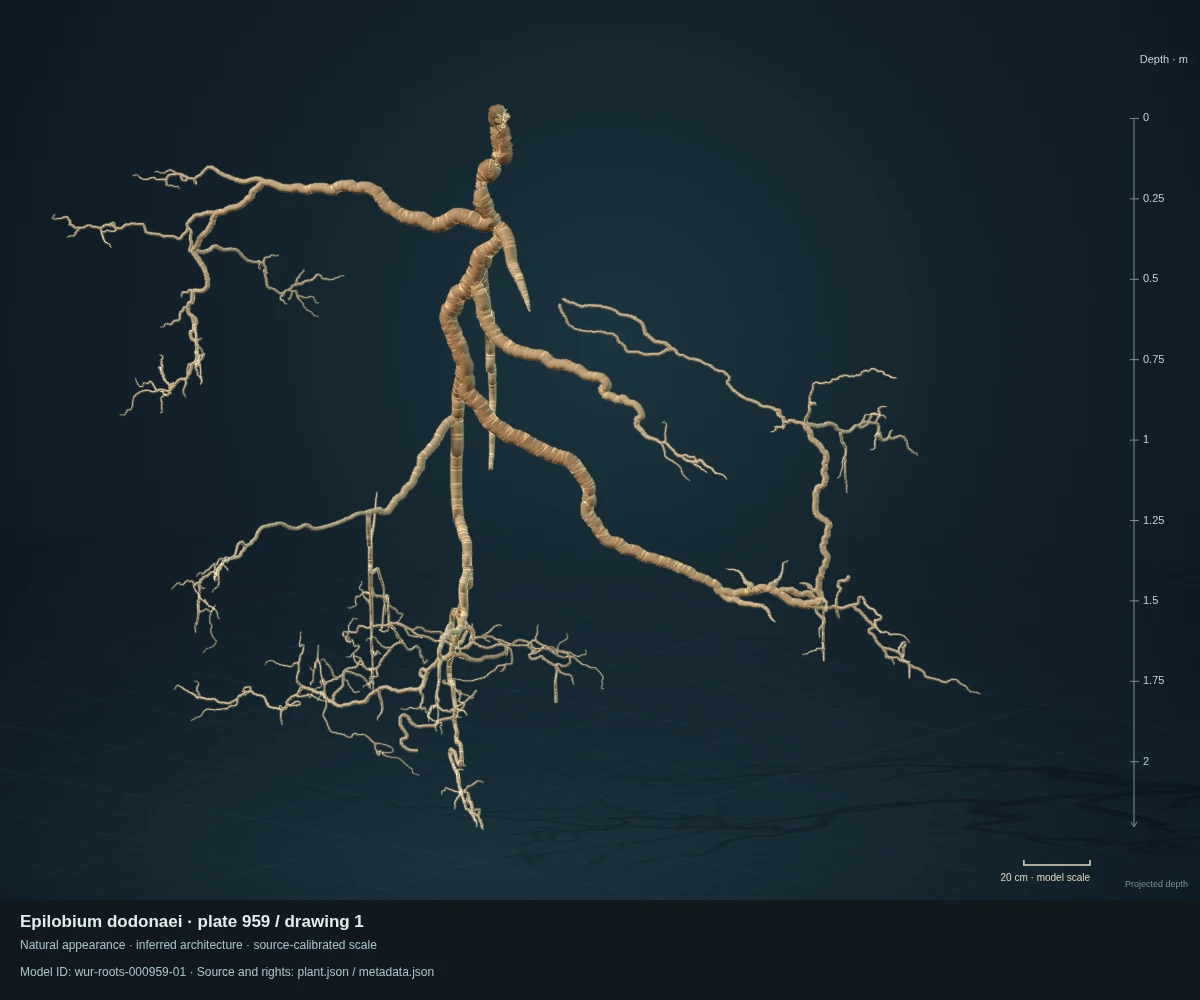
  • The thick textured curved neck divides into widely separated winding coarse roots; finer terminal branches form a broad lower field below the 200 mark.
  • The textured narrow neck bends before dividing into the large root courses.

Biologically constrained spatial reconstruction from source morphology. Root azimuths, hidden placement, growth responses, circular sections, thickness and proposed connections are inferred. The separate source trace retains exact drawing coordinates. No measured 3D anatomy or observed growth sequence is claimed.

Source and attribution

Study 959 · Model 01

Epilobium dodonaei · Wageningen University & Research archive
Names & classification

Family
Onagraceae
Genus
Epilobium
Order
Myrtales
Botanical authority
Vill.
Taxonomic rank
Species
Life form
perennial
Native range
Europe to NW. Iran
Climate
temperate
Archive names
Epilobium dodonaei

European ecological indicators

Light (1–9, shade to sun)
8.8
Moisture (1–12, dry to submerged)
4.1
Soil reaction (1–9, acidic to base-rich)
8
Nutrients (1–9, poor to rich)
2.4
Tichý et al. (2023)