Arbor.guide

Eryngium campestre

Field Eryngo

Root studies

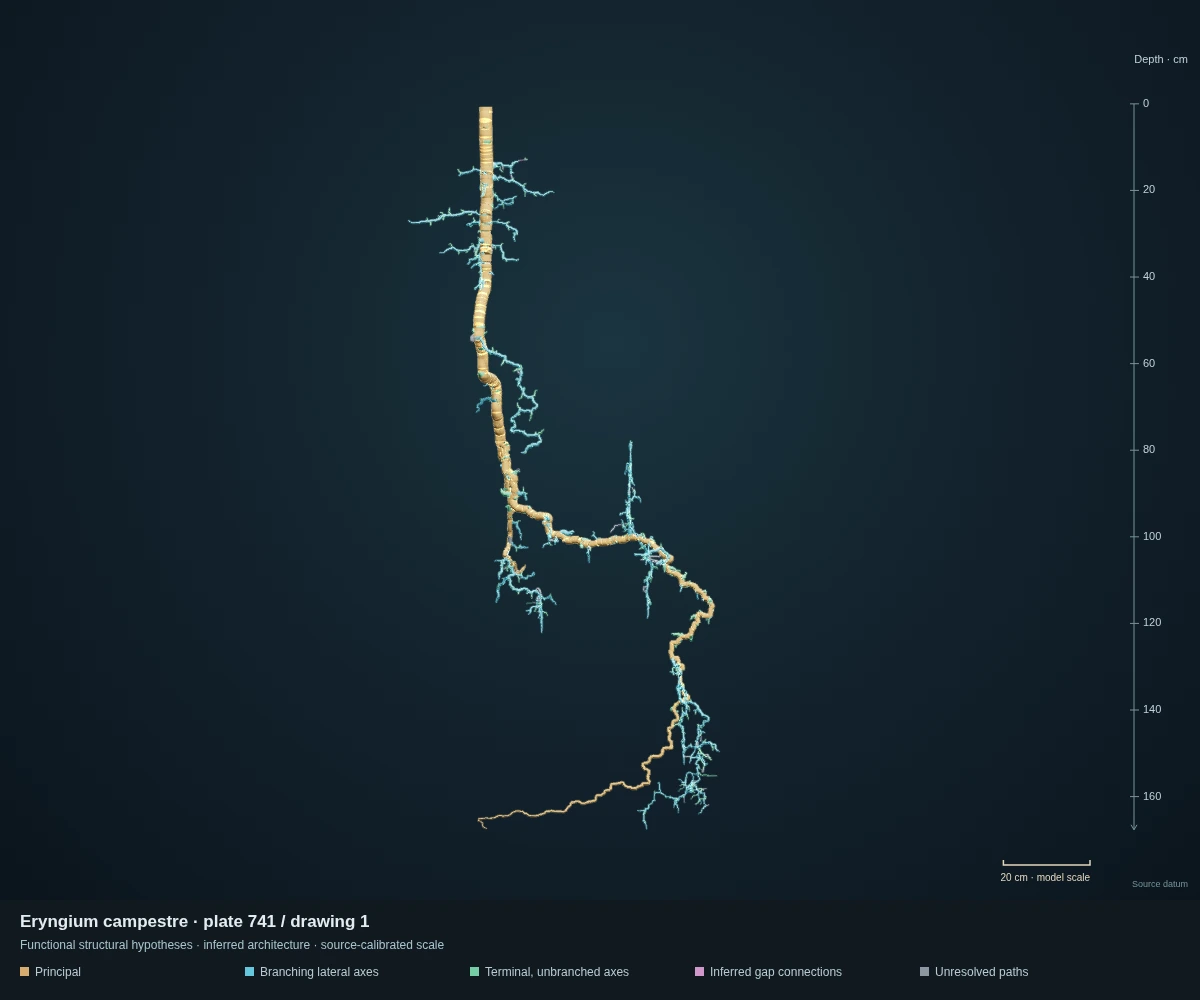
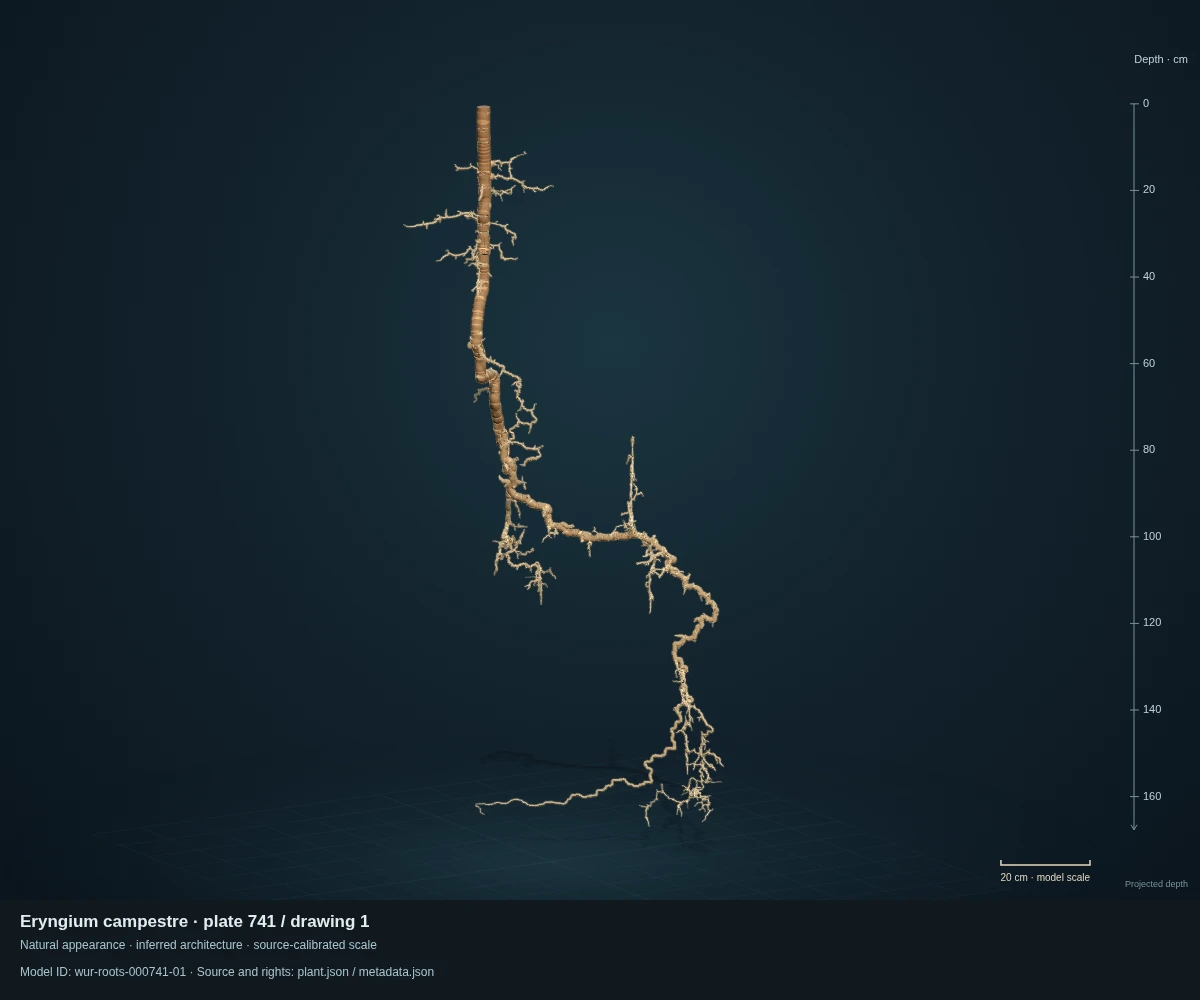
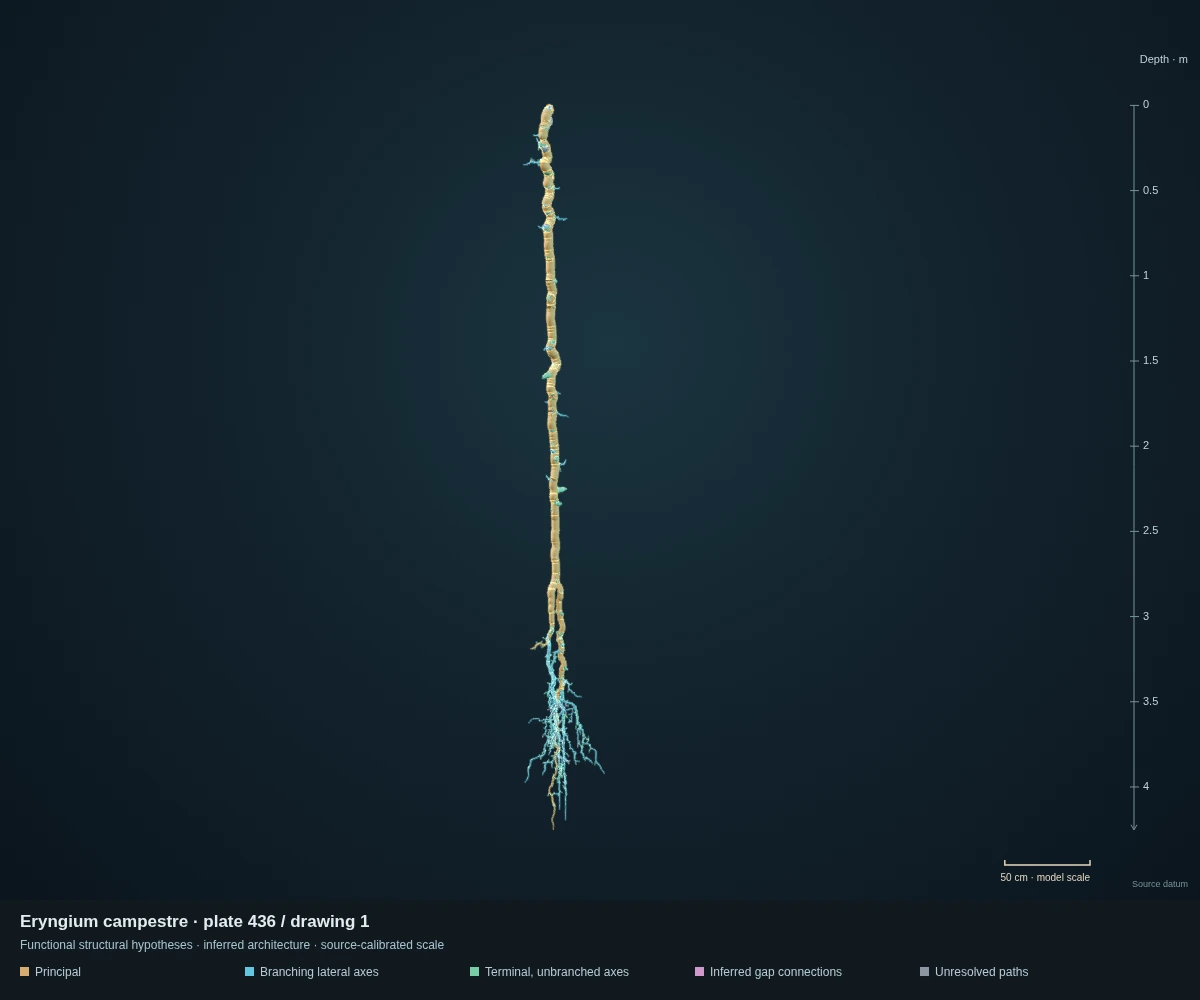
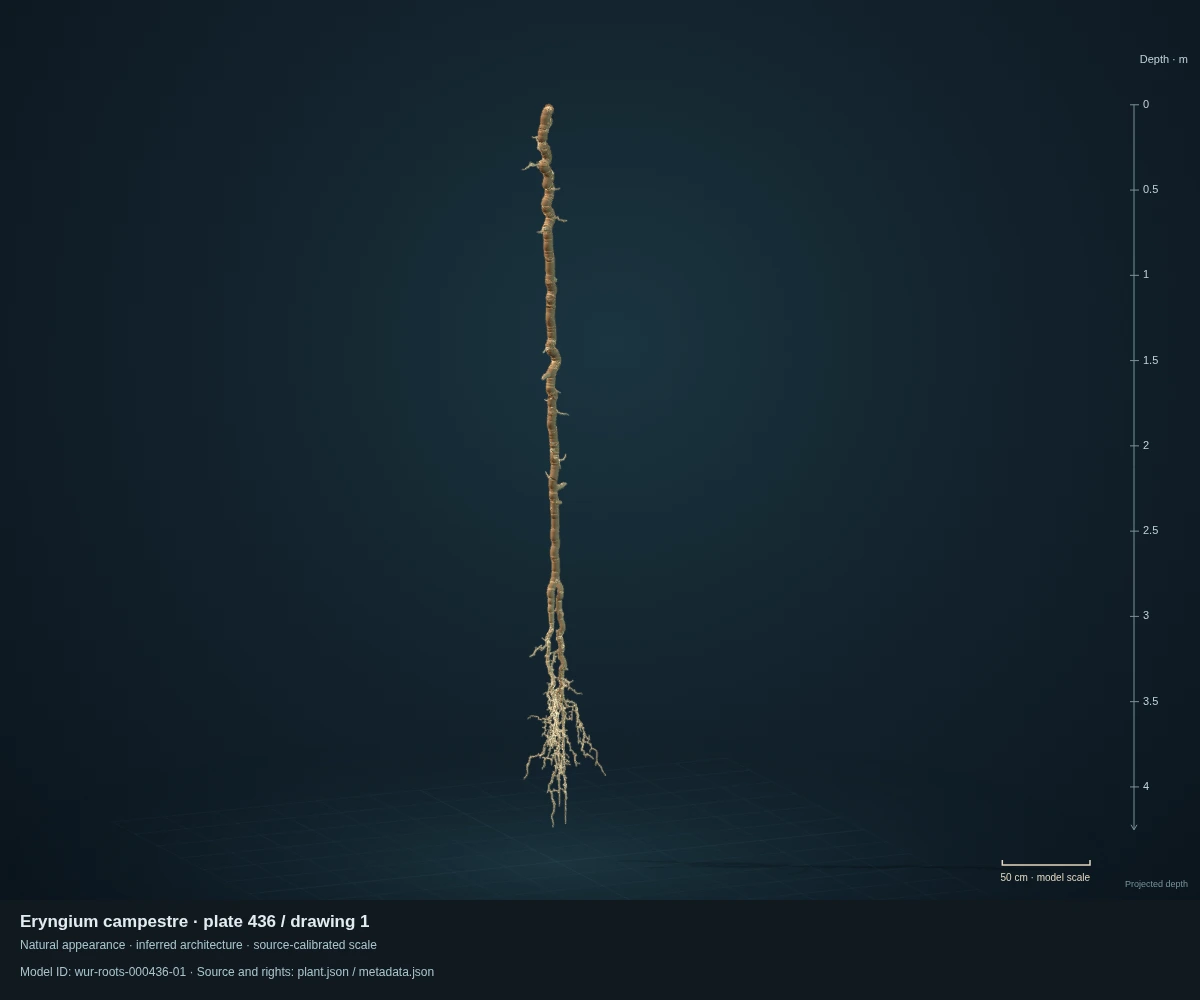
These reconstructions follow archived root drawings. Colour identifies the modelled structural role of each root.

Functional view
Natural view
Source projection
Side view
Calibration
Source-calibrated
Vertical extent
4.25 m
Inferred axes
487
Model metrics and plate observations

Model metrics

Depth follows the printed scale. Equal horizontal scale and hidden depth are modeling assumptions; root thickness is illustrative.

Vertical extent
4.25 m
Horizontal span (x)
32 cm
Horizontal span (z)
47 cm
Centreline length
26.2 m
Inferred axes
487
Branching sites
457
Terminal paths
462
Mean modelled diameter
1.57 cm
Surface area proxy
1.34 m²
Volume proxy
10,900 cm³
Inferred connection length
2.45 cm
Projected length
23 m
Mean angle from vertical
43.1°

Dimensions reported on the source plate

Plant height
40 cm plate_436
Root depth
459 cm plate_436
Root-system diameter
48 cm plate_436

Drawing observations

  • finely divided leaf group and exceptionally deep narrow taproot
  • long upright and outward spreading branched leaf axes
  • long wavy coarse taproot with extended sparsely branched middle
  • small scattered short side branches
  • main axis divides before the deep fine branching zone
  • denser forked root fan below 300cm axis tick
  • several long unequal lower descenders

Biologically constrained spatial reconstruction from source morphology. Root azimuths, hidden placement, growth responses, circular sections, thickness and proposed connections are inferred. The separate source trace retains exact drawing coordinates. No measured 3D anatomy or observed growth sequence is claimed.

Source and attribution

Study 436 · Model 01

Eryngium campestre · Wageningen University & Research archive
Functional view
Natural view
Source projection
Side view
Calibration
Source-calibrated
Vertical extent
1.67 m
Inferred axes
641
Model metrics and plate observations

Model metrics

Depth follows the printed scale. Equal horizontal scale and hidden depth are modeling assumptions; root thickness is illustrative.

Vertical extent
1.67 m
Horizontal span (x)
61.1 cm
Horizontal span (z)
64.7 cm
Centreline length
18.1 m
Inferred axes
641
Branching sites
622
Terminal paths
629
Mean modelled diameter
6.42 mm
Surface area proxy
3,760 cm²
Volume proxy
1,180 cm³
Inferred connection length
4.75 cm
Projected length
16.1 m
Mean angle from vertical
50.0°

Dimensions reported on the source plate

Plant height
24 cm plate_741
Root depth
168 cm plate_741
Root-system diameter
74 cm plate_741

Drawing observations

  • long thick dominant root with fine upper twigs
  • larger lateral tiers among sparse fine roots
  • strong bends and loops with sparse coarse side roots
  • long nearly horizontal low terminal segment
  • short fine twigs and unequal sparse deep axes

Biologically constrained spatial reconstruction from source morphology. Root azimuths, hidden placement, growth responses, circular sections, thickness and proposed connections are inferred. The separate source trace retains exact drawing coordinates. No measured 3D anatomy or observed growth sequence is claimed.

Source and attribution

Study 741 · Model 01

Eryngium campestre · Wageningen University & Research archive
Names & classification

Family
Apiaceae
Genus
Eryngium
Order
Apiales
Botanical authority
L.
Taxonomic rank
Species
Life form
perennial
Growth form
Herb
Native range
Europe to Caucasus, NW. Africa
Climate
temperate
Mean vegetative height (TRY)
0.357 m
Maximum recorded vegetative height (TRY)
0.75 m
Archive names
Eryngium campestre

European ecological indicators

Light (1–9, shade to sun)
8.7
Moisture (1–12, dry to submerged)
3
Soil reaction (1–9, acidic to base-rich)
7.5
Nutrients (1–9, poor to rich)
3.3
Tichý et al. (2023)