Arbor.guide

Botanical field guide

Calluna vulgaris

Heather

1332 / 2,347

Shrub / Ericaceae

The plant, in detail

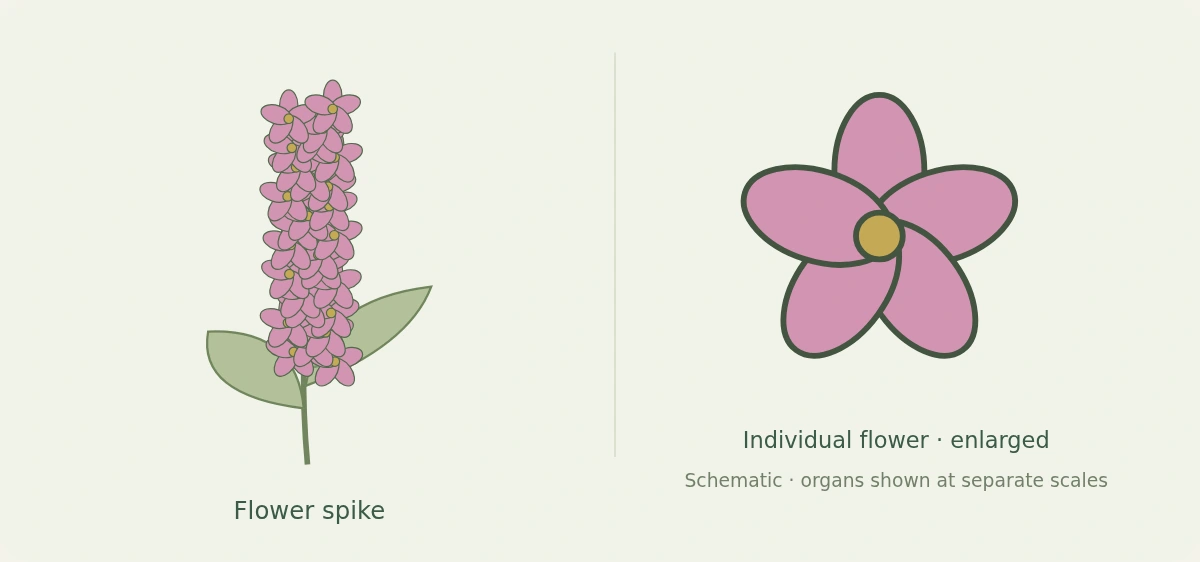
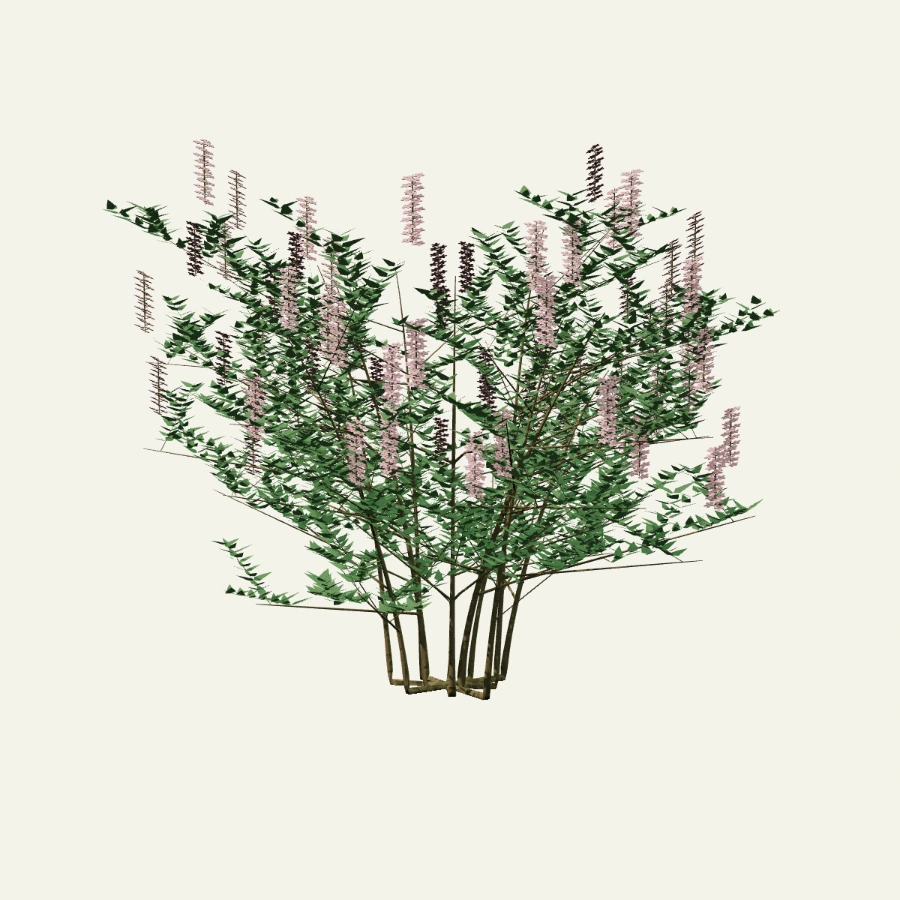
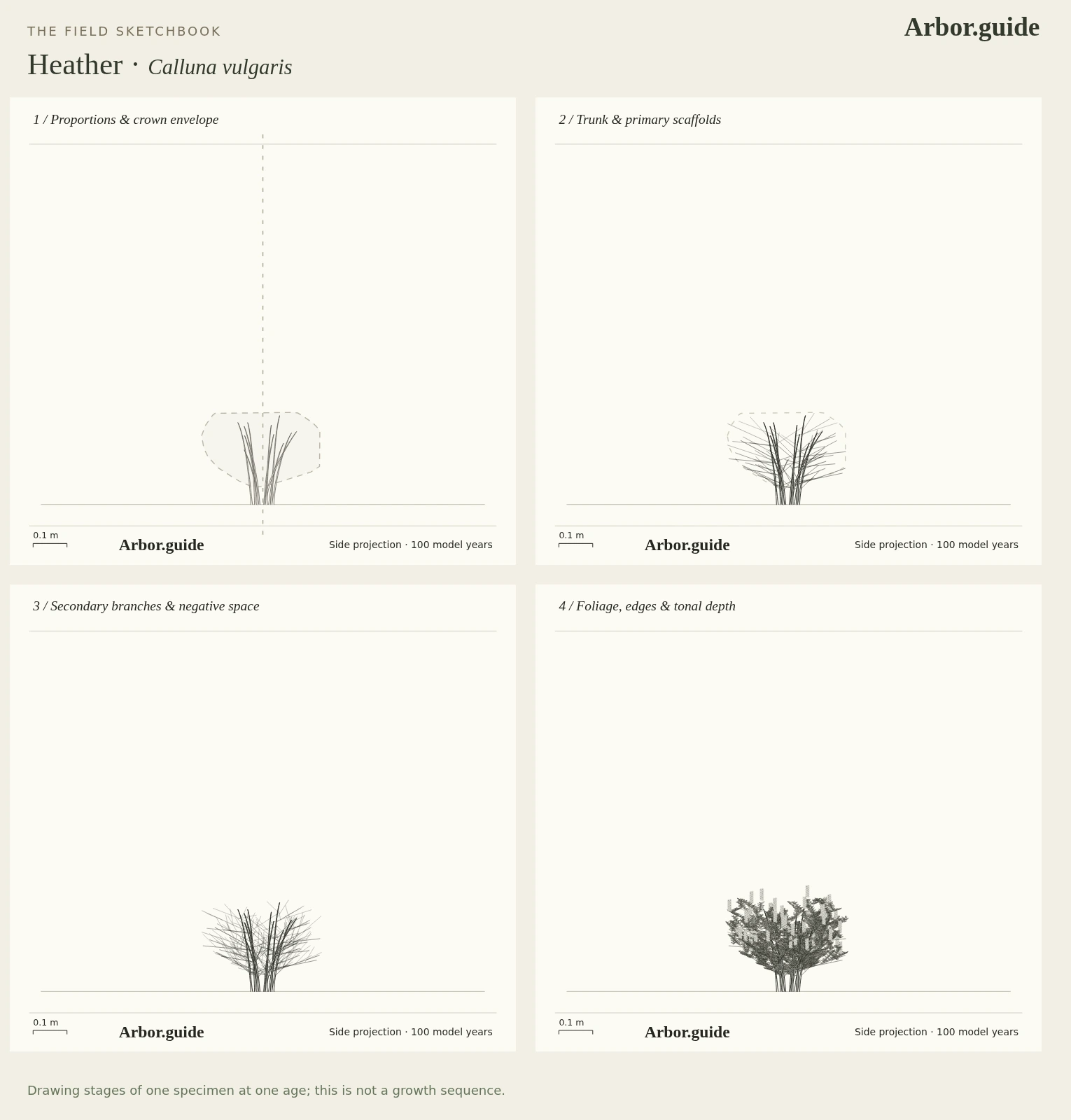
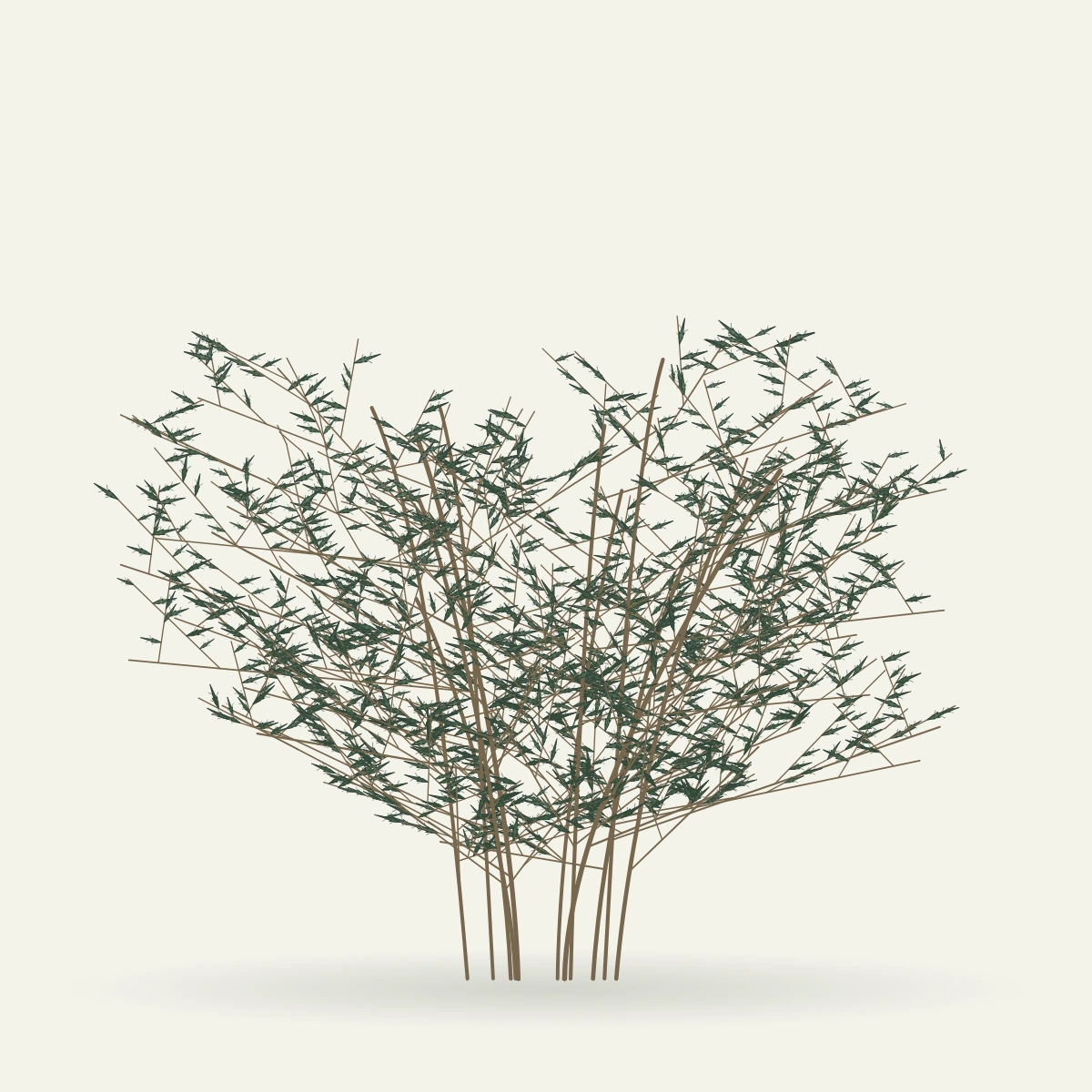
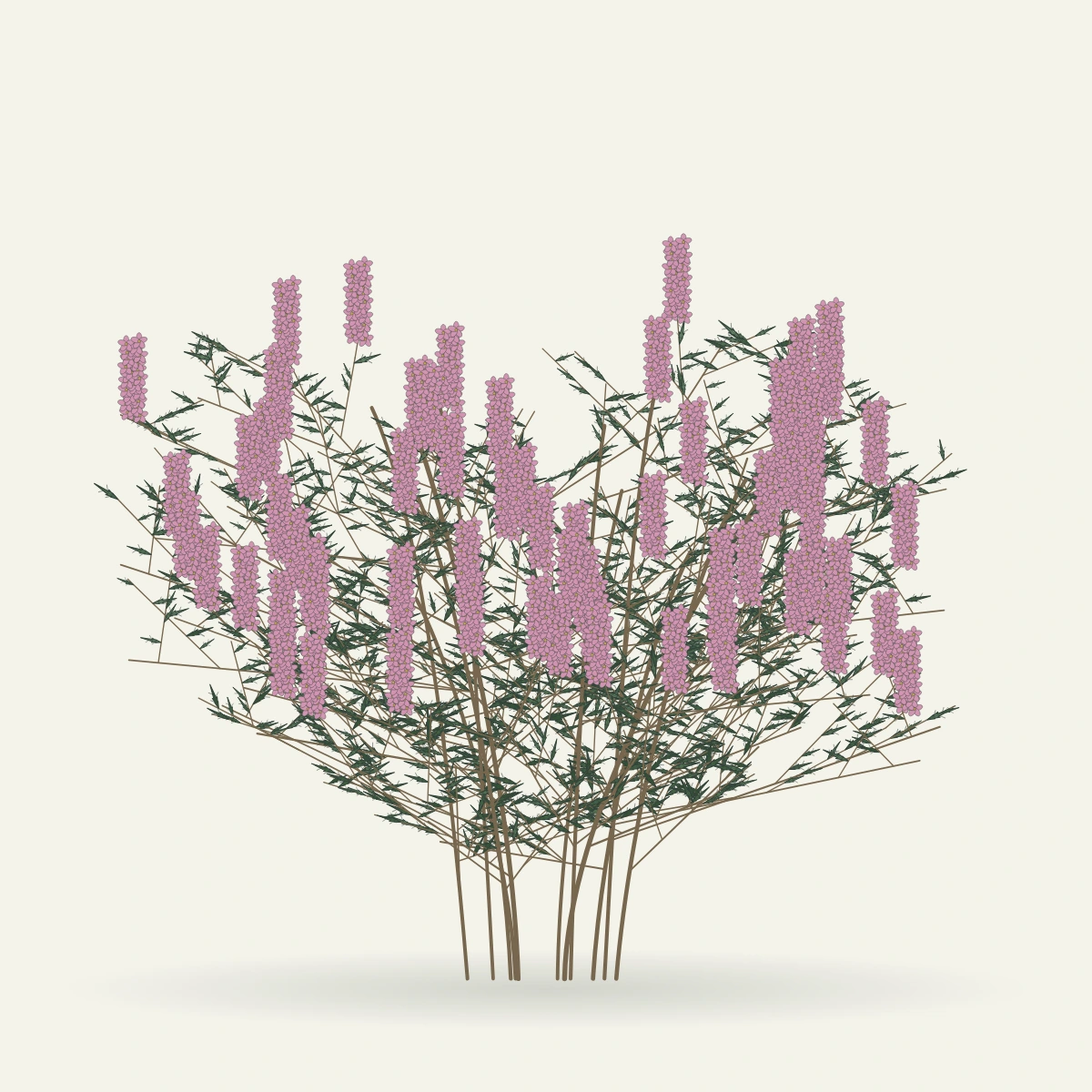
Heather has a ascending · dense · spreading habit. Simple; ; ; opposite insertion. Pink · Purple/Lavender · Red/Burgundy flowers; fall · summer.

Reference height
0.1–0.61 m
Foliage habit
Evergreen
USDA zones
4–6
Light
Full sun · Partial shade

Horticultural reference range in metres. Cultivars and site conditions can differ; this range is not a species maximum.

Crown

Ascending · dense · spreading.

Branching

Opposite leaf insertion; branch positions in the reconstruction are ArborAI.

Bark

Colour varies with stem age; texture described in the source.

Roots

A schematic spreading root framework. The selected source does not quantify root depth or radius.

Root studies

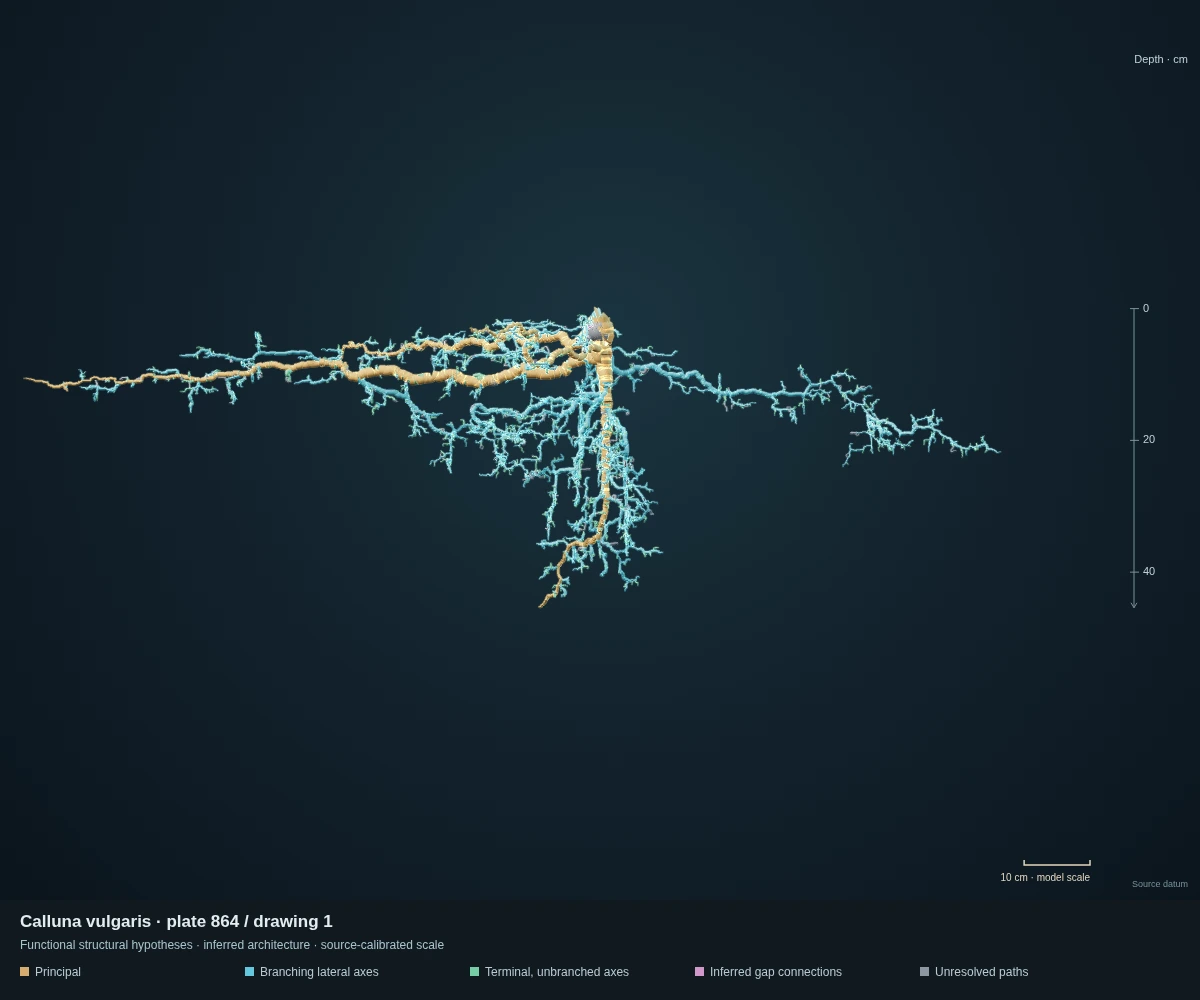
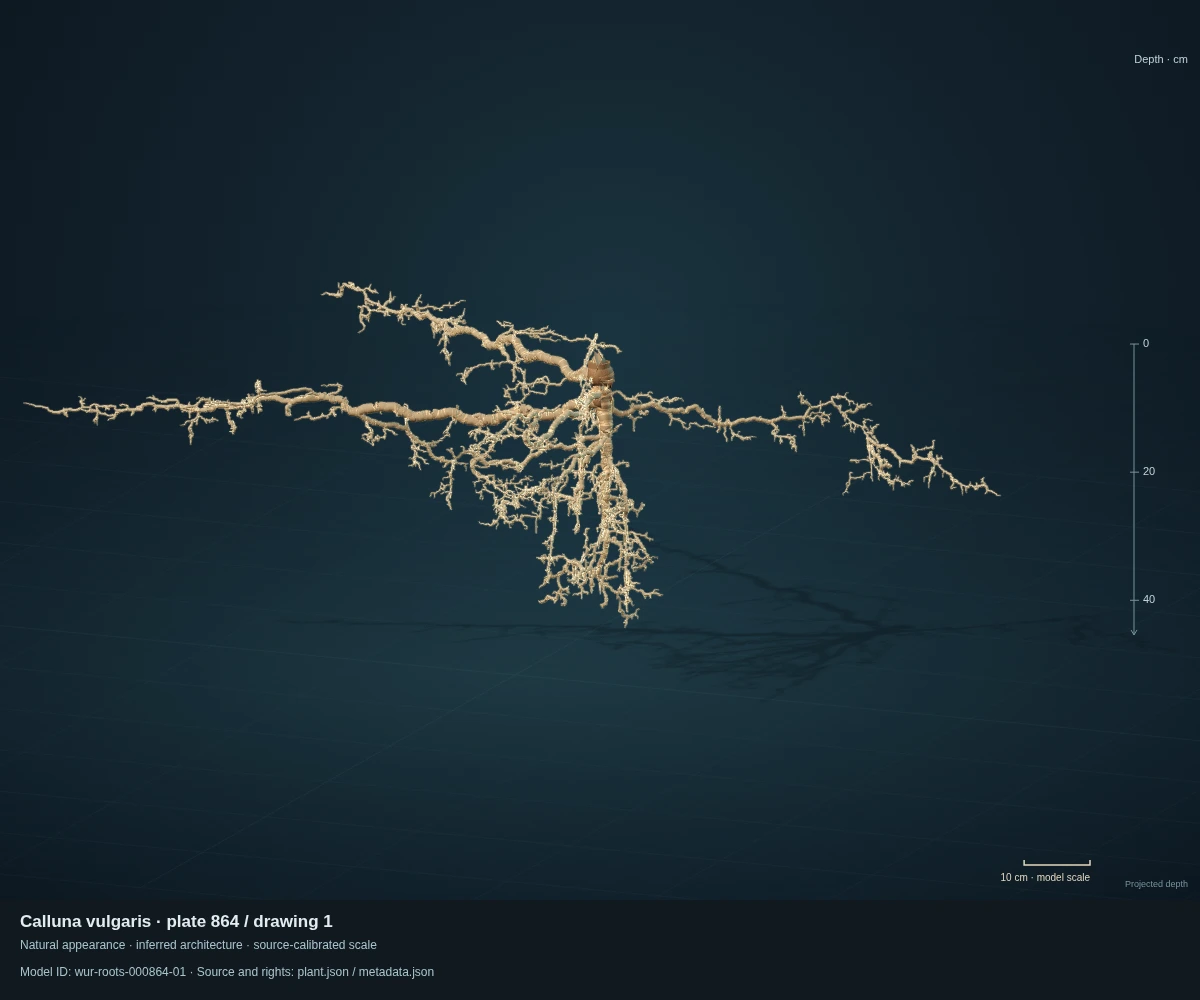
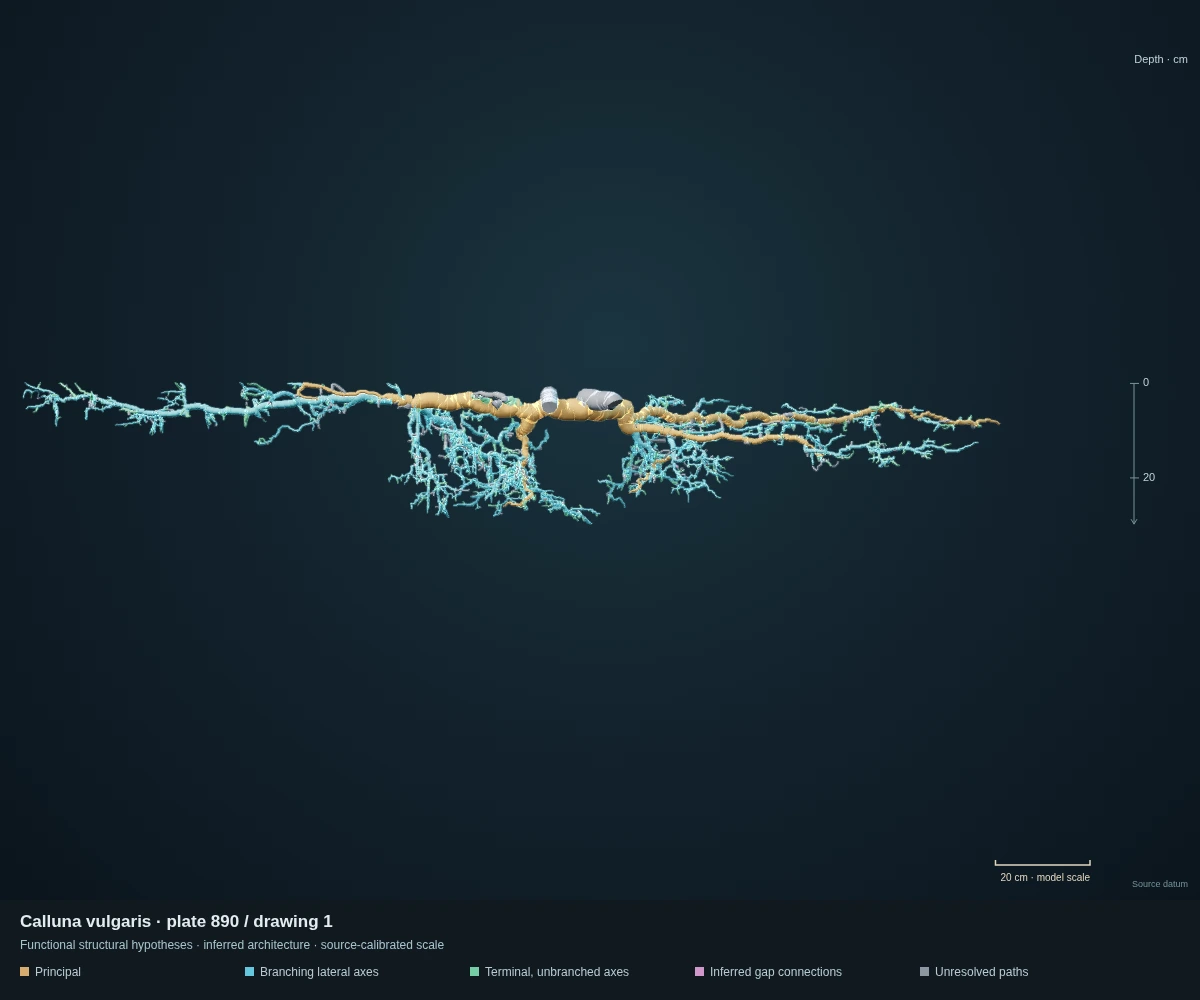
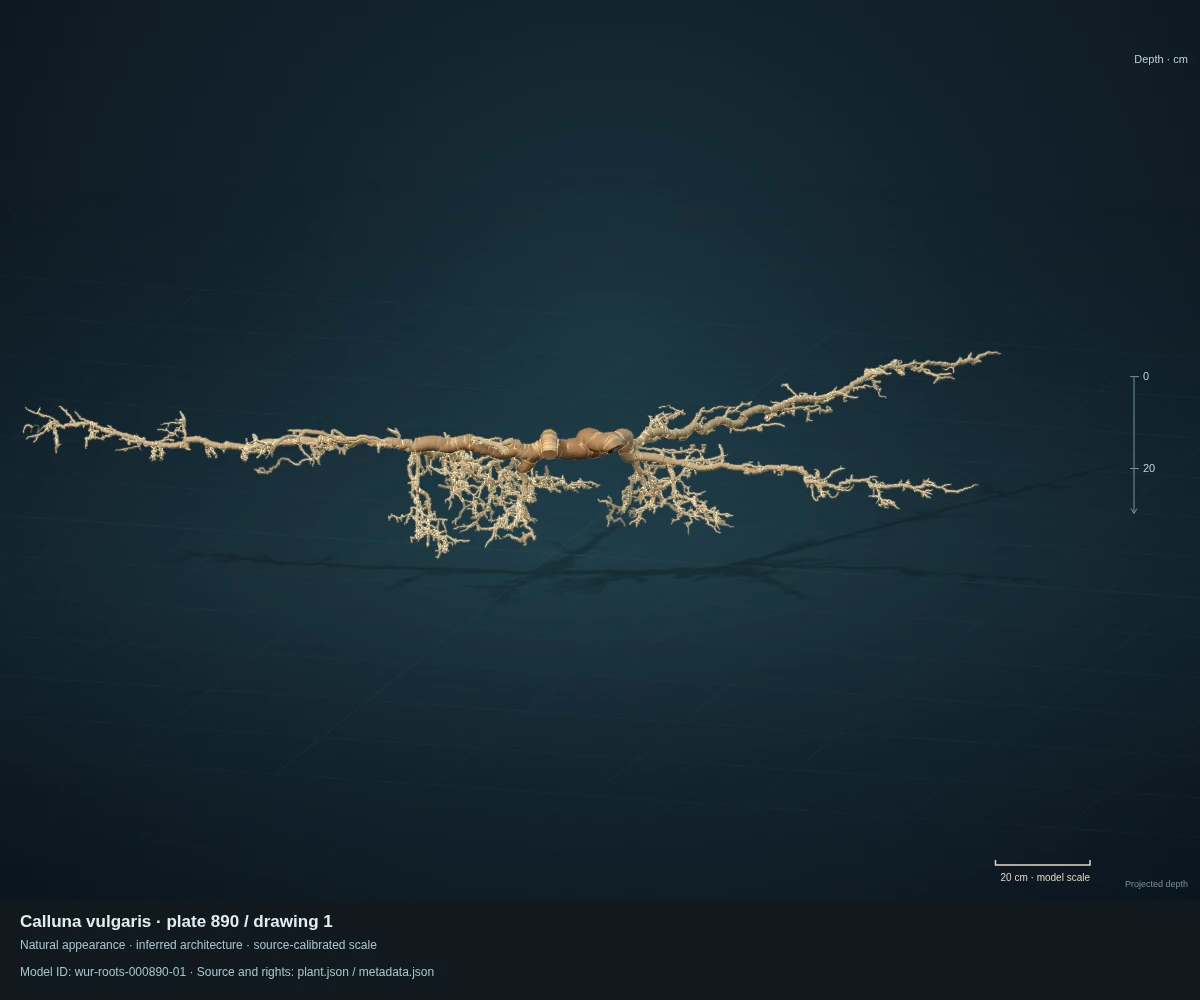
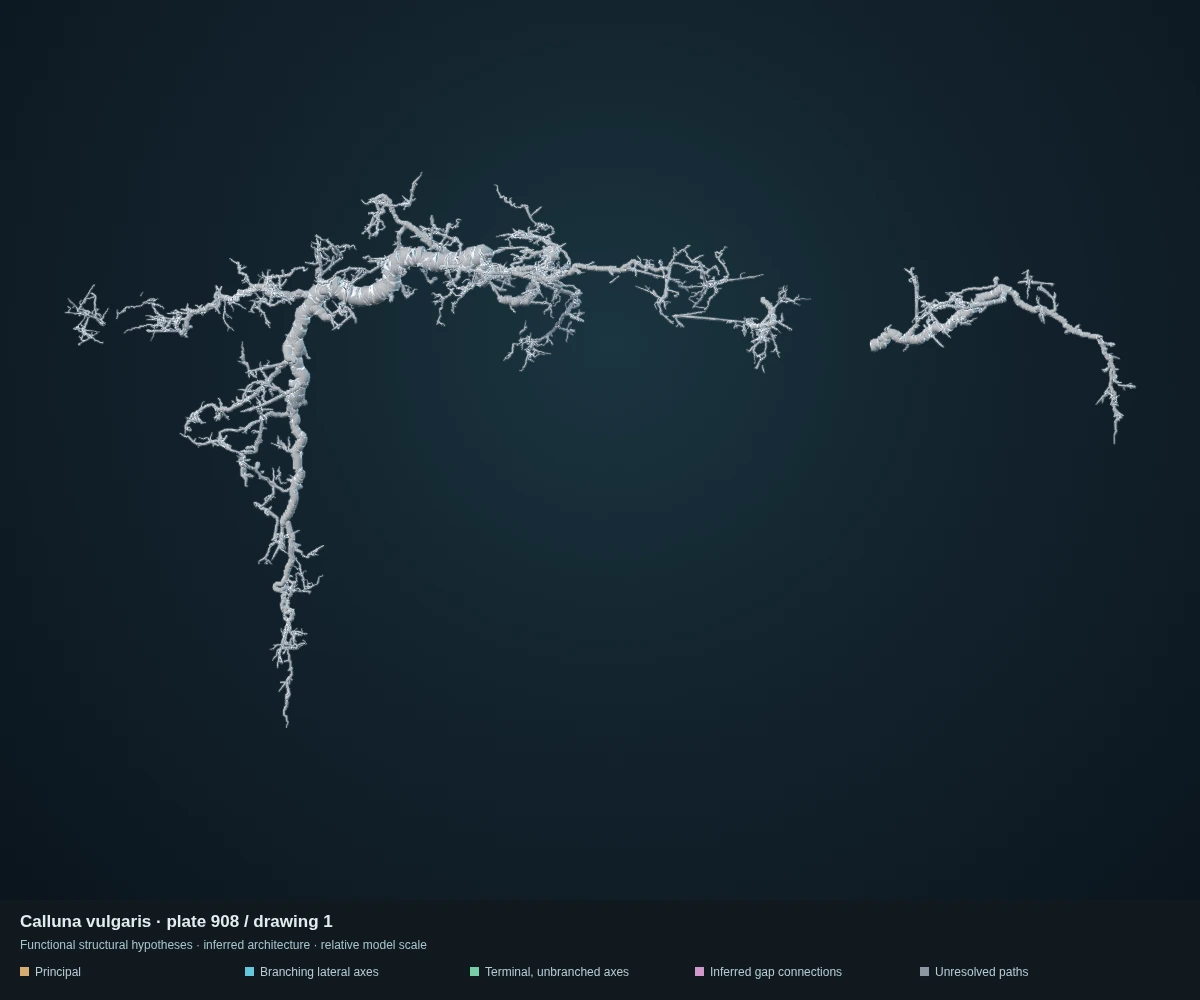
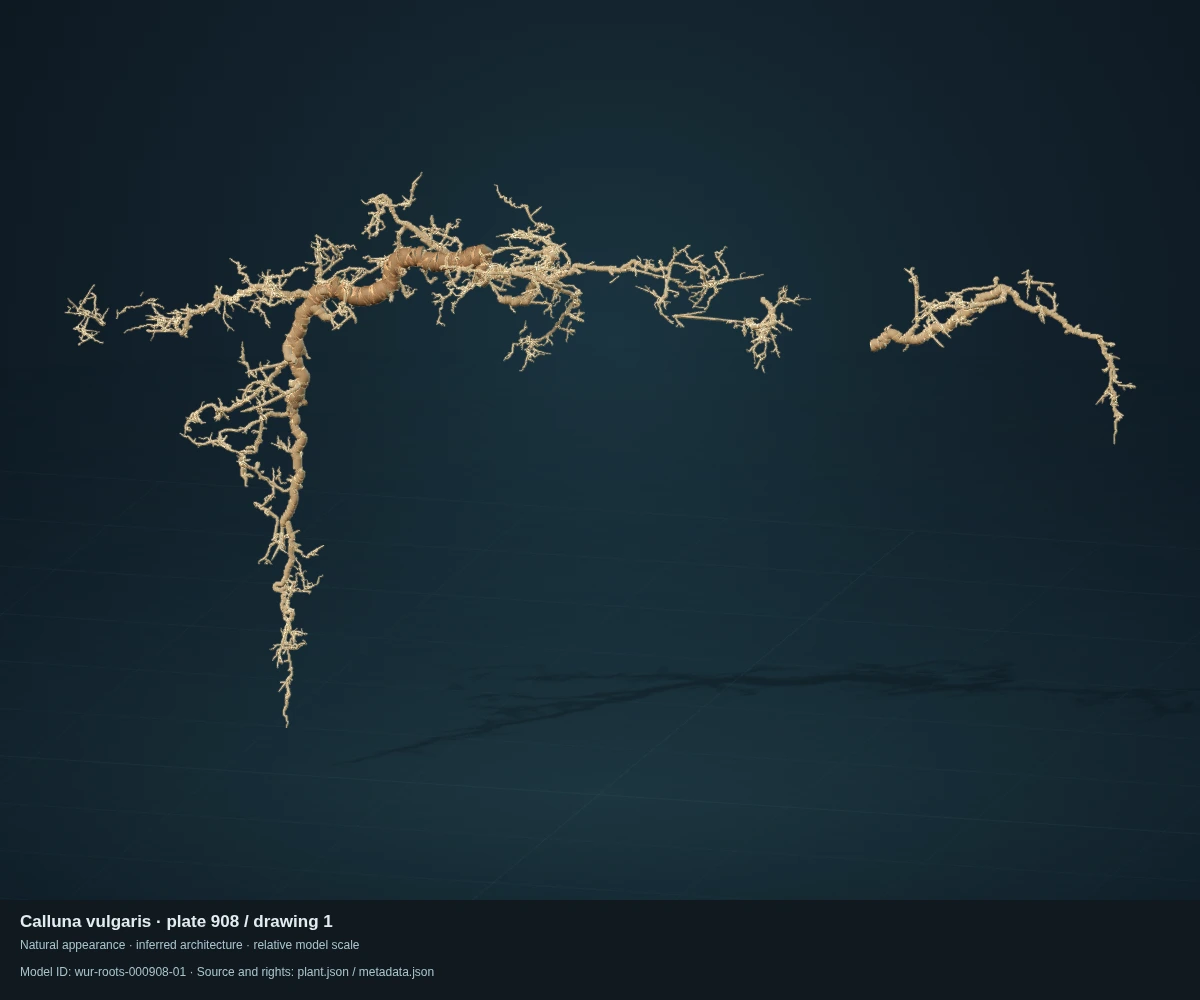
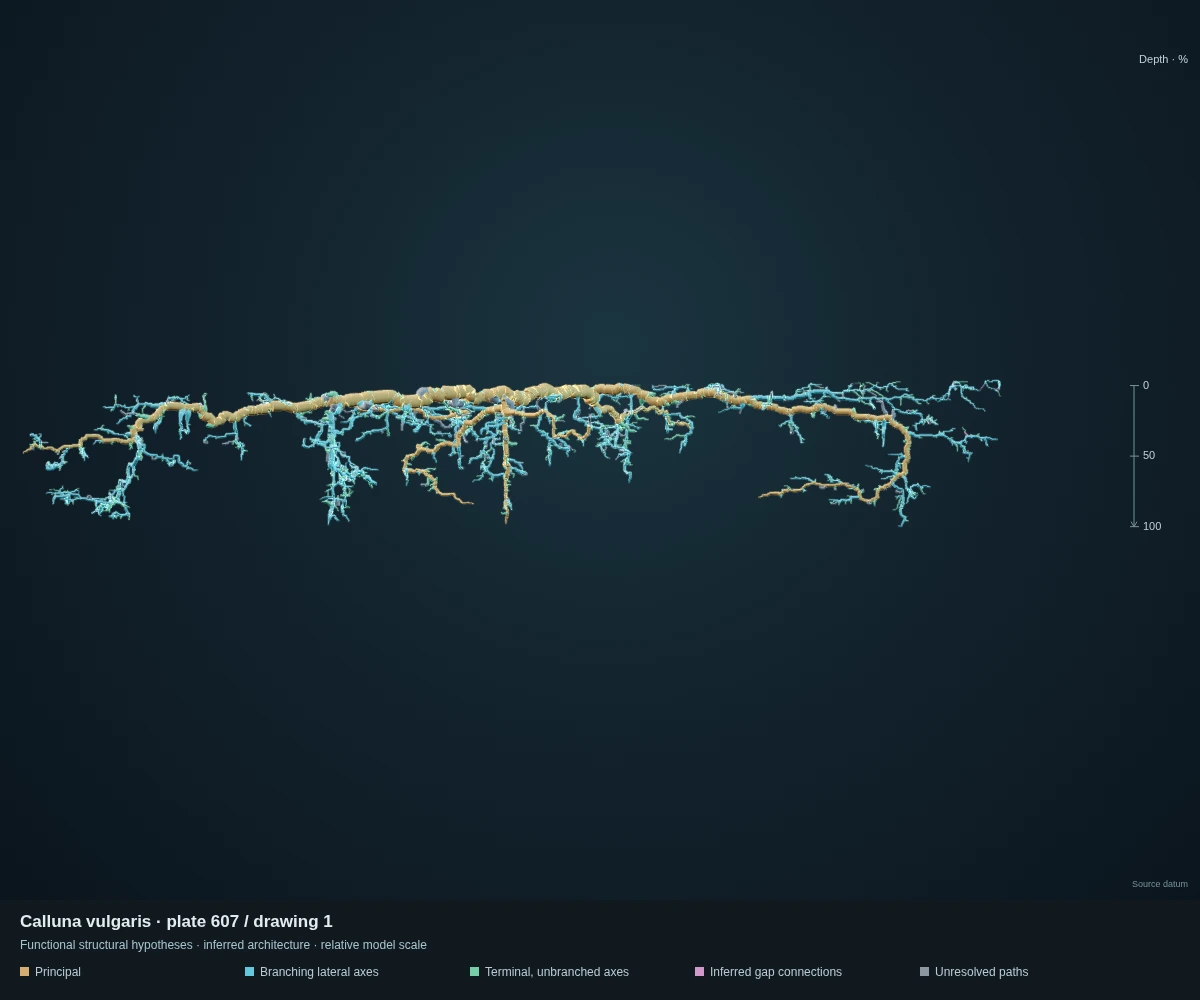
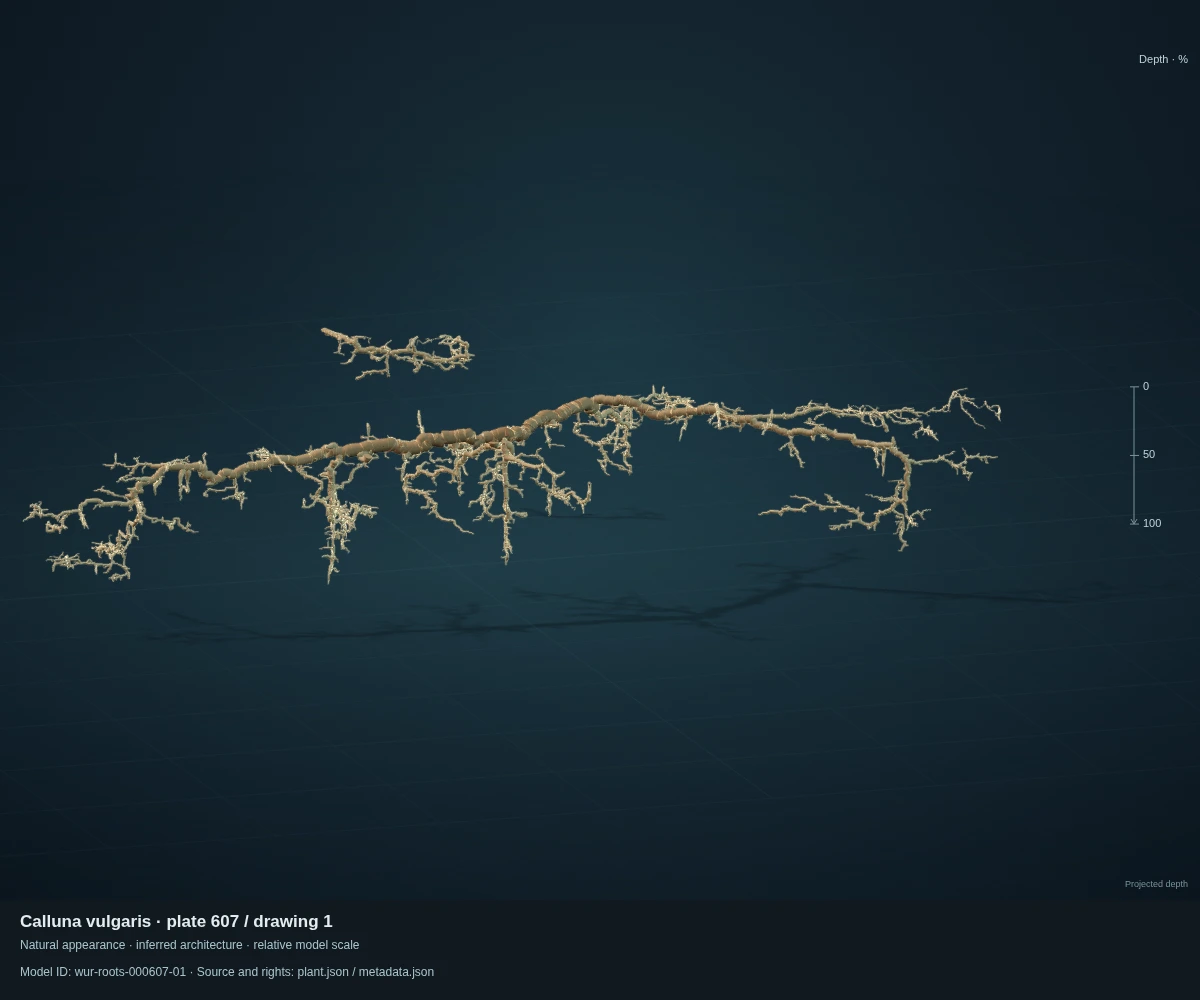
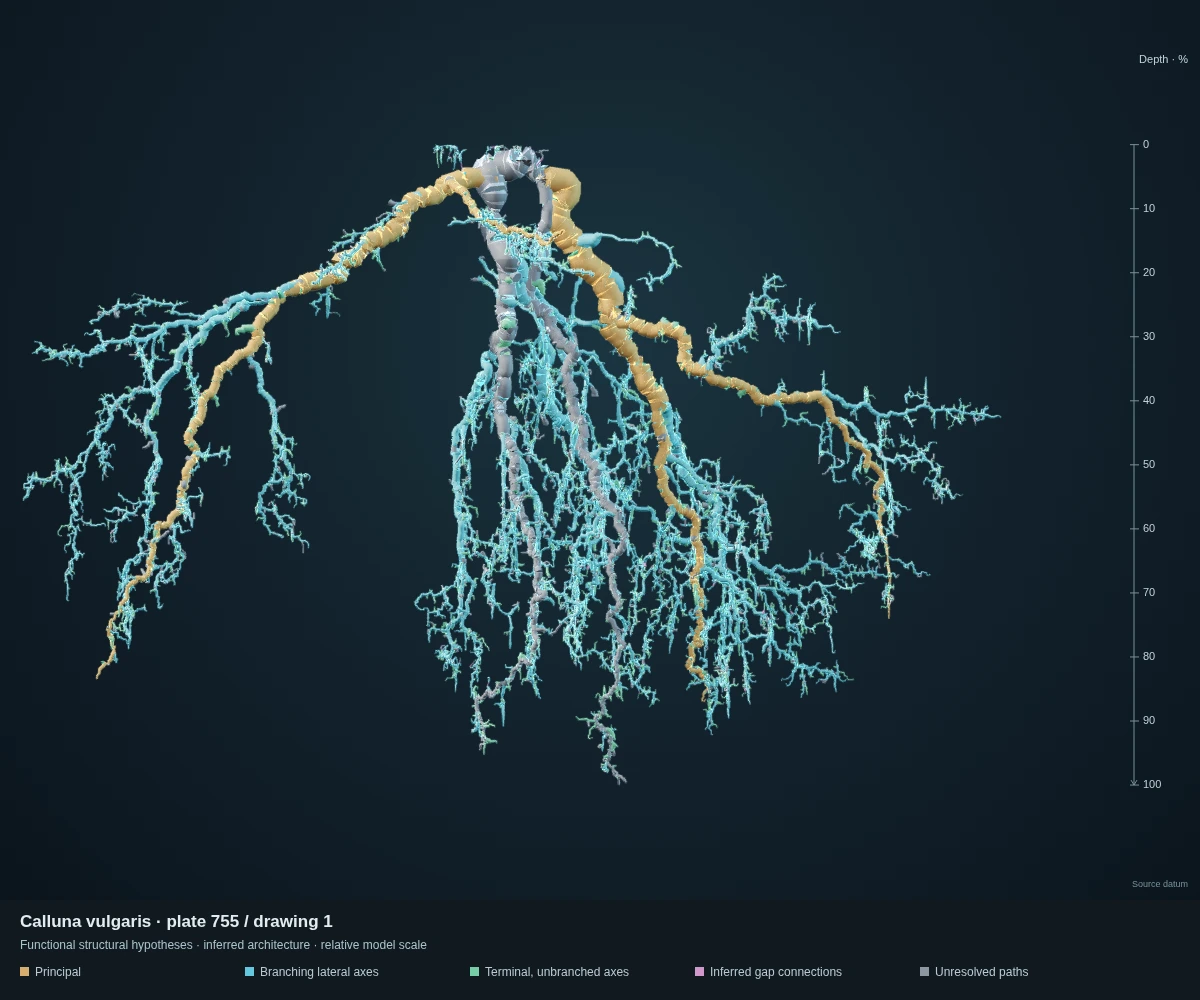
These reconstructions follow archived root drawings. Colour identifies the modelled structural role of each root.

Functional view
Natural view
Source projection
Side view
Calibration
Unresolved scale
Vertical extent
0.123 model units
Inferred axes
1371
Model metrics and plate observations

Model metrics

No metric calibration; values are in normalized model coordinates.

Vertical extent
0.123 model units
Horizontal span (x)
0.533 model units
Horizontal span (z)
0.84 model units
Centreline length
15.4 model units
Inferred axes
1371
Branching sites
1292
Terminal paths
1317
Mean modelled diameter
0.00212 model units
Surface area proxy
0.106 model units²
Volume proxy
0.000105 model units³
Inferred connection length
0.0777 model units
Projected length
13 model units
Mean angle from vertical
57.4°

Dimensions reported on the source plate

Plant height
21 cm plate_607
Root depth
38 cm plate_607
Root-system diameter
219 cm plate_607

Drawing observations

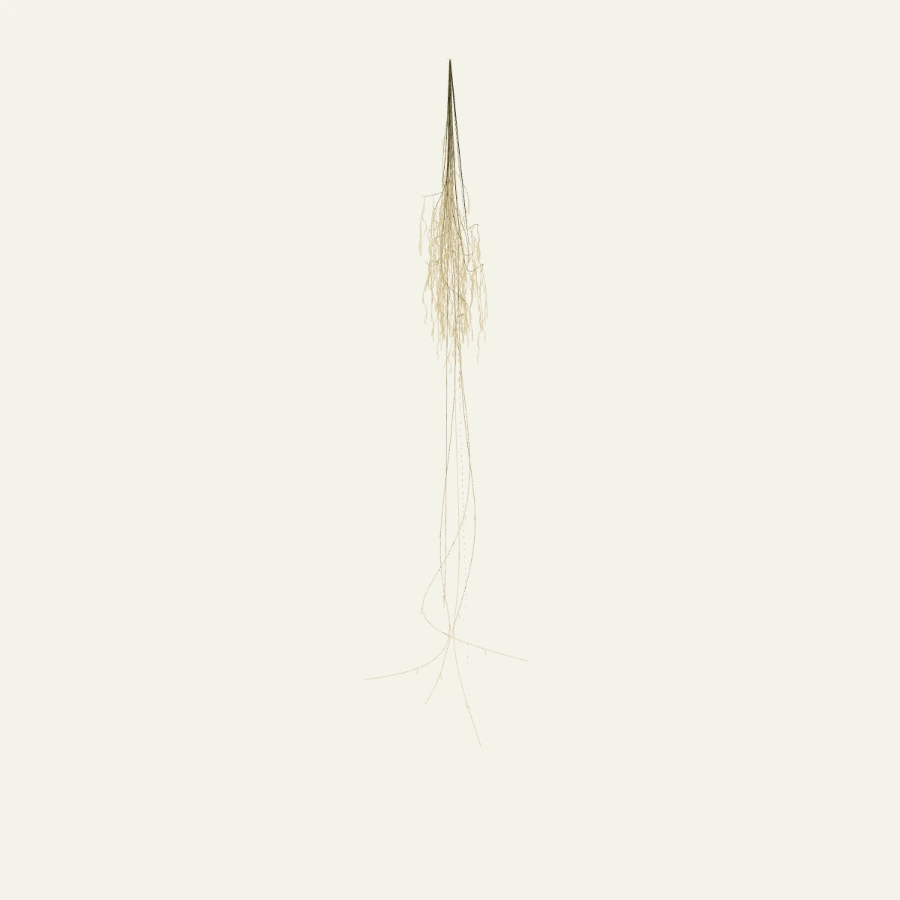
  • A low finely branched shrub-like shoot stands above a very wide shallow root profile.
  • Numerous coarse roots extend horizontally from a compact origin.
  • A dense shallow mesh gives several localized deeper branching tufts.
  • Unequal short descending ends remain scattered below the broad upper field.

Biologically constrained spatial reconstruction from source morphology. Root azimuths, hidden placement, growth responses, circular sections, thickness and proposed connections are inferred. The separate source trace retains exact drawing coordinates. No measured 3D anatomy or observed growth sequence is claimed.

Source and attribution

Study 607 · Model 01

Calluna vulgaris · Wageningen University & Research archive
Functional view
Natural view
Source projection
Side view
Calibration
Unresolved scale
Vertical extent
0.576 model units
Inferred axes
6261
Model metrics and plate observations

Model metrics

No metric calibration; values are in normalized model coordinates.

Vertical extent
0.576 model units
Horizontal span (x)
0.718 model units
Horizontal span (z)
0.872 model units
Centreline length
62.4 model units
Inferred axes
6261
Branching sites
5769
Terminal paths
5824
Mean modelled diameter
0.00254 model units
Surface area proxy
0.517 model units²
Volume proxy
0.000785 model units³
Inferred connection length
0.31 model units
Projected length
59.4 model units
Mean angle from vertical
45.7°

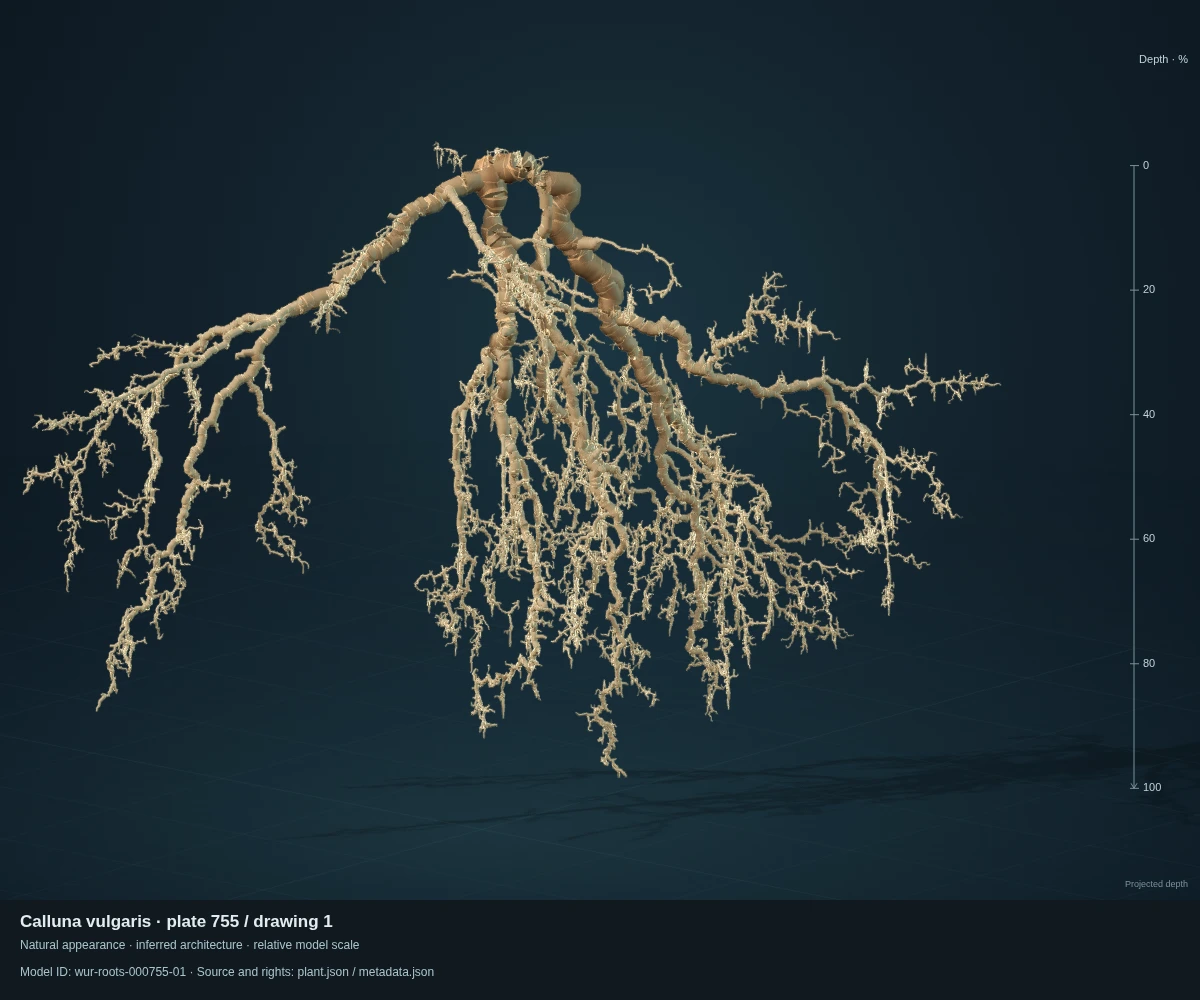
Dimensions reported on the source plate

Plant height
20 cm plate_755
Root depth
78 cm plate_755
Root-system diameter
129 cm plate_755

Drawing observations

  • Many spreading curved branches rise into short fine terminal shoots with tiny pointed and rounded parts.
  • A short thick curved basal axis gives several coarse roots and small shallow root tufts near the crown.
  • Broad oblique roots fork repeatedly and support dense fine branching throughout the middle and lower field.
  • Several short descending terminal fields extend near 80 cm, with the central-right field deepest.

Biologically constrained spatial reconstruction from source morphology. Root azimuths, hidden placement, growth responses, circular sections, thickness and proposed connections are inferred. The separate source trace retains exact drawing coordinates. No measured 3D anatomy or observed growth sequence is claimed.

Source and attribution

Study 755 · Model 01

Calluna vulgaris · Wageningen University & Research archive
Functional view
Natural view
Source projection
Side view
Calibration
Source-calibrated
Vertical extent
36.2 cm
Inferred axes
478
Model metrics and plate observations

Model metrics

Depth follows the printed scale. Equal horizontal scale and hidden depth are modeling assumptions; root thickness is illustrative.

Vertical extent
36.2 cm
Horizontal span (x)
1.55 m
Horizontal span (z)
1.55 m
Centreline length
21 m
Inferred axes
478
Branching sites
467
Terminal paths
469
Mean modelled diameter
4.34 mm
Surface area proxy
2,880 cm²
Volume proxy
566 cm³
Inferred connection length
3 cm
Projected length
15.8 m
Mean angle from vertical
59.5°

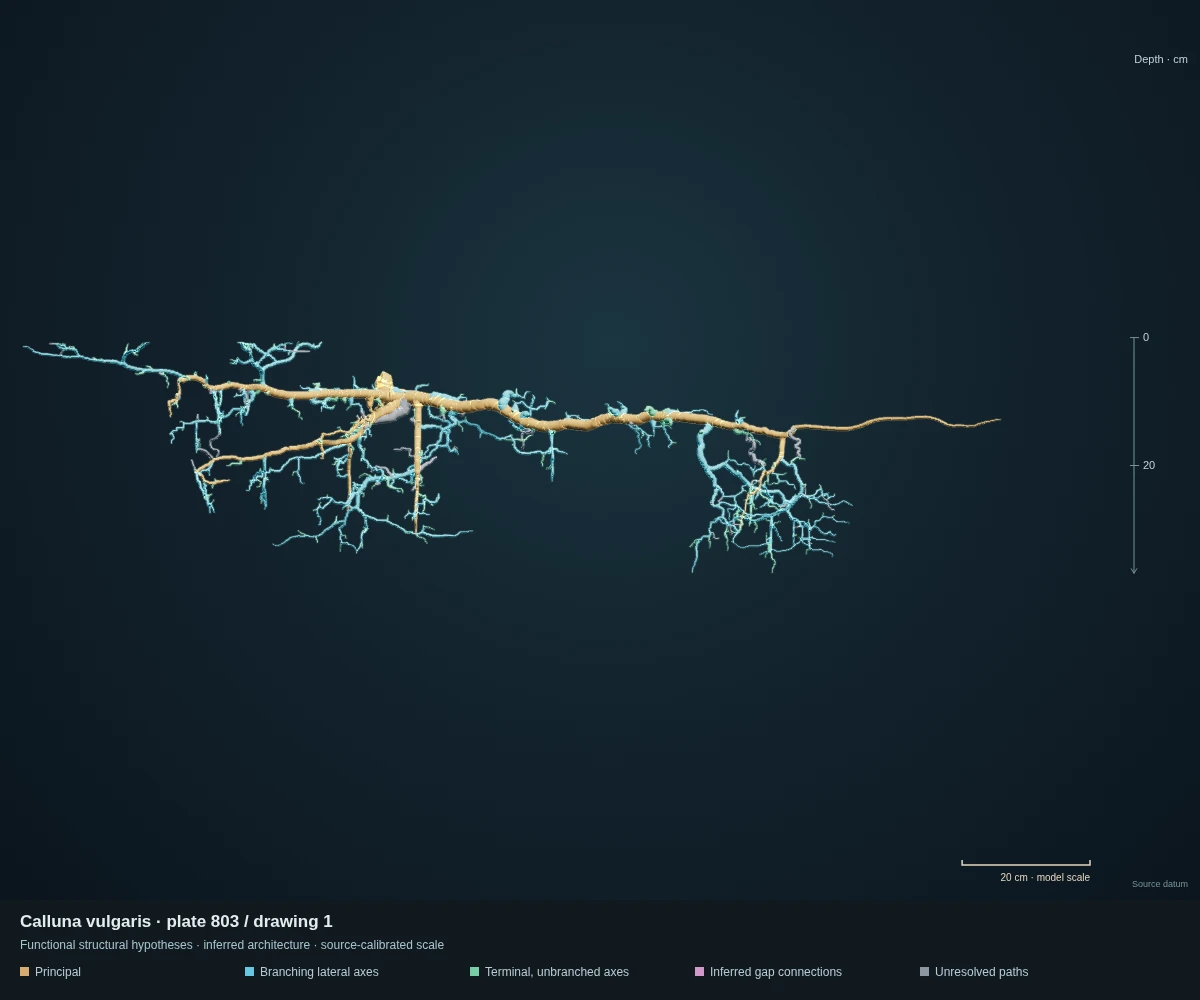
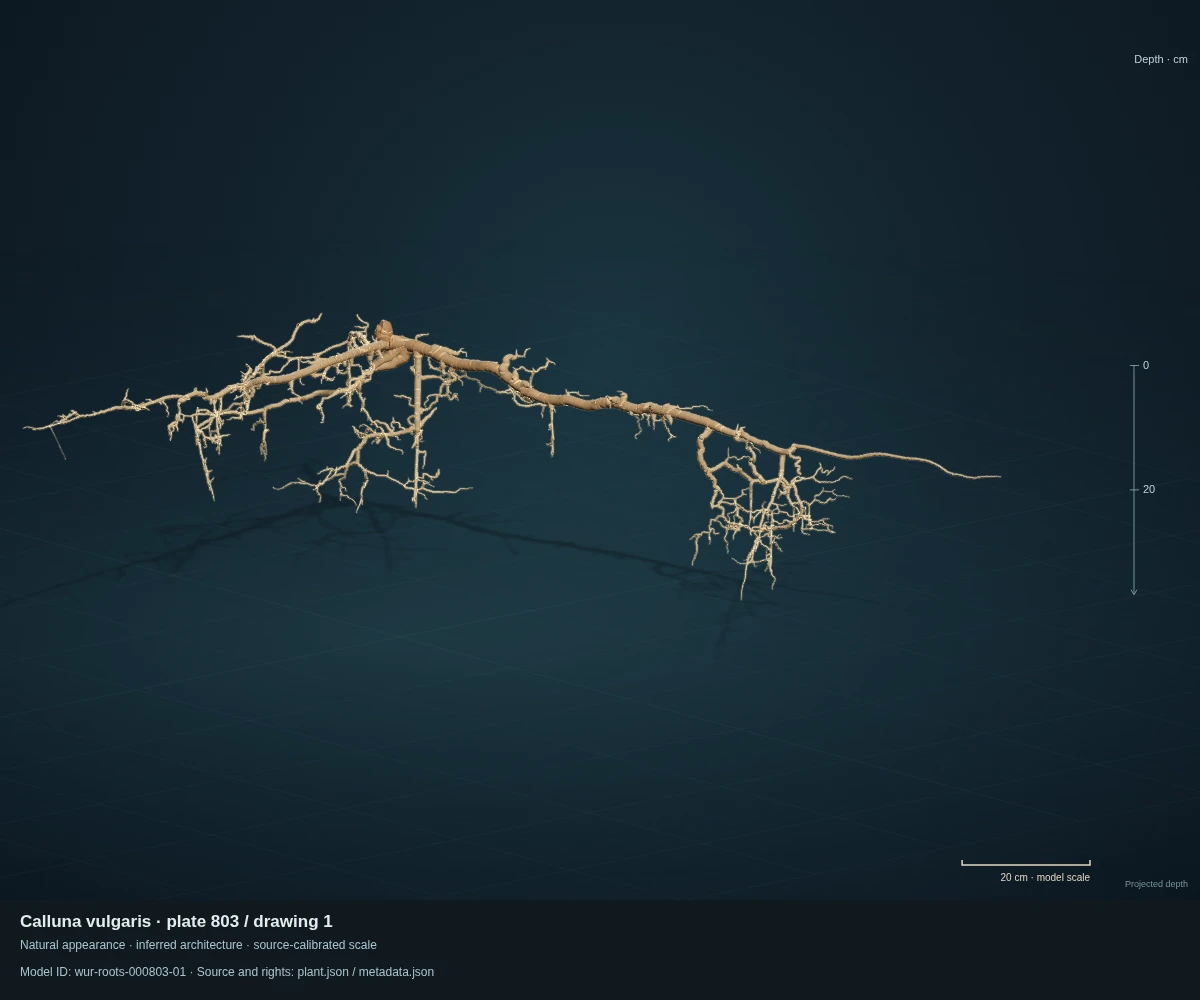
Drawing observations

  • A low spreading branch system occupies the right side above a long shallow leftward root field.
  • Roots arise repeatedly along a long nearly horizontal basal framework beneath the shoots.
  • One strong shallow path extends far left, with a broad lower branching network beneath it.
  • Fine irregular laterals and repeated forks occur along the coarse horizontal and oblique paths.

Biologically constrained spatial reconstruction from source morphology. Root azimuths, hidden placement, growth responses, circular sections, thickness and proposed connections are inferred. The separate source trace retains exact drawing coordinates. No measured 3D anatomy or observed growth sequence is claimed.

Source and attribution

Study 803 · Model 01

Calluna vulgaris · Wageningen University & Research archive
Functional view
Natural view
Source projection
Side view
Calibration
Source-calibrated
Vertical extent
44.3 cm
Inferred axes
1894
Model metrics and plate observations

Model metrics

Depth follows the printed scale. Equal horizontal scale and hidden depth are modeling assumptions; root thickness is illustrative.

Vertical extent
44.3 cm
Horizontal span (x)
1.42 m
Horizontal span (z)
1.05 m
Centreline length
33.4 m
Inferred axes
1894
Branching sites
1820
Terminal paths
1857
Mean modelled diameter
3.64 mm
Surface area proxy
3,940 cm²
Volume proxy
647 cm³
Inferred connection length
2.76 cm
Projected length
30.3 m
Mean angle from vertical
53.9°

Drawing observations

  • marked central neck forks into coarse roots
  • wide nearly horizontal roots below surface
  • deep field of long axes with fine repeated laterals

Biologically constrained spatial reconstruction from source morphology. Root azimuths, hidden placement, growth responses, circular sections, thickness and proposed connections are inferred. The separate source trace retains exact drawing coordinates. No measured 3D anatomy or observed growth sequence is claimed.

Source and attribution

Study 864 · Model 01

Calluna vulgaris · Wageningen University & Research archive
Functional view
Natural view
Source projection
Side view
Calibration
Source-calibrated
Vertical extent
29.8 cm
Inferred axes
1543
Model metrics and plate observations

Model metrics

Depth follows the printed scale. Equal horizontal scale and hidden depth are modeling assumptions; root thickness is illustrative.

Vertical extent
29.8 cm
Horizontal span (x)
1.99 m
Horizontal span (z)
1.62 m
Centreline length
38.5 m
Inferred axes
1543
Branching sites
1380
Terminal paths
1394
Mean modelled diameter
5.6 mm
Surface area proxy
6,850 cm²
Volume proxy
2,030 cm³
Inferred connection length
5.62 cm
Projected length
35.6 m
Mean angle from vertical
55.1°

Drawing observations

  • Short branched leafy shoots arise repeatedly from long connected horizontal axes.
  • A long thick winding basal axis connects several rooting junctions and leafy shoot groups.
  • Root tufts descend at several junctions; longer roots run rightward near the reference surface.
  • Short branched root fans form an irregular shallow lower fringe, locally below 20 cm.

Biologically constrained spatial reconstruction from source morphology. Root azimuths, hidden placement, growth responses, circular sections, thickness and proposed connections are inferred. The separate source trace retains exact drawing coordinates. No measured 3D anatomy or observed growth sequence is claimed.

Source and attribution

Study 890 · Model 01

Calluna vulgaris · Wageningen University & Research archive
Functional view
Natural view
Source projection
Compound plate
Calibration
Ambiguous scale
Vertical extent
0.443 model units
Inferred axes
1972
Model metrics and plate observations

Model metrics

No metric calibration; values are in normalized model coordinates.

Vertical extent
0.443 model units
Horizontal span (x)
0.848 model units
Horizontal span (z)
0.149 model units
Centreline length
18.7 model units
Inferred axes
1972
Branching sites
1818
Terminal paths
1862
Mean modelled diameter
0.00186 model units
Surface area proxy
0.113 model units²
Volume proxy
0.000114 model units³
Inferred connection length
0 model units
Projected length
18.7 model units
Mean angle from vertical
58.2°

Drawing observations

  • The large crown has many spreading branched shoots; the small right crown has a few short twigs.
  • The large crown has a short thick base with long descending and lateral roots; the right crown has a slender base that forks into several roots.
  • A broad finely branched field surrounds the main crown; the right shrub has a separate local root fan whose left strands overlap the wider field.
  • The main central-left root descends well below 20 cm; the right shrub roots end higher.

Biologically constrained spatial reconstruction from source morphology. Root azimuths, hidden placement, growth responses, circular sections, thickness and proposed connections are inferred. The separate source trace retains exact drawing coordinates. No measured 3D anatomy or observed growth sequence is claimed.

Source and attribution

Study 908 · Model 01

Calluna vulgaris · Wageningen University & Research archive
02 / Seasons

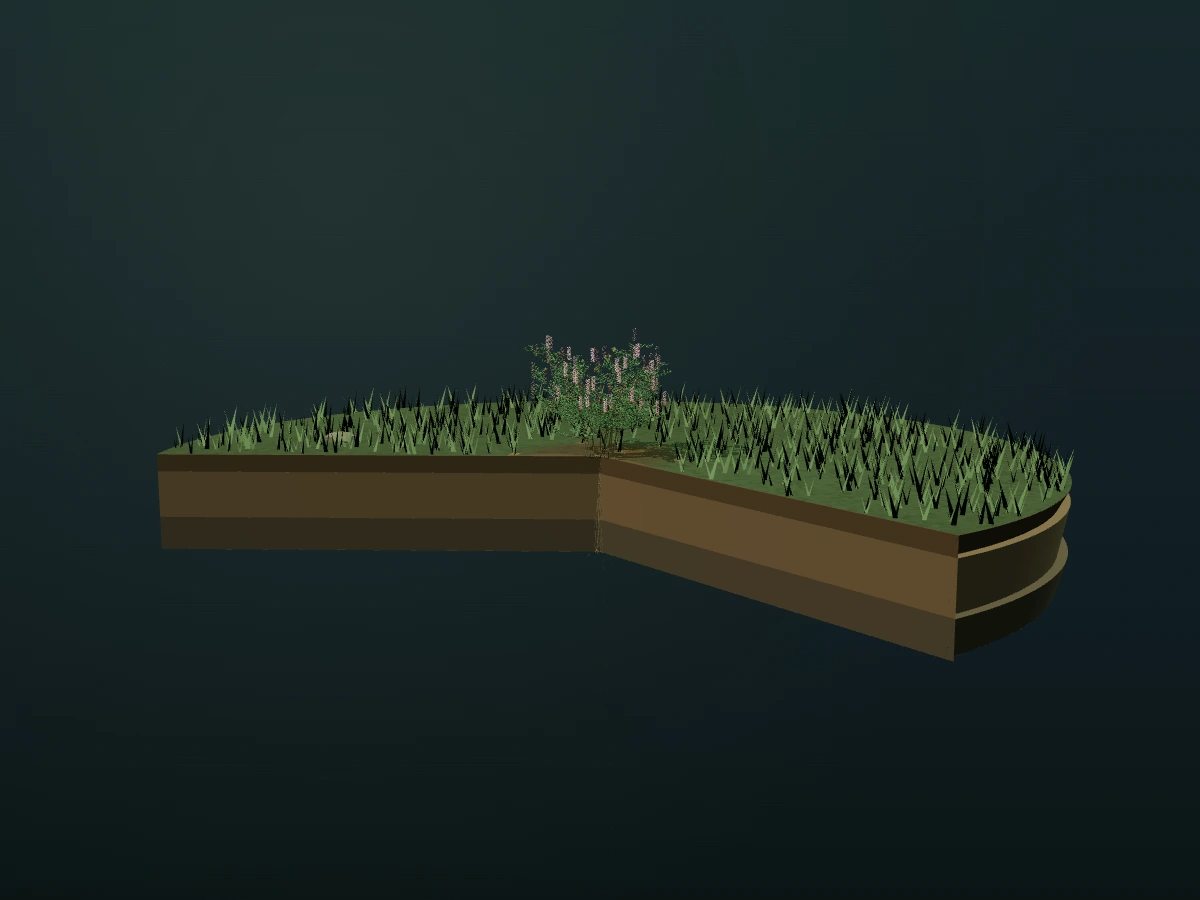
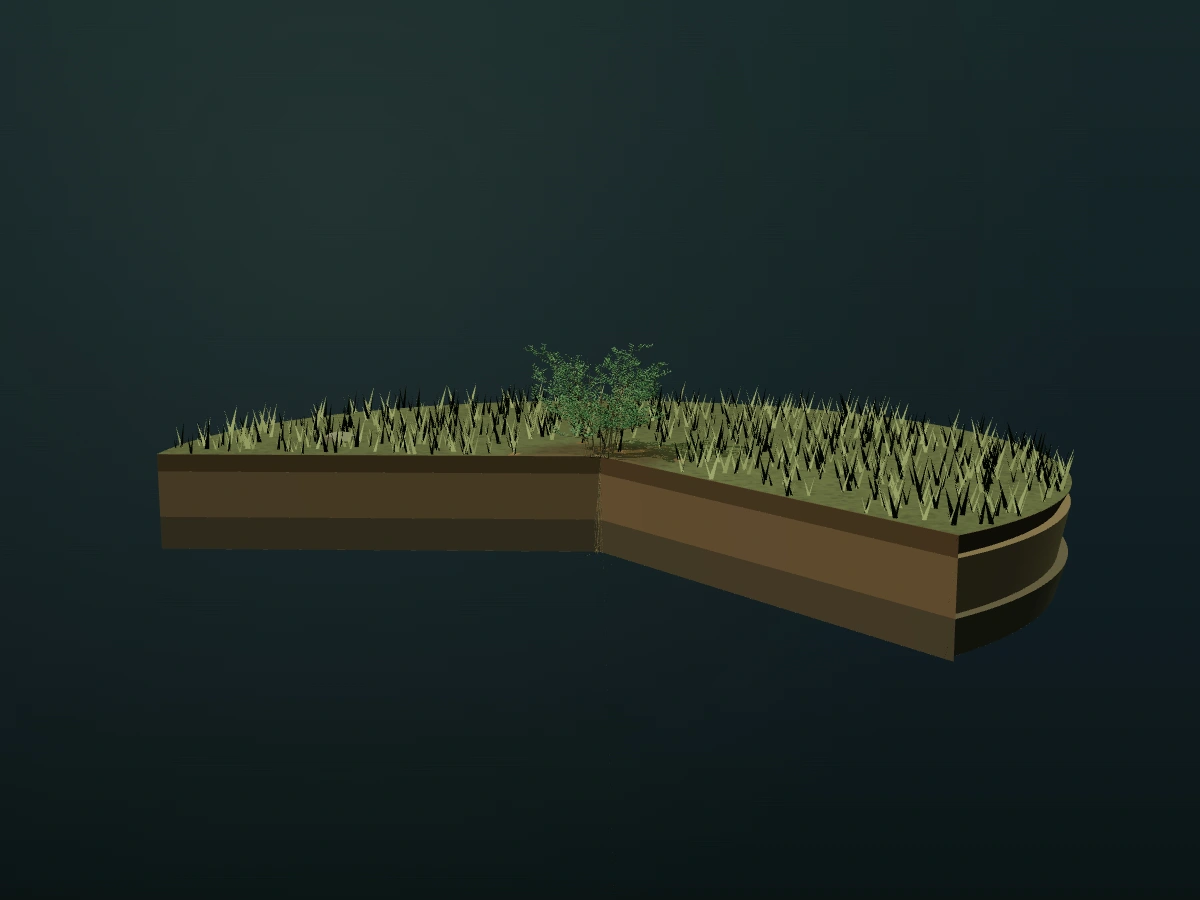
Through the seasons

Four portraits. One plant.

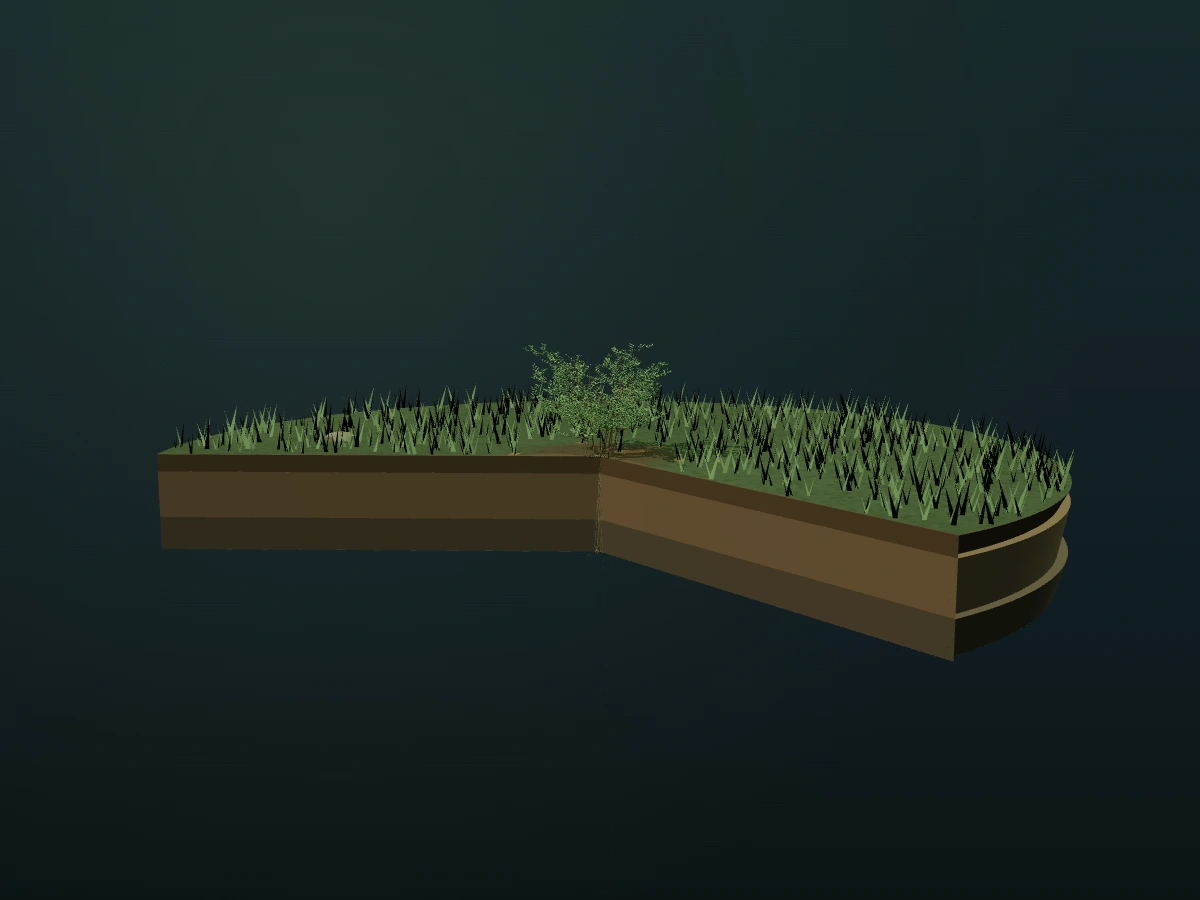
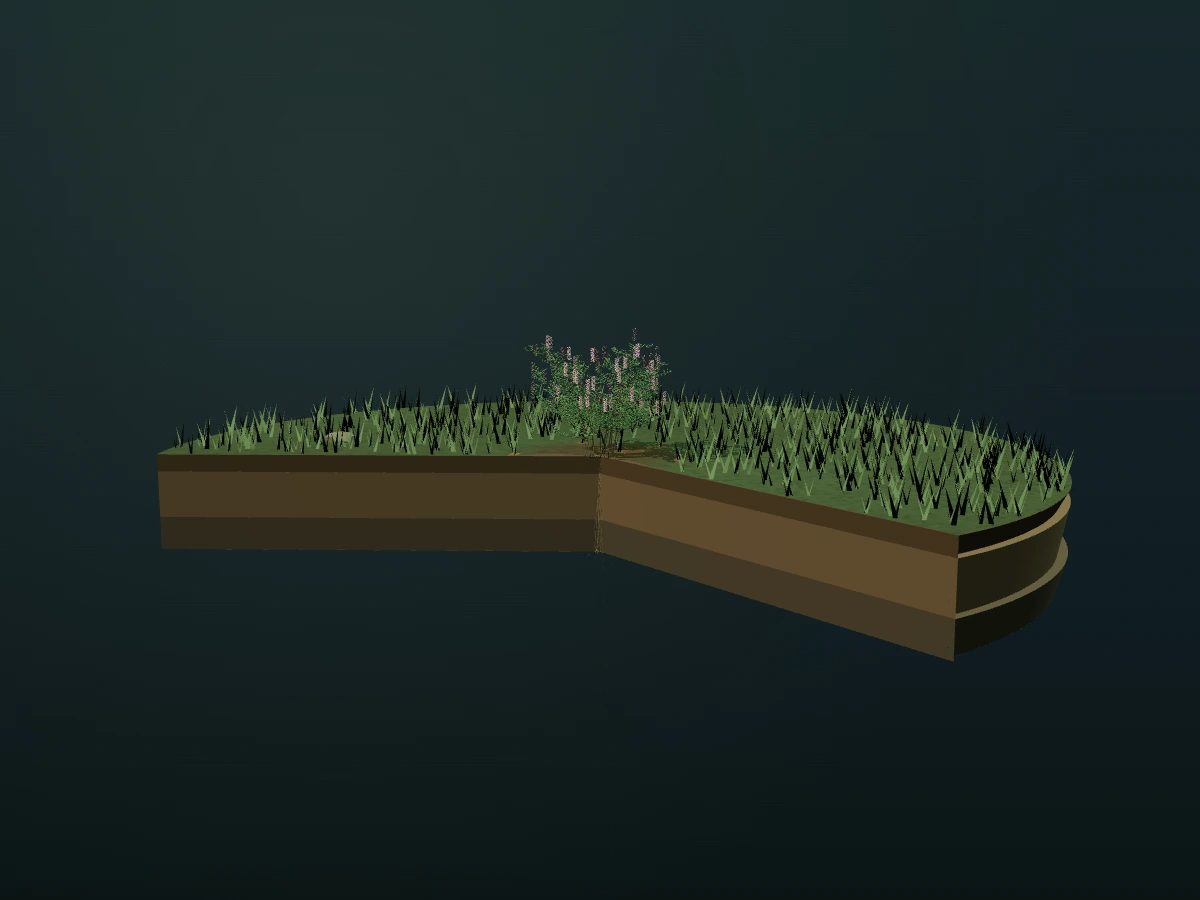
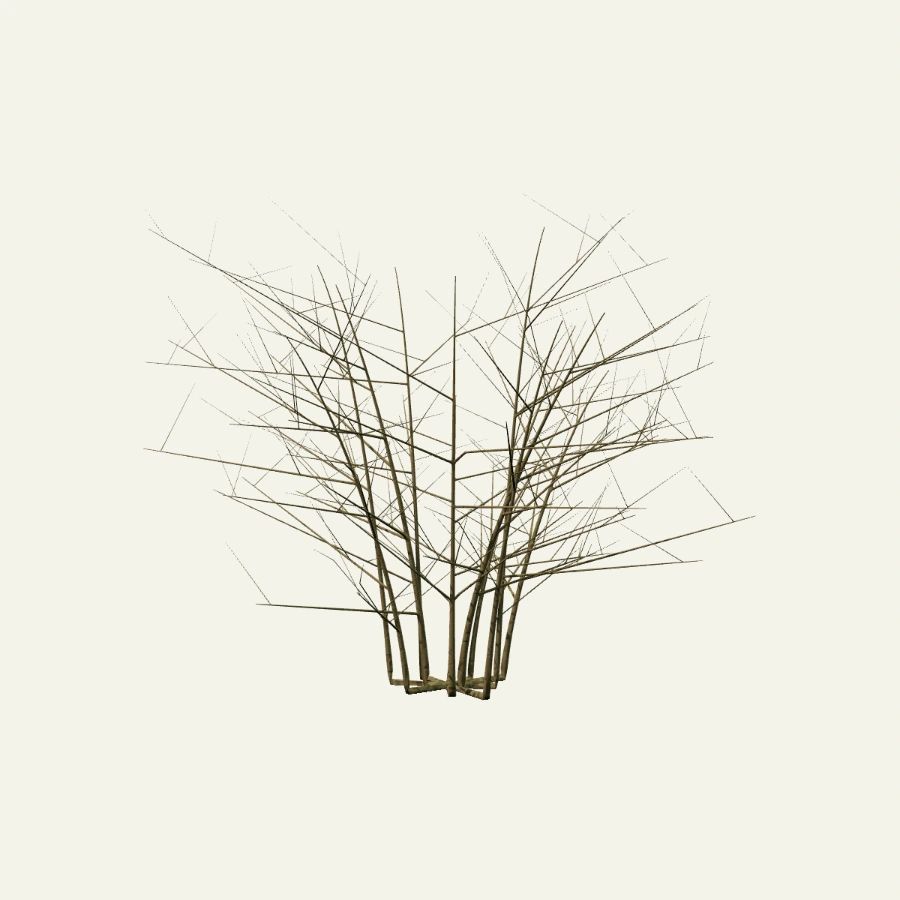
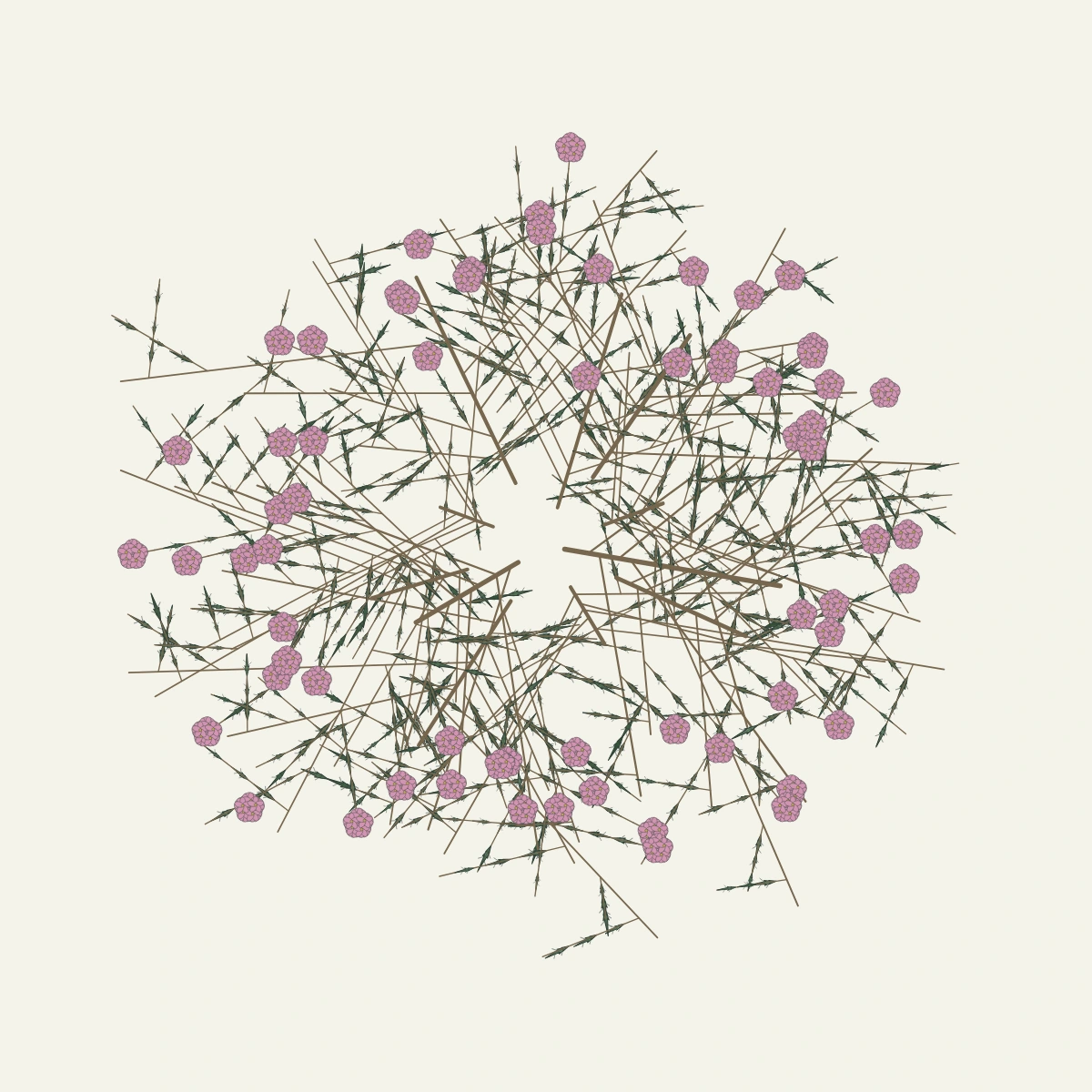
Read the crown, foliage and reproductive structures together. The four views compare seasonal appearances; the reference notes explain what is actually documented.

Seasonal illustration; the same plant, age and camera across four views.

Seasonal record

North Carolina botanical account

Flowering
Summer · Autumn[1]
Fruiting / dispersal
Autumn[1]

Leaf renewal

Evergreen[1]

A green canopy can persist while individual leaves age and are replaced. Evergreen does not mean that every leaf lasts indefinitely or that flowering and fruiting are continuous.

Reading these views

Season names organize these four views, not a universal calendar. Hemisphere, local climate, cultivar and management can change timing; months are shown only when explicitly recorded.

The views emphasize crown structure. Buds, small flowers, individual retained leaves and fine reproductive changes may be unresolved; model age and fruit count are not production forecasts.

No separate on-tree fruit display is configured for this record.

Seasonal references

  1. NC State Extension · Calluna vulgaris ↗plants.ces.ncsu.edu

03 / Leaves & flowers

A closer look at the organs

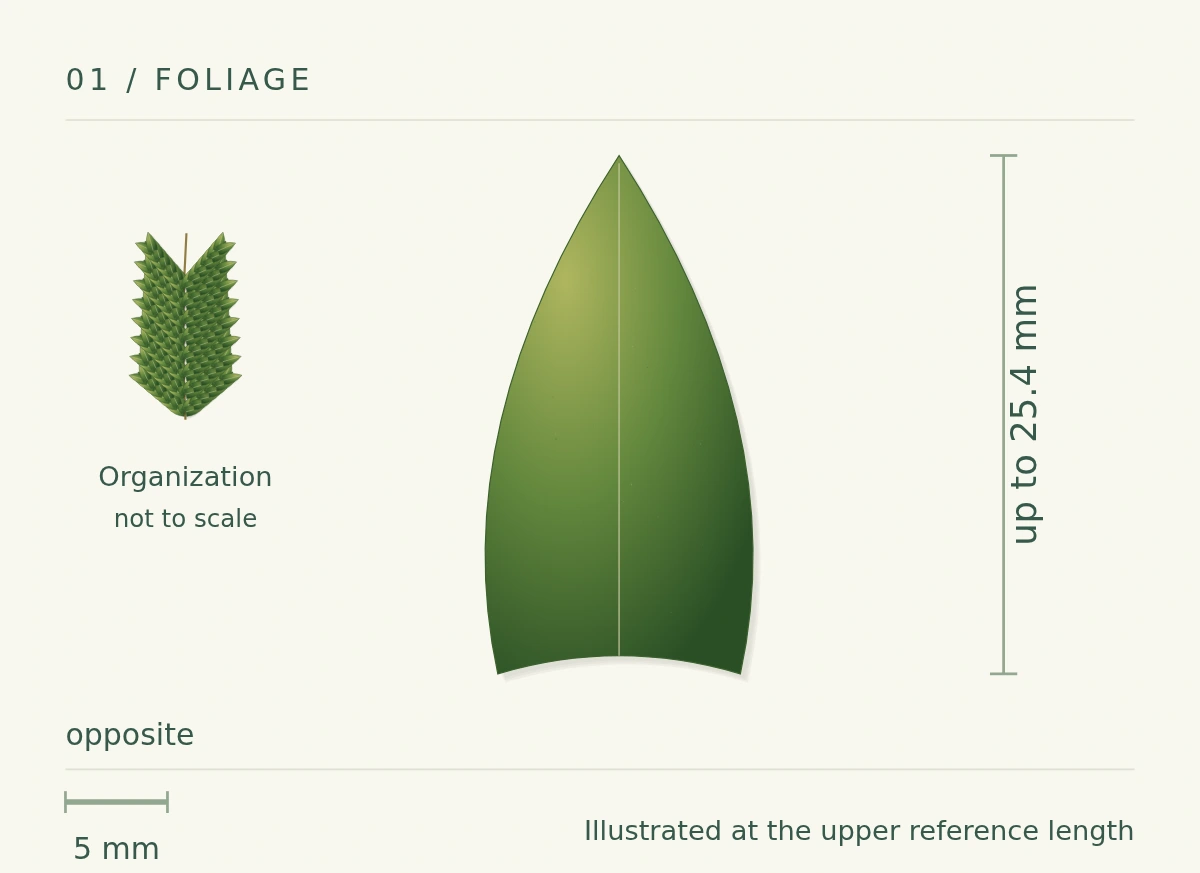
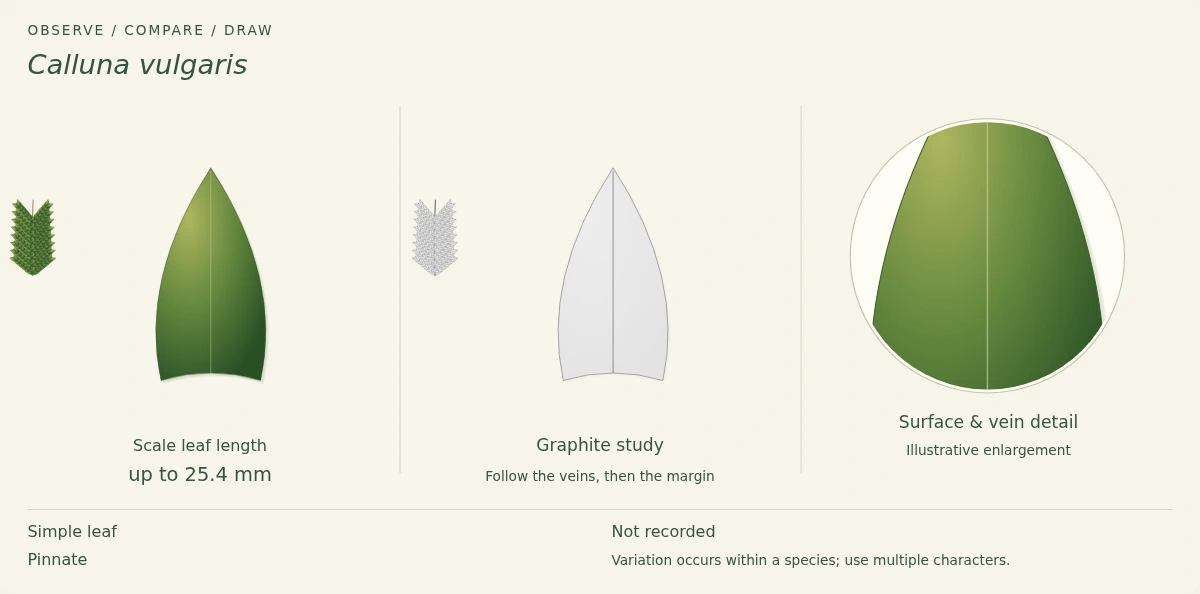
Leaves

Scale leaf length
≤ 25.4 mmSource notes

Simple; ; ; opposite insertion.

Simple leaf · Not recorded · Pinnate · opposite

Seasonal notes

Seasonal palette follows reported colour categories; dates and saturation vary with site and weather.

Flowering reference
Summer · Autumn

04 / Fruit & seed

Named structures, separate scales

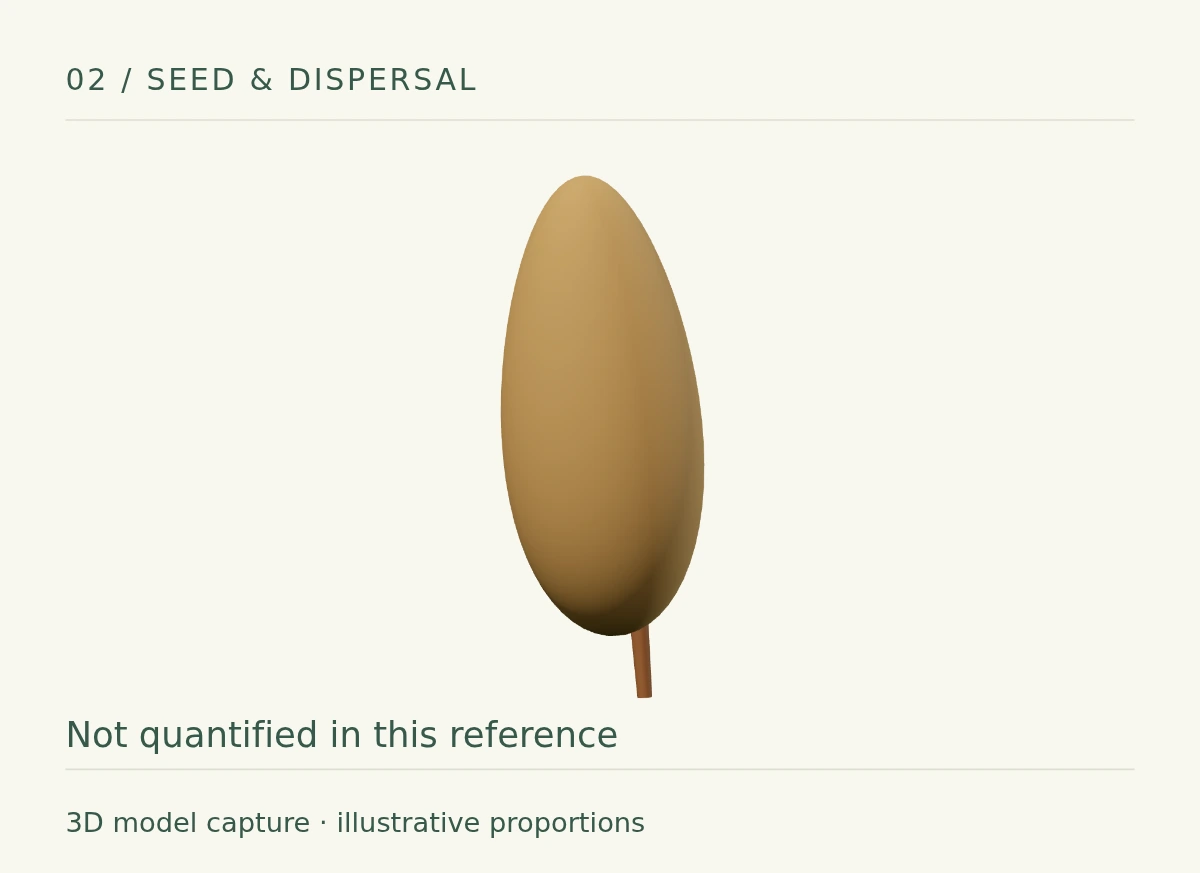
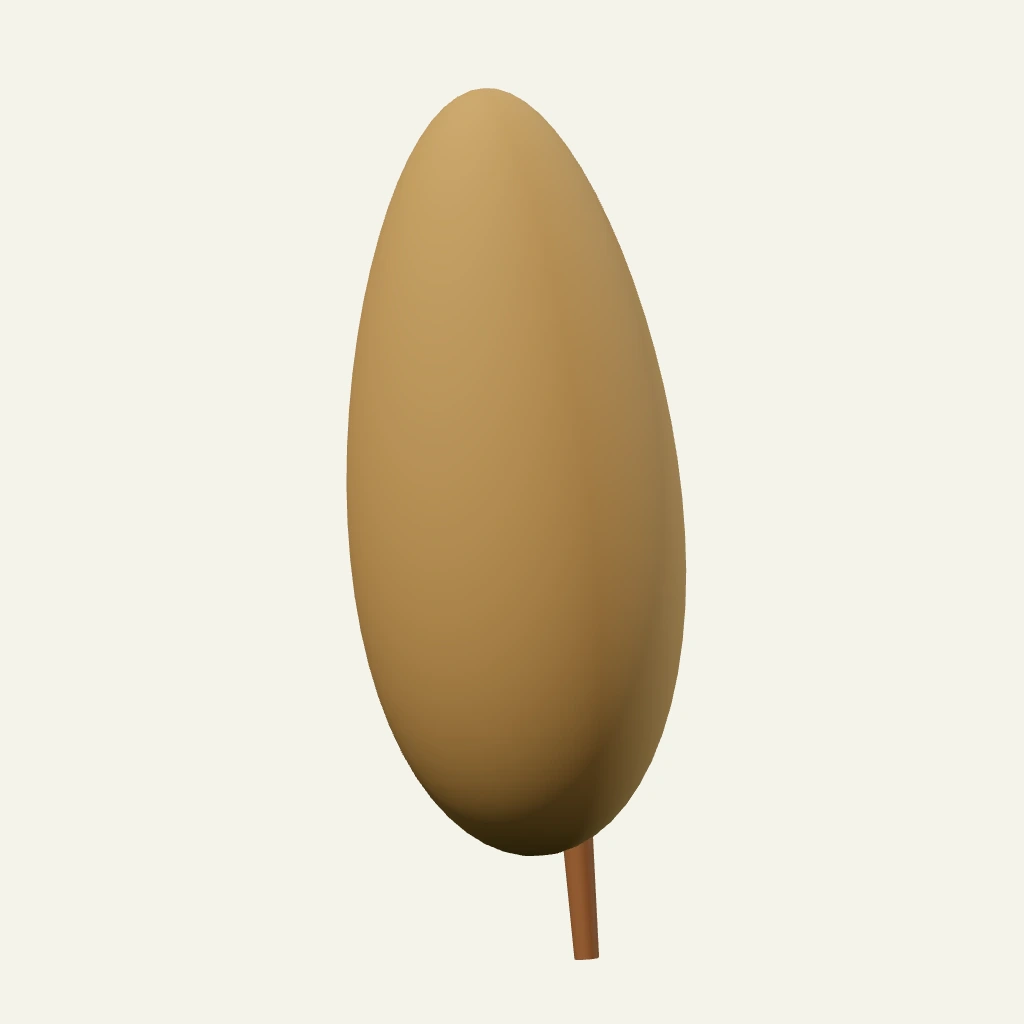
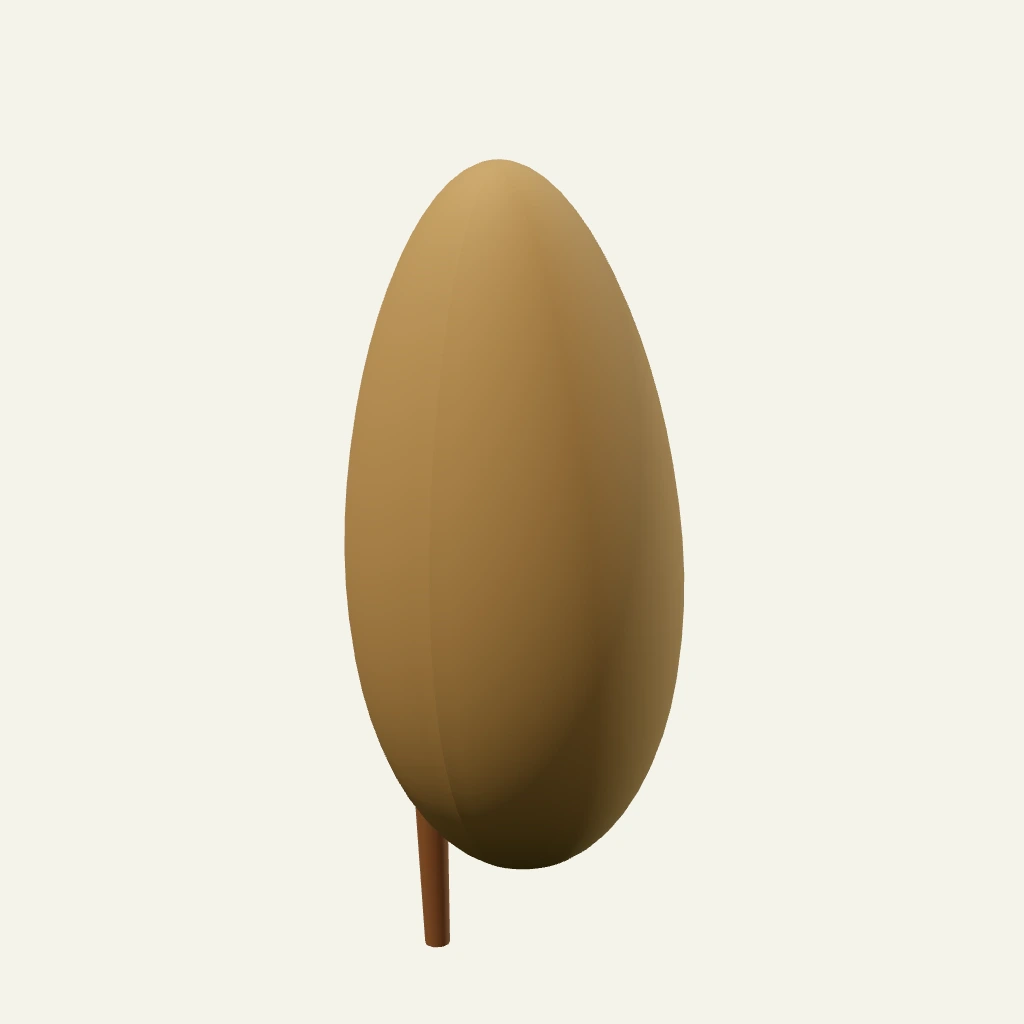
Fruit / dispersal unit

Whole capsule length
Not documentedSource notes

Source structure: capsule. The illustration represents the reproductive unit, not a separately measured enclosed seed.

Fruiting reference
Autumn

North Carolina botanical account

Organs are enlarged independently. Refer to the named measurement, not image size.

05 / Habitat

Native range & growing context

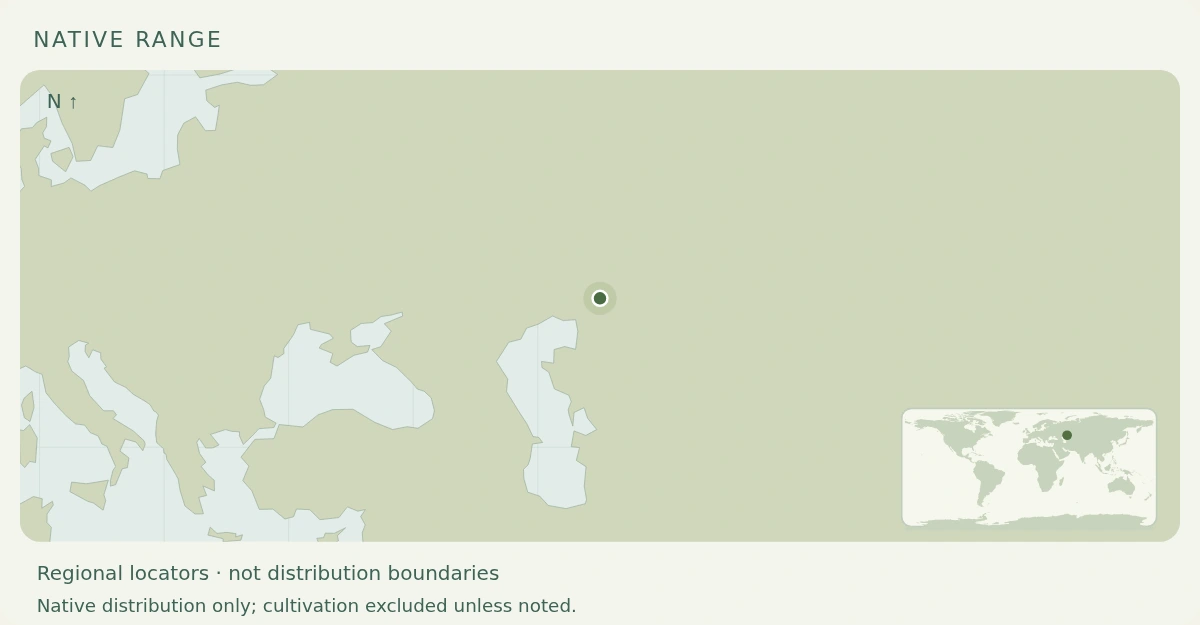
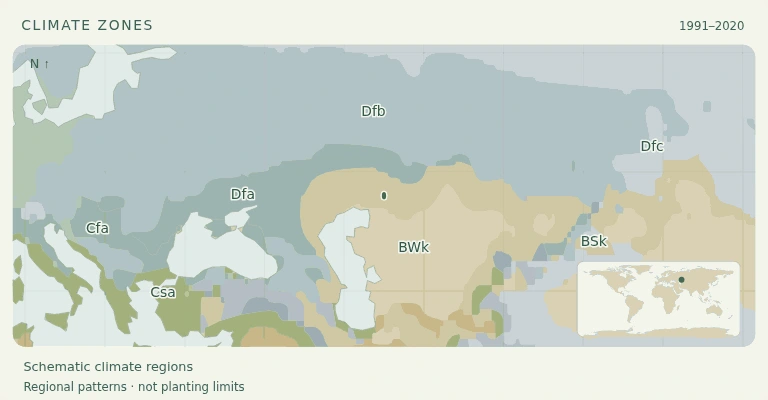
Native range & growing context

Eurasia

Reference spread
0.3–0.61 m
Moisture
drained · Moist
Growth tendency
Medium
Life span
No numerical lifespan is established by this reference. Model age is an illustration parameter.

Regional context, not a measured occurrence or suitability map.

06 / Sources & interpretation

Read the evidence behind the illustration

Names & classification

Family
Ericaceae
Genus
Calluna
Synonyms
—
  • Heather has a ascending · dense · spreading habit. Simple; ; ; opposite insertion. Pink · Purple/Lavender · Red/Burgundy flowers; fall · summer.
  • Propagation methods recorded: Division · Seed.

ArborAI teaching geometry. Branch positions, ages, root extents and colours are illustrative; foliage is enlarged. Not a surveyed specimen or calibrated growth forecast.

ArborAI maintained-size design envelope; editable dimensions and branching are not a growth forecast.

  1. NC State Extension · Calluna vulgaris ↗plants.ces.ncsu.edu
Plant data and references · 9
Heightm[0.1016, 0.6096]Source-level landscape reference. Site and cultivar variation apply. No independent specialist validation is claimed.plants.ces.ncsu.edu
Spreadm[0.3048, 0.6096]Source-level landscape reference. Site and cultivar variation apply. No independent specialist validation is claimed.plants.ces.ncsu.edu
NativerangeEurasiaSource-level landscape reference. Site and cultivar variation apply. No independent specialist validation is claimed.plants.ces.ncsu.edu
LeafhabitcategoryEvergreenSource-level landscape reference. Site and cultivar variation apply. No independent specialist validation is claimed.plants.ces.ncsu.edu
Lightcategory["sun", "partial"]Source-level landscape reference. Site and cultivar variation apply. No independent specialist validation is claimed.plants.ces.ncsu.edu
Moisturecategory["drained", "moist"]Source-level landscape reference. Site and cultivar variation apply. No independent specialist validation is claimed.plants.ces.ncsu.edu
Hardinesscategory{"system": "USDA", "zones": [4, 6], "source": "ncsu"}Source-level landscape reference. Site and cultivar variation apply. No independent specialist validation is claimed.plants.ces.ncsu.edu
DescriptionHeather has a ascending · dense · spreading habit. Simple; ; ; opposite insertion. Pink · Purple/Lavender · Red/Burgundy flowers; fall · summer.Source-level landscape reference. Site and cultivar variation apply. No independent specialist validation is claimed.plants.ces.ncsu.edu
Reference phenologycategory{"flowering": {"seasons": ["summer", "autumn"]}, "fruiting": {"seasons": ["autumn"]}, "reference": "North Carolina botanical account", "source": "https://plants.ces.ncsu.edu/plants/calluna-vulgaris/", "reviewed": "2026-10-16"}Regional observations. Fruit display may include persistence and is not automatically ripening. Missing dates remain unspecified. Independent botanical review remains pending.plants.ces.ncsu.edu