Arbor.guide

Hippocrepis comosa

Horseshoe Vetch

Root studies

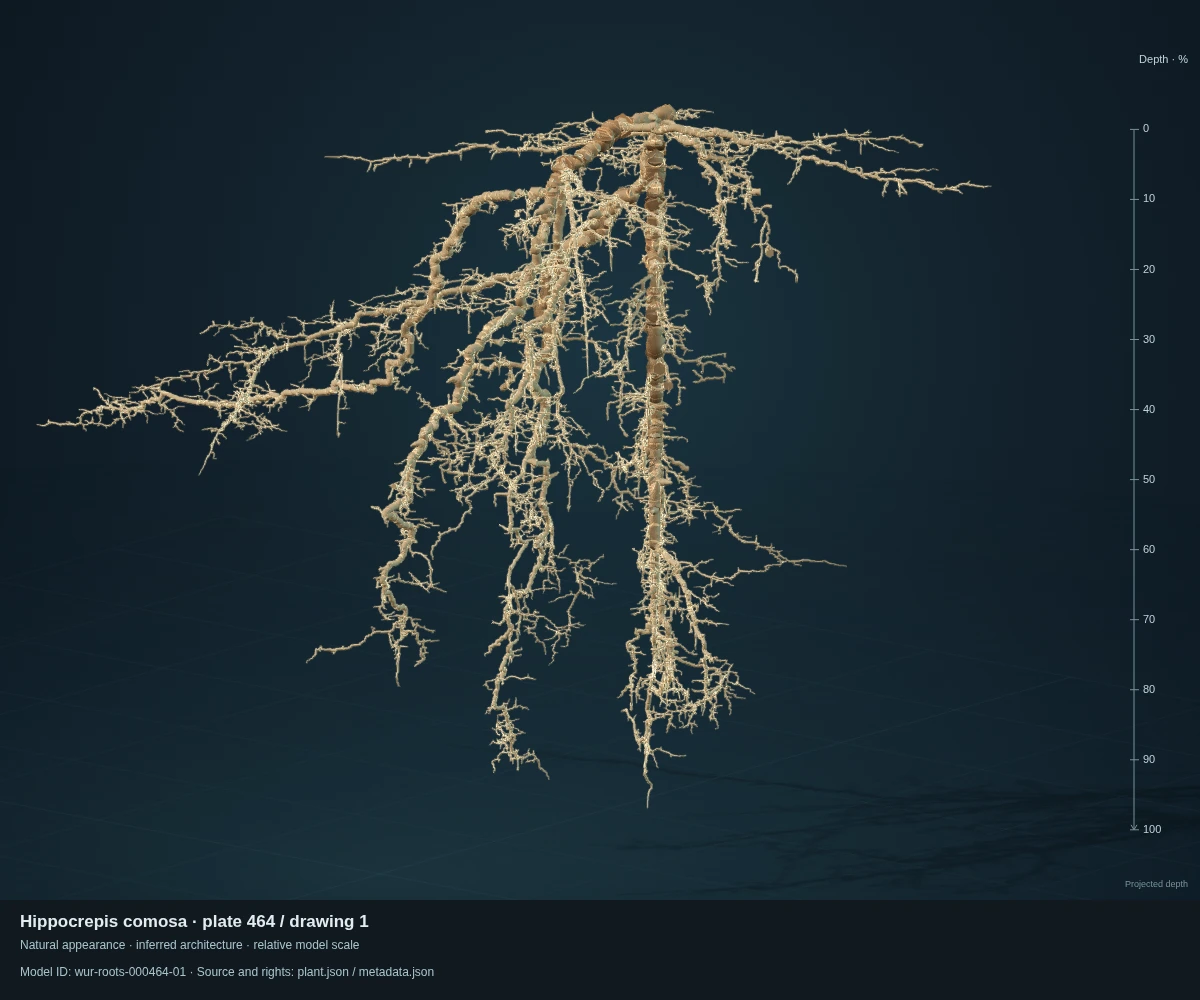
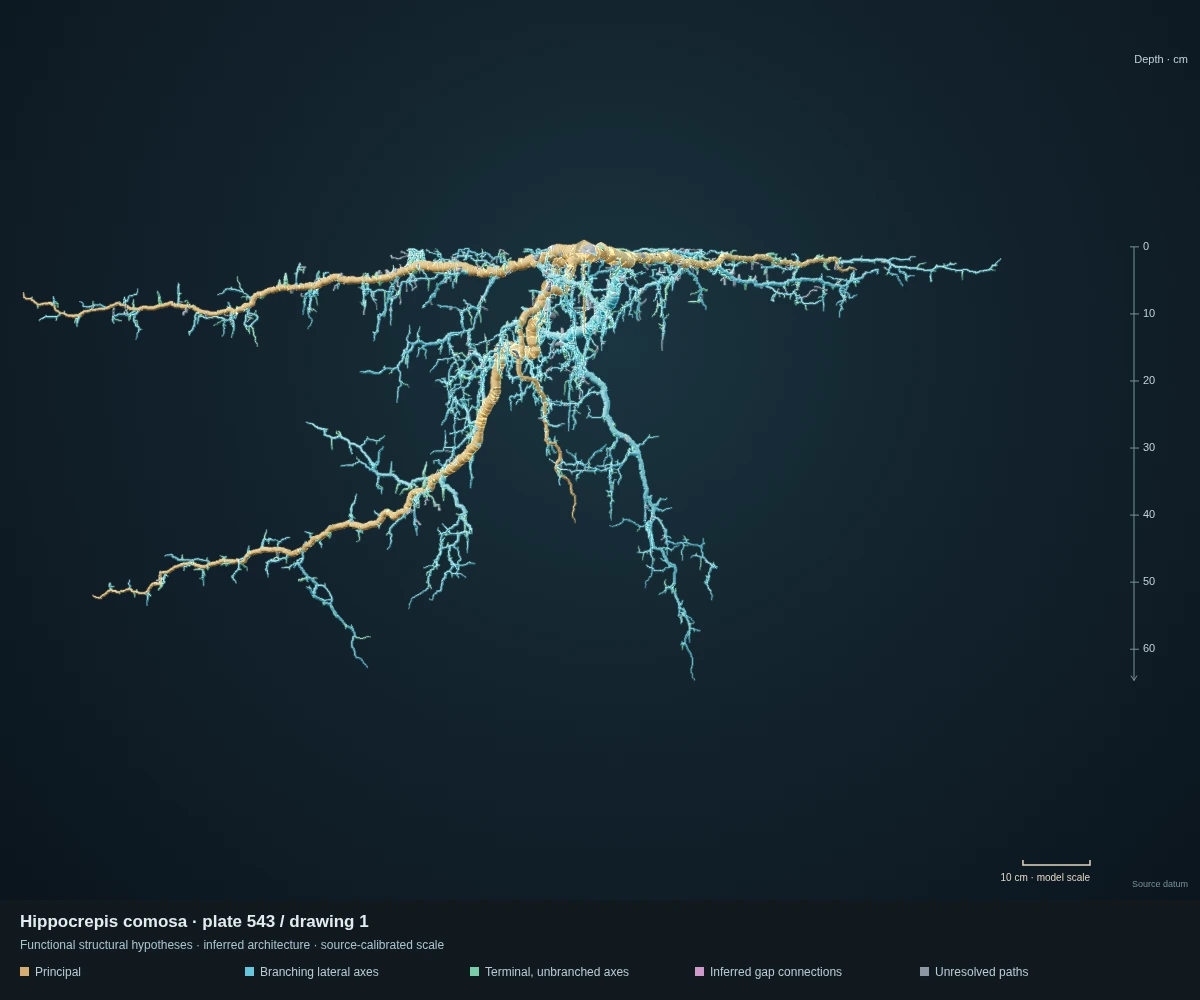
These reconstructions follow archived root drawings. Colour identifies the modelled structural role of each root.

Functional view
Natural view
Source projection
Side view
Calibration
Unresolved scale
Vertical extent
0.645 model units
Inferred axes
5665
Model metrics and plate observations

Model metrics

No metric calibration; values are in normalized model coordinates.

Vertical extent
0.645 model units
Horizontal span (x)
0.932 model units
Horizontal span (z)
0.703 model units
Centreline length
66.2 model units
Inferred axes
5665
Branching sites
5191
Terminal paths
5229
Mean modelled diameter
0.00209 model units
Surface area proxy
0.457 model units²
Volume proxy
0.000537 model units³
Inferred connection length
0.0299 model units
Projected length
51.3 model units
Mean angle from vertical
57.7°

Dimensions reported on the source plate

Plant height
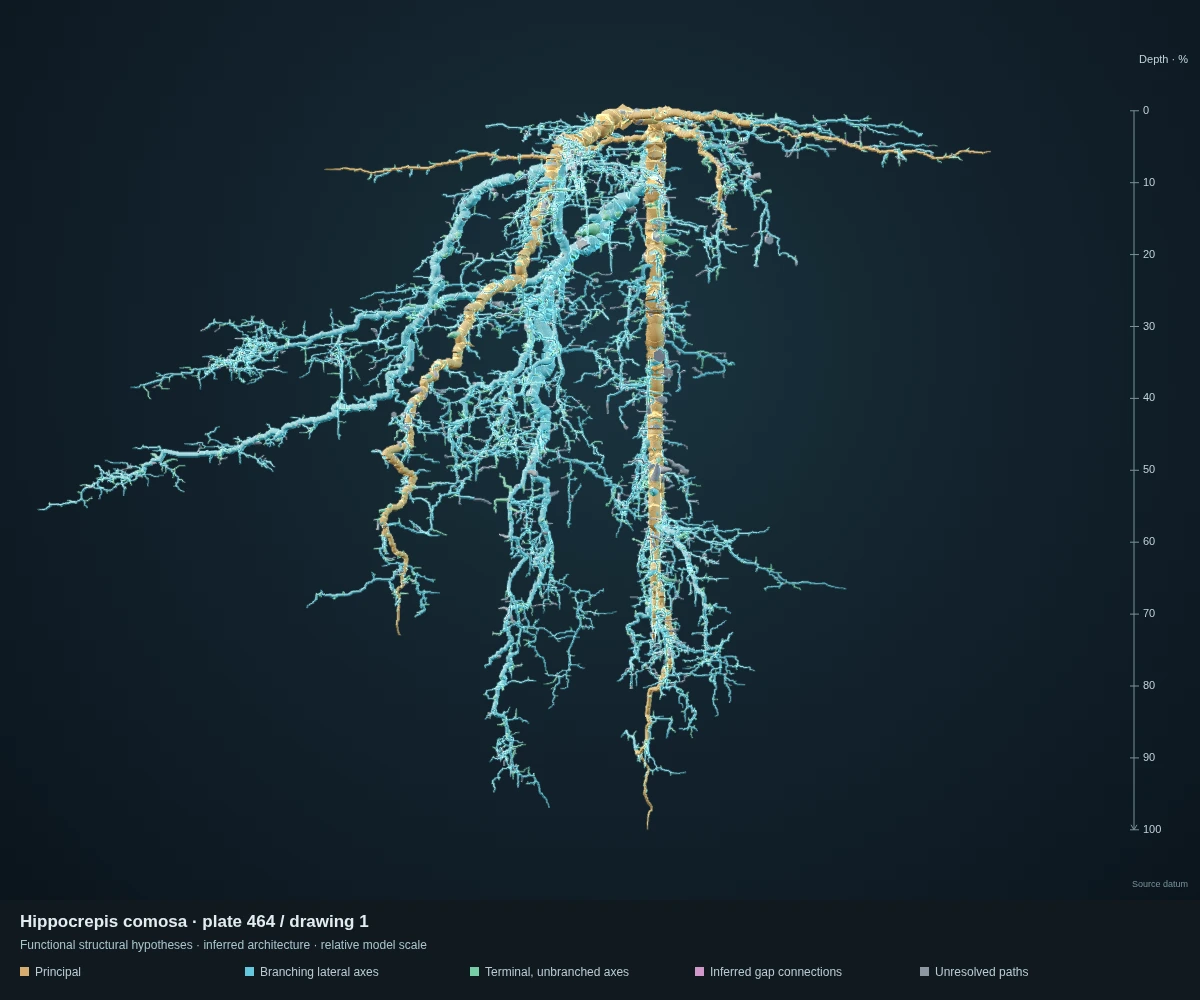
21 cm plate_464
Root depth
161 cm plate_464
Root-system diameter
238 cm plate_464

Drawing observations

  • central coarse taproot below crowded shoot base
  • dense wide fine branching network
  • long coarse arms depart at multiple depths
  • many unequal fine descenders and separated branch fans

Biologically constrained spatial reconstruction from source morphology. Root azimuths, hidden placement, growth responses, circular sections, thickness and proposed connections are inferred. The separate source trace retains exact drawing coordinates. No measured 3D anatomy or observed growth sequence is claimed.

Source and attribution

Study 464 · Model 01

Hippocrepis comosa · Wageningen University & Research archive
Functional view
Natural view
Source projection
Side view
Calibration
Source-calibrated
Vertical extent
64.3 cm
Inferred axes
2314
Model metrics and plate observations

Model metrics

Depth follows the printed scale. Equal horizontal scale and hidden depth are modeling assumptions; root thickness is illustrative.

Vertical extent
64.3 cm
Horizontal span (x)
1.37 m
Horizontal span (z)
1.04 m
Centreline length
43.3 m
Inferred axes
2314
Branching sites
2152
Terminal paths
2159
Mean modelled diameter
3.48 mm
Surface area proxy
4,910 cm²
Volume proxy
843 cm³
Inferred connection length
5.87 mm
Projected length
36.5 m
Mean angle from vertical
50.3°

Dimensions reported on the source plate

Plant height
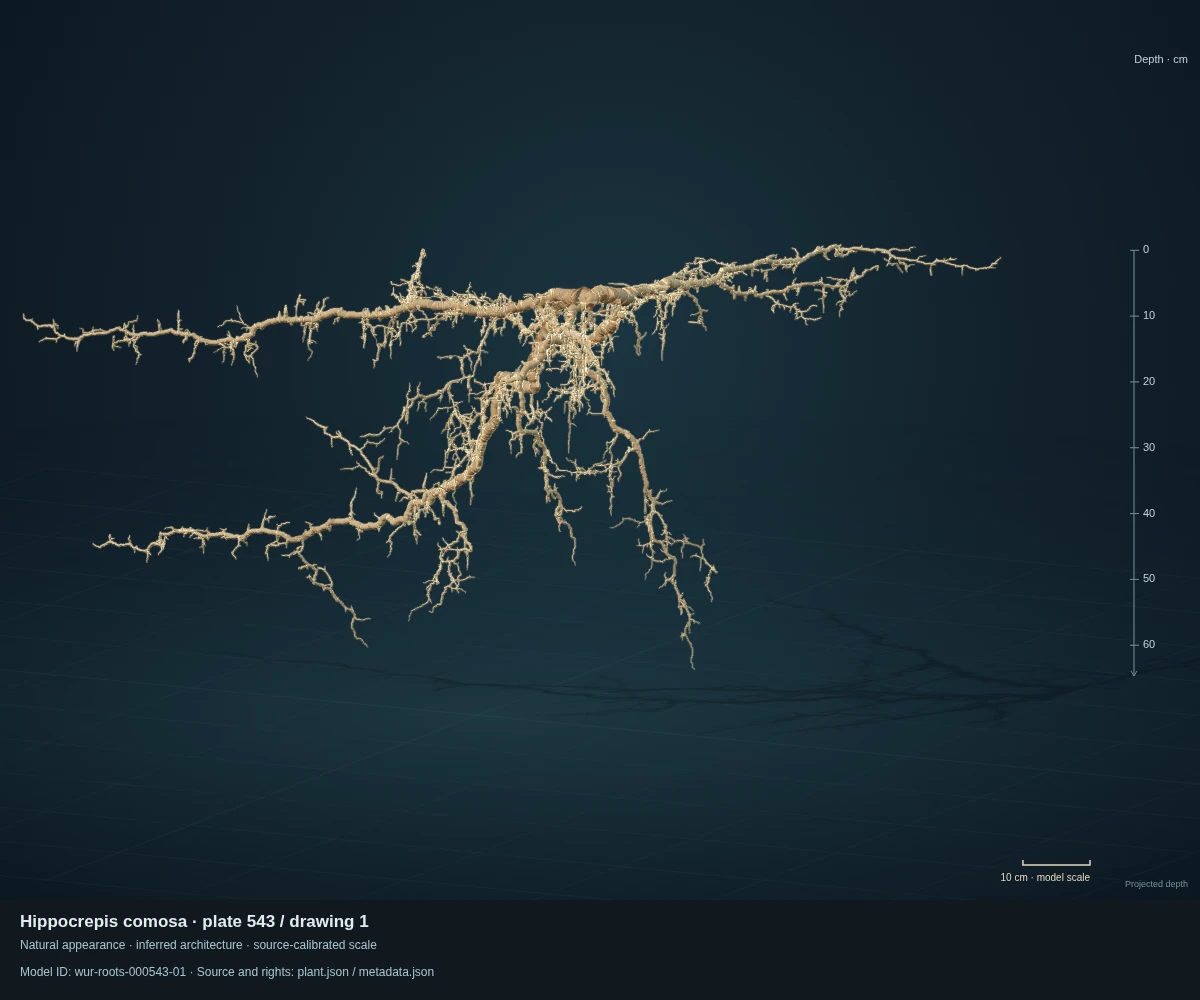
14 cm plate_543
Root depth
66 cm plate_543
Root-system diameter
150 cm plate_543

Drawing observations

  • broad low leafy system along thick horizontal axes with distributed roots
  • roots leave many separated points along horizontal basal system
  • dense fine shallow branching and long lateral paths
  • separate coarse descenders and laterals with fine forks below 60 cm
  • thick outlined horizontal or curved axes link many leafy joins

Biologically constrained spatial reconstruction from source morphology. Root azimuths, hidden placement, growth responses, circular sections, thickness and proposed connections are inferred. The separate source trace retains exact drawing coordinates. No measured 3D anatomy or observed growth sequence is claimed.

Source and attribution

Study 543 · Model 01

Hippocrepis comosa · Wageningen University & Research archive
Functional view
Natural view
Source projection
Side view
Calibration
Source-calibrated
Vertical extent
74.9 cm
Inferred axes
1427
Model metrics and plate observations

Model metrics

Depth follows the printed scale. Equal horizontal scale and hidden depth are modeling assumptions; root thickness is illustrative.

Vertical extent
74.9 cm
Horizontal span (x)
62.6 cm
Horizontal span (z)
57.2 cm
Centreline length
21.2 m
Inferred axes
1427
Branching sites
1379
Terminal paths
1390
Mean modelled diameter
2.68 mm
Surface area proxy
1,850 cm²
Volume proxy
246 cm³
Inferred connection length
2.21 cm
Projected length
18.4 m
Mean angle from vertical
50.4°

Dimensions reported on the source plate

Plant height
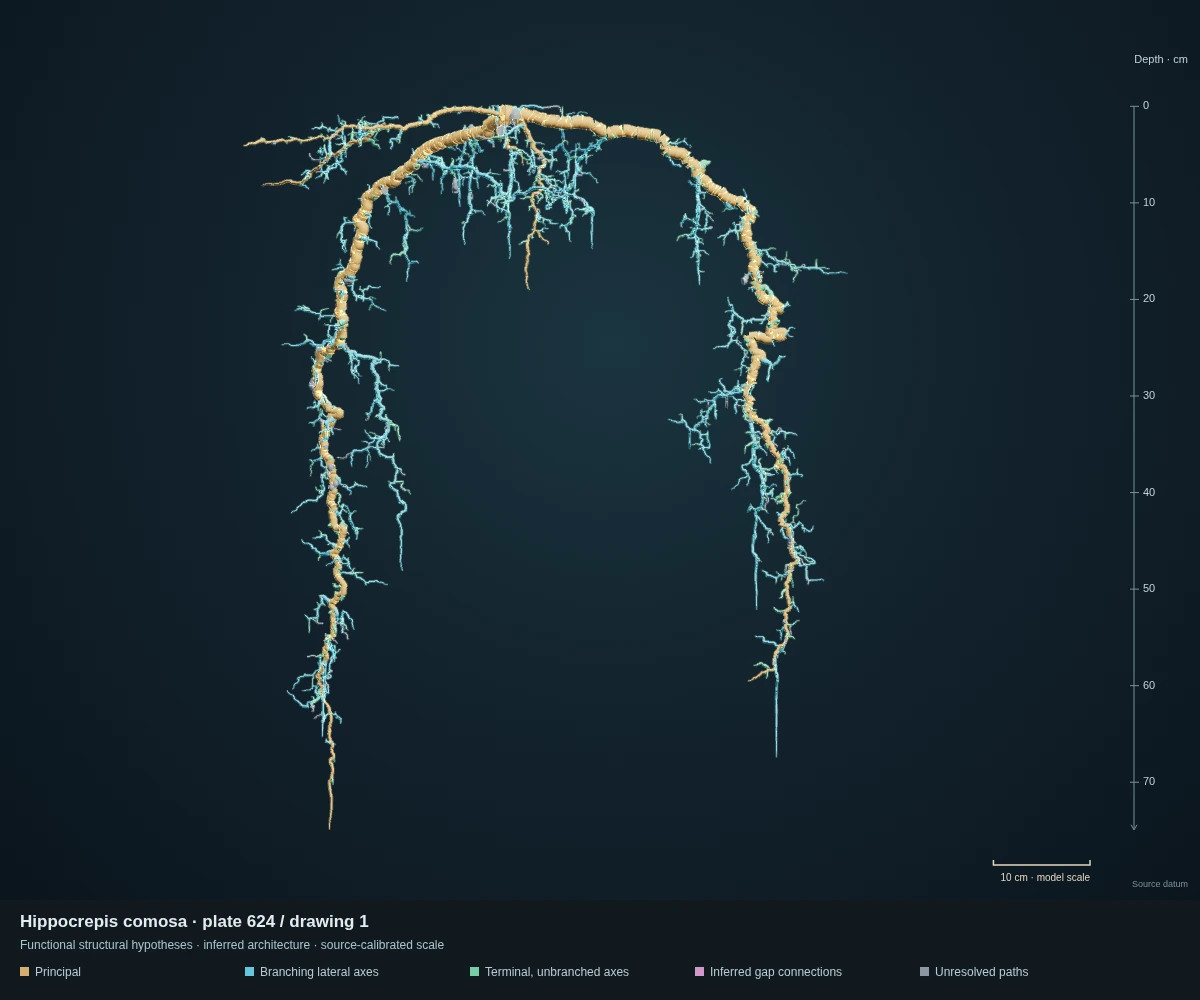
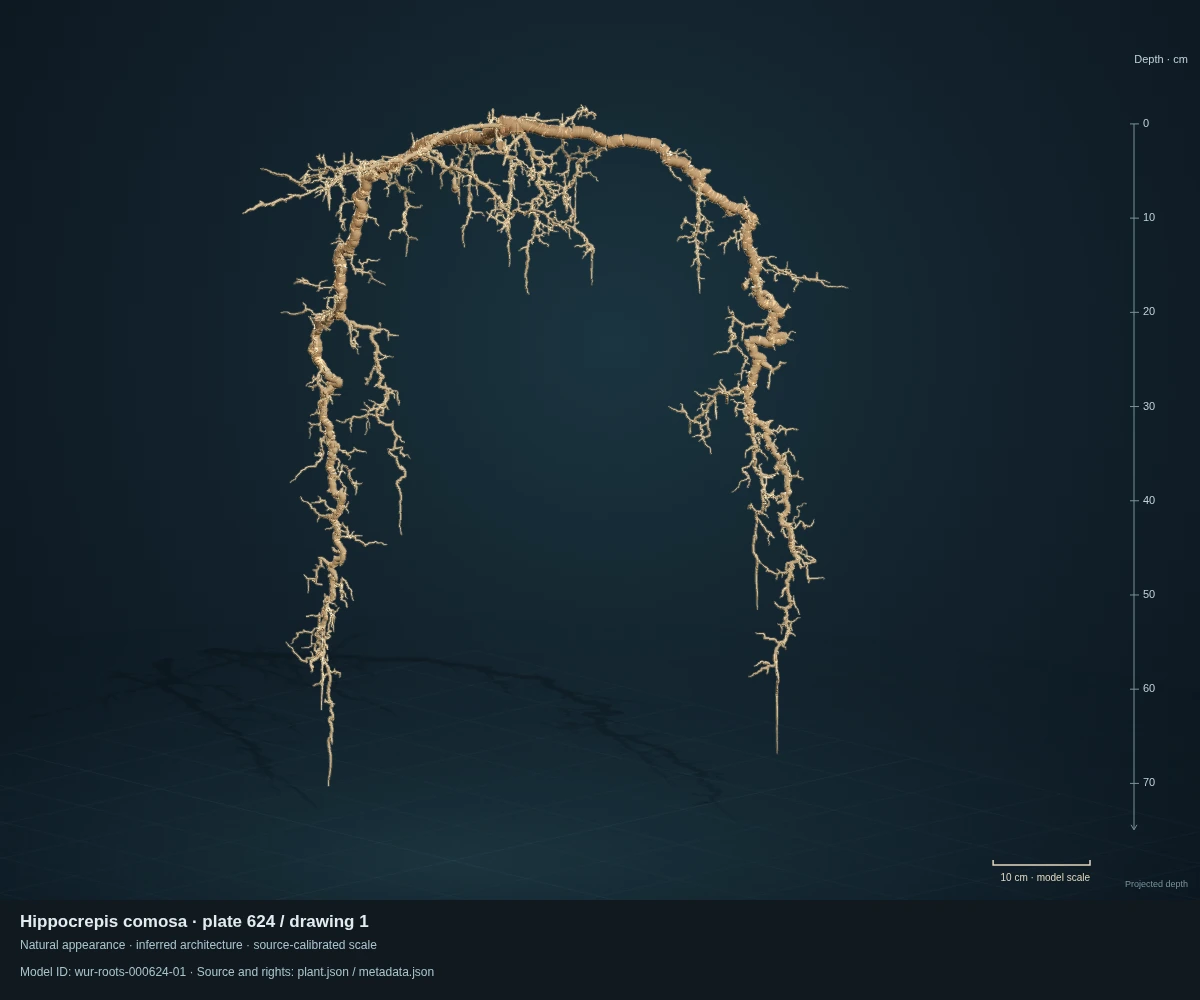
8 cm plate_624
Root depth
74 cm plate_624
Root-system diameter
64 cm plate_624

Drawing observations

  • Multiple coarse roots emerge from the low crown, including long left and right spreading arms.
  • Upper lateral roots curve down into two widely separated deep columns around a large open central space.
  • Both outer columns carry many fine forks and extend below 60 cm; the right column ends deepest.

Biologically constrained spatial reconstruction from source morphology. Root azimuths, hidden placement, growth responses, circular sections, thickness and proposed connections are inferred. The separate source trace retains exact drawing coordinates. No measured 3D anatomy or observed growth sequence is claimed.

Source and attribution

Study 624 · Model 01

Hippocrepis comosa · Wageningen University & Research archive
Names & classification

Family
Fabaceae
Genus
Hippocrepis
Order
Fabales
Botanical authority
L.
Taxonomic rank
Species
Life form
biennial or subshrub
Growth form
Herb
Native range
Europe
Climate
temperate
Mean vegetative height (TRY)
0.181 m
Maximum recorded vegetative height (TRY)
0.6 m
Archive names
Hippocrepis comosa

European ecological indicators

Light (1–9, shade to sun)
7.8
Moisture (1–12, dry to submerged)
2.9
Soil reaction (1–9, acidic to base-rich)
7.4
Nutrients (1–9, poor to rich)
2
Tichý et al. (2023)