Arbor.guide

Knautia arvensis

Field Scabious

Root studies

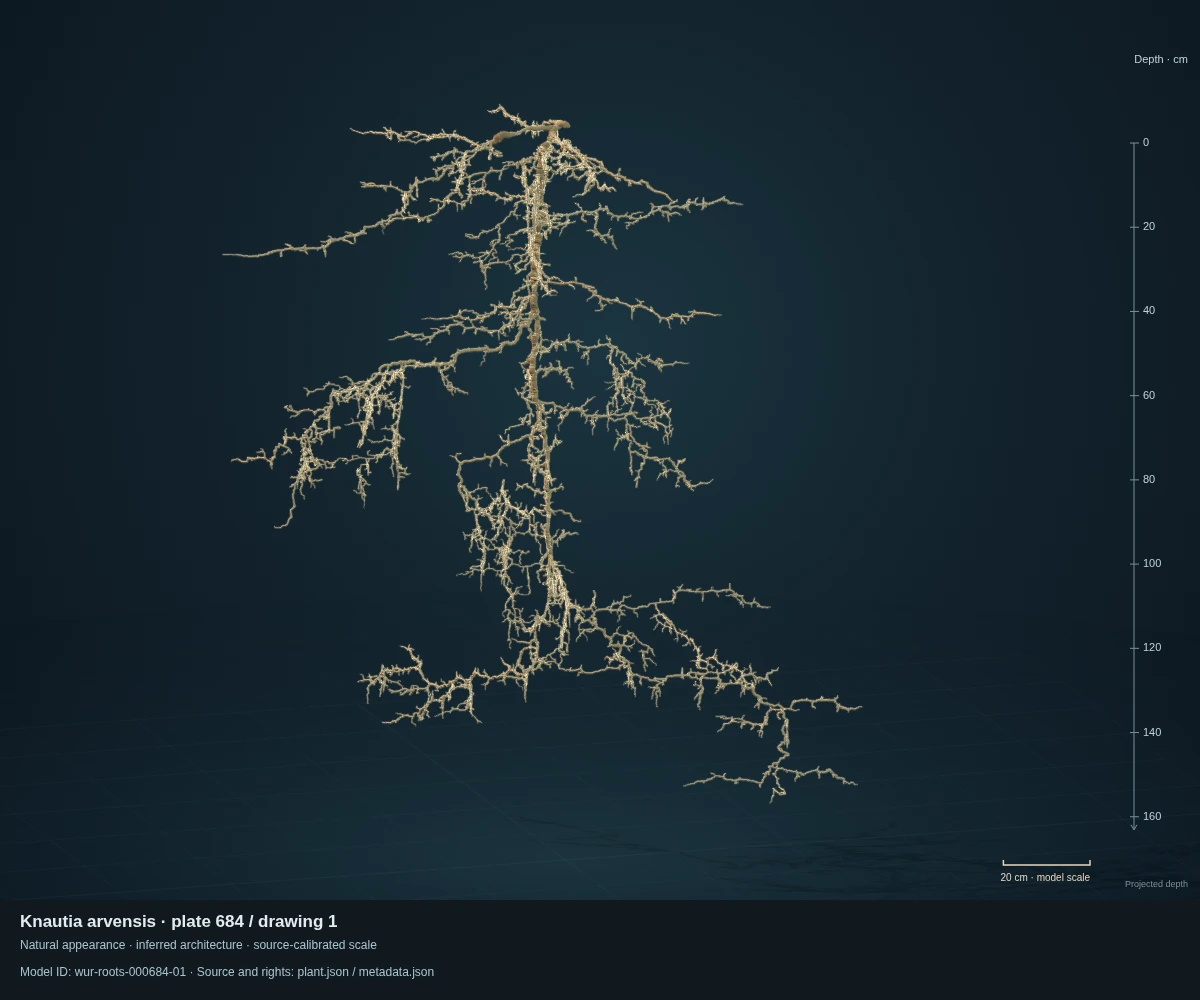
These reconstructions follow archived root drawings. Colour identifies the modelled structural role of each root.

Functional view
Natural view
Source projection
Side view
Calibration
Source-calibrated
Vertical extent
1.62 m
Inferred axes
3273
Model metrics and plate observations

Model metrics

Depth follows the printed scale. Equal horizontal scale and hidden depth are modeling assumptions; root thickness is illustrative.

Vertical extent
1.62 m
Horizontal span (x)
1.42 m
Horizontal span (z)
1.54 m
Centreline length
82.3 m
Inferred axes
3273
Branching sites
3036
Terminal paths
3069
Mean modelled diameter
3.35 mm
Surface area proxy
8,720 cm²
Volume proxy
1,010 cm³
Inferred connection length
16.5 cm
Projected length
70 m
Mean angle from vertical
53.7°

Dimensions reported on the source plate

Plant height
31 cm plate_684
Root depth
172 cm plate_684
Root-system diameter
80 cm plate_684

Drawing observations

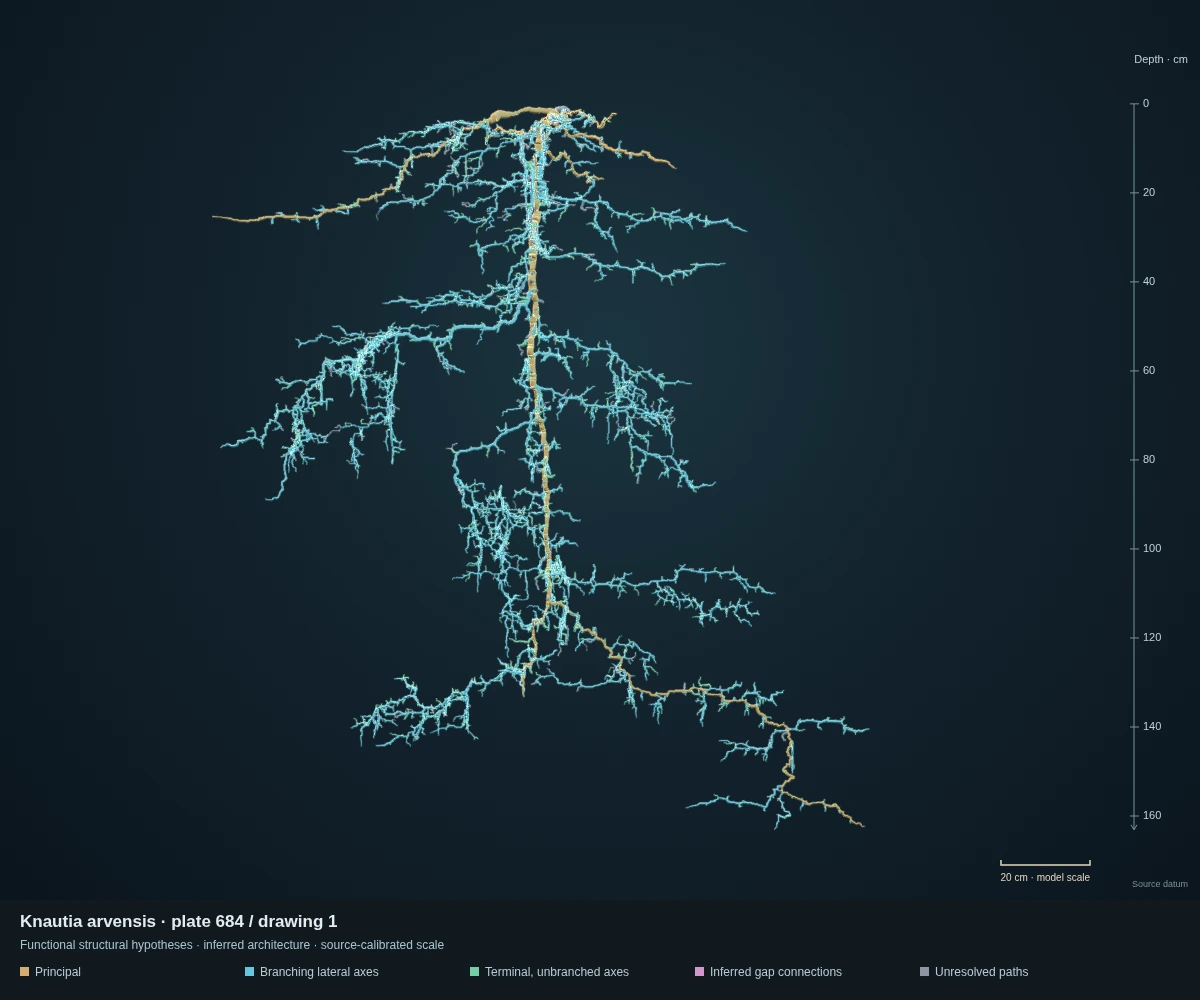
  • Long headed stems and a broad basal rosette above a deep taproot with separated lateral fields
  • A long coarser main root descends from the compact rosette base
  • Separated fine lateral fields occur at many depths on both sides
  • Asymmetric finer root fields terminate beyond the 160 cm tick

Biologically constrained spatial reconstruction from source morphology. Root azimuths, hidden placement, growth responses, circular sections, thickness and proposed connections are inferred. The separate source trace retains exact drawing coordinates. No measured 3D anatomy or observed growth sequence is claimed.

Source and attribution

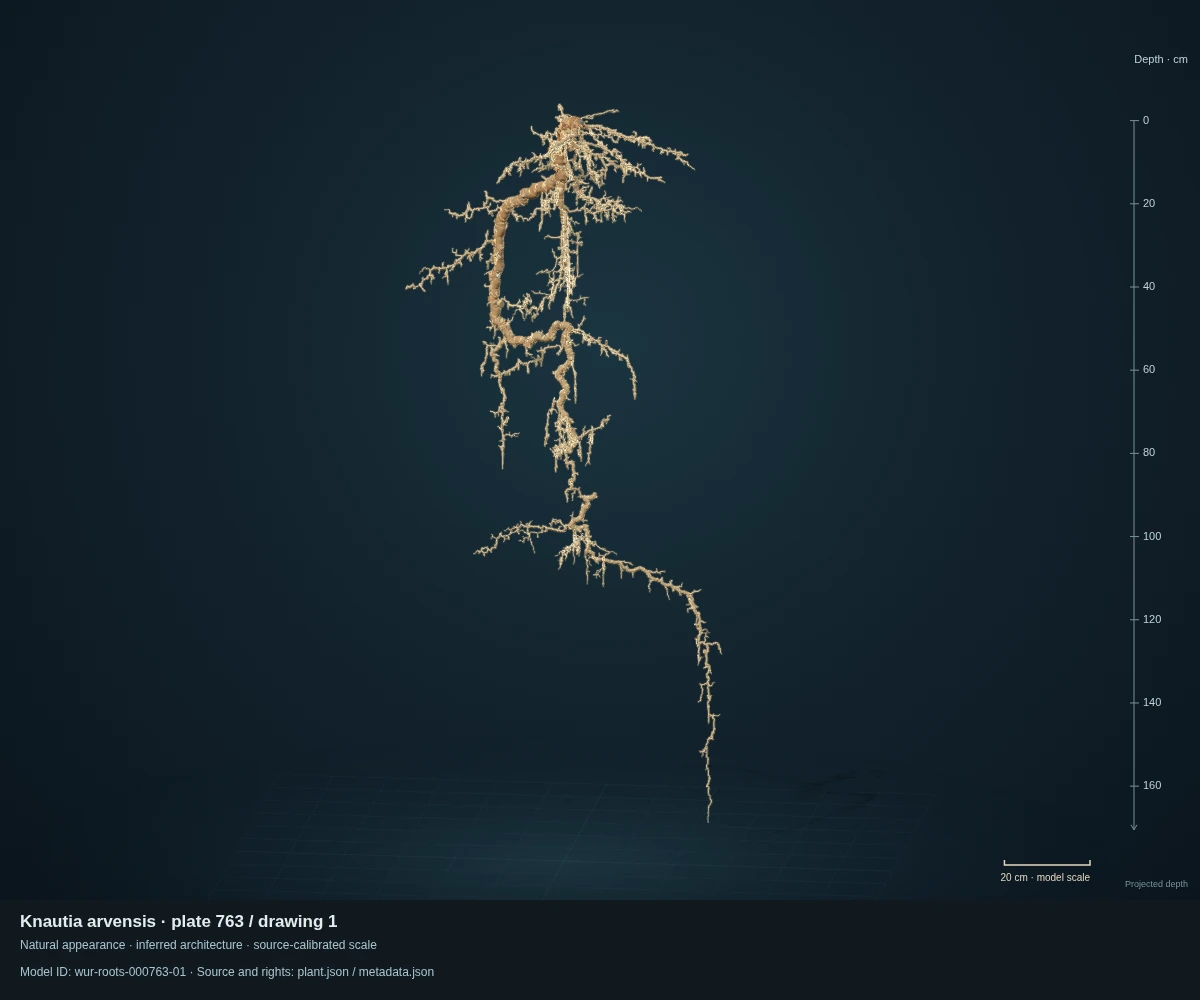
Study 684 · Model 01

Knautia arvensis · Wageningen University & Research archive
Functional view
Natural view
Source projection
Side view
Calibration
Source-calibrated
Vertical extent
1.7 m
Inferred axes
2276
Model metrics and plate observations

Model metrics

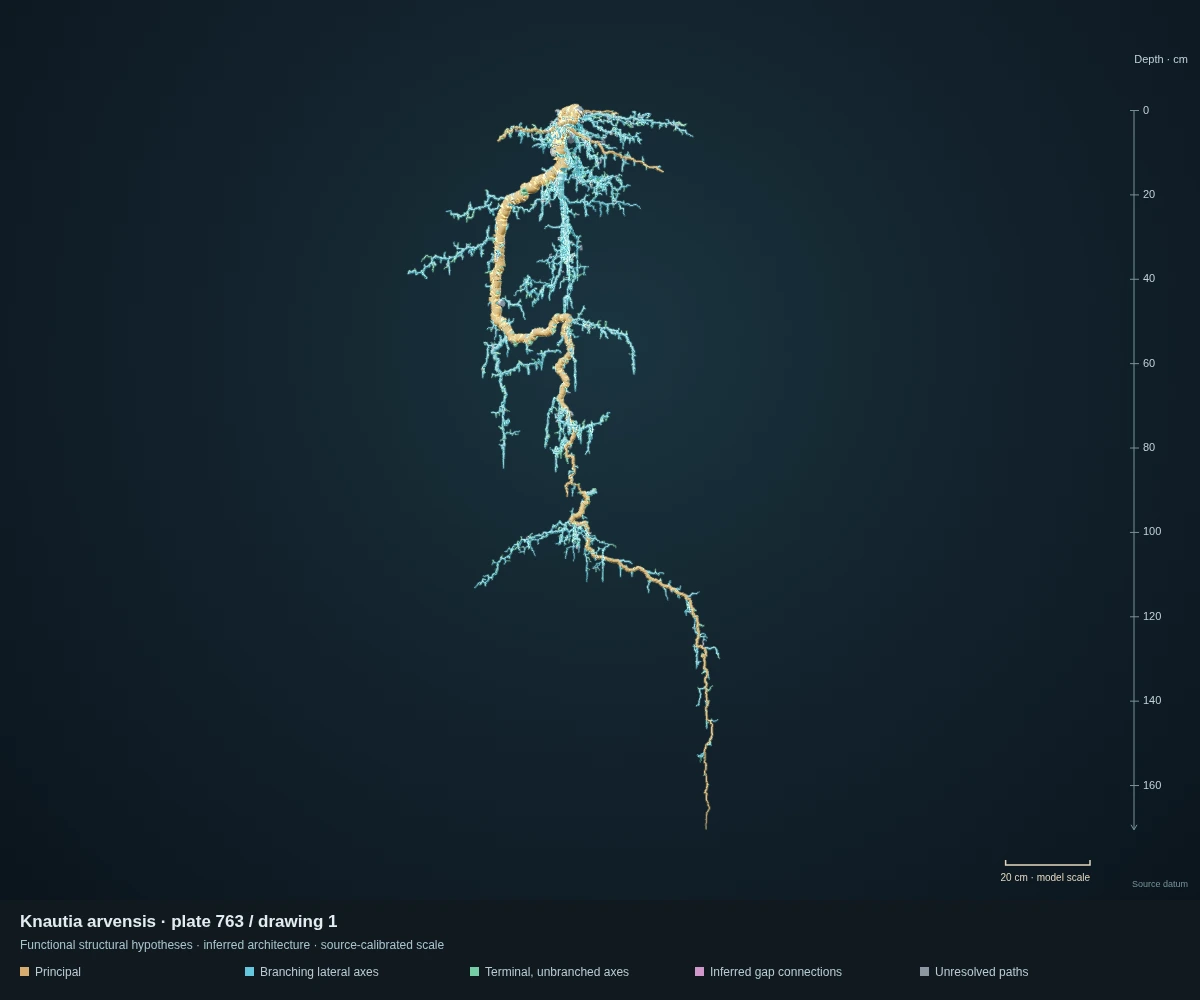
Depth follows the printed scale. Equal horizontal scale and hidden depth are modeling assumptions; root thickness is illustrative.

Vertical extent
1.7 m
Horizontal span (x)
71.5 cm
Horizontal span (z)
68.9 cm
Centreline length
40.5 m
Inferred axes
2276
Branching sites
2178
Terminal paths
2193
Mean modelled diameter
4.32 mm
Surface area proxy
5,770 cm²
Volume proxy
1,230 cm³
Inferred connection length
0 cm
Projected length
39.7 m
Mean angle from vertical
47.4°

Dimensions reported on the source plate

Plant height
55 cm plate_763
Root depth
161 cm plate_763
Root-system diameter
154 cm plate_763

Reported dimensions and drawn scaled proportions appear inconsistent; both remain explicit.

Drawing observations

  • A small upright divided-leaf shoot stands over a deep root with repeated horizontal side fans.
  • A dense short crown root fan converges on one slender descending axis.
  • Successive wide lateral fans occur down the central root, separated by comparatively open stretches.
  • A major lower right branch turns down and ends deepest beyond 160 cm while the central path ends higher.

Biologically constrained spatial reconstruction from source morphology. Root azimuths, hidden placement, growth responses, circular sections, thickness and proposed connections are inferred. The separate source trace retains exact drawing coordinates. No measured 3D anatomy or observed growth sequence is claimed.

Source and attribution

Study 763 · Model 01

Knautia arvensis · Wageningen University & Research archive
Functional view
Natural view
Source projection
Side view
Calibration
Source-calibrated
Vertical extent
1.78 m
Inferred axes
1122
Model metrics and plate observations

Model metrics

Depth follows the printed scale. Equal horizontal scale and hidden depth are modeling assumptions; root thickness is illustrative.

Vertical extent
1.78 m
Horizontal span (x)
96.8 cm
Horizontal span (z)
74.4 cm
Centreline length
48.4 m
Inferred axes
1122
Branching sites
1067
Terminal paths
1071
Mean modelled diameter
5.83 mm
Surface area proxy
9,090 cm²
Volume proxy
2,440 cm³
Inferred connection length
2.08 cm
Projected length
42 m
Mean angle from vertical
47.6°

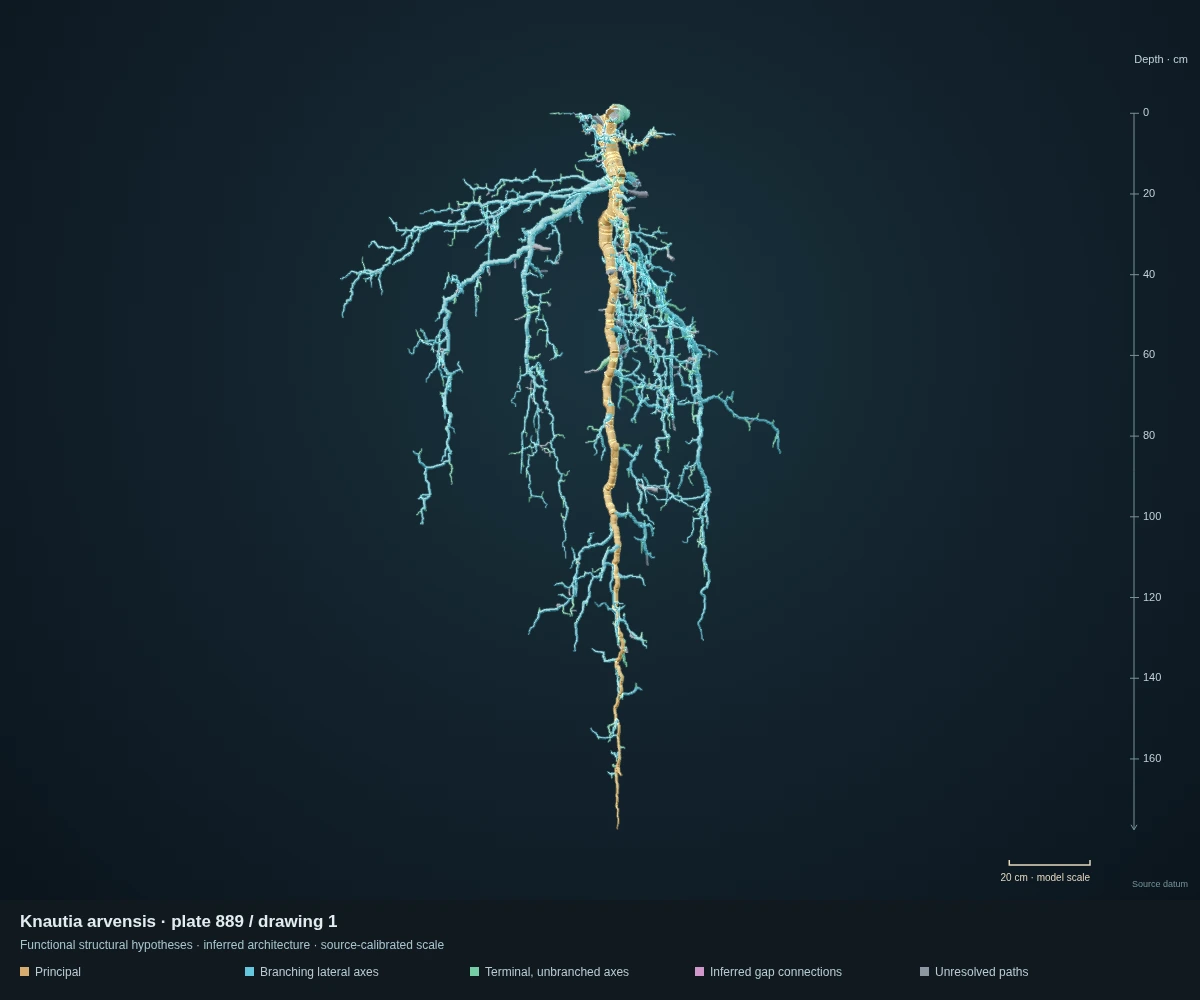
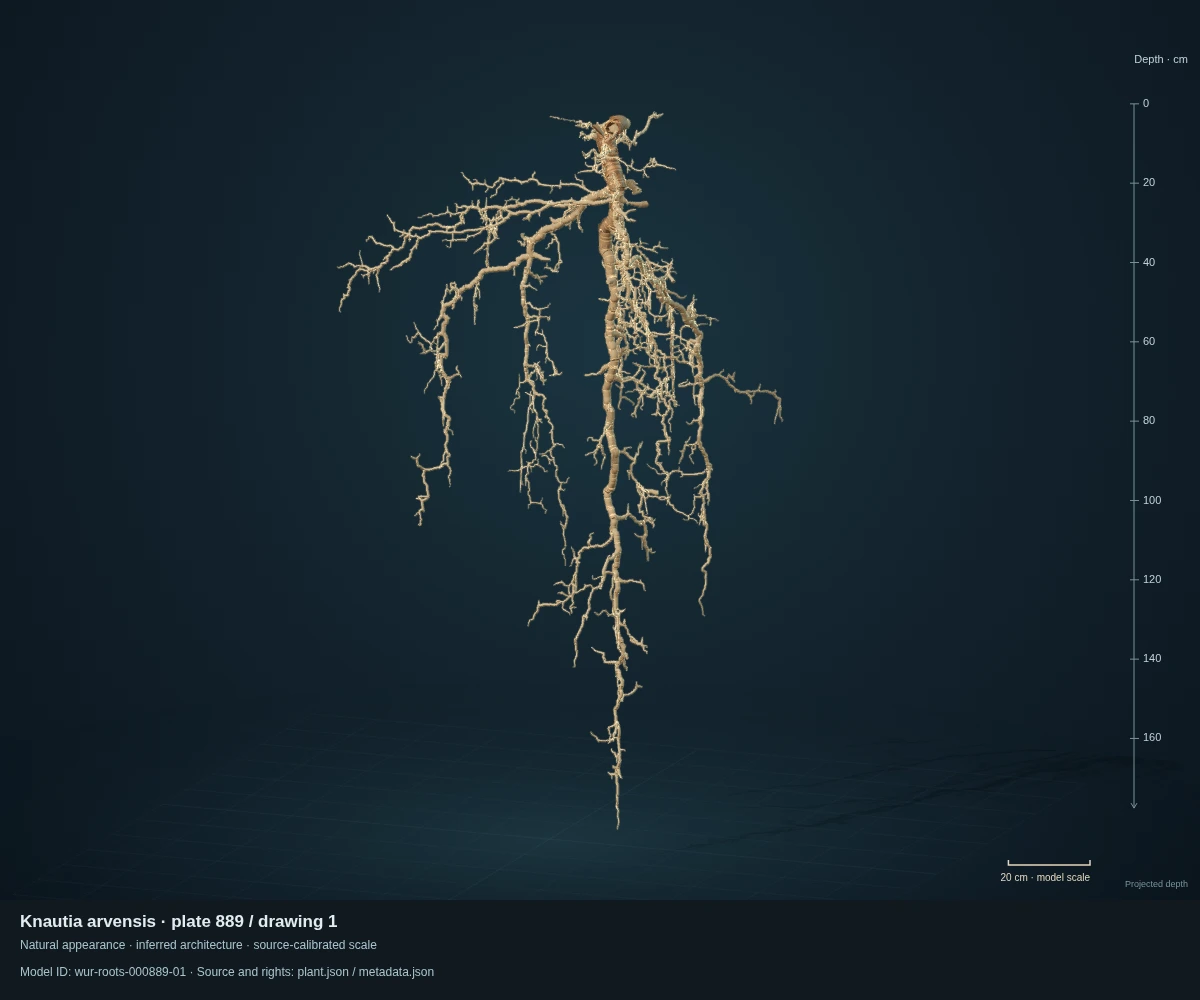
Drawing observations

  • A slanted coarse basal root narrows downward and gives broad upper lateral roots.
  • Long laterals spread to both sides before turning downward; the central field remains branched to greater depth.
  • A thin central path extends beyond the 150 cm tick; shorter side columns end at different higher levels.

Biologically constrained spatial reconstruction from source morphology. Root azimuths, hidden placement, growth responses, circular sections, thickness and proposed connections are inferred. The separate source trace retains exact drawing coordinates. No measured 3D anatomy or observed growth sequence is claimed.

Source and attribution

Study 889 · Model 01

Knautia arvensis · Wageningen University & Research archive
Names & classification

Family
Caprifoliaceae
Genus
Knautia
Order
Dipsacales
Botanical authority
(L.) Coult.
Taxonomic rank
Species
Life form
biennial or perennial
Growth form
Herb
Native range
Europe to Siberia and N. Caucasus
Climate
temperate
Mean vegetative height (TRY)
0.436 m
Maximum recorded vegetative height (TRY)
1.0 m
Archive names
Knautia arvensis

European ecological indicators

Light (1–9, shade to sun)
7.1
Moisture (1–12, dry to submerged)
4.1
Soil reaction (1–9, acidic to base-rich)
6.5
Nutrients (1–9, poor to rich)
3.7
Tichý et al. (2023)