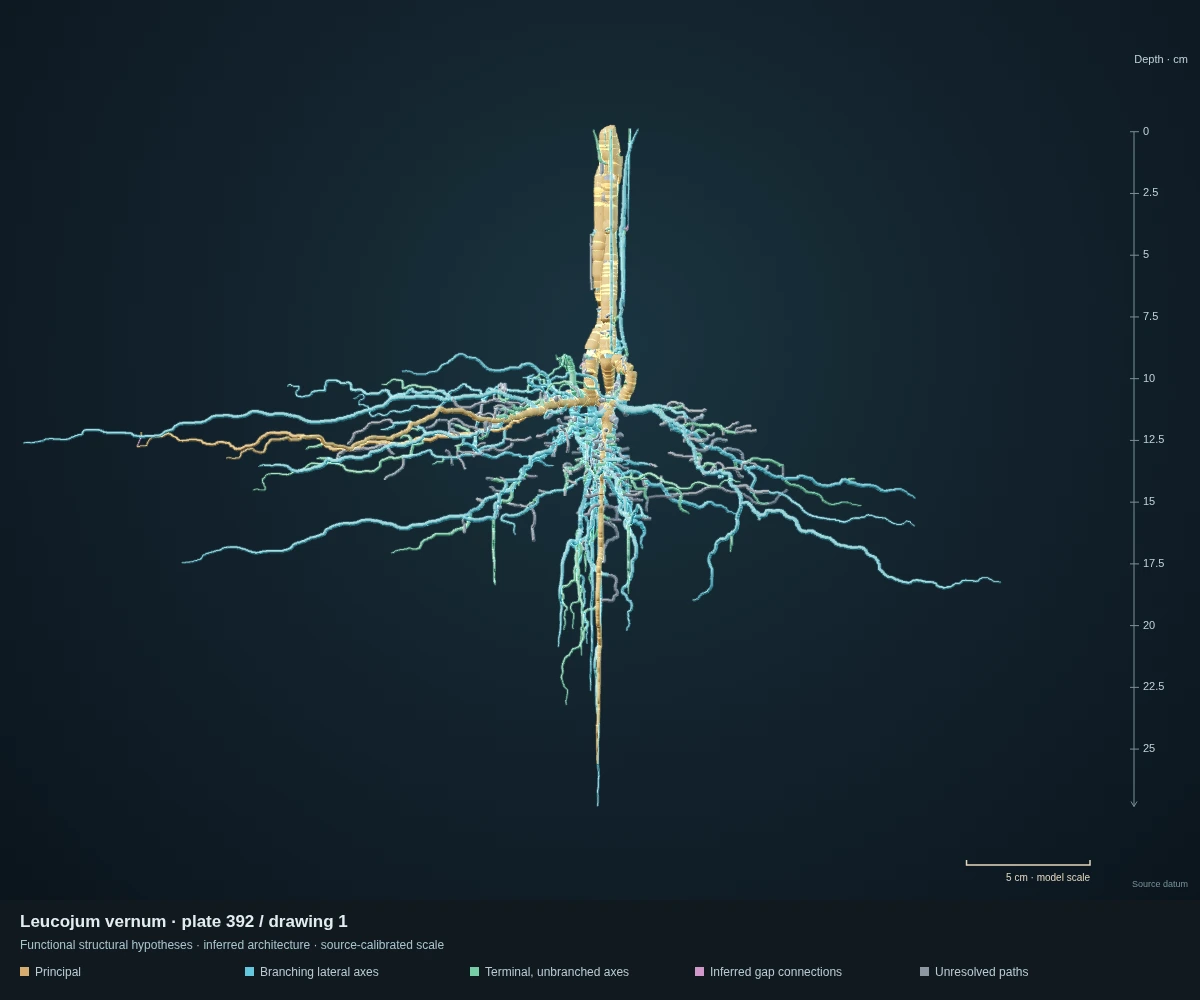
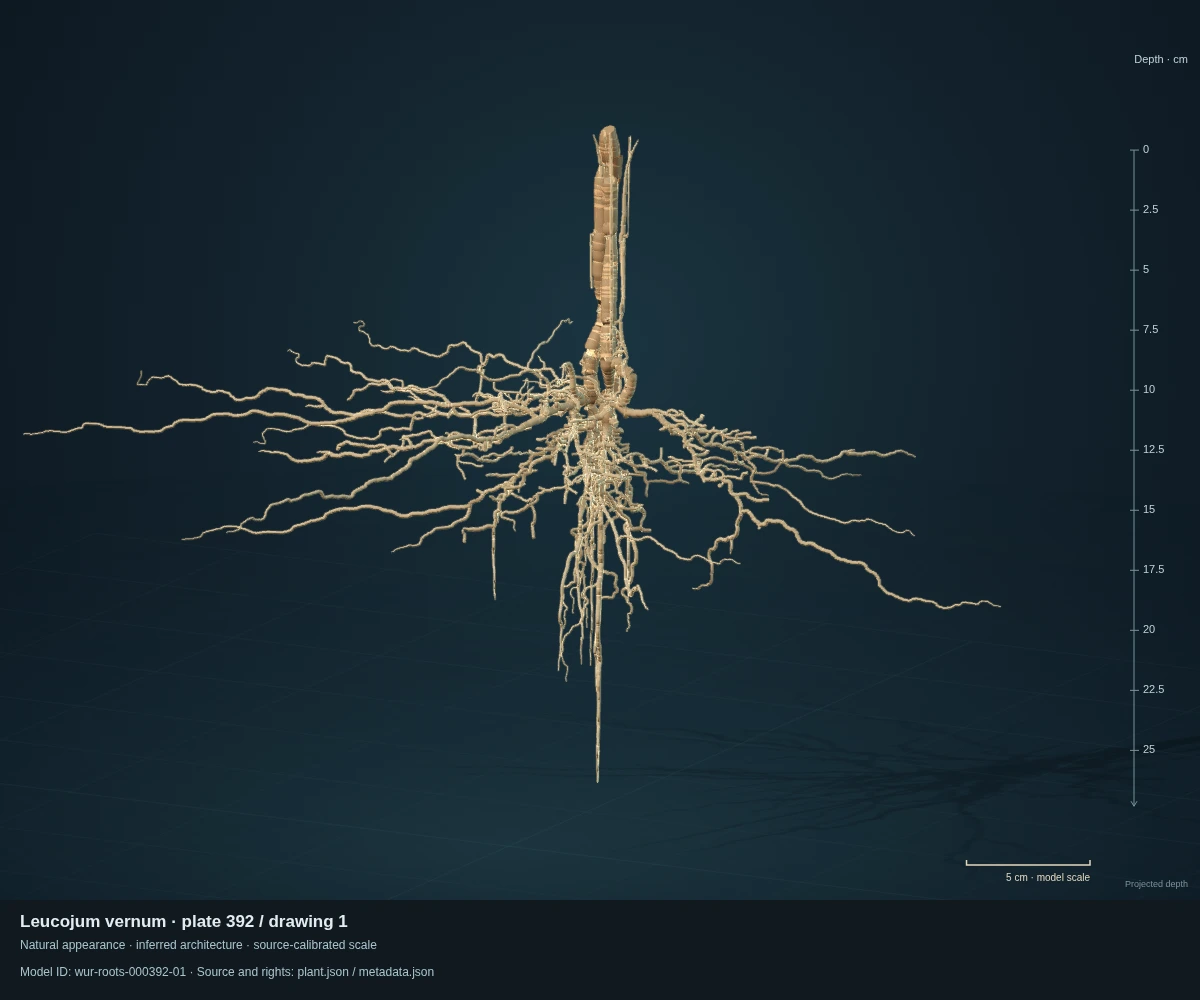
- Source projection
- Side view
- Calibration
- Source-calibrated
- Vertical extent
- 27.4 cm
- Inferred axes
- 769
Model metrics and plate observations
Model metrics
Depth follows the printed scale. Equal horizontal scale and hidden depth are modeling assumptions; root thickness is illustrative.
- Vertical extent
- 27.4 cm
- Horizontal span (x)
- 38.2 cm
- Horizontal span (z)
- 30.6 cm
- Centreline length
- 9.3 m
- Inferred axes
- 769
- Branching sites
- 634
- Terminal paths
- 637
- Mean modelled diameter
- 1.42 mm
- Surface area proxy
- 423 cm²
- Volume proxy
- 24.4 cm³
- Inferred connection length
- 1.88 cm
- Projected length
- 8.23 m
- Mean angle from vertical
- 52.7°
Dimensions reported on the source plate
- Plant height
- 14 cm plate_392
- Root depth
- 28 cm plate_392
- Root-system diameter
- 40 cm plate_392
Drawing observations
- A dense cluster of roots leaves the bases of the underground organs.
- Thick wavy roots spread broadly to both sides.
- Many central roots descend farther, with relatively little fine branching.
Biologically constrained spatial reconstruction from source morphology. Root azimuths, hidden placement, growth responses, circular sections, thickness and proposed connections are inferred. The separate source trace retains exact drawing coordinates. No measured 3D anatomy or observed growth sequence is claimed.
Source and attribution
Study 392 · Model 01
Leucojum vernum · Wageningen University & Research archive