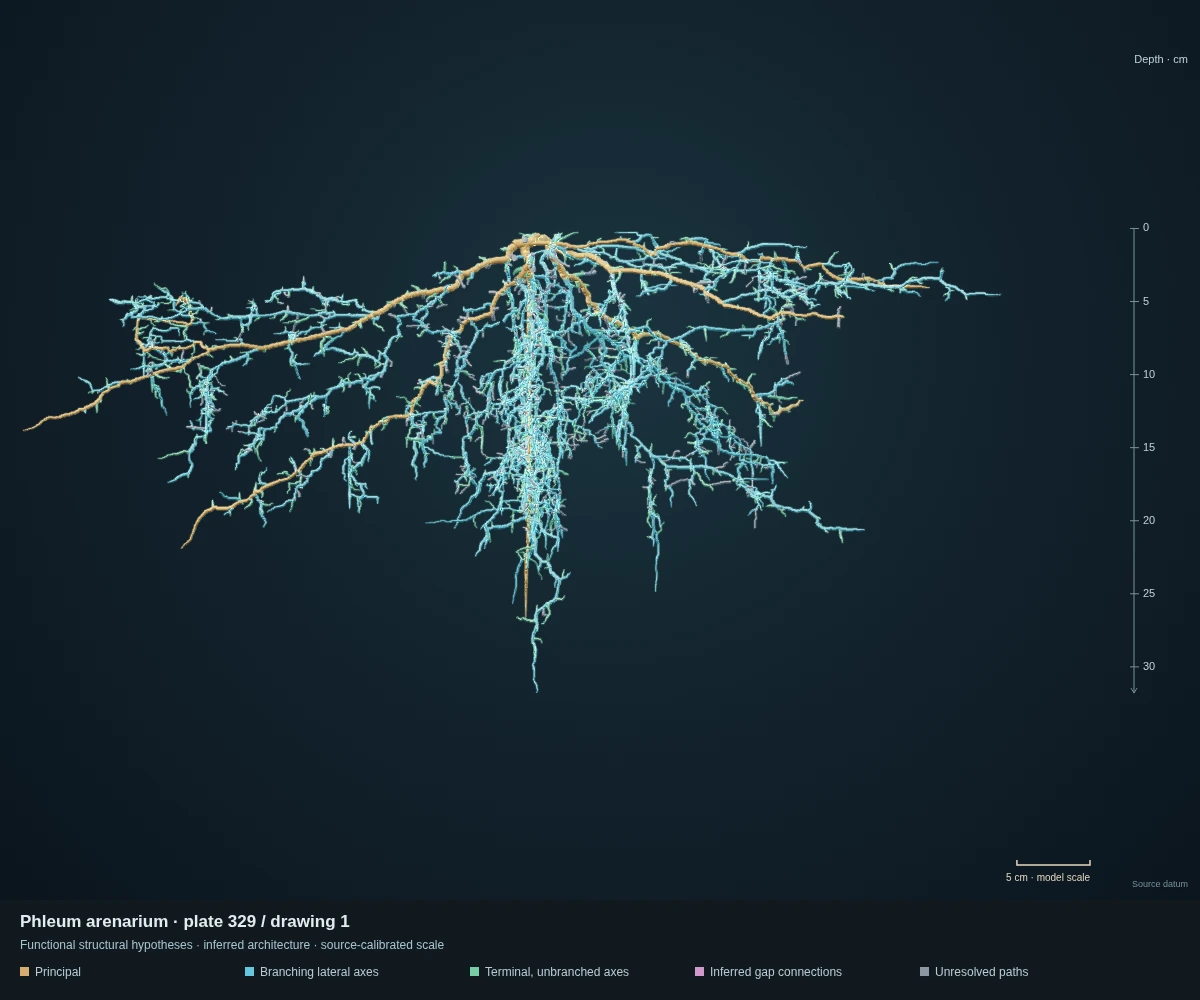
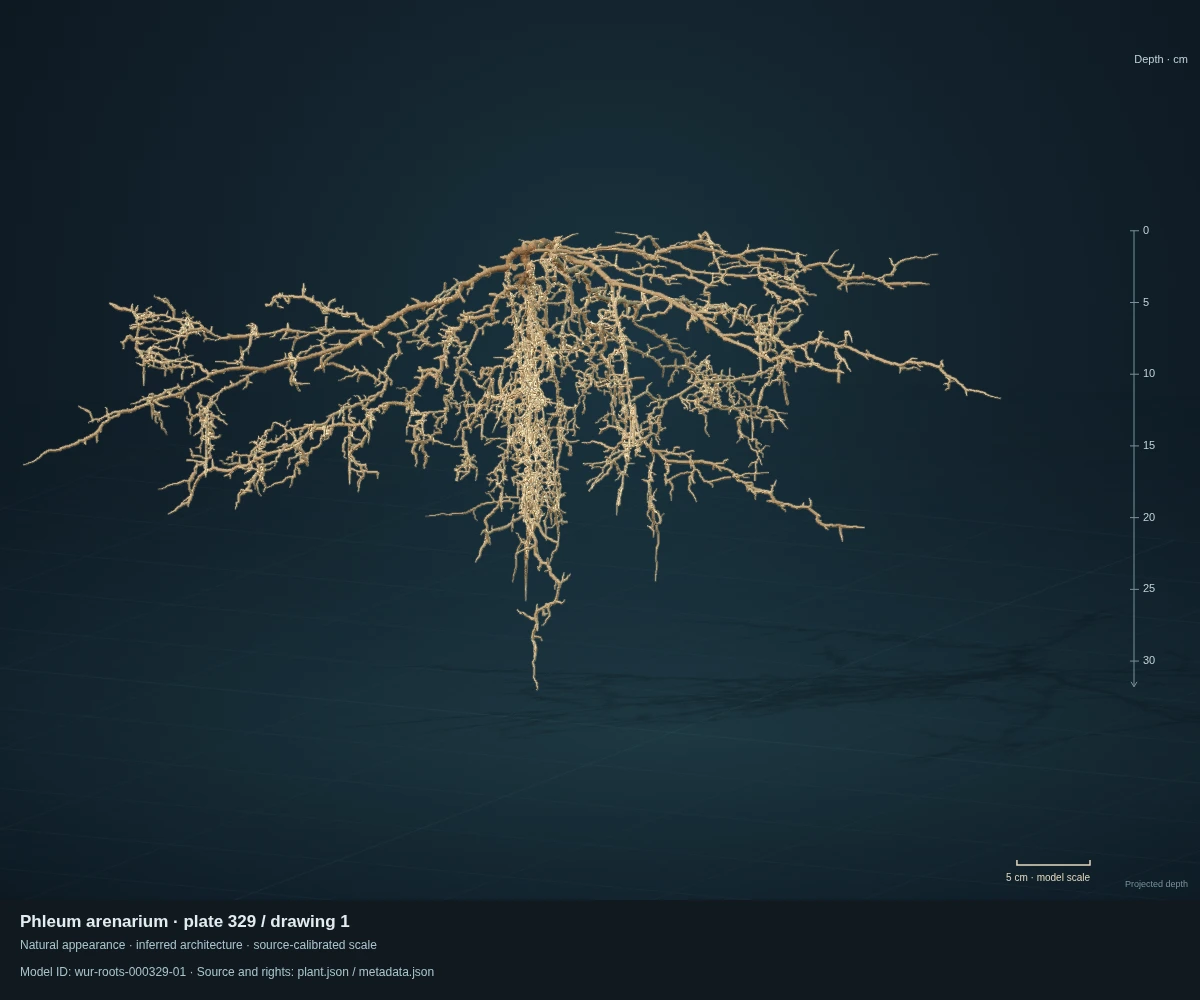
- Source projection
- Side view
- Calibration
- Source-calibrated
- Vertical extent
- 31.5 cm
- Inferred axes
- 2700
Model metrics and plate observations
Model metrics
Depth follows the printed scale. Equal horizontal scale and hidden depth are modeling assumptions; root thickness is illustrative.
- Vertical extent
- 31.5 cm
- Horizontal span (x)
- 73.1 cm
- Horizontal span (z)
- 62.6 cm
- Centreline length
- 30.4 m
- Inferred axes
- 2700
- Branching sites
- 2455
- Terminal paths
- 2465
- Mean modelled diameter
- 1.42 mm
- Surface area proxy
- 1,360 cm²
- Volume proxy
- 58.5 cm³
- Inferred connection length
- 1.21 cm
- Projected length
- 26.6 m
- Mean angle from vertical
- 54.2°
Dimensions reported on the source plate
- Plant height
- 16 cm plate_329
- Root depth
- 32 cm plate_329
- Root-system diameter
- 77 cm plate_329
Drawing observations
- Long bilateral roots spread widely beneath the ground line
- A dense central fan contains many fine descending and oblique branches
- Few central descenders continue below most branching; some end in long nearly bare tips
Biologically constrained spatial reconstruction from source morphology. Root azimuths, hidden placement, growth responses, circular sections, thickness and proposed connections are inferred. The separate source trace retains exact drawing coordinates. No measured 3D anatomy or observed growth sequence is claimed.
Source and attribution
Study 329 · Model 01
Phleum arenarium · Wageningen University & Research archive