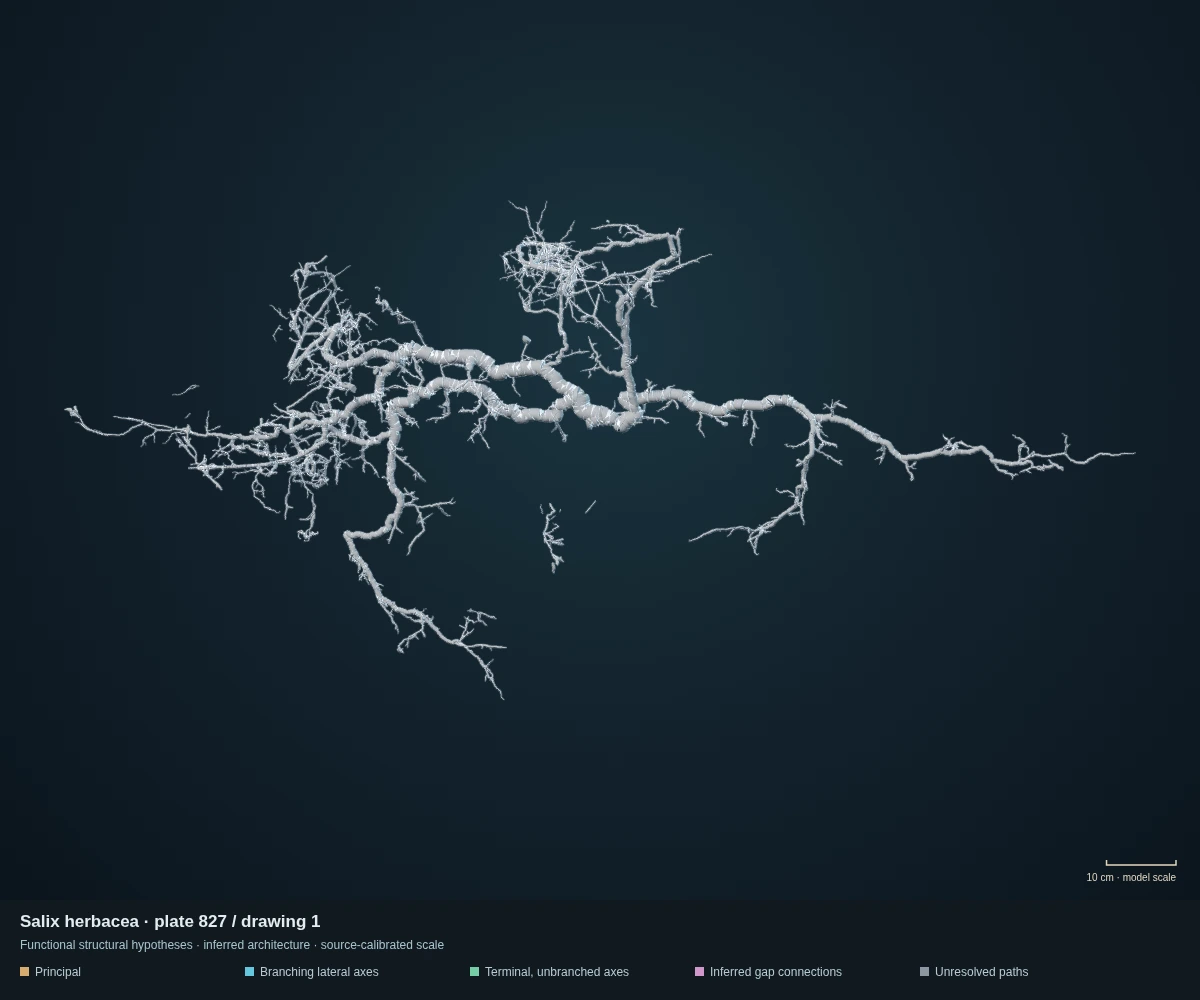
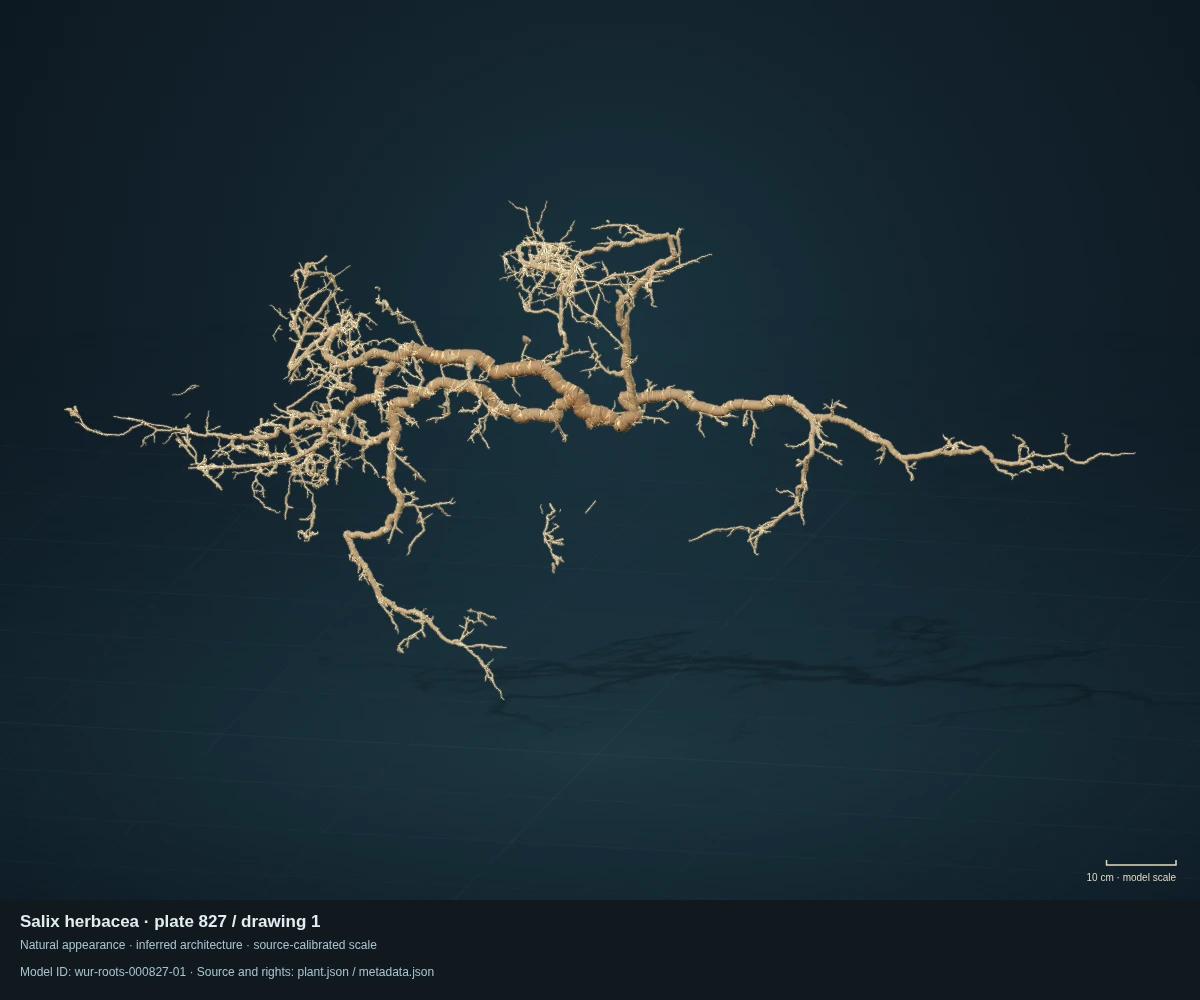
- Source projection
- Detached spread
- Calibration
- Source-calibrated
- Vertical extent
- 74.2 cm
- Inferred axes
- 1957
Model metrics and plate observations
Model metrics
The transcribed printed bar calibrates its source direction. Endpoints are detected to the stated pixel uncertainty; other directions and hidden depth assume equal scale.
- Vertical extent
- 74.2 cm
- Horizontal span (x)
- 1.58 m
- Horizontal span (z)
- 42.2 cm
- Centreline length
- 39.7 m
- Inferred axes
- 1957
- Branching sites
- 1851
- Terminal paths
- 1876
- Mean modelled diameter
- 3.29 mm
- Surface area proxy
- 4,190 cm²
- Volume proxy
- 748 cm³
- Inferred connection length
- 0 cm
- Projected length
- 39.7 m
- Mean angle from vertical
- 58.0°
Drawing observations
- Several coarse axes cross and branch around the central join
- Long outward courses carry scattered short branching laterals and tapering tips
- Numerous short leafy branch systems arise from thicker spreading axes
Biologically constrained spatial reconstruction from source morphology. Root azimuths, hidden placement, growth responses, circular sections, thickness and proposed connections are inferred. The separate source trace retains exact drawing coordinates. No measured 3D anatomy or observed growth sequence is claimed.