Arbor.guide

Salix retusa

Root studies

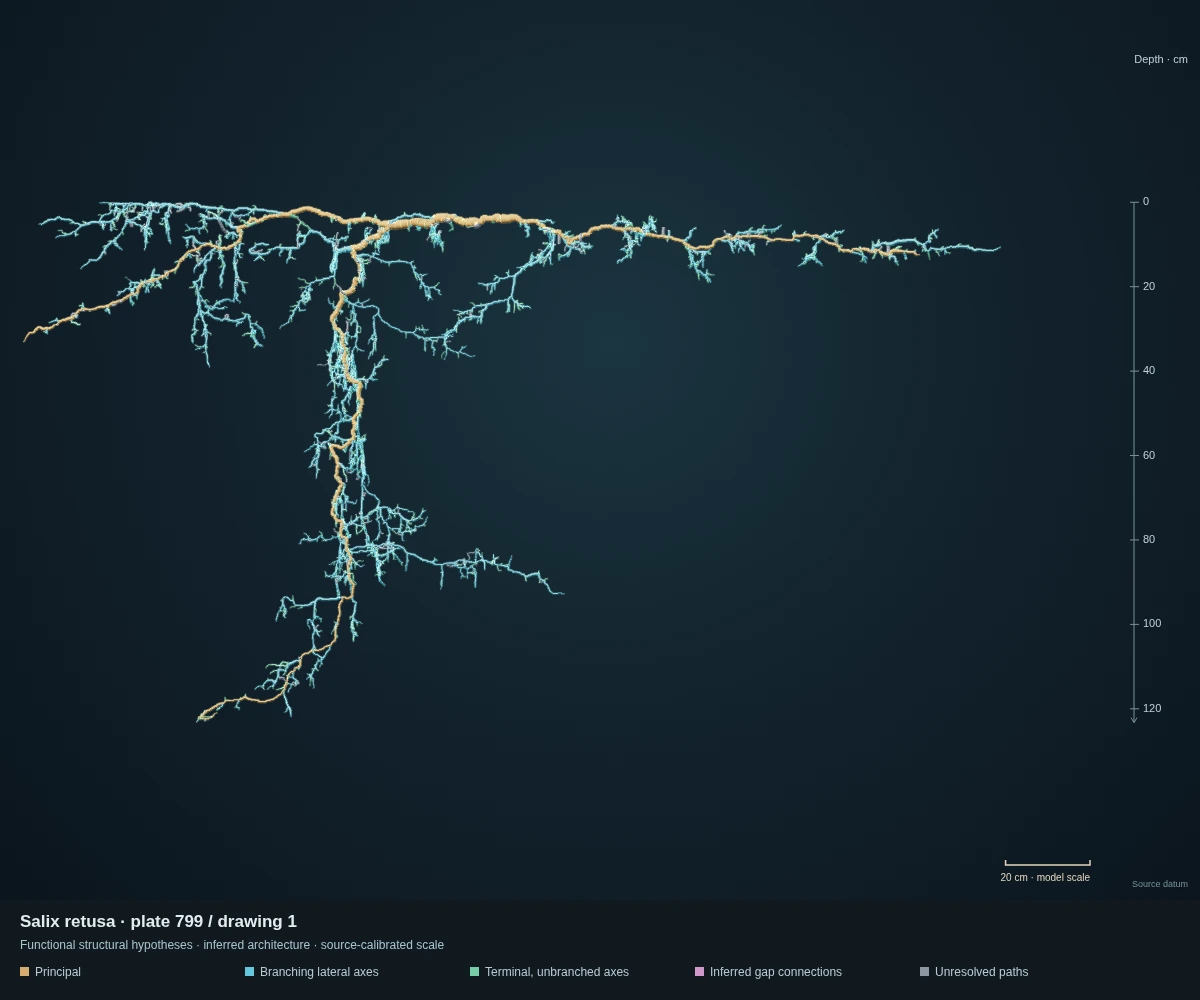
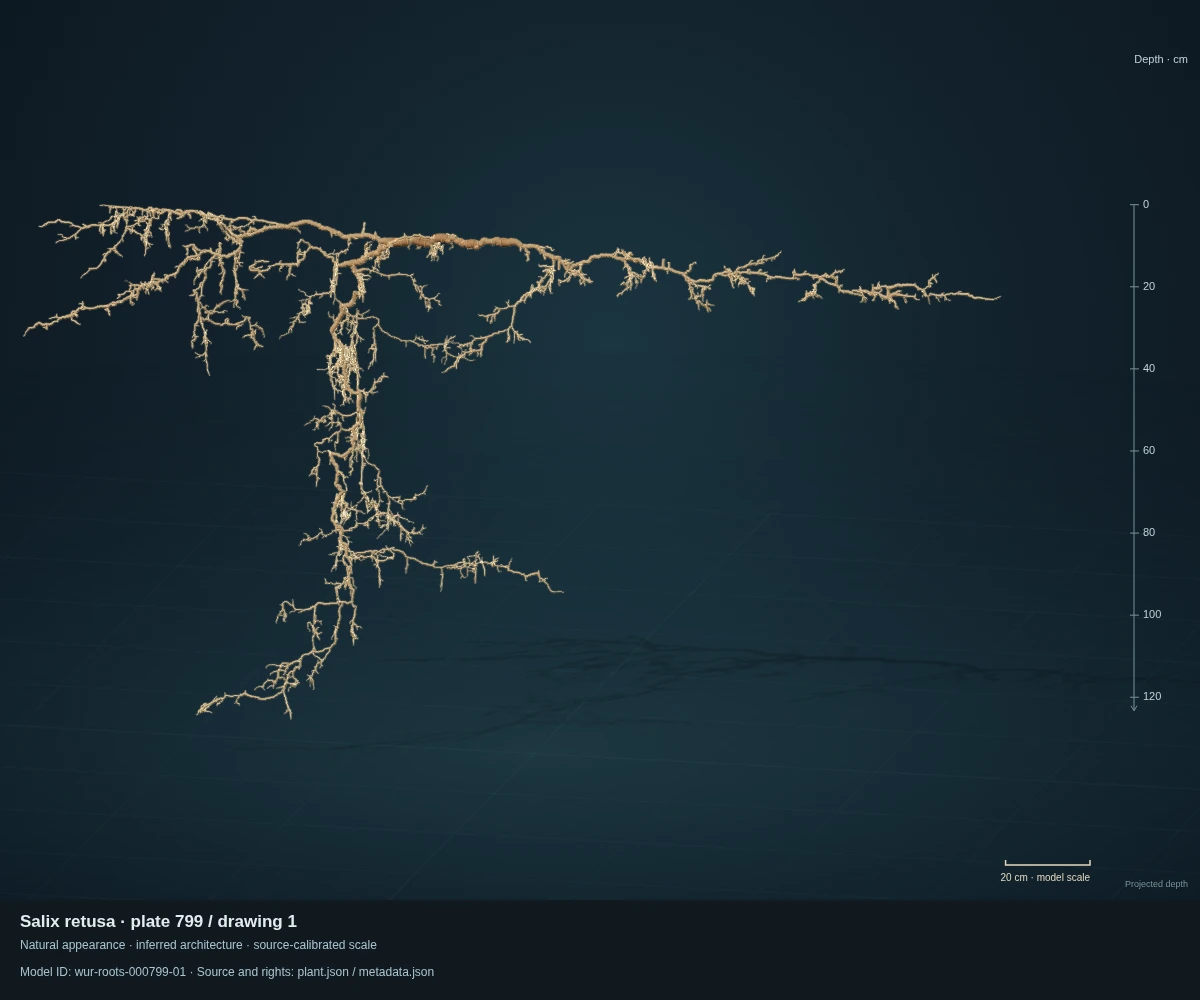
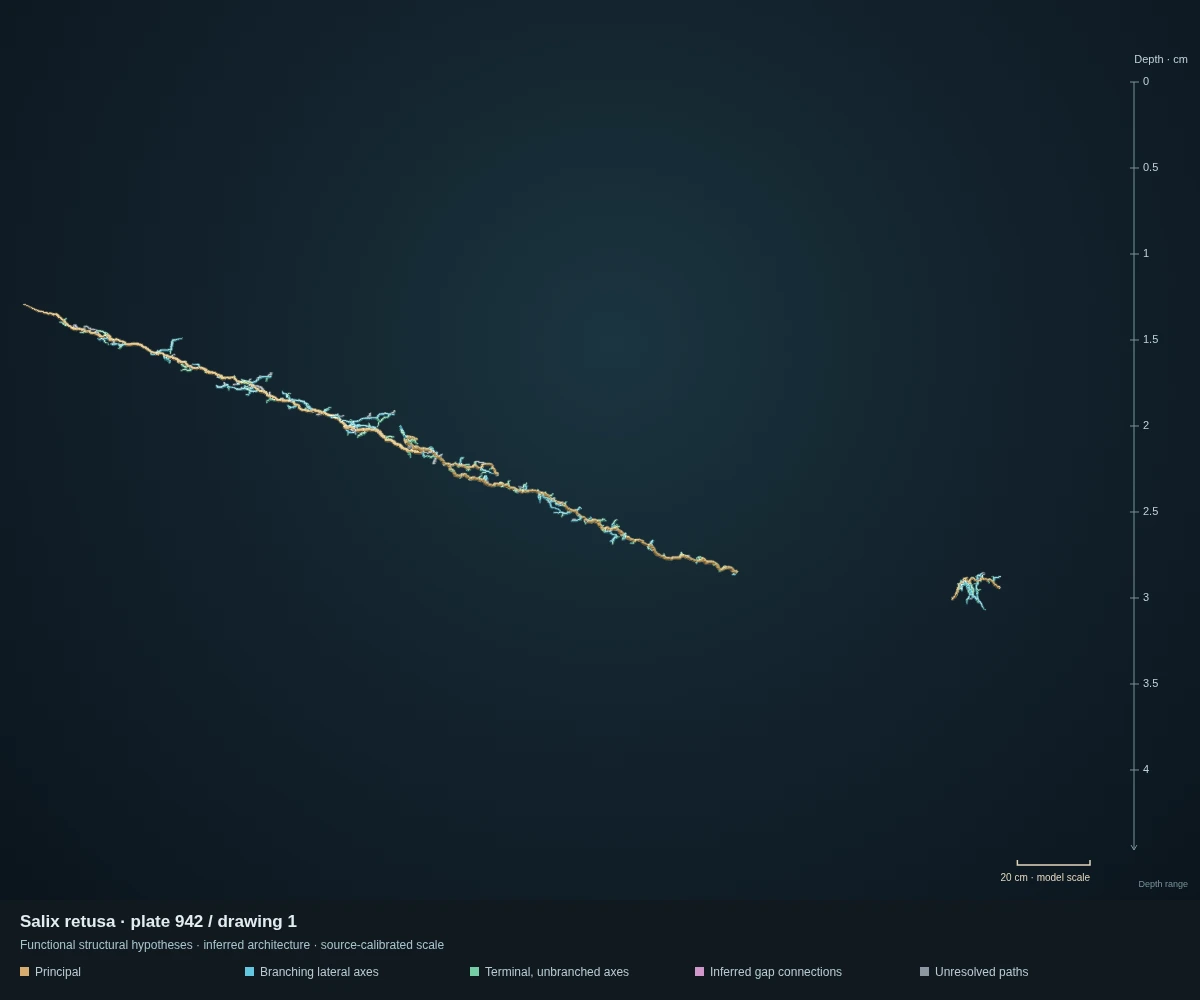
These reconstructions follow archived root drawings. Colour identifies the modelled structural role of each root.

Functional view
Natural view
Source projection
Side view
Calibration
Source-calibrated
Vertical extent
1.23 m
Inferred axes
1873
Model metrics and plate observations

Model metrics

Depth follows the printed scale. Equal horizontal scale and hidden depth are modeling assumptions; root thickness is illustrative.

Vertical extent
1.23 m
Horizontal span (x)
2.38 m
Horizontal span (z)
86.6 cm
Centreline length
47.9 m
Inferred axes
1873
Branching sites
1779
Terminal paths
1792
Mean modelled diameter
3.78 mm
Surface area proxy
5,730 cm²
Volume proxy
769 cm³
Inferred connection length
3.61 mm
Projected length
47.9 m
Mean angle from vertical
49.1°

Drawing observations

  • Short creeping and ascending twigs form a low crown near the left part of the ground reference.
  • Many roots diverge from the low basal framework and its adjoining shallow paths.
  • A long shallow field extends far right, while several left-center groups descend through the 50 and 100 cm references.
  • Repeated fine forks form dense local clusters separated by long coarser stretches.

Biologically constrained spatial reconstruction from source morphology. Root azimuths, hidden placement, growth responses, circular sections, thickness and proposed connections are inferred. The separate source trace retains exact drawing coordinates. No measured 3D anatomy or observed growth sequence is claimed.
Source and attribution

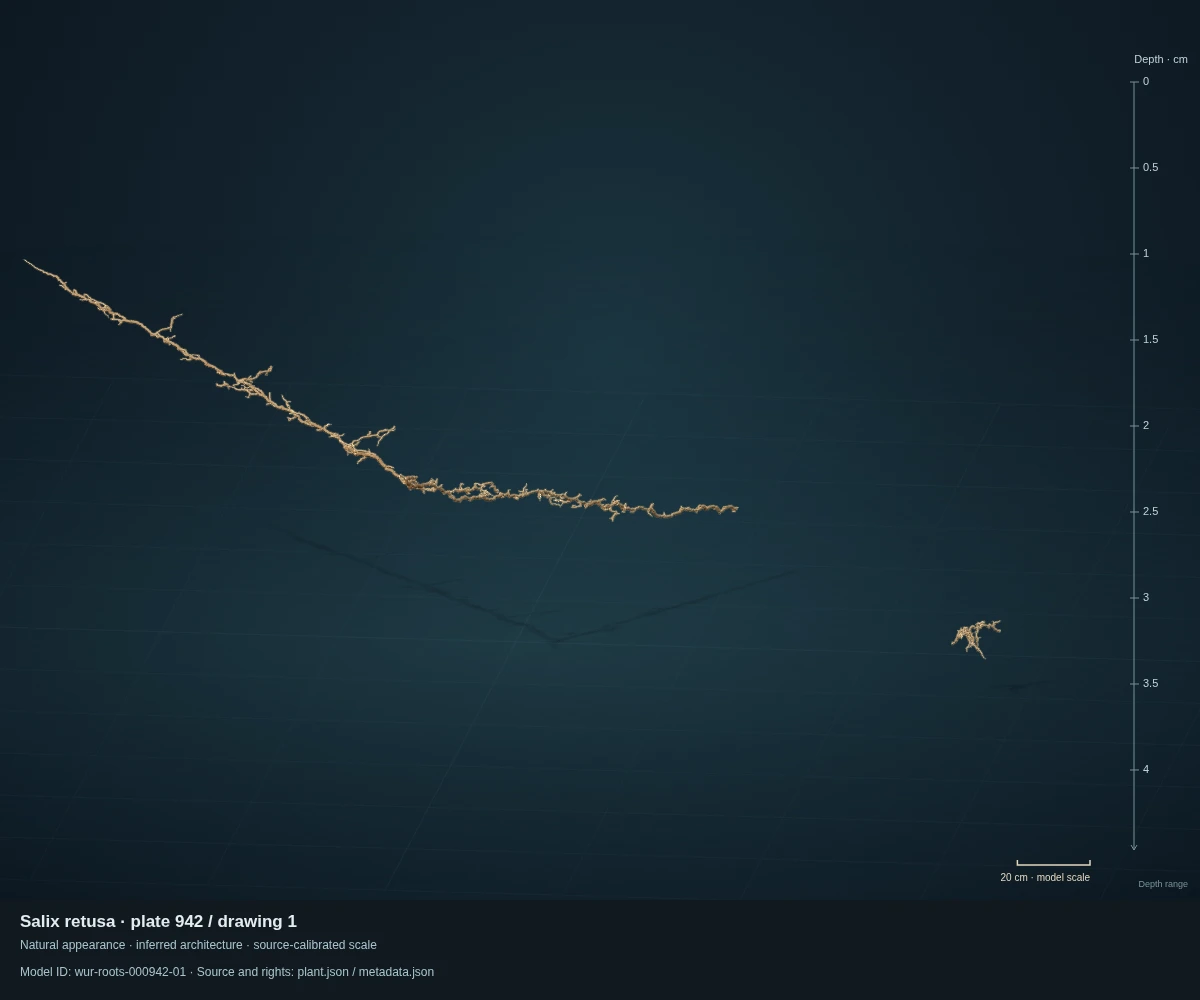
Study 799 · Model 01

Salix retusa · Wageningen University & Research archive

Functional view
Natural view
Source projection
Side view
Calibration
Source-calibrated
Vertical extent
84.1 cm
Inferred axes
292
Model metrics and plate observations

Model metrics

Depth follows the printed scale. Equal horizontal scale and hidden depth are modeling assumptions; root thickness is illustrative.

Vertical extent
84.1 cm
Horizontal span (x)
2.81 m
Horizontal span (z)
1.4 m
Centreline length
10.3 m
Inferred axes
292
Branching sites
279
Terminal paths
283
Mean modelled diameter
5.46 mm
Surface area proxy
1,780 cm²
Volume proxy
281 cm³
Inferred connection length
0 cm
Projected length
10 m
Mean angle from vertical
61.2°

Drawing observations

  • The shoot-bearing lower-right axis connects to an exceptionally long upslope root and a small local cluster of downward roots.
  • One long thin root runs nearly the full slope upslope left with many small short laterals; the fine locally descending roots cluster near the right-hand foliage.

Biologically constrained spatial reconstruction from source morphology. Root azimuths, hidden placement, growth responses, circular sections, thickness and proposed connections are inferred. The separate source trace retains exact drawing coordinates. No measured 3D anatomy or observed growth sequence is claimed.
Source and attribution

Study 942 · Model 01

Salix retusa · Wageningen University & Research archive

Names & classification

Family
Salicaceae
Genus
Salix
Order
Malpighiales
Botanical authority
L.
Taxonomic rank
Species
Life form
subshrub
Native range
C. & S. European Mts.
Climate
subalpine or subarctic
Archive names
Salix retusa

European ecological indicators

Light (1–9, shade to sun)
7.3
Moisture (1–12, dry to submerged)
5.9
Soil reaction (1–9, acidic to base-rich)
8
Nutrients (1–9, poor to rich)
4
Tichý et al. (2023)