Arbor.guide

Salix serpillifolia

Root studies

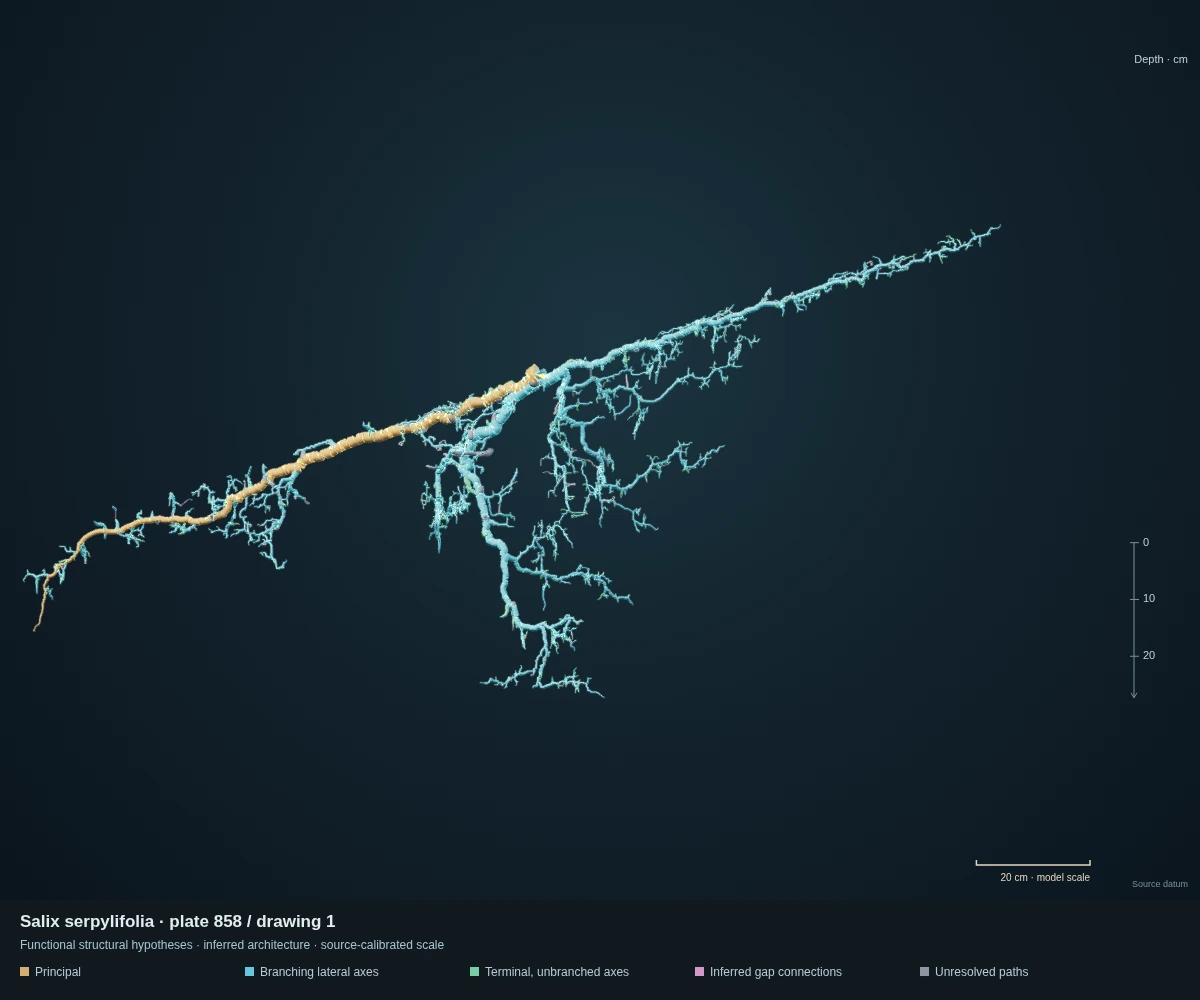
These reconstructions follow archived root drawings. Colour identifies the modelled structural role of each root.

Functional view
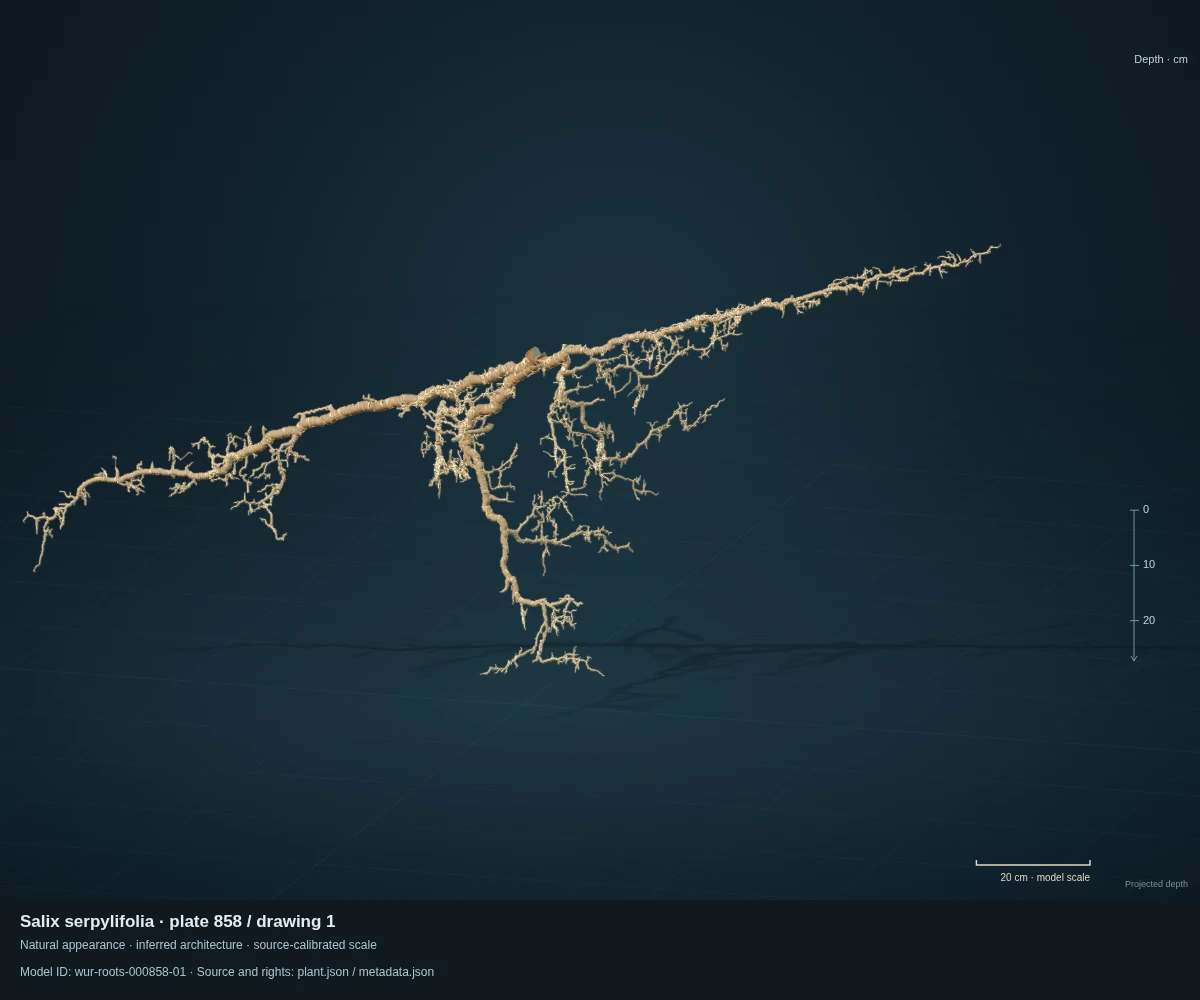
Natural view
Source projection
Side view
Calibration
Source-calibrated
Vertical extent
83.3 cm
Inferred axes
1613
Model metrics and plate observations

Model metrics

Depth follows the printed scale. Equal horizontal scale and hidden depth are modeling assumptions; root thickness is illustrative.

Vertical extent
83.3 cm
Horizontal span (x)
1.8 m
Horizontal span (z)
44.7 cm
Centreline length
29.6 m
Inferred axes
1613
Branching sites
1504
Terminal paths
1514
Mean modelled diameter
3.98 mm
Surface area proxy
3,780 cm²
Volume proxy
735 cm³
Inferred connection length
3.52 cm
Projected length
29.5 m
Mean angle from vertical
48.8°

Drawing observations

  • very low creeping shoots with separated leafy clusters
  • short roots arise at several points below shoots
  • larger coarse axes run upslope to right
  • angular forks curved loops and short fine laterals

Biologically constrained spatial reconstruction from source morphology. Root azimuths, hidden placement, growth responses, circular sections, thickness and proposed connections are inferred. The separate source trace retains exact drawing coordinates. No measured 3D anatomy or observed growth sequence is claimed.

Source and attribution

Study 858 · Model 01

Salix serpylifolia · Wageningen University & Research archive
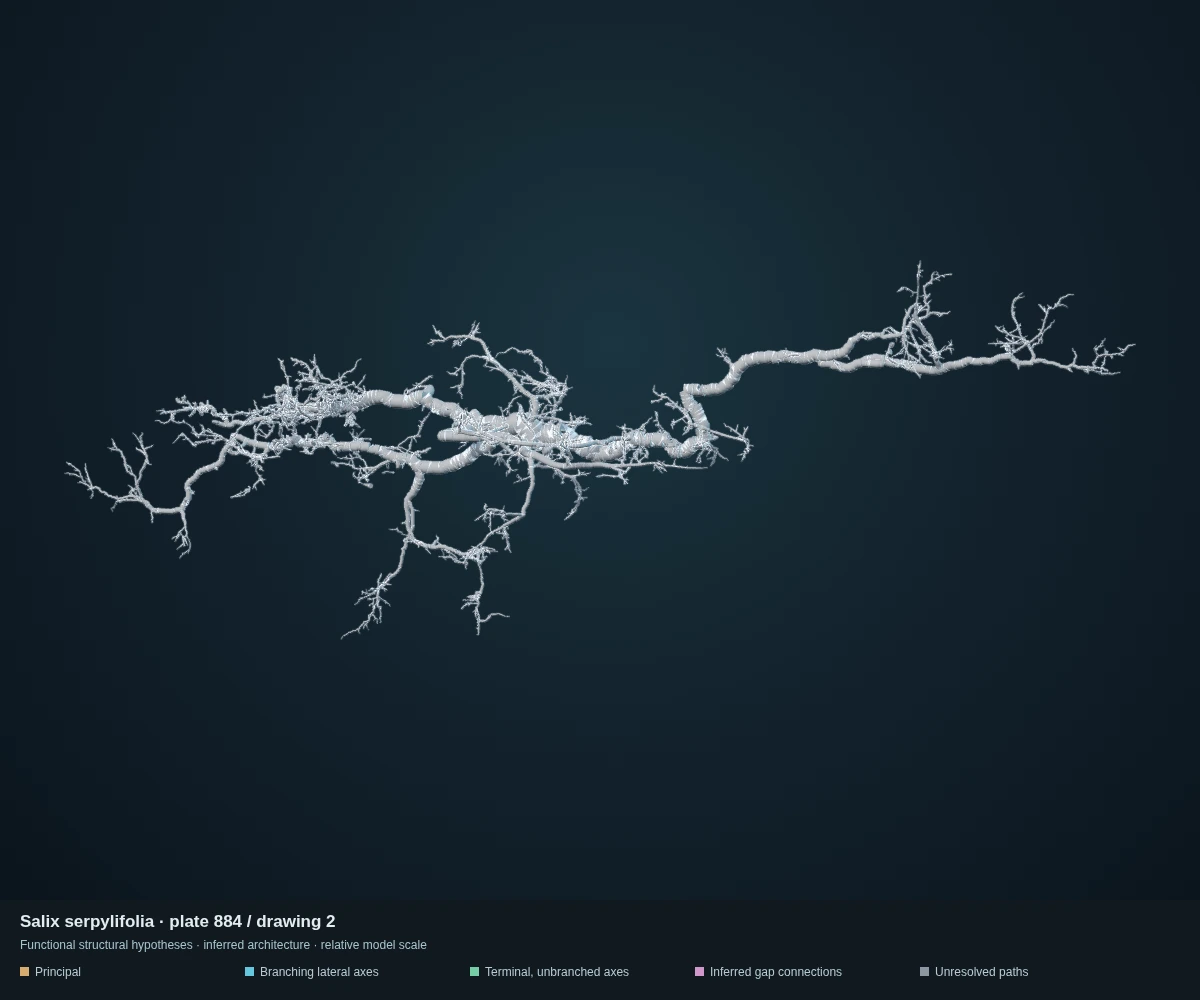
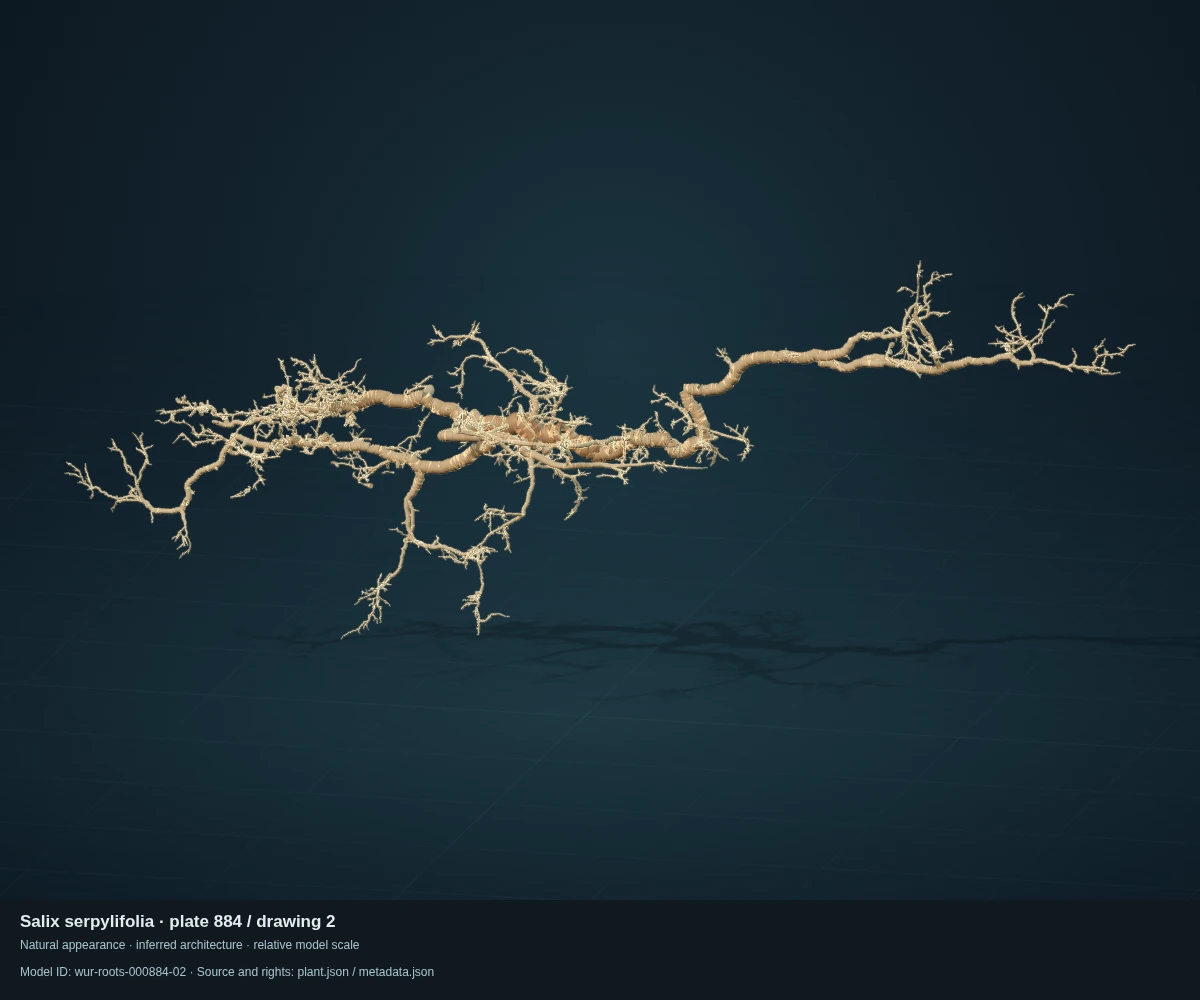
Functional view
Natural view
Source projection
Possible mixed projection
Calibration
Unresolved scale
Vertical extent
0.392 model units
Inferred axes
2803
Model metrics and plate observations

Model metrics

No metric calibration; values are in normalized model coordinates.

Vertical extent
0.392 model units
Horizontal span (x)
1 model units
Horizontal span (z)
0.297 model units
Centreline length
26 model units
Inferred axes
2803
Branching sites
2605
Terminal paths
2642
Mean modelled diameter
0.00226 model units
Surface area proxy
0.191 model units²
Volume proxy
0.000261 model units³
Inferred connection length
0 model units
Projected length
26 model units
Mean angle from vertical
60.0°

Drawing observations

  • long roots extend far right from leafy canopy
  • shorter fans extend left of hooked axis
  • repeated fine distal forks along longer roots

Biologically constrained spatial reconstruction from source morphology. Root azimuths, hidden placement, growth responses, circular sections, thickness and proposed connections are inferred. The separate source trace retains exact drawing coordinates. No measured 3D anatomy or observed growth sequence is claimed.

Source and attribution

Study 884 · Model 02

Salix serpylifolia · Wageningen University & Research archive
Names & classification

Family
Salicaceae
Genus
Salix
Order
Malpighiales
Botanical authority
Scop.
Taxonomic rank
Species
Life form
subshrub
Native range
C. Europe to NW. Balkan Pen.
Climate
subalpine or subarctic
Archive names
Salix serpylifolia

European ecological indicators

Light (1–9, shade to sun)
7
Moisture (1–12, dry to submerged)
4.7
Soil reaction (1–9, acidic to base-rich)
9
Nutrients (1–9, poor to rich)
2
Tichý et al. (2023)