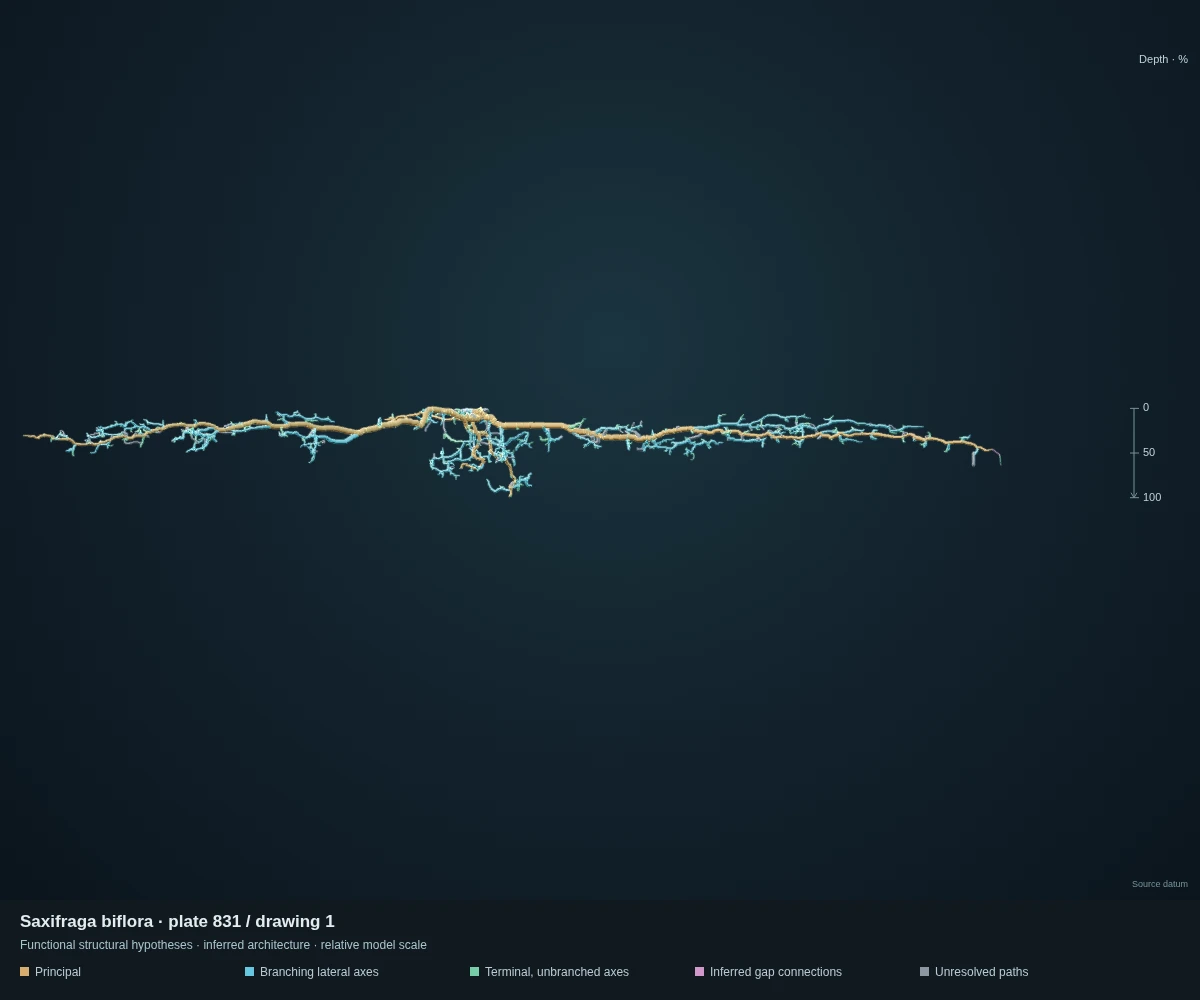
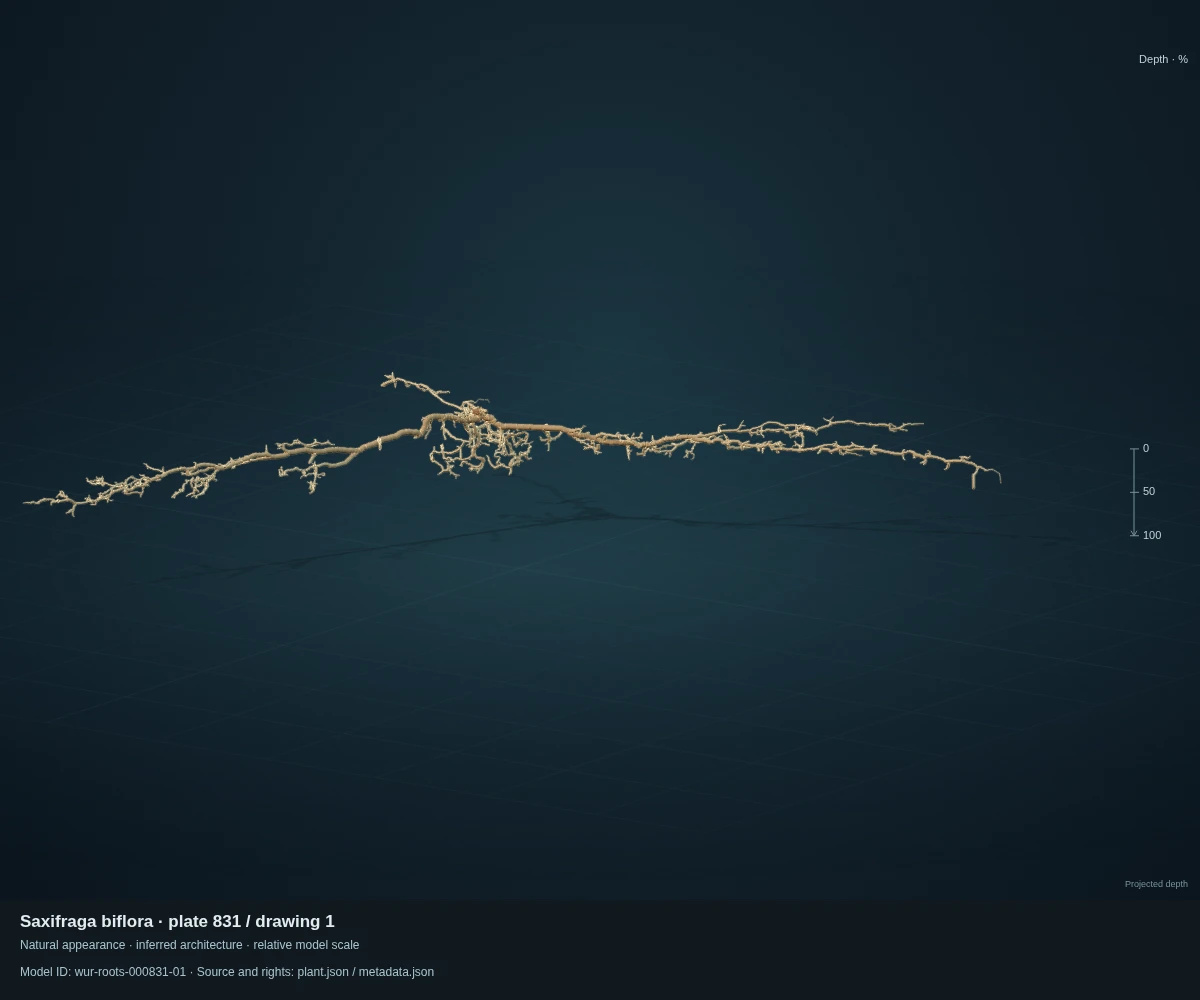
- Source projection
- Side view
- Calibration
- Unresolved scale
- Vertical extent
- 0.0882 model units
- Inferred axes
- 613
Model metrics and plate observations
Model metrics
No metric calibration; values are in normalized model coordinates.
- Vertical extent
- 0.0882 model units
- Horizontal span (x)
- 0.679 model units
- Horizontal span (z)
- 0.771 model units
- Centreline length
- 7.65 model units
- Inferred axes
- 613
- Branching sites
- 557
- Terminal paths
- 561
- Mean modelled diameter
- 0.00216 model units
- Surface area proxy
- 0.0523 model units²
- Volume proxy
- 0.0000376 model units³
- Inferred connection length
- 0.0251 model units
- Projected length
- 7.28 model units
- Mean angle from vertical
- 60.0°
Drawing observations
- Upper low cushion profile with very broad shallow roots
- Several short basal joins beneath the cushion give lateral and descending roots
- Roots extend far on both sides with scattered finer branches
- A short central-right branch field extends below the 10 cm tick
Biologically constrained spatial reconstruction from source morphology. Root azimuths, hidden placement, growth responses, circular sections, thickness and proposed connections are inferred. The separate source trace retains exact drawing coordinates. No measured 3D anatomy or observed growth sequence is claimed.
Source and attribution
Study 831 · Model 01
Saxifraga biflora · Wageningen University & Research archive