Arbor.guide

Triticum aestivum

Bread Wheat

Root studies

These reconstructions follow archived root drawings. Colour identifies the modelled structural role of each root.

Functional view
Natural view
Source projection
Side view
Calibration
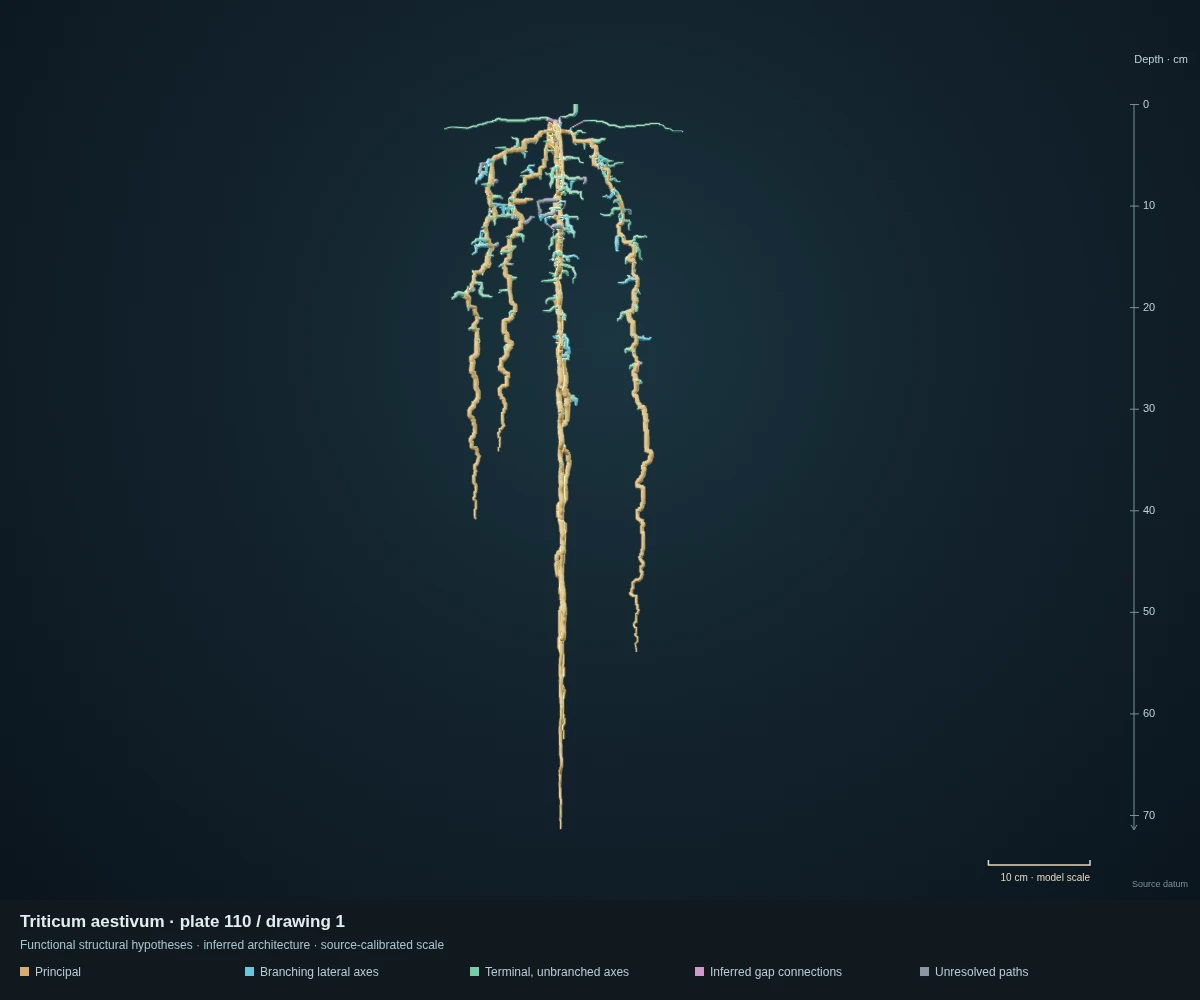
Source-calibrated
Vertical extent
71.4 cm
Inferred axes
241
Model metrics and plate observations

Model metrics

Depth follows the printed scale. Equal horizontal scale and hidden depth are modeling assumptions; root thickness is illustrative.

Vertical extent
71.4 cm
Horizontal span (x)
23.4 cm
Horizontal span (z)
21.8 cm
Centreline length
6.87 m
Inferred axes
241
Branching sites
229
Terminal paths
234
Mean modelled diameter
3.54 mm
Surface area proxy
768 cm²
Volume proxy
77.4 cm³
Inferred connection length
7.25 cm
Projected length
5.65 m
Mean angle from vertical
46.2°

Dimensions reported on the source plate

Root depth
179 cm plate_110
Root-system diameter
81 cm plate_110

Drawing observations

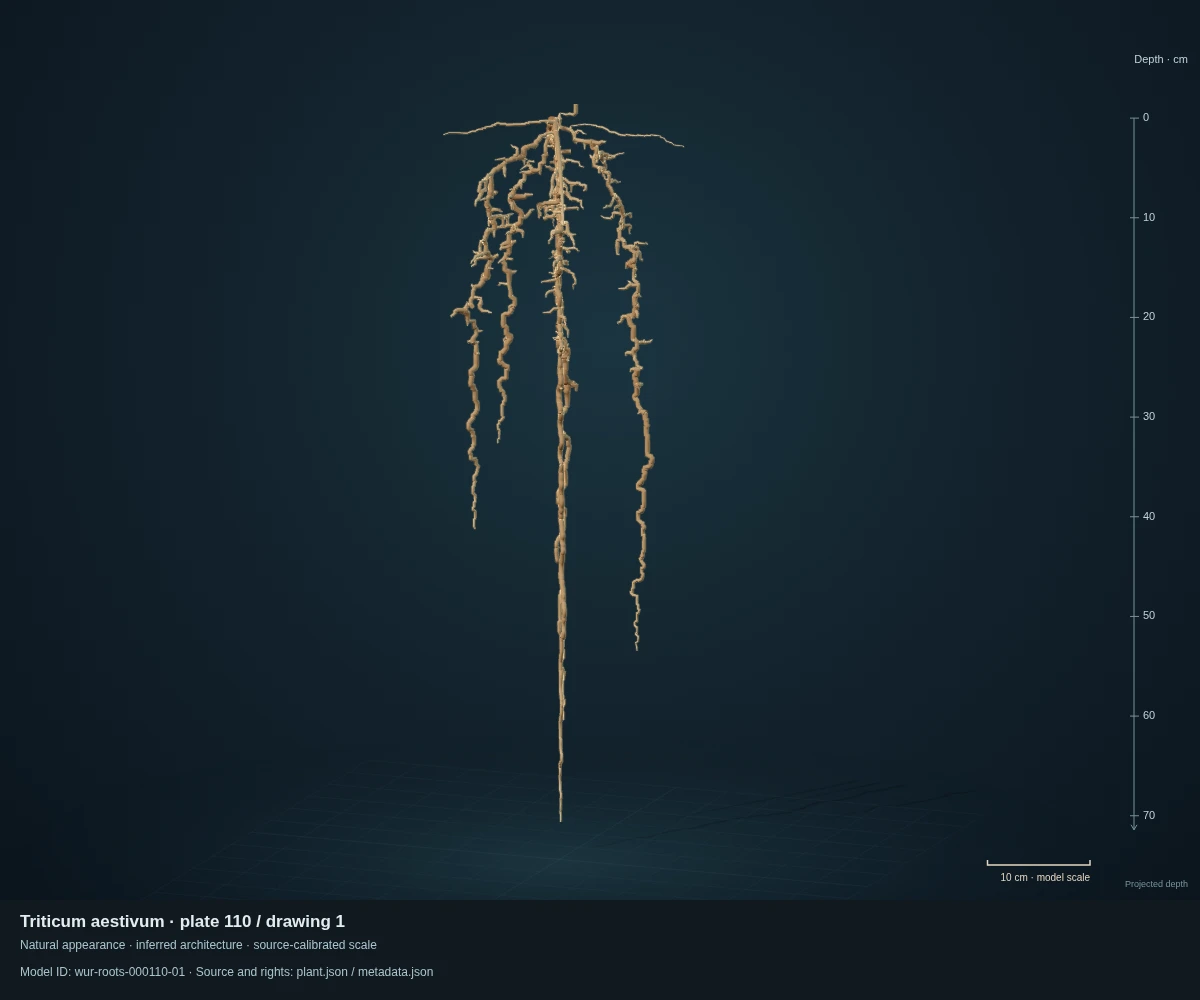
  • few long thin descenders beneath small basal fan
  • short side forks denser above long sparse lower ends

Biologically constrained spatial reconstruction from source morphology. Root azimuths, hidden placement, growth responses, circular sections, thickness and proposed connections are inferred. The separate source trace retains exact drawing coordinates. No measured 3D anatomy or observed growth sequence is claimed.

Source and attribution

Study 110 · Model 01

Triticum aestivum · Wageningen University & Research archive
Functional view
Natural view
Source projection
Side view
Calibration
Source-calibrated
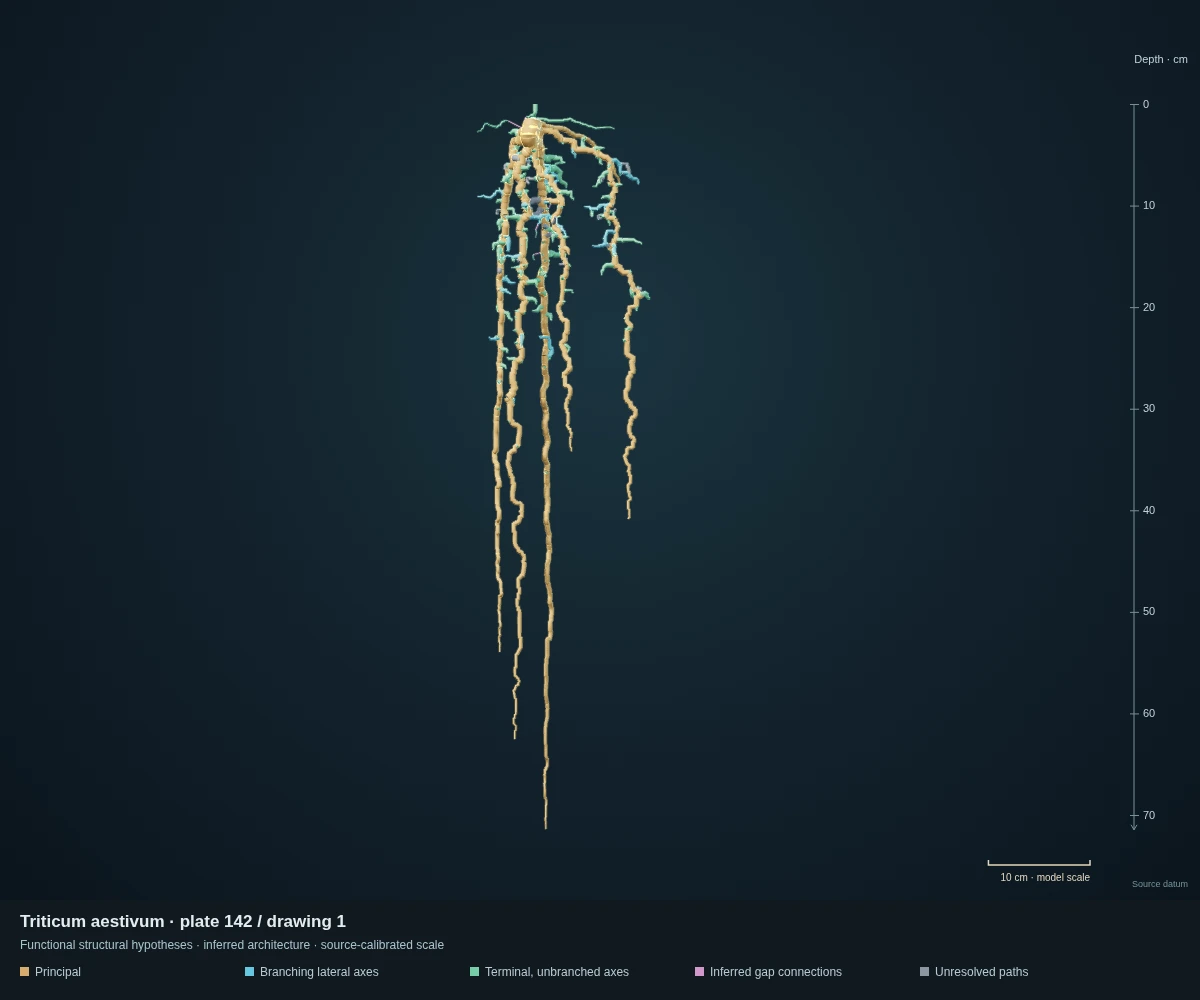
Vertical extent
71.4 cm
Inferred axes
241
Model metrics and plate observations

Model metrics

Depth follows the printed scale. Equal horizontal scale and hidden depth are modeling assumptions; root thickness is illustrative.

Vertical extent
71.4 cm
Horizontal span (x)
17 cm
Horizontal span (z)
21.5 cm
Centreline length
6.35 m
Inferred axes
241
Branching sites
229
Terminal paths
234
Mean modelled diameter
4.36 mm
Surface area proxy
879 cm²
Volume proxy
119 cm³
Inferred connection length
6.25 cm
Projected length
5.65 m
Mean angle from vertical
42.4°

Dimensions reported on the source plate

Plant height
7 cm plate_142
Root depth
120 cm plate_142
Root-system diameter
52 cm plate_142

Drawing observations

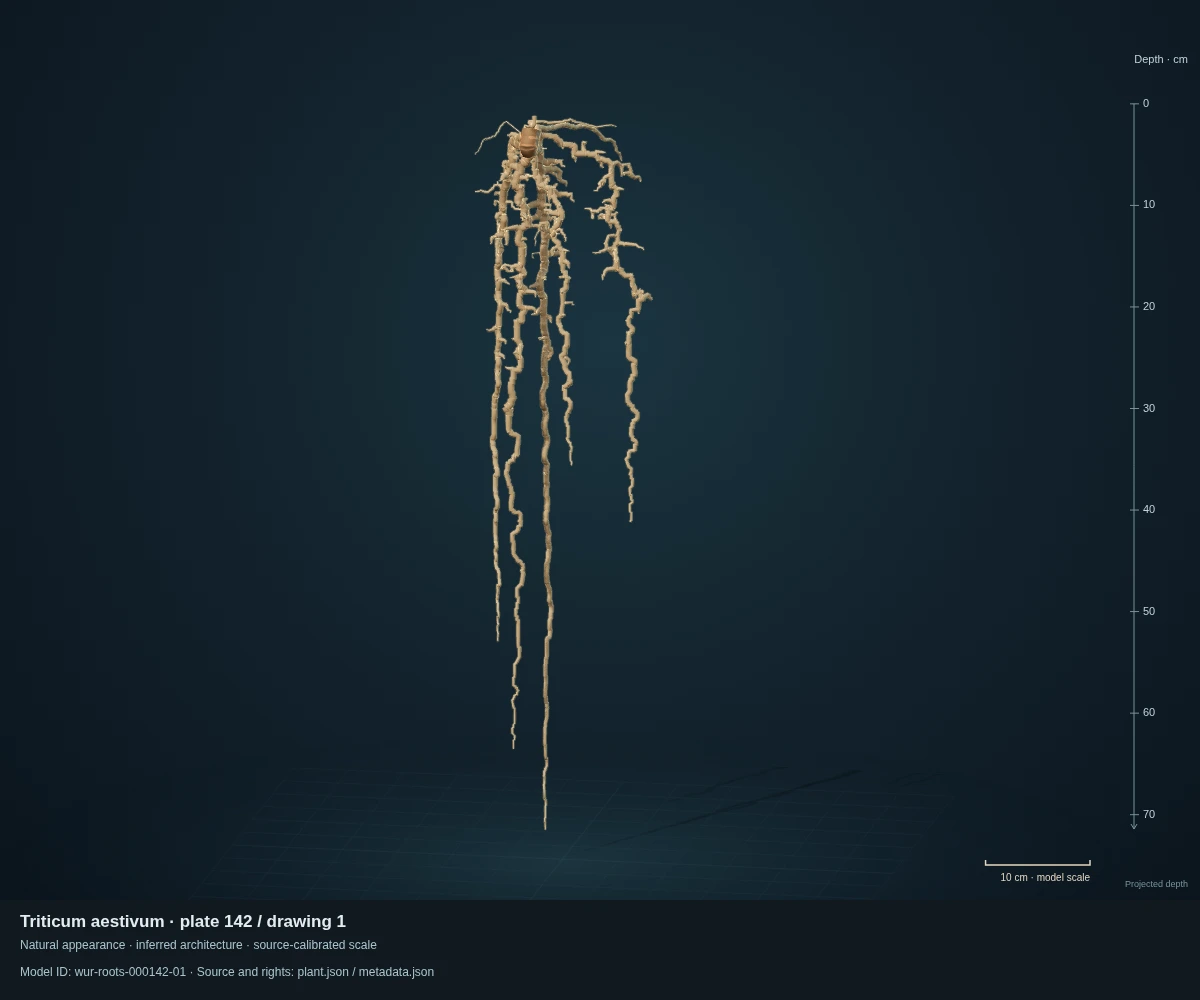
  • few long nearly vertical coarse roots
  • several shallow outward paths with fine forks
  • sparser small branches on long lower descenders

Biologically constrained spatial reconstruction from source morphology. Root azimuths, hidden placement, growth responses, circular sections, thickness and proposed connections are inferred. The separate source trace retains exact drawing coordinates. No measured 3D anatomy or observed growth sequence is claimed.

Source and attribution

Study 142 · Model 01

Triticum aestivum · Wageningen University & Research archive
Functional view
Natural view
Source projection
Side view
Calibration
Source-calibrated
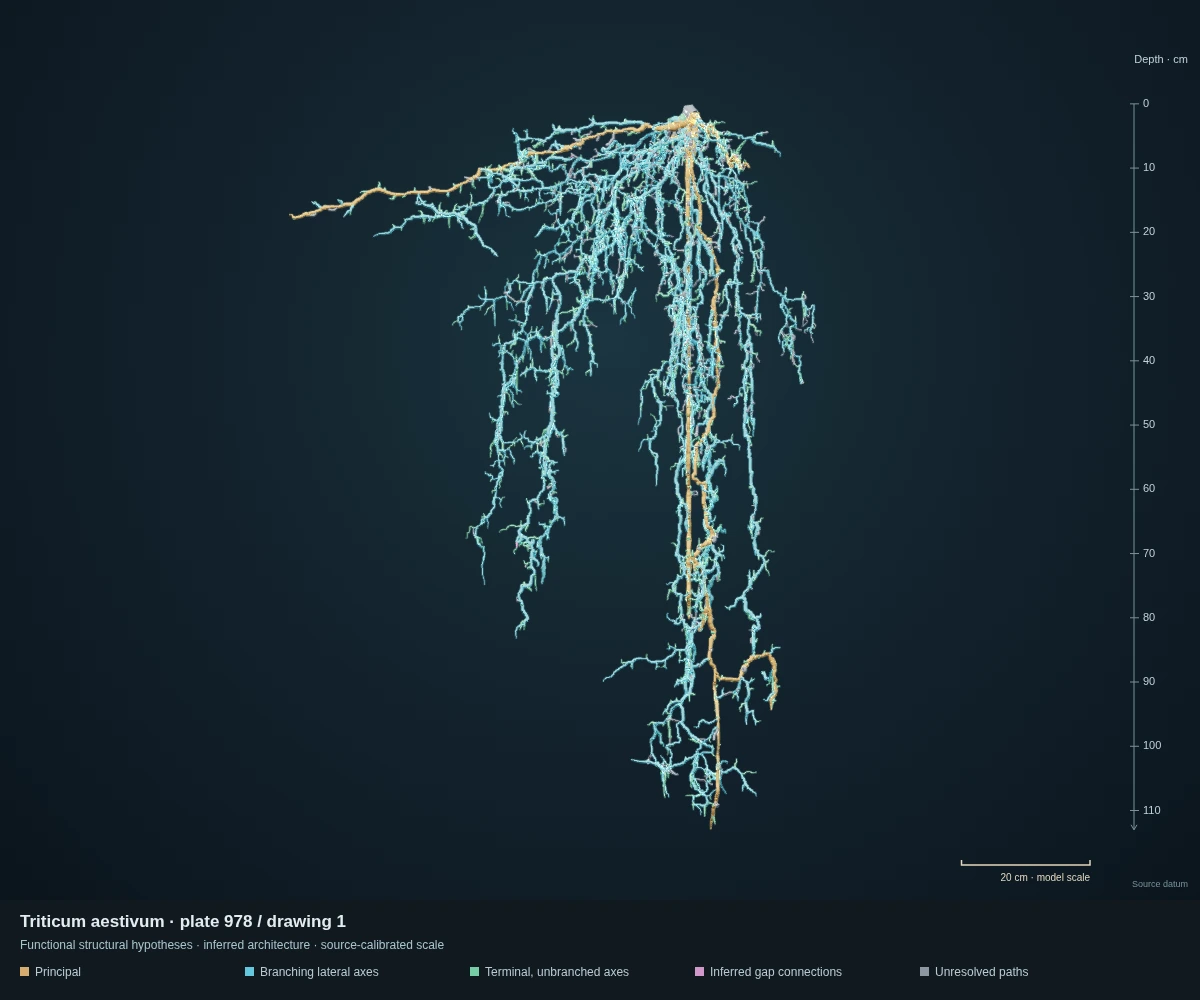
Vertical extent
1.12 m
Inferred axes
3187
Model metrics and plate observations

Model metrics

Depth follows the printed scale. Equal horizontal scale and hidden depth are modeling assumptions; root thickness is illustrative.

Vertical extent
1.12 m
Horizontal span (x)
82.1 cm
Horizontal span (z)
1 m
Centreline length
61.1 m
Inferred axes
3187
Branching sites
2874
Terminal paths
2901
Mean modelled diameter
2.97 mm
Surface area proxy
5,740 cm²
Volume proxy
547 cm³
Inferred connection length
6.83 cm
Projected length
57.5 m
Mean angle from vertical
43.4°

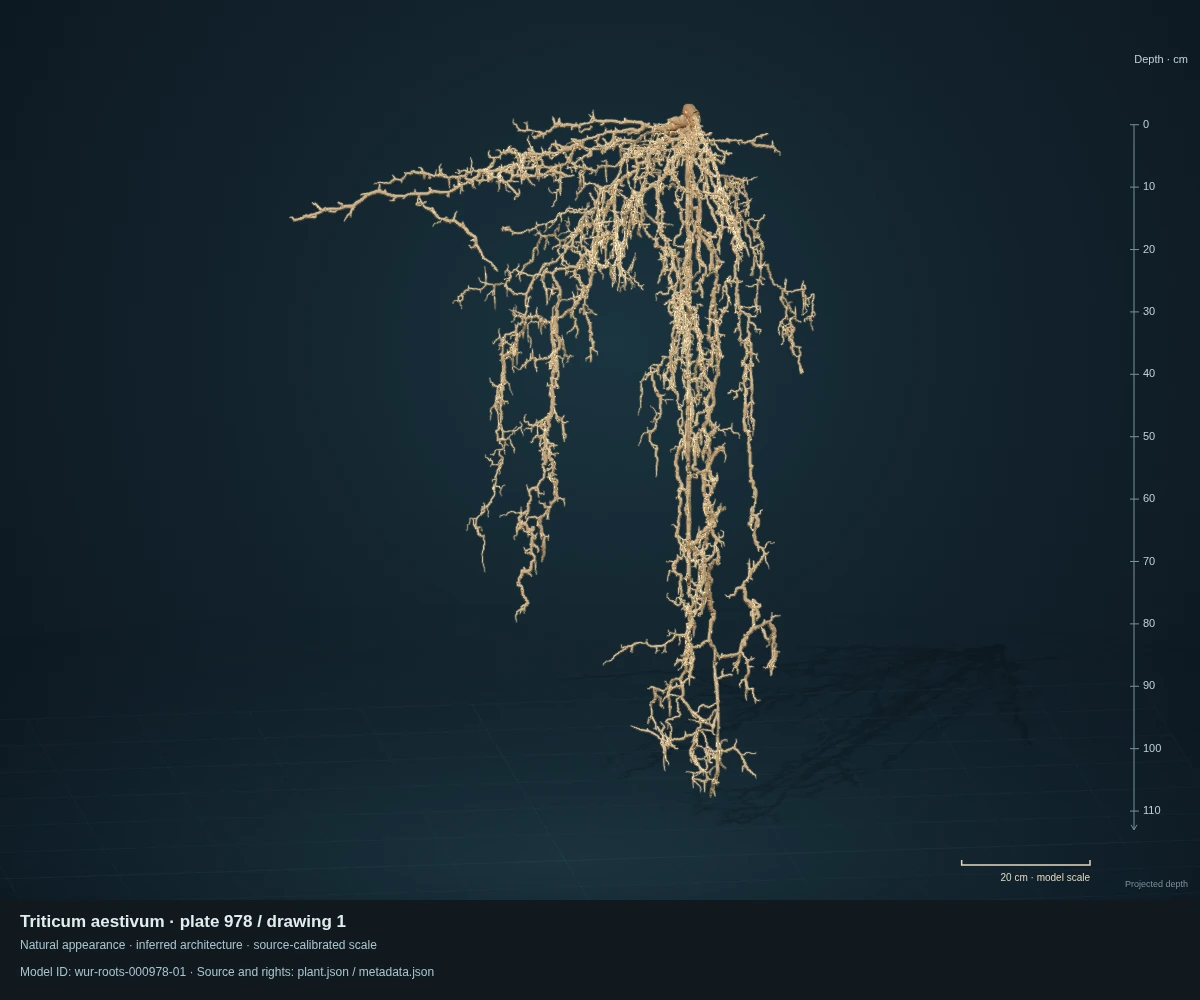
Drawing observations

  • Many fine branching roots spread shallowly to both sides and descend in a dense central fan; the lowest forked courses pass below 100.
  • Fine lower branches pass below the last labelled 100 level.

Biologically constrained spatial reconstruction from source morphology. Root azimuths, hidden placement, growth responses, circular sections, thickness and proposed connections are inferred. The separate source trace retains exact drawing coordinates. No measured 3D anatomy or observed growth sequence is claimed.

Source and attribution

Study 978 · Model 01

Triticum aestivum · Wageningen University & Research archive
Functional view
Natural view
Source projection
Side view
Calibration
Source-calibrated
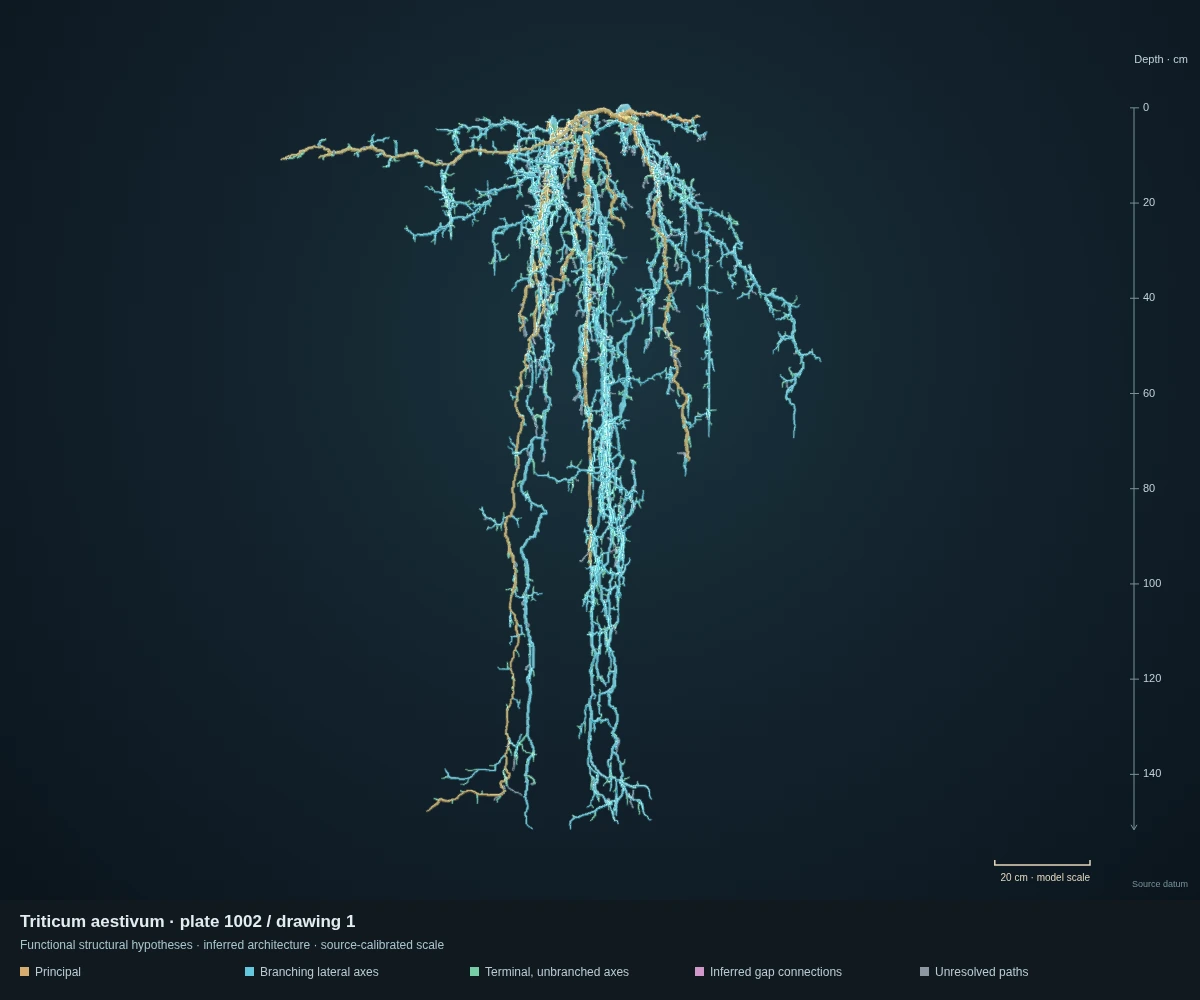
Vertical extent
1.52 m
Inferred axes
2979
Model metrics and plate observations

Model metrics

Depth follows the printed scale. Equal horizontal scale and hidden depth are modeling assumptions; root thickness is illustrative.

Vertical extent
1.52 m
Horizontal span (x)
1.01 m
Horizontal span (z)
1.15 m
Centreline length
72.8 m
Inferred axes
2979
Branching sites
2704
Terminal paths
2720
Mean modelled diameter
3.67 mm
Surface area proxy
8,450 cm²
Volume proxy
964 cm³
Inferred connection length
1.94 cm
Projected length
67.8 m
Mean angle from vertical
43.3°

Drawing observations

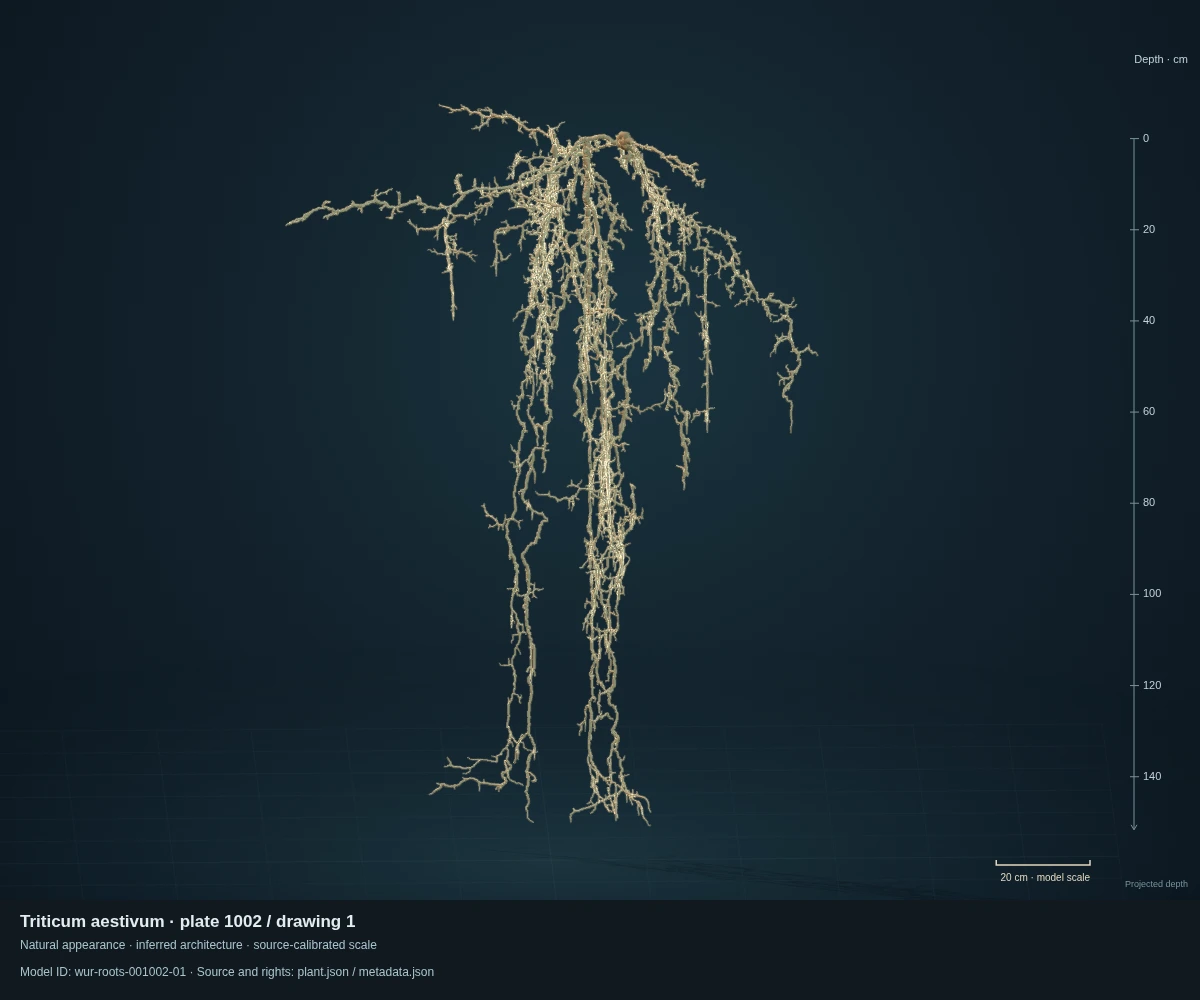
  • dense fibrous crown
  • widely divergent finely branched laterals
  • many deep sinuous roots retain fine laterals
  • spreading forked terminal tufts below 140 cm

Biologically constrained spatial reconstruction from source morphology. Root azimuths, hidden placement, growth responses, circular sections, thickness and proposed connections are inferred. The separate source trace retains exact drawing coordinates. No measured 3D anatomy or observed growth sequence is claimed.

Source and attribution

Study 1002 · Model 01

Triticum aestivum · Wageningen University & Research archive
Functional view
Natural view
Source projection
Side view
Calibration
Source-calibrated
Vertical extent
1.51 m
Inferred axes
2687
Model metrics and plate observations

Model metrics

Depth follows the printed scale. Equal horizontal scale and hidden depth are modeling assumptions; root thickness is illustrative.

Vertical extent
1.51 m
Horizontal span (x)
65.5 cm
Horizontal span (z)
1.18 m
Centreline length
70.3 m
Inferred axes
2687
Branching sites
2499
Terminal paths
2520
Mean modelled diameter
3.55 mm
Surface area proxy
7,900 cm²
Volume proxy
882 cm³
Inferred connection length
2.91 cm
Projected length
60.1 m
Mean angle from vertical
46.8°

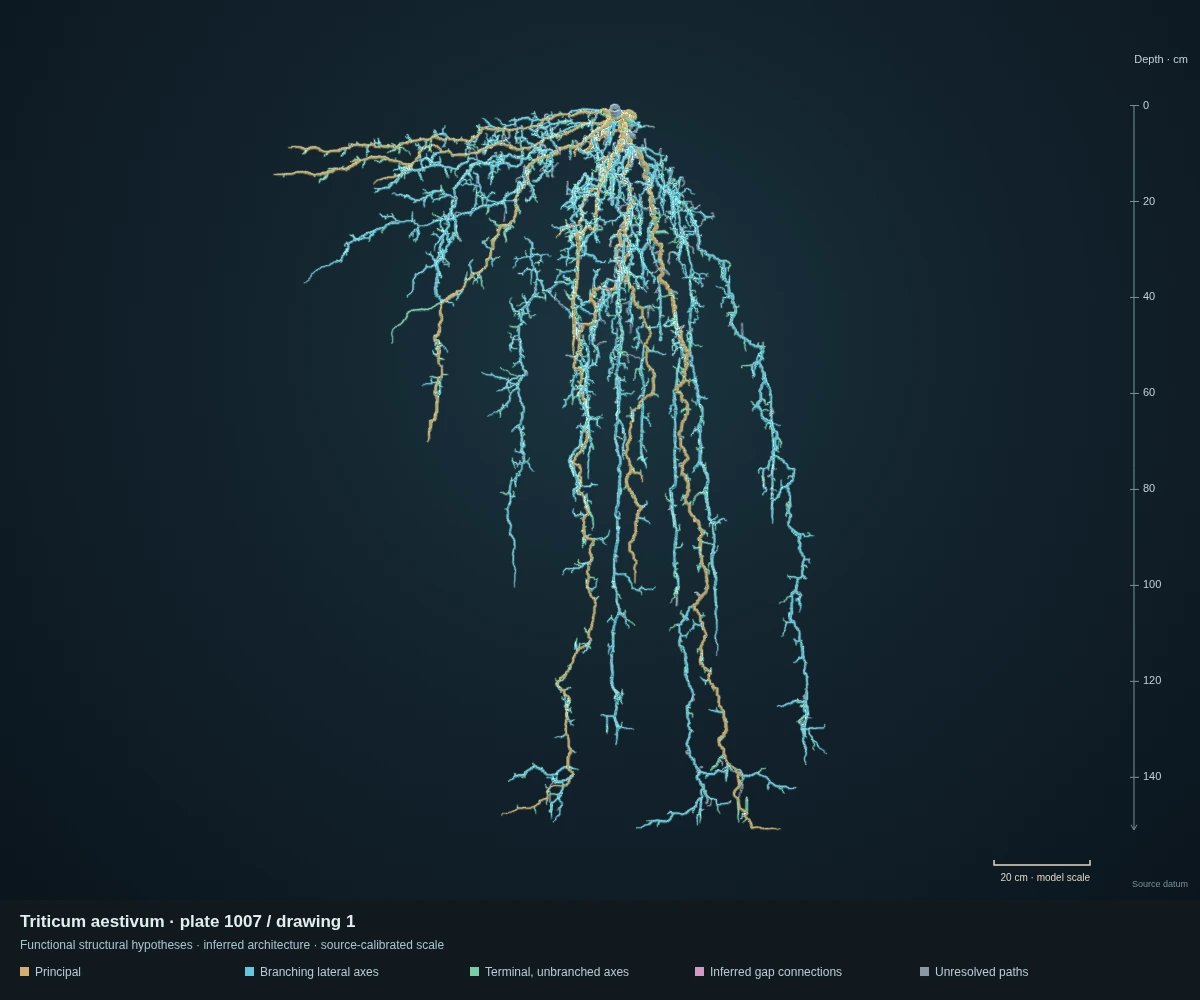
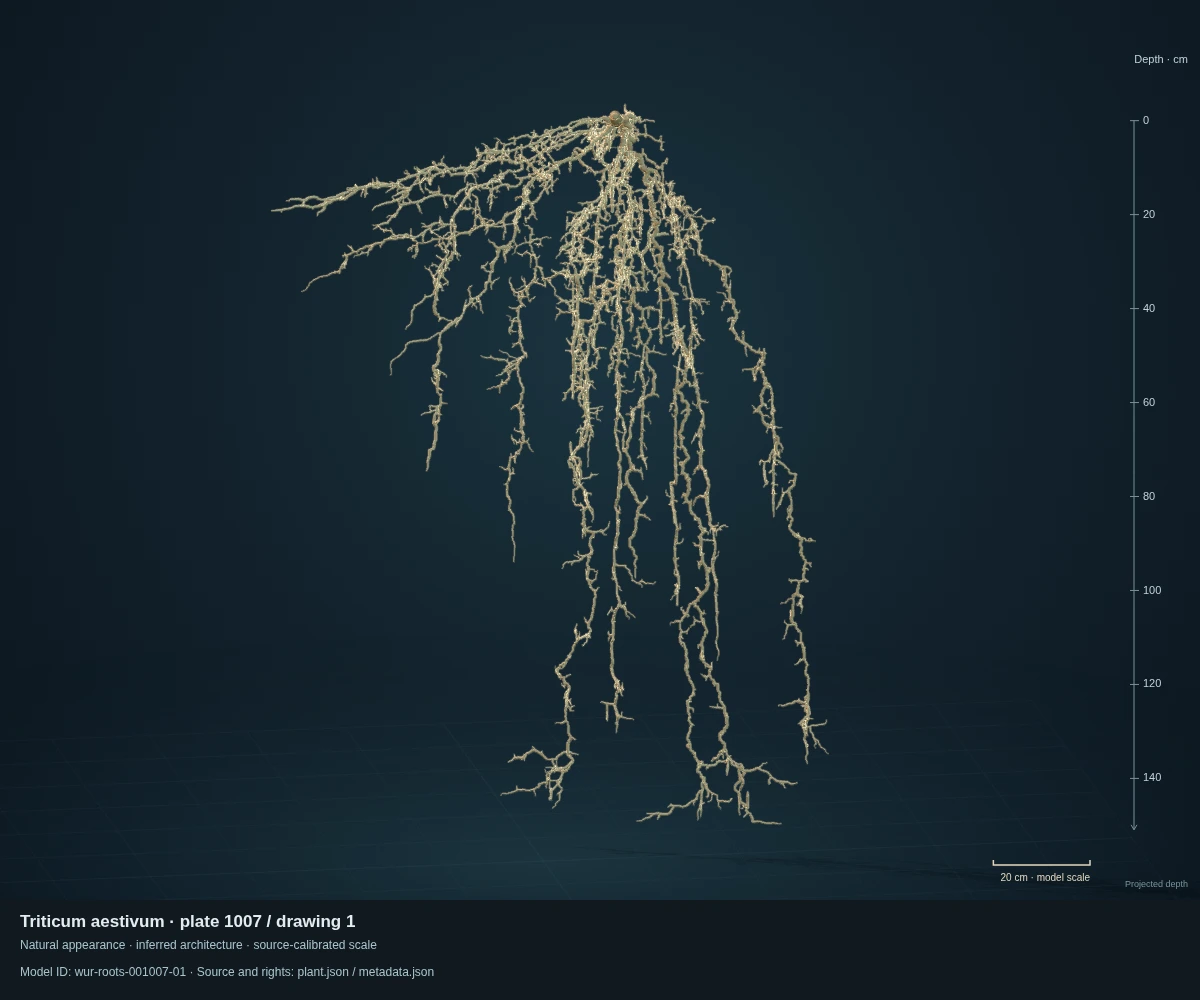
Drawing observations

  • dense fibrous common root origin
  • long widely divergent laterals
  • deep descending axes with fine repeated side forks
  • conspicuous forked terminal tufts below 140 cm

Biologically constrained spatial reconstruction from source morphology. Root azimuths, hidden placement, growth responses, circular sections, thickness and proposed connections are inferred. The separate source trace retains exact drawing coordinates. No measured 3D anatomy or observed growth sequence is claimed.

Source and attribution

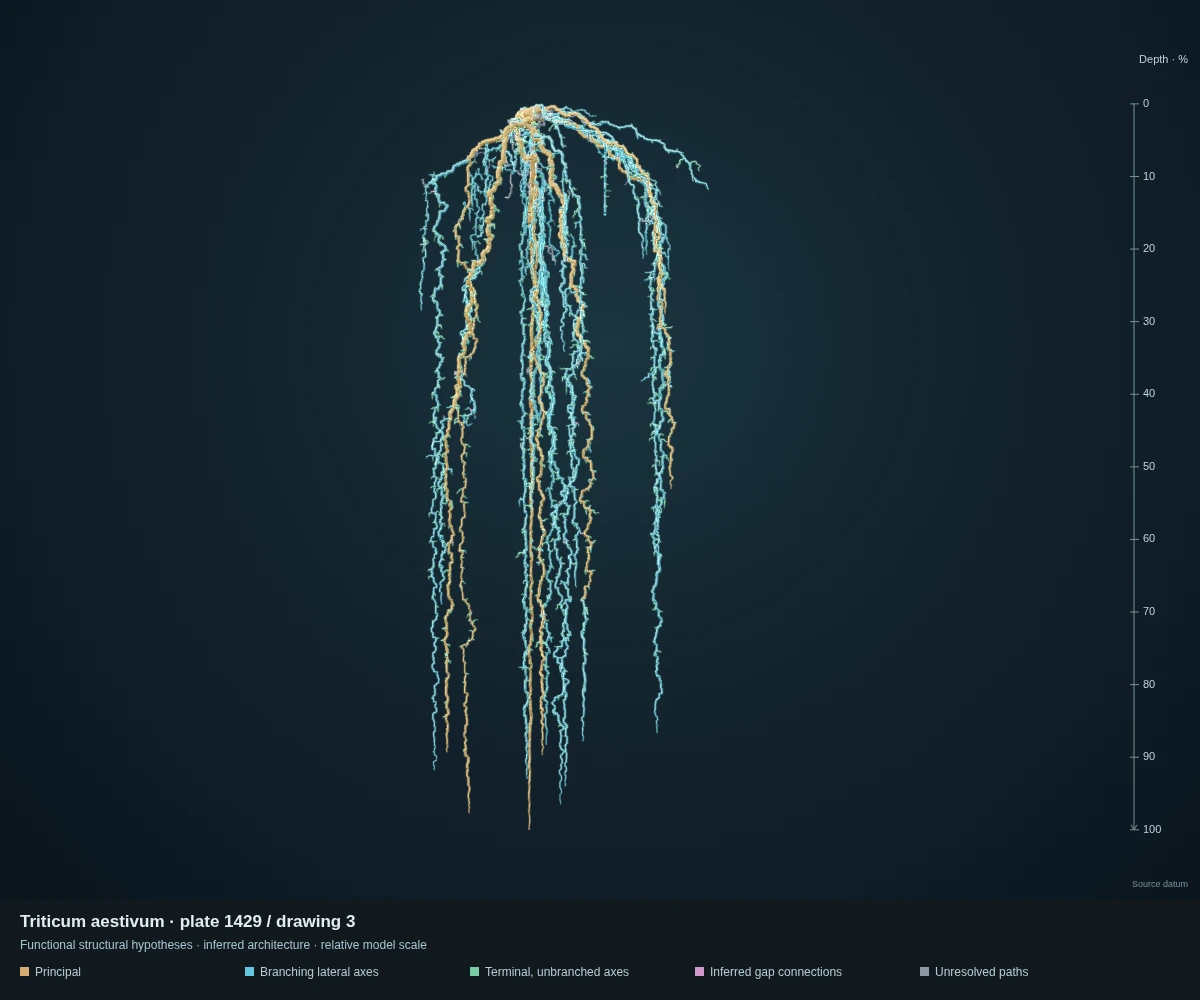
Study 1007 · Model 01

Triticum aestivum · Wageningen University & Research archive
Functional view
Natural view
Source projection
Side view
Calibration
Unresolved scale
Vertical extent
0.956 model units
Inferred axes
2199
Model metrics and plate observations

Model metrics

No metric calibration; values are in normalized model coordinates.

Vertical extent
0.956 model units
Horizontal span (x)
0.44 model units
Horizontal span (z)
0.396 model units
Centreline length
34.9 model units
Inferred axes
2199
Branching sites
2132
Terminal paths
2154
Mean modelled diameter
0.00246 model units
Surface area proxy
0.272 model units²
Volume proxy
0.000221 model units³
Inferred connection length
0.119 model units
Projected length
30.8 model units
Mean angle from vertical
41.5°

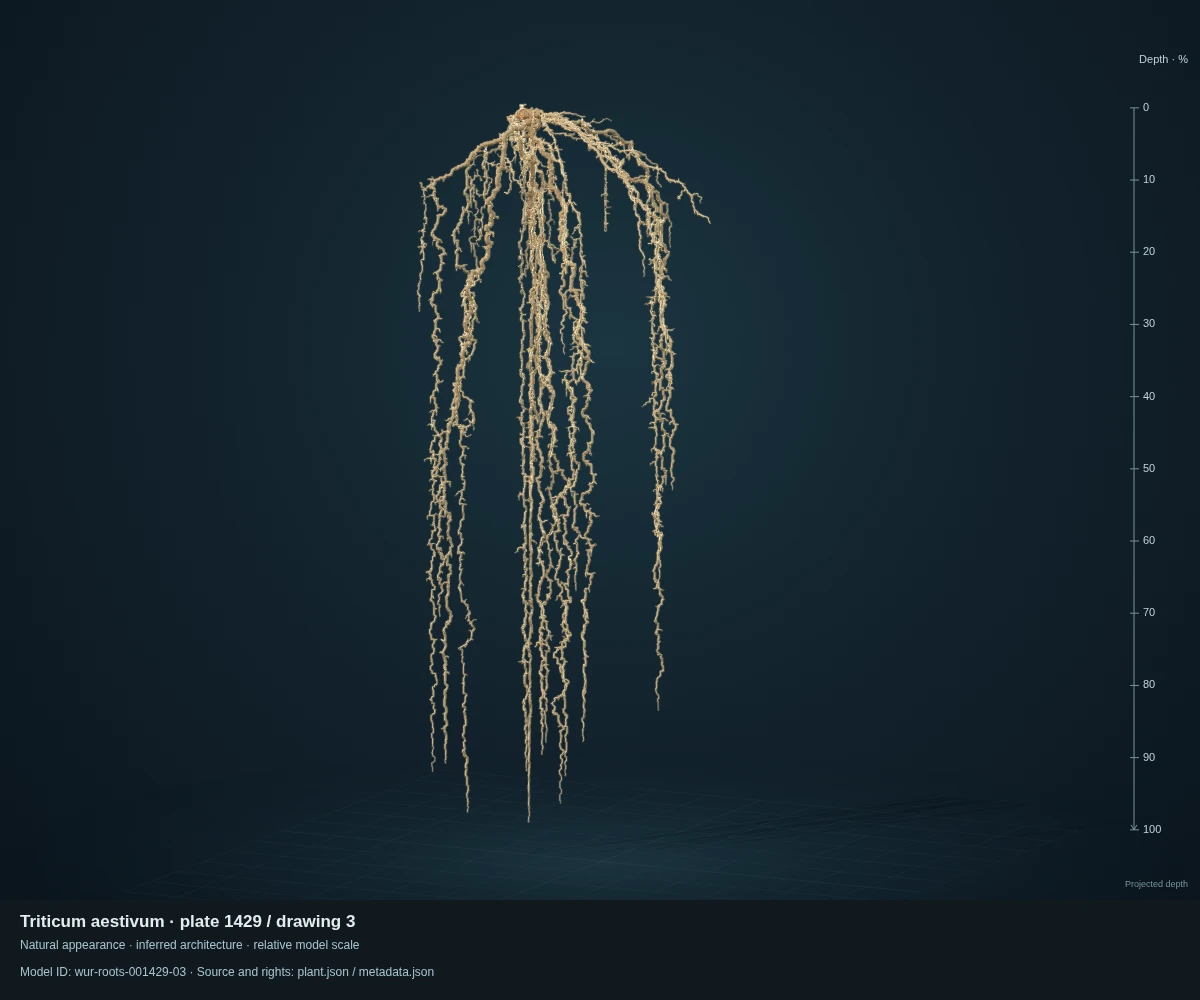
Drawing observations

  • many roots fan from compact basal zone
  • dense long sinuous descenders with arching outer axes
  • repeated short side forks along most axes
  • broadest deepest and densest drawn root field on parent plate

Biologically constrained spatial reconstruction from source morphology. Root azimuths, hidden placement, growth responses, circular sections, thickness and proposed connections are inferred. The separate source trace retains exact drawing coordinates. No measured 3D anatomy or observed growth sequence is claimed.

Source and attribution

Study 1429 · Model 03

Triticum aestivum · Wageningen University & Research archive
Names & classification

Family
Poaceae
Genus
Triticum
Order
Poales
Botanical authority
L.
Taxonomic rank
Species
Life form
annual or biennial
Growth form
Graminoid
Native range
as a cultigen from Transcaucasus to Israel and NW. Iran, S. Pakistan to NW. India
Climate
temperate
Mean vegetative height (TRY)
0.95 m
Maximum recorded vegetative height (TRY)
1.7 m
Archive names
Triticum aestivum

European ecological indicators

Light (1–9, shade to sun)
8.2
Moisture (1–12, dry to submerged)
4.7
Soil reaction (1–9, acidic to base-rich)
6.7
Nutrients (1–9, poor to rich)
6.2
Tichý et al. (2023)