Arbor.guide

Viscaria vulgaris

clammy campion

Root studies

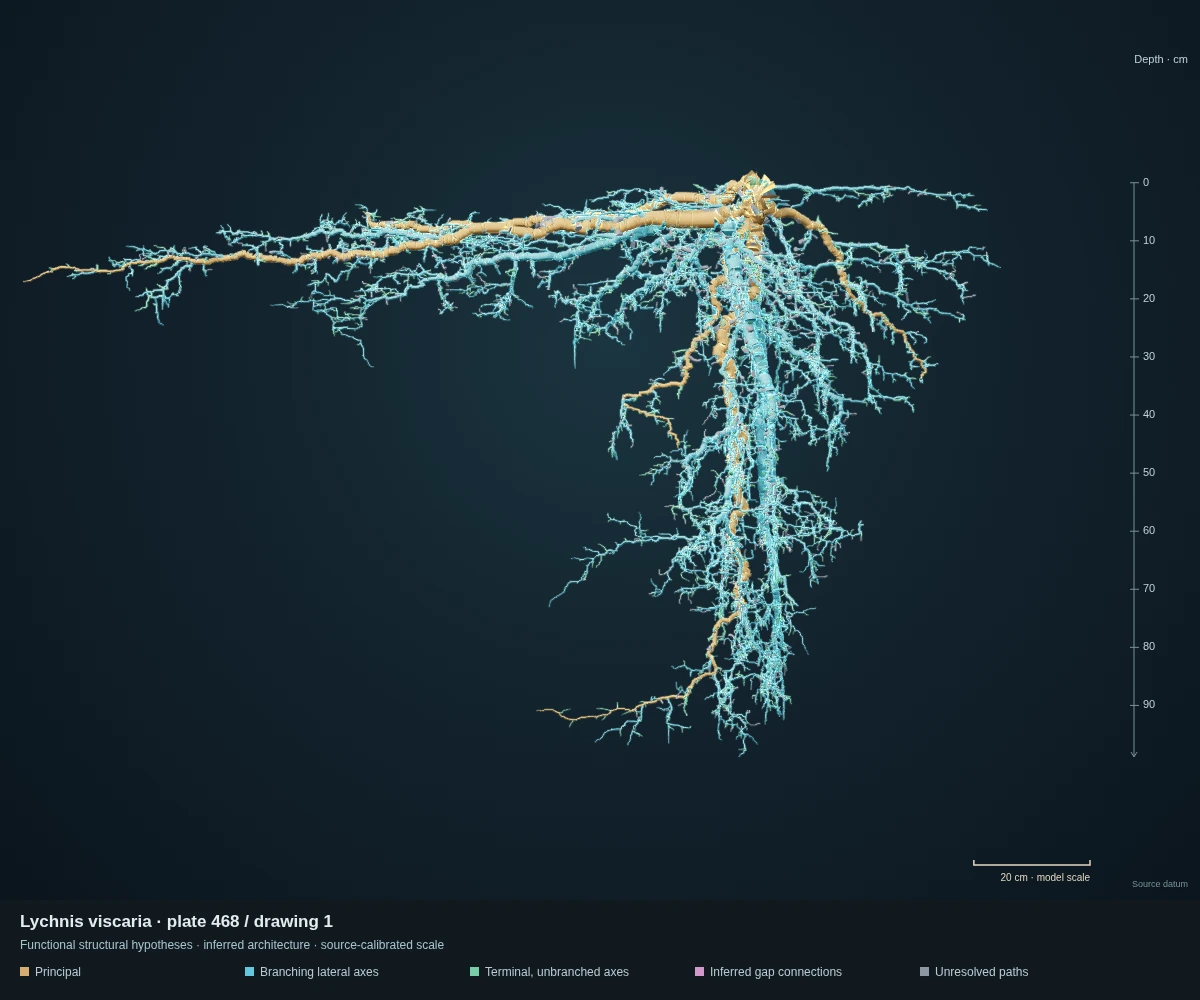
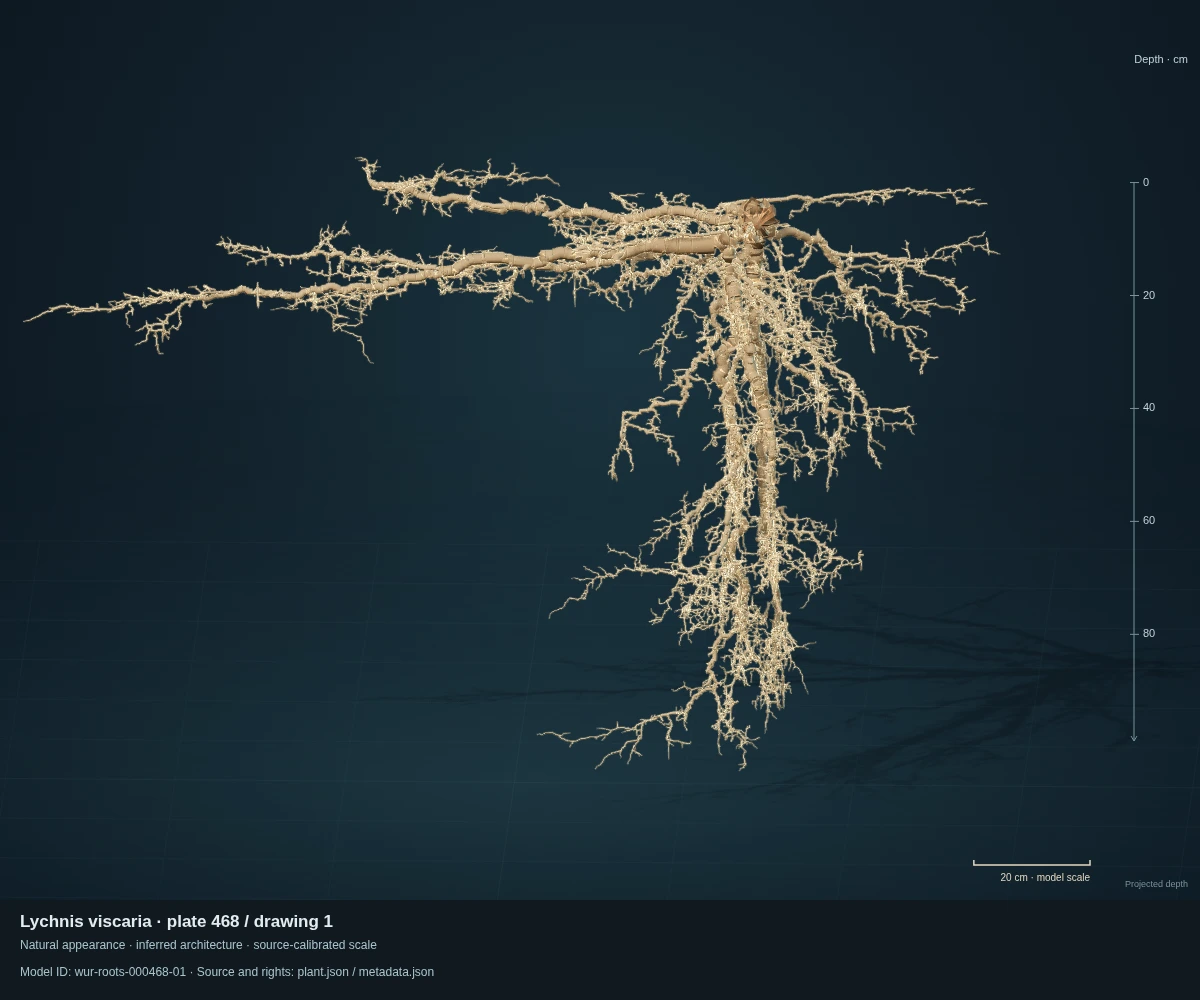
These reconstructions follow archived root drawings. Colour identifies the modelled structural role of each root.

Functional view
Natural view
Source projection
Side view
Calibration
Source-calibrated
Vertical extent
98.6 cm
Inferred axes
6880
Model metrics and plate observations

Model metrics

Depth follows the printed scale. Equal horizontal scale and hidden depth are modeling assumptions; root thickness is illustrative.

Vertical extent
98.6 cm
Horizontal span (x)
1.67 m
Horizontal span (z)
1.23 m
Centreline length
128 m
Inferred axes
6880
Branching sites
6113
Terminal paths
6138
Mean modelled diameter
3.59 mm
Surface area proxy
1.51 m²
Volume proxy
2,940 cm³
Inferred connection length
7.5 cm
Projected length
104 m
Mean angle from vertical
54.9°

Dimensions reported on the source plate

Plant height
32 cm plate_468
Root depth
82 cm plate_468
Root-system diameter
84 cm plate_468

Reported root depth 82 cm conflicts with roots drawn below the 90 cm tick; both remain explicit.

Drawing observations

  • Three long stems end in branched clusters of cup-like and spreading flower forms.
  • Several coarse sinuous roots descend from a compact crown, with long shallow lateral arms.
  • A very dense network of fine forks surrounds the coarser central descending paths.
  • The narrow lower field extends below the horizontal level of the printed 90 cm tick.

Biologically constrained spatial reconstruction from source morphology. Root azimuths, hidden placement, growth responses, circular sections, thickness and proposed connections are inferred. The separate source trace retains exact drawing coordinates. No measured 3D anatomy or observed growth sequence is claimed.

Source and attribution

Study 468 · Model 01

Lychnis viscaria · Wageningen University & Research archive
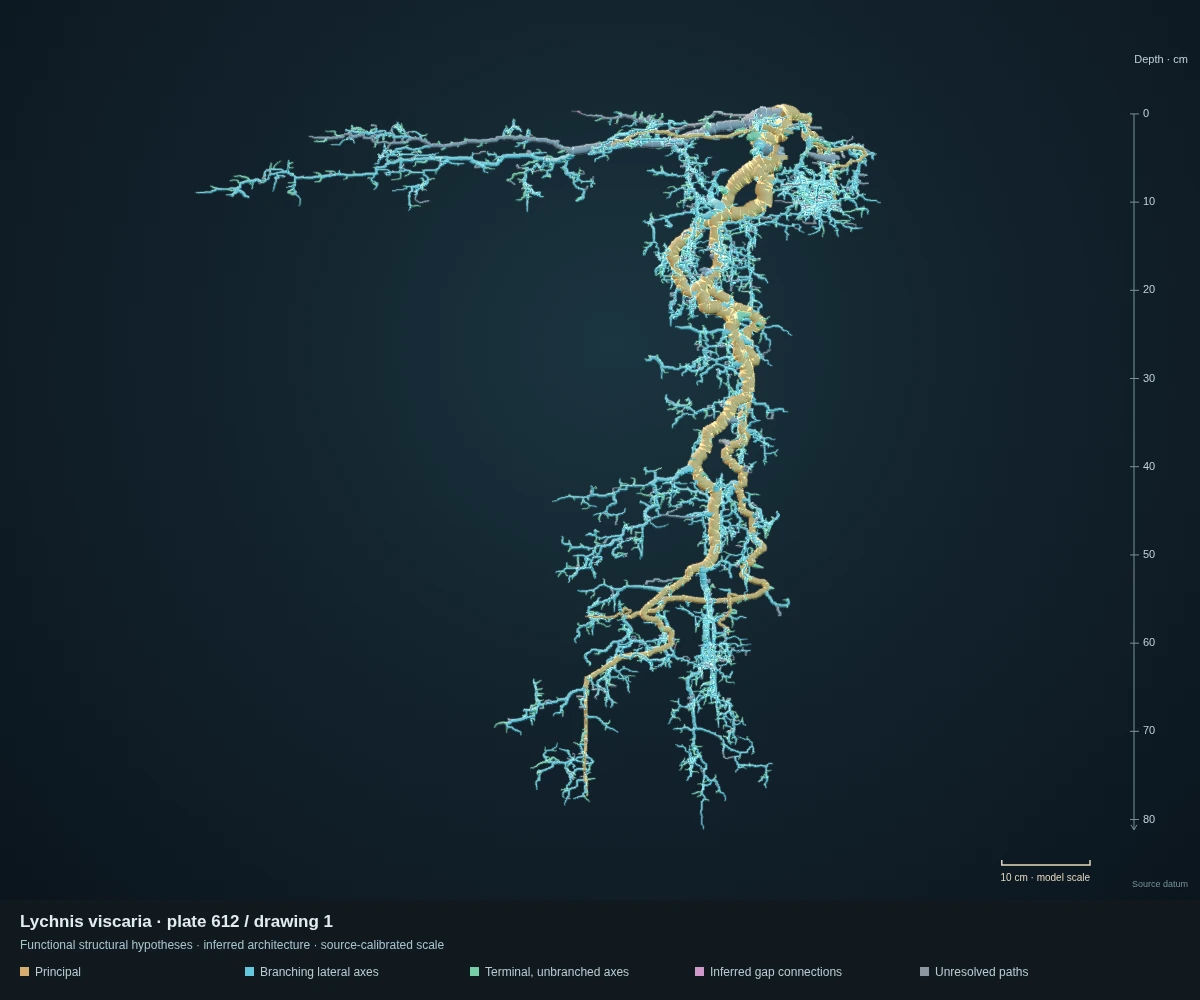
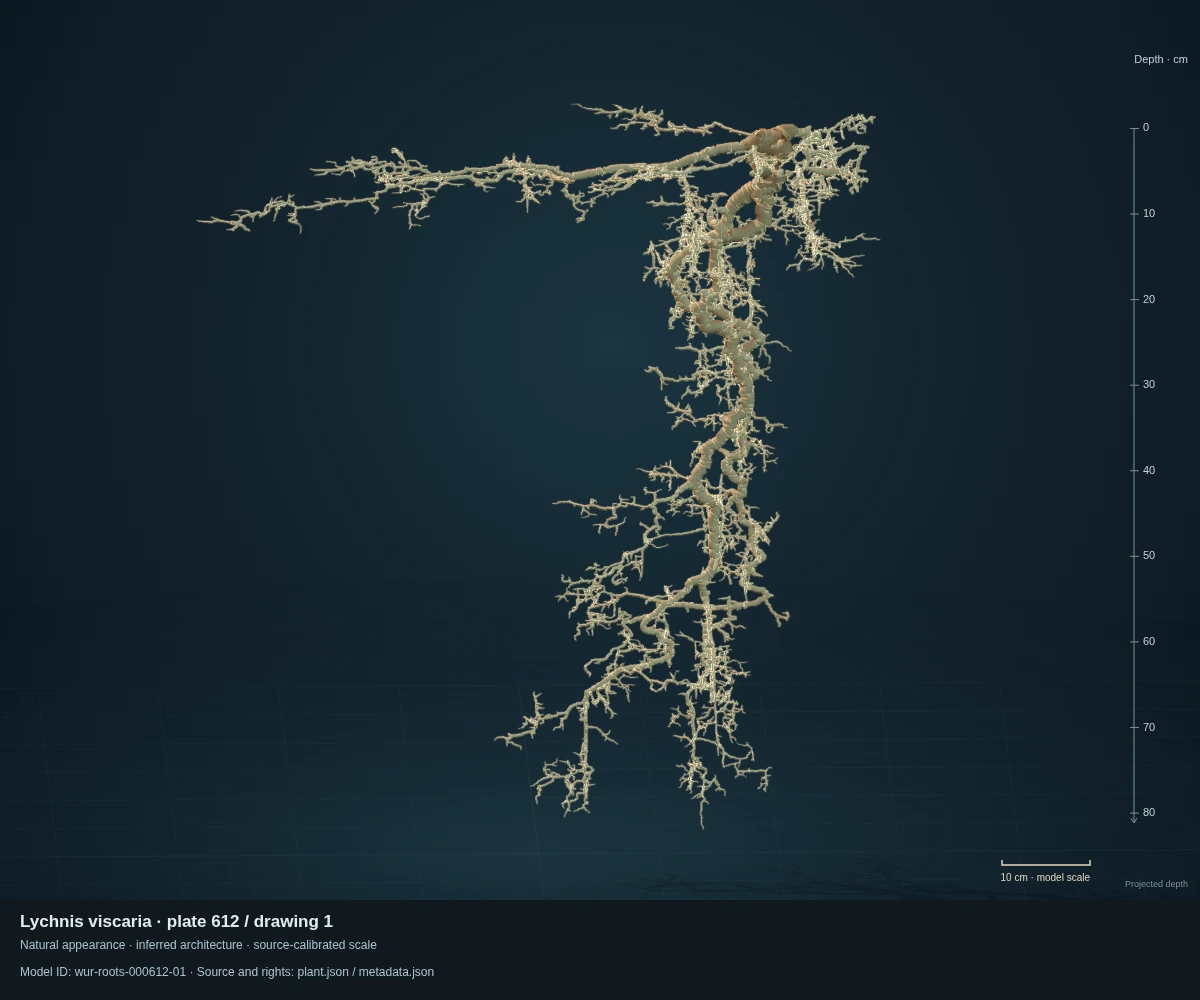
Functional view
Natural view
Source projection
Side view
Calibration
Source-calibrated
Vertical extent
81.4 cm
Inferred axes
2806
Model metrics and plate observations

Model metrics

Depth follows the printed scale. Equal horizontal scale and hidden depth are modeling assumptions; root thickness is illustrative.

Vertical extent
81.4 cm
Horizontal span (x)
47 cm
Horizontal span (z)
78.1 cm
Centreline length
47.6 m
Inferred axes
2806
Branching sites
2644
Terminal paths
2663
Mean modelled diameter
2.66 mm
Surface area proxy
4,040 cm²
Volume proxy
568 cm³
Inferred connection length
2.75 cm
Projected length
33.8 m
Mean angle from vertical
59.2°

Dimensions reported on the source plate

Plant height
58 cm plate_612
Root depth
98 cm plate_612
Root-system diameter
173 cm plate_612

Explicit discrepancy between reported dimensions and the depicted scale/geometry; no silent correction.

Drawing observations

  • Several coarse roots diverge from the crown, with looped upper paths and long shallow lateral arms.
  • Two main descending trajectories bear repeated local tufts of fine short branches.
  • The deep narrow field ends near the printed 80 cm level, with one thin central extension.

Biologically constrained spatial reconstruction from source morphology. Root azimuths, hidden placement, growth responses, circular sections, thickness and proposed connections are inferred. The separate source trace retains exact drawing coordinates. No measured 3D anatomy or observed growth sequence is claimed.

Source and attribution

Study 612 · Model 01

Lychnis viscaria · Wageningen University & Research archive
Names & classification

Family
Caryophyllaceae
Genus
Viscaria
Order
Caryophyllales
Botanical authority
Bernh.
Taxonomic rank
Species
Life form
perennial
Native range
Europe to SW. Siberia and N. Caucasus
Climate
temperate
Archive names
Lychnis viscaria

European ecological indicators

Light (1–9, shade to sun)
7.3
Moisture (1–12, dry to submerged)
3.5
Soil reaction (1–9, acidic to base-rich)
4
Nutrients (1–9, poor to rich)
2.2
Tichý et al. (2023)